100 Books to read
I would not necessarily recommend all of these books but there are many that I have read and do recommend and I have some already on my TBR list plus a few more that I have added. What recommendations do you have?
PHILOSOPHY & THINKING
- Meditations by Marcus Aurelius — It is a private journal written by a Roman Emperor to hold himself accountable, and it is the most practical and honest philosophical text ever written by someone who actually had to govern.
- The Republic by Plato — It is the foundational text of Western political philosophy, and it asks questions about justice, power, and the ideal society that nobody has fully answered in 2,400 years.
- Critique of Pure Reason by Immanuel Kant — It permanently redrew the boundaries of what human beings can claim to know, and it is one of the hardest and most important books in the entire philosophical canon.
- Beyond Good and Evil by Friedrich Nietzsche — It dismantles the moral frameworks most people inherit without examination and demands that you construct something more honest in their place.
- Being and Time by Martin Heidegger — It asks what it actually means to exist in the most rigorous and demanding way possible, and reading it seriously will permanently alter how you experience being alive.
- The Genealogy of Morality by Friedrich Nietzsche — It traces every value you live by back to its historical and asks with genuine force whether those values were ever really yours to begin with.
- Simulacra and Simulation by Jean Baudrillard — It argues that modern society has replaced reality with representations of reality so completely that most people can no longer locate the original.
- Being and Nothingness by Jean-Paul Sartre — It argues that you are condemned to be free in a way that most people spend their entire lives running from, and it is one of the most uncomfortable books in existence.
- The Consolation of Philosophy by Alain de Botton — It takes the six greatest philosophical thinkers in Western history and applies their thinking directly to the problems that are actually ruining your life right now.
- Phenomenology of Spirit by Georg Wilhelm Friedrich Hegel — It is arguably the most difficult book in the Western philosophical canon, and engaging with it seriously is one of the few intellectual undertakings that will leave you genuinely changed.
- A Brief History of Time by Stephen Hawking — It takes the most mind-bending ideas in modern physics and makes them genuinely accessible without ever losing their fundamental strangeness.
- The Selfish Gene by Richard Dawkins — It rewires your understanding of life, behavior, and human motivation by showing that evolution operates at a level most people never think about.
SCIENCE & NATURE
- The Structure of Scientific Revolutions by Thomas Kuhn — It reveals that science does not accumulate smoothly, but shifts violently when the frameworks holding it together finally collapse under their own weight.
- Behave by Robert Sapolsky — It traces every human behavior backwards through neuroscience, hormones, childhood, and evolution until your understanding of why people do anything is permanently transformed.
- The Order of Time by Carlo Rovelli — A theoretical physicist dismantles your common sense understanding of time in under 200 pages, and leaves you genuinely unable to think about it the way you did before.
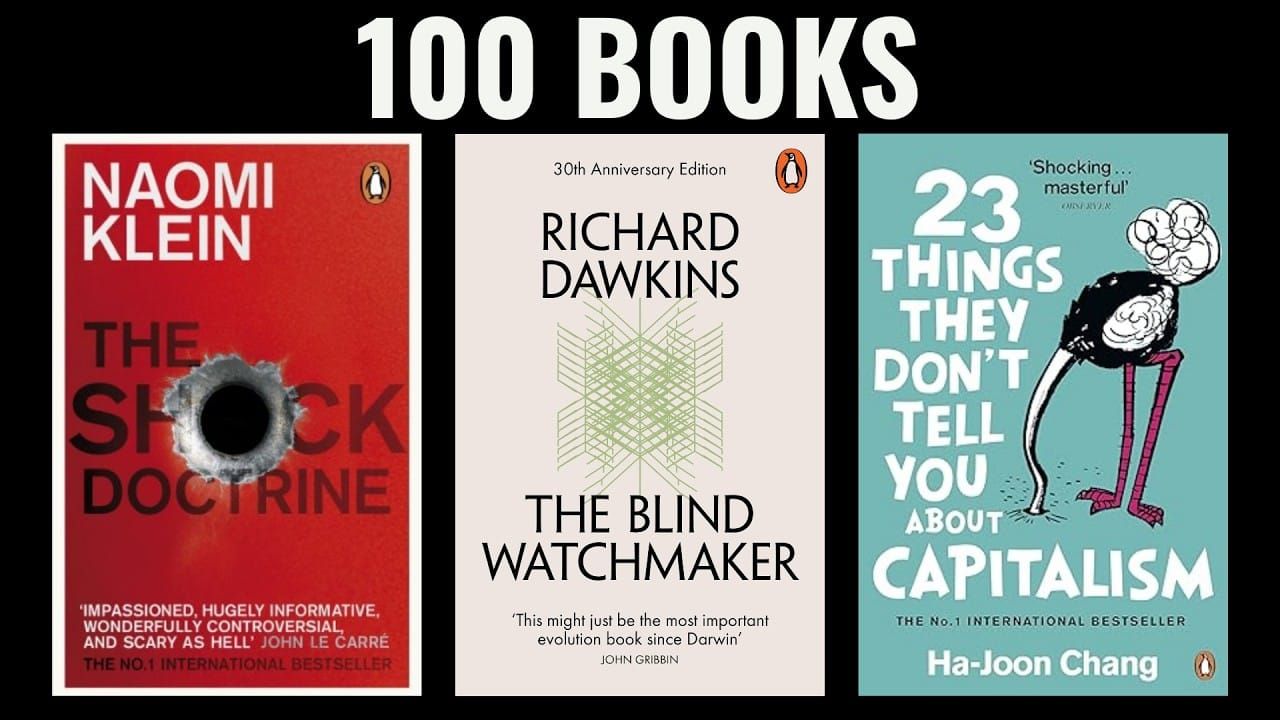
- The Blind Watchmaker by Richard Dawkins — It makes the case for natural selection with such clarity and force that after reading it, the complexity of life becomes more astonishing rather than less.
- Gödel, Escher, Bach by Douglas Hofstadter — It is a sprawling masterpiece about consciousness, logic, and self-reference that will permanently expand the ceiling of how you think about thinking itself.
- The Elegant Universe by Brian Greene — It explains string theory and the search for a unified theory of everything with more clarity and narrative drive than any other physics book written for general readers.
- Surely You're Joking, Mr. Feynman by Richard Feynman — It shows what a life built entirely on genuine curiosity rather than credentials or approval actually looks like from the inside.
- The Double Helix by James Watson — It is the most honest and human account ever written of a major scientific discovery, messy, competitive, occasionally unethical, and completely alive.
- The Lessons of History by Will and Ariel Durant — Two historians compressed every major pattern from 5,000 years of civilization into 128 pages of concentrated truth that rewards rereading indefinitely.
HISTORY & CIVILIZATION
- Guns, Germs, and Steel by Jared Diamond — It answers why some civilizations dominated others without resorting to lazy or comfortable explanation, and it permanently changes how you read history.
- The Guns of August by Barbara Tuchman — It reconstructs the first month of World War I with such narrative precision that you will never again wonder how catastrophic wars begin almost by accident.
- The Origins of Totalitarianism by Hannah Arendt — It explains with surgical clarity exactly how free societies talk themselves into tyranny and it has never been more relevant than it is right now.
- Sapiens by Yuval Noah Harari — It tells the complete story of how one unremarkable primate rewrote the rules of life on Earth and does not flatter us in the telling.
- The Peloponnesian War by Thucydides — It was written 2,400 years ago by a general who watched a great democracy destroy itself through pride, overreach, and fear and it reads like it was written this morning.
- The Decline of the West by Oswald Spengler — It argues that every civilization is a living organism with a natural lifespan and that the West entered its terminal phase long before anyone was willing to admit it.
- A Study of History by Arnold Toynbee — It examined every major civilization ever to exist and identified the patterns of challenge, response, and collapse that repeat across cultures and centuries without exception.
- The Anatomy of Fascism by Robert O. Paxton — It is the most rigorous examination ever written of how fascism actually operates in practice rather than how it describes itself in theory.
- Postwar by Tony Judt — It is the most complete and serious history of Europe after 1945 ever written in a single volume and it is essential reading for anyone who wants to understand how the modern world was assembled.
- Thinking Fast and Slow by Daniel Kahneman — It exposes the two systems running your brain and shows precisely why the one you trust most is the one that fails you most reliably.
PSYCHOLOGY & HUMAN NATURE
- The Righteous Mind by Jonathan Haidt — It explains why brilliant people disagree so violently on moral questions and reveals that almost nobody is as rational as they sincerely believe themselves to be.
- The Denial of Death by Ernest Becker — It argues that human civilization is largely an elaborate defense mechanism against the terror of knowing we are mortal and it is almost impossible to argue with.
- Influenced by Robert Cialdini — It reveals the six psychological mechanisms people use to manipulate each other, and understanding them is one of the most practically useful things you can do with a book.
- The Body Keeps the Score by Bessel van der Kolk — It proves that the trauma people ignore does not disappear, but moves into the body, and it permanently changes how you understand human behavior and suffering.
- Man's Search for Meaning by Viktor Frankl — A psychiatrist survived four Nazi concentration camps and concluded that a person can endure almost anything if they have a reason why, and the book makes that case irrefutably.
- The Lucifer Effect by Philip Zimbardo — It examines the Stanford prison experiment and asks how ordinary people become capable of extraordinary cruelty, and the answer is more disturbing than most people are prepared for.
- Mistakes Were Made, But Not by Me by Carol Tavris — It is the most accessible and practically useful book ever written about self-justification, the mechanism that allows intelligent people to remain wrong indefinitely.
- The Drama of the Gifted Child by Alice Miller — It reveals how the emotional wounds from childhood are suppressed and carried forward, and it is one of the most clarifying short books ever written about why adults behave the way they do.
- Prometheus Rising by Robert Anton Wilson — It maps the human nervous system as a programmable machine and asks who installed the program currently running inside your head, and whether you have ever consciously chosen to update it.
- Debt: The First 5,000 Years by David Graeber — It proves that almost everything you were taught about the origins of money, markets, and economic life is a myth constructed long after the fact.
- Capital in the Twenty-First Century by Thomas Piketty — It used two centuries of economic data to make one devastating argument about wealth inequality and where unregulated capitalism always eventually arrives.
ECONOMICS & POWER
- The Protestant Ethic and the Spirit of Capitalism by Max Weber — It traces the theological roots of modern capitalism and shows that economic systems are never purely about economics.
- The Wealth of Nations by Adam Smith — It is the foundational text of modern economics, and it is far more nuanced, humane, and skeptical of unchecked markets than the people who most frequently cite it seem to have noticed.
- Freakonomics by Steven Levitt and Stephen Dubner — It applies economic thinking to questions nobody thought to ask economically and permanently changes how you look for hidden incentives beneath the surface of human behavior.
- The Prince by Machiavelli — It is a short, ruthless, and completely honest manual on how power actually operates in the real world rather than how we wish it did.
- Thinking in Systems by Donella Meadows — It teaches you to stop reacting to isolated events and start seeing the invisible structures underneath every problem that keeps reproducing itself.
- Poor Economics by Abhijit Banerjee and Esther Duflo — It uses randomized controlled trials to examine global poverty at the level of individual decisions, and it dismantles more assumptions per page than almost any other economics book.
- The Shock Doctrine by Naomi Klein — It argues that free market policies have been systematically imposed on vulnerable societies immediately after disasters, and it makes a case that is difficult to dismiss even when you want to.
- 23 Things They Don't Tell You About Capitalism by Ha-Joon Chang — It dismantles 23 assumptions that mainstream economics presents as obvious truths and replaces each of them with something more accurate and considerably more uncomfortable.
MATHEMATICS & LOGIC
- How to Solve It by George Pólya — It is a short, elegant book by a mathematician that gives you a universal framework for attacking any problem in any domain with patience and structural clarity.
- The Book of Why by Judea Pearl — It introduces causal reasoning, the science of understanding why things happen rather than merely what correlates with what, and it permanently changes how you think about evidence.
- Fermat's Last Theorem by Simon Singh — It tells the story of a mathematical problem that resisted solution for 358 years, and in doing so makes the interior life of mathematical thinking more vivid than any textbook ever has.
- The Man Who Loved Only Numbers by Paul Hoffman — It is a biography of the mathematician Paul Erdős, who lived out of a suitcase his entire life and collaborated with more mathematicians than anyone in history and it is one of the most joyful books about obsessive intellectual life ever written.
- Zero by Charles Seife — It is a history of the number zero and the philosophical and mathematical crises it provoked across civilization and it makes the history of mathematics feel like a thriller.
- The Art of Problem Solving by Richard Rusczyk — It trains the brain to approach problems structurally rather than intuitively and builds the kind of reasoning that most formal education systems fail to teach.
- Logicomix by Apostolos Doxiadis — It is a graphic novel about Bertrand Russell's lifelong attempt to build mathematics on logical foundations and it makes the philosophy of mathematics genuinely gripping and emotionally devastating.
- Mathematics by David Bergamini — It is a comprehensive and beautifully illustrated history of mathematical thought from ancient civilizations to modern abstraction and it makes the entire discipline feel alive and human.
- The Colossal Book of Mathematics by Martin Gardner — It is a collection of mathematical puzzles and paradoxes that makes pure mathematical thinking feel like the most enjoyable game ever invented.
- Innumeracy by John Allen Paulos — It explains why mathematical illiteracy is as serious and as socially damaging as regular illiteracy and it will permanently change how you evaluate statistics, risk, and probability in everyday life.
LANGUAGE & COMMUNICATION
- The Elements of Style by Strunk and White — It is the shortest and most useful book ever written about writing clearly and every page is itself a demonstration of the principles it describe.
- On Writing by Stephen King — It is half memoir and half masterclass and it is the most honest and practical book about the craft of writing ever produced by a working writer at the height of his powers.
- Metaphors We Live By by George Lakoff and Mark Johnson — It reveals that human thought is fundamentally metaphorical and that the metaphors embedded in your language are quietly shaping every conclusion you reach.
- The Language Instinct by Steven Pinker — It argues that language is a biological adaptation rather than a cultural invention and it permanently changes how you think about communication, meaning, and what it means to be human.
- Don't Think of an Elephant by George Lakoff — It explains how political framing shapes public thought at a level below conscious awareness, and it is one of the most practically important books about language and power ever written for general readers.
- Orality and Literacy by Walter Ong — It examines how the transition from oral to written culture permanently restructured human consciousness, and it will make you think differently about reading itself.
- The Art of Rhetoric by Aristotle — It is the foundational text of persuasion written 2,400 years ago, and every technique of effective communication that has been developed since can be traced back to something Aristotle already identified.
- A Dictionary of Modern English Usage by H.W. Fowler — It is the most opinionated and entertaining usage guide ever written, and reading it cover to cover will make you a permanently more precise and confident writer.
- Eats, Shoots and Leaves by Lynn Truss — It is a passionate and funny defense of punctuation that will make you care about commas in a way you never previously thought possible.
- The Sense of Style by Steven Pinker — It is the most modern and linguistically sophisticated guide to writing well ever produced, and it improves on Strunk and White by explaining the reasons behind every rule rather than simply issuing commands.
- The Mismeasure of Man by Stephen Jay Gould — It dismantles how scientific authority has been repeatedly borrowed to give prejudice the appearance of objective measurement, and it is one of the most important critiques of bad science ever written.
SOCIOLOGY & CULTURE
- Orientalism by Edward Said — It permanently changed how the academic world thinks about representation, cultural power, and the politics embedded in who gets to tell whose story.
- Crowds and Power by Elias Canetti — It is one of the strangest and most profound books ever written about how human beings behave in masses, and why the hunger for power over crowds is one of the oldest and most dangerous human appetites.
- The Presentation of Self in Everyday Life by Erving Goffman — It argues that all human social interaction is a form of theatrical performance, and once you see that framework, you cannot stop applying it to everything you observe.
- Bowling Alone by Robert Putnam — It documented the collapse of social capital and community in America with such rigor that it permanently changed how sociologists, politicians, and ordinary citizens think about belonging.
- The Civilizing Process by Norbert Elias — It traces how European standards of behavior, table manners, bodily functions, emotional control changed over centuries and argues that civilization is fundamentally a project of managing human violence.
- Tribe by Sebastian Junger — It explains why modern comfort has produced more anxiety, purposelessness, and depression than any previous generation and points to the absence of belonging as the central wound of contemporary life.
- The Culture Industry by Theodor Adorno — It argues that mass entertainment does not liberate people but pacifies them and that the products of popular culture are designed to prevent rather than enable genuine thought.
- The Lonely Crowd by David Riesman — It is a 1950 sociological study that identified the shift from inner-directed to other-directed personalities in American society and it describes the present moment with uncomfortable accuracy.
- Stigma by Erving Goffman — It examines how society manages and responds to people it considers abnormal and it permanently changes how you think about identity, social norms, and the mechanisms of exclusion.
BIOLOGY & MEDICINE
- The Gene by Siddhartha Mukherjee — It is the most complete and humanely written history of genetics ever produced for general readers and it connects the science to the deepest questions about identity, disease, and what we inherit from those who came before us.
- The Emperor of All Maladies by Siddhartha Mukherjee — It is a biography of cancer, its history, its biology, its treatment, and it is one of the most serious and beautifully written works of medical non-fiction ever published.
- Being Mortal by Atul Gawande — It is the most honest book ever written about aging, dying, and what medicine gets wrong when it prioritizes survival over the quality of the life being extended.
- The Immortal Life of Henrietta Lacks by Rebecca Skloot — It tells the story of the woman whose cancer cells became the most important biological research material of the 20th century without her knowledge or consent, and it is a masterclass in science writing and moral complexity.
- Stiff by Mary Roach — It is a funny, rigorous, and completely unsentimental examination of what happens to human bodies after death, and it will permanently change your relationship with your own mortality.
- Why We Sleep by Matthew Walker — It makes the scientific case for sleep with such force and clarity that it will change your behavior more reliably than almost any other book on this list.
- The Developing Mind by Daniel Siegel — It explains how early relationships shape the architecture of the brain, and it permanently changes how you think about childhood, attachment, and emotional regulation.
- Survival of the Sickest by Sharon Moalem — It explains why evolution preserved genes that cause disease, and the answers are so counterintuitive and fascinating that the book reads more like a collection of detective stories than a science text.
- The Anatomy of Hope by Jerome Groopman — It examines the biology and psychology of hope in medical contexts, and it makes a rigorous and moving case that what patients believe about their condition materially affects what happens to them.
- The Variant Effect by G. Wells Taylor — It imagines a future biological catastrophe with enough scientific grounding to function as both a thriller and a serious meditation on the fragility of human civilization.
TECHNOLOGY & THE FUTURE
- Superintelligence by Nick Bostrom — It is the most rigorous and unsettling examination ever written of what artificial general intelligence will mean for the human species, and it deserves to be taken seriously by everyone alive right now.
- The Second Machine Age by Erik Brynjolfsson and Andrew McAfee — It examines what happens to human labor, creativity, and economic organization when machines become capable of doing most of what humans currently do for money.
- Zero to One by Peter Thiel — It challenges every assumption about innovation and progress, and argues that the most important advances come not from incremental improvement, but from building something that has never existed before.
- The Innovators by Walter Isaacson — It tells the complete history of the digital revolution through the people who built it, and it makes a powerful case that every major technological breakthrough was a collaborative rather than individual achievement.
- The Shallows by Nicholas Carr — It makes the neurological case that the internet is physically restructuring the human brain in ways that make deep reading, sustained attention, and complex thought progressively harder.
- Life 3.0 by Max Tegmark — It examines every possible scenario for the future of artificial intelligence, from utopian to catastrophic, with enough scientific rigor to make the optimistic scenarios feel genuinely possible and the pessimistic ones genuinely urgent.
- The Age of Surveillance Capitalism by Shoshana Zuboff — It is the most complete and serious examination ever written of how technology companies have built an economic system based on the prediction and modification of human behavior without consent.
- Chaos by James Gleick — It is the story of how scientists discovered chaos theory, and it makes one of the most important scientific revolutions of the 20th century feel as gripping and human as any novel.
- The Dream Machine by M. Mitchell Waldrop — It is the biography of J.C.R. Licklider, the man whose vision directly produced the personal computer and the internet, and it is one of the most important and least read books about how the modern world was actually built.
- Physics of the Future by Michio Kaku — It examines where science and technology are heading over the next 100 years based on what is already in laboratory development, and it will permanently alter your expectations of what the future will look like.