110 Objections analysed
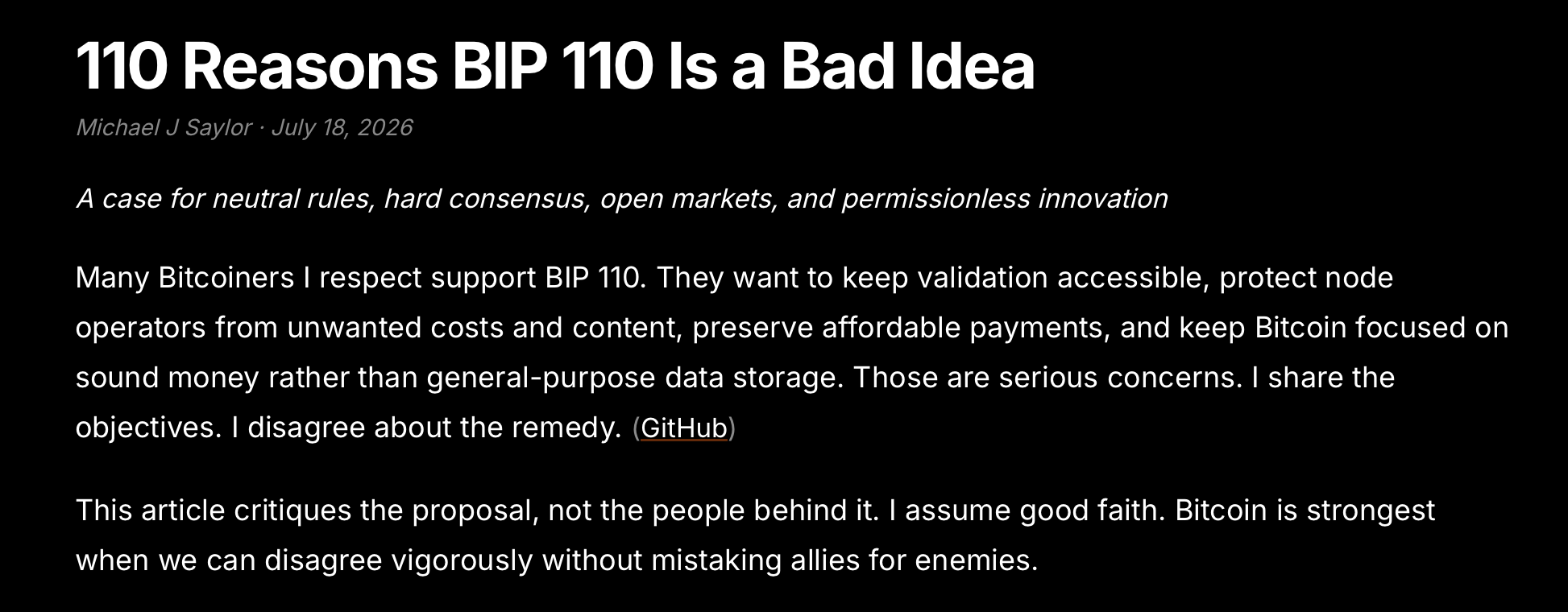
This article is a rhetorically dense piece of advocacy. Viewed through Robert Dilts’s Sleight of Mouth patterns, it is not merely a technical objection to a Bitcoin Improvement Proposal; it is a systematic reframing of the debate from an engineering trade-off into a constitutional crisis of governance and precedent.
Below is a pattern-by-pattern analysis.
1. Redefinition (Redefine)
Saylor repeatedly redefines the language of BIP 110’s supporters to shift its semantic field.
- “Disapproval is not invalidity” (07). He separates the emotional/cultural judgment (“we don’t like data storage”) from the technical/legal category of consensus validity. This is a pure redefinition: your label of “spam” does not equal my category of “invalid.”
- “Conservatism at the base layer should mean reluctance to alter consensus, not eagerness to alter consensus in favor of a conservative use philosophy” (10). He seizes the word “conservative” from the proponents and redefines it. In their frame, conservatism means protecting money; in his, it means not changing the protocol.
- “Bitcoin Iatrogenic Proposal” (110). This is a masterful redefinition. He does not merely say it is a bad idea; he redefines BIP as a medical intervention whose side effects exceed the disease. The acronym remains “BIP,” but the meaning is surgically replaced.
2. Consequence (Outcome Reframe)
This is the single most frequent pattern in the text. Whenever supporters frame BIP 110 as a solution to node costs or spam, Saylor redirects attention to negative second- and third-order effects.
- “The proposed cure is more dangerous than the condition” (110). The classic outcome reframe: compare the stated benefit to the actual harm.
- “Lower aggregate fee demand can weaken security at the margin” (58). He converts a fee-market argument into a long-term security budget problem.
- “The rules expire, but the precedent does not” (91). He redirects from the temporary technical fix to the permanent political consequence.
- “It establishes a precedent for using consensus restrictions to discourage a category of otherwise valid use” (What BIP 110 Proposes). The reframe is not about what happens to data storage, but about what future “categories” can be voted out of validity.
3. Chunking Up (Move to Higher Hierarchy / Abstraction)
Saylor consistently jumps from the specific technical mechanism to first principles, making the particular dispute subservient to a universal rule.
- “Consensus is Bitcoin’s most powerful intervention” (01). From “should we limit scriptPubKeys?” to “what is the proper use of sovereign force?”
- “Permissionless systems must tolerate unapproved experimentation” (09). From a debate about image inscriptions to the definition of permissionlessness itself.
- “Bitcoin cannot read intent” (04). From “this particular transaction is frivolous” to an epistemological limit of distributed systems.
- “Bitcoin does not need guardians of purity. It needs guardians of neutrality” (Closing). From a policy fight to a mission statement for the entire network.
4. Chunking Down (Move to Specifics / Evidence)
When the opposition appeals to urgency or vague costs, Saylor chunks down to demand measurable specifics, dissolving the abstraction.
- “The BIP itself does not quantify the node burden it would remove” (14); “does not quantify the decentralization benefit” (15); “does not quantify payment relief” (16). He demands operational definitions for every claimed benefit.
- “UTXO-state growth, initial-sync bandwidth, archival storage, relay burden, and validation time have different causes and may require different remedies” (17). He decomposes the monolithic term “node cost” into distinct variables, making the bundled solution look imprecise.
- “A historical relay-policy limit is not proof of an optimal consensus limit” (19). He chunks down the rationale “we’ve always done it this way” to expose its logical gap.
5. Hierarchy of Criteria
Saylor does not deny that node accessibility and affordable payments are good. Instead, he subordinates them to higher values.
| Supporters’ Criteria | Saylor’s Higher Criteria |
|---|---|
| Keep validation cheap | Preserve hard consensus neutrality (01, 02) |
| Protect node operators | Preserve permissionless innovation (09) |
| Lower fees for payments | Maintain miner revenue / security budget (57–60) |
| Stop “spam” | Prevent precedent-based governance (91–96) |
The entire closing section, “Guardians of Neutrality,” is a explicit hierarchy statement: neutrality > purity.
6. Meta-Frame (Frame about Framing)
Saylor constantly steps outside the technical argument to comment on the rules of the argument itself.
- “This article critiques the proposal, not the people behind it. I assume good faith” (Introduction). He frames the debate as civil and principled, pre-emptively claiming the moral high ground.
- “It turns protocol conservatism upside down” (10). He frames the proponents as the ones violating their own stated ethos.
- “Activation machinery cannot manufacture consensus” (87). He shifts from debating the mechanism to debating what the mechanism means socially.
- “A social message is not sufficient grounds for a consensus change” (06). He meta-frames the proposal as an attempt to use code as speech, which he rules out of order.
7. Intent Reframe
He acknowledges the opponents’ positive intent, then redirects it to a different means.
- “Many Bitcoiners I respect support BIP 110. They want to keep validation accessible, protect node operators… I share the objectives. I disagree about the remedy” (Introduction). This is textbook intent reframe: we want the same thing; your method is wrong.
- “The proposal expressly treats activation as a way to communicate that data storage is unwelcome. Consensus should be changed for compelling technical or monetary reasons, not primarily to express disapproval” (06). He separates the intent (community signaling) from the appropriate channel (consensus code).
8. Counter-Example
He systematically finds exceptions that break the generalizations made by BIP 110.
- “A payment channel, proof of reserves, custody policy, smart contract, or settlement commitment is both financial activity and data” (12). A direct counter-example to the claim that “monetary” and “nonmonetary” data are cleanly separable.
- “Private systems, unpublished contracts, experimental wallets, and future protocols are not fully observable” (40). A counter-example to “no known use case,” proving absence of evidence ≠ evidence of absence.
- “The same logic can be reused… Privacy tools, novel custody, stablecoin settlement, token systems, corporate applications, or other unpopular uses could face similar arguments” (95). He turns the current target into a counter-example of a future, larger pattern of exclusion.
9. Another Outcome (Alternative Solution)
Rather than simply opposing, he redirects to a different pathway that satisfies the need without the cost.
- Section VII (“Better Market and Policy Tools Exist”) is entirely this pattern. Instead of consensus restriction, he proposes:
- Relay policy (64)
- Mining policy (65)
- Content-neutral limits (68)
- Pruning and optional-data designs (69)
- Improved fee-market transparency (106)
- Section XI (“A Better Path Is Available”) repeats the pattern at the structural level.
10. Change Frame Size (Especially Temporal & Scope)
Saylor manipulates the time horizon and scope to alter the perceived weight of the proposal.
- Temporary → Permanent Artifacts: “Temporary consensus code is still consensus code” (41); “Temporary rules can leave permanent artifacts” (49); most importantly, “The rules expire, but the precedent does not” (91).
- Local → Universal: “Today’s target does not limit tomorrow’s target” (95). He expands the spatial/temporal frame from “this one-year fix” to “permanent governance culture.”
- “A one-year closure can still disrupt development timelines” (33). He compresses the timeframe to show that “temporary” is still too long for software ecosystems.
11. Model of the World
He imposes a different epistemological and political framework onto the same data.
- “Miner signaling is not a referendum on all Bitcoin users” (83). He rejects the miners-as-voters model and inserts a multi-stakeholder model (holders, exchanges, wallets, custodians).
- “Fees price block space… They apply technical validity and resource limits rather than a semantic test” (63). His model of Bitcoin is a content-neutral market, not a community with shared taste.
- “Bitcoin cannot read intent” (04). This is a model-of-the-world reframe about what a decentralized protocol is capable of knowing.
12. Analogy / Metaphor
- “Hard consensus is Bitcoin’s immune system” (90). Biological metaphor: the immune system (consensus) must not attack healthy tissue (valid uses).
- “Iatrogenic Proposal” (110). Medical metaphor extended from #01’s “intervention.”
- “Social cohesion is a scarce asset” (97). Economic metaphor applied to community trust.
13. Reality Strategy (How do you know?)
He systematically questions the cognitive process by which the opposition formed its conclusions.
- “Urgency is asserted rather than operationally defined” (18).
- “The 256-byte line is heuristic” (20).
- “A historical relay-policy limit is not proof of an optimal consensus limit” (19).
14. Apply to Self
- “Conservatism at the base layer should mean reluctance to alter consensus…” (10). While not a direct tu quoque, it forces the proponents’ self-identified value (“conservative”) to fold back onto their behavior (proposing a consensus change) and find it inconsistent.
Summary: The Master Reframe
Strategically, the article performs one overarching Sleight of Mouth maneuver:
It chunks the debate up from “How do we stop data storage?” to “Who gets to decide what Bitcoin is for?”
By doing so, Saylor shifts the burden of proof entirely. The proponents must now defend not a technical limit, but a governance philosophy. He redefines BIP 110 from an engineering patch into a constitutional amendment that would break Bitcoin’s content neutrality.
The sheer density of these patterns—especially Consequence, Chunk Up, Hierarchy of Criteria, and Meta-Frame—explains why the piece reads less like a code review and more like a declaration of first principles. It is designed not merely to disagree with the proposal, but to make adoption of the proposal conceptually impossible for anyone who accepts his frame.