Andrei on AI
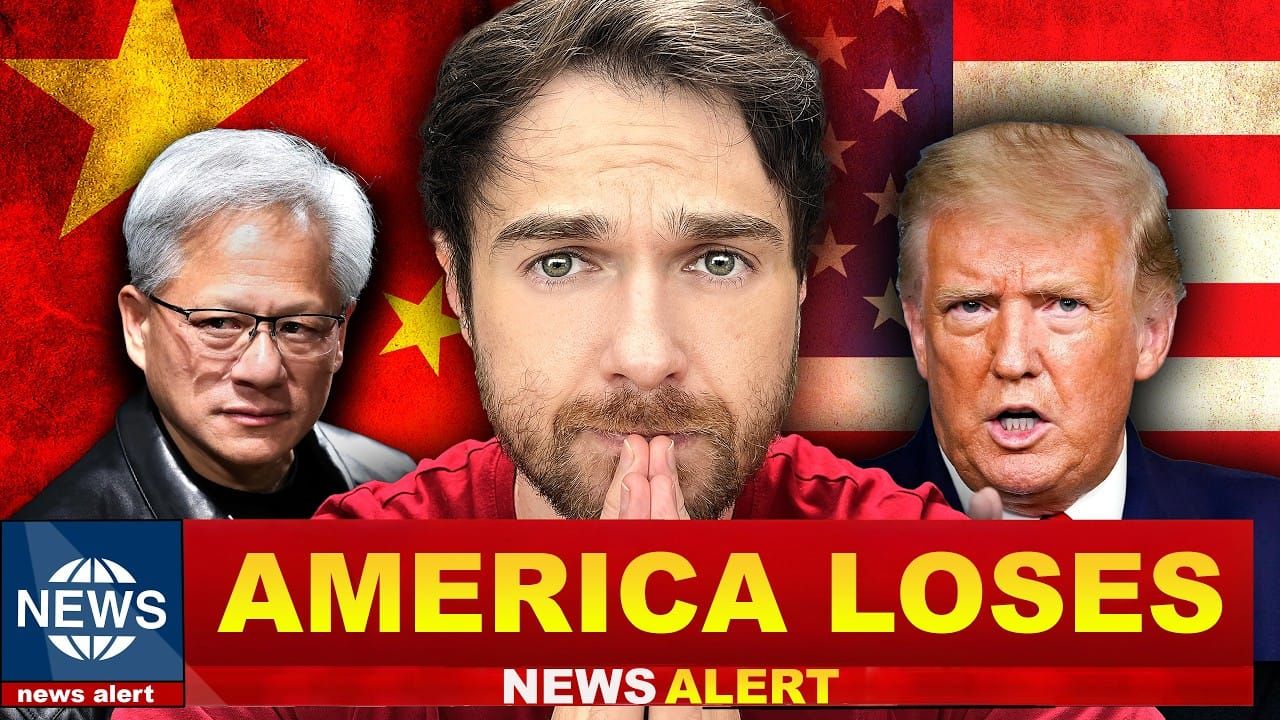
What If China Wins the AI Race? — Summary
Core thesis: the real contest is not chips but pricing — whether AI becomes an owned product (closed source) or a utility (open source). The video argues that if America regulates or litigates its way into a fully closed system, China wins by default, and that either AI outcome (success or failure) pushes the US towards printing money.
1. The framing: closed source vs open source
| Closed source | Open source | |
|---|---|---|
| Model | You rent access to a model on someone else's computer | Model is published; anyone can download, run or modify it |
| AI is treated as | A product to own and sell | A utility, like electricity or the internet |
| Who benefits | OpenAI, Anthropic, Google (paid access) | Nvidia, cloud providers, users in the developing world |
| Why | Only way to recoup the hundreds of billions borrowed | More AI everywhere → more chips and compute sold |
- Nvidia's incentive: it does not sell models, it sells the chips that run them — hence a plan to spend roughly $26 billion over five years building open models and giving them away.
- China's incentive: it cannot yet build the best chips, so it does not need to win on product — it only needs to make AI worth nothing, because America has bet everything on it being worth trillions.
2. Evidence the fight is already under way (as told in the video)
- Kimi K3 (Moonshot AI): a 2.8-trillion-parameter, open-source model, free to download, which beat a leading US model on some benchmarks and unsettled chip stocks.
- Treasury Secretary Scott Bessent said on television that the administration would examine Chinese models for intellectual-property theft — describing open models' "industrial distillation" as "a nice word for stealing from the US model".
- According to the New York Times (as cited in the video), the administration seriously considered sanctions and trade bans on Chinese open models — with OpenAI and Anthropic lobbying hardest, framed as national security.
- 24 July: more than 25 companies, including Nvidia, Microsoft and Meta, signed a letter urging Washington not to ban open models. Jensen Huang made the letter his first-ever post on X, writing that open models "enable sovereignty". Days earlier he had said US companies should be allowed to use Chinese models; Elon Musk reposted it with "this has my full support. Jensen is right." The administration backed off — for now.
- 29 October: the New York Times reported that US intelligence believed a woman close to Huang — named in the video as Alice Huang, an executive at "Mega Speed AI" (transcript wording) and an alleged Chinese intelligence asset — was passing information to China. Three Republican congressmen demanded answers; Huang subsequently admitted to an affair; Nvidia's board opened an investigation.
3. The "why now?" theory (explicitly speculative)
- Per the video, Trump knew about Alice Huang roughly a year earlier, and a separate Times report said Marco Rubio oversaw a memo on the relationship in 2025 — yet nothing happened, and businesses linked to her kept buying Nvidia chips into 2026.
- The creator's argument: the question is not whether the story is true, but why it surfaced when it did. For a year the intelligence sat unused because Huang was not a problem. He became a problem only once he was winning the argument against banning Chinese models — and the simplest way to discredit someone saying "trust China's AI" is to show he is compromised by China.
- He stresses: no one knows who leaked it.
4. The regulatory irony
- The video states that Democrats swept Congress (week of the recording) and are preparing mandatory safety testing before release plus new liability for harm caused by AI.
- His read: these sound like rules on big tech but function as a moat for big tech — only a closed lab with lawyers and a compliance department can absorb them, while a free open-source project cannot.
- Result: American open source is regulated out; the world keeps using open models — which will be Chinese ones. "The short-term thinking of our politicians and their greed is going to cost them the race in the long run."
5. The macro framework: Luke Gromen's two outcomes
Credited to Luke Gromen of FFTT ("Forest for the Trees") [3] — the video links his research in the description.
| Outcome A: AI doesn't work | Outcome B: AI works | |
|---|---|---|
| What happens | Borrowed trillions blow up; deflationary collapse | Productivity soars, jobs go, tax receipts fall |
| Fiscal effect | Write-offs, bailouts needed | Government loses ~half of all US tax revenue, which comes from employment |
| Policy response | Create money | Create money |
| End state | Inflationary collapse ("collapse up") | Inflationary collapse ("collapse up") |
Supporting points made along the way:
- The four-month problem: an executive told Gromen that the top-end model he had four months ago is now free — implying only a four-month window to monetise each generation. "The capital's already been burned and it just hasn't been marked to market yet."
- Chinese models are roughly 90–95% as good for about 1/100th of the price.
- Crowding out: AI firms now borrow in the same pool of capital as the US Treasury, pushing yields — and therefore mortgages, car loans and credit cards — higher.
- The absurdity of the bet: America is "borrowing against its own future" to fund technology designed to remove the tax base that pays for it.
- The electricity constraint: the US added no electricity generation between 2004 and 2024, so it needs far more power, grid, copper and silver regardless of whether AI is real or a bubble.
- The pet-rock test: since ChatGPT's launch in November 2022, gold has underperformed the Nasdaq by only about 15% — a strange result for a "shiny pet rock" versus the most revolutionary technology of our lifetime.
6. The creator's own positioning (not financial advice, as stated)
| Scenario | What he expects to hold up best |
|---|---|
| Deflationary collapse (AI fails) | Cash and gold — "go down the least" |
| Inflationary collapse (AI succeeds, money printed) | Bitcoin — as in 2020–21, when gold rose but Bitcoin "really took off" |
He says he therefore holds both: physical gold and silver, self-custodied Bitcoin, plus hard-to-print assets such as energy and metals.
Significant takeaways
- The battleground is price, not capability. Free Chinese models at 90–95% of frontier quality destroy the payback maths on US AI capex.
- Nvidia is structurally aligned with China's strategy — it profits from ubiquity, not from rent — which is why Huang became the flashpoint.
- Sanctions and safety rules may achieve the opposite of their intent, handing China the global open-source market and giving US labs the compliance moat they want.
- Both AI futures converge on the printing press, which is the video's central investment argument, not the spy story.
- The spy narrative is treated as a lens on incentives, with the creator explicitly refusing to adjudicate whether it is true.
References
- What If China Wins The AI Race? (14%) ↩︎
- Andrei Jikh - YouTube (52%) ↩︎
- FFTT, LLC: Home (35%) ↩︎ ↩︎