Baal is dead
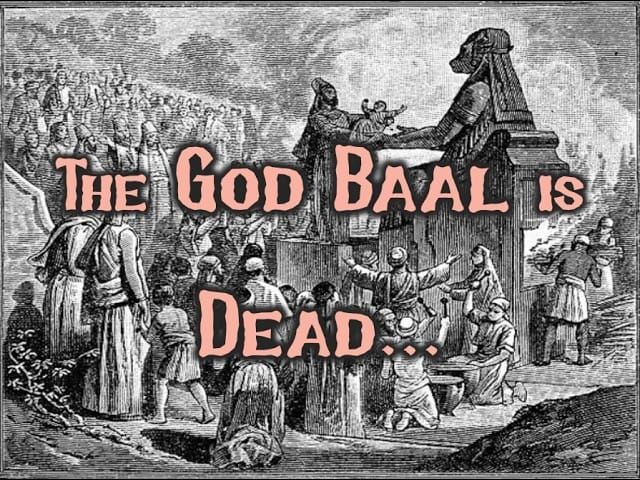
This is the second part of a two-part presentation (the first ran 3 h 08 min; this one 3 h 29 min, with the first already past 50,000 views).
Jason stated thesis: the ancient exclamation “the god Baal is dead” was not a modern slogan but a real event that “shocked everyone” — uttered, in his estimate, roughly 36 centuries ago and carried along trade routes, ports and maritime journeys across the ancient world. He argues that all the great “gods” were originally one historical man, later multiplied into many names, and later demonised after a cataclysm.
1. Source book and framing
- The presentation expands on The Doctrine of the Deluge by the Rev. L. Vernon Harcourt — dated 1836 in one place and 1838 in another in the transcript; the real book is 1838, in two volumes [1]. He is reviewing Volume One.
- He stresses the copy he uses is a facsimile reprint (photographic reproductions of the original pages), published by “Booktree” of San Diego — not a rewrite or retypeset edition. He uses this to rebut a viewer who claimed the book “looks brand new.”
- He says he cites older works from the 1400s, 1500s, 1600s and 1700s within it, and that he has 11 more files of images to work through after the first.
- Recurring secondary reference: a large encyclopaedic work he calls the Dictionary of Deities and Demons of the Bible, which he says supplies etymologies of gods and demons and is now hard to find.
2. The central claim: one man, many names
His “chain of custody” argument is that throne names, birth names, dynastic names and tributary titles have been mistaken by scholars for separate people. The names he equates as one and the same individual:
| Category | Names given in the video |
|---|---|
| Mesopotamian | Nimrod, Amar Udak, Marduk / Merodach, Amraphel, Ammurapi (Hammurabi), Sargon I (Sharru-kin), Naram-Sin, Bilgamesh/Gilgamesh |
| Indian | Rama (Ramayana), Manis-Tusu, Pashupati (Lord of the Animals) |
| Greek | Dionysus (Dionysius), Hercules/Heracles, Bacchus, Adonis, Zeus (in part) |
| Egyptian | Osiris, Menes/Mina (called “Nar”), Anom |
| Levantine | Baal/Bel, Molech/Moloch, Melqart, Baal-Zebub-type storm-god figures |
| Titles | “Lord of the Animals,” “star of the two horns” (Athtoreth/Astarte Karnaim), Melik/Molech (“king”), Baal (“lord”) |
He insists these are titles, not separate deities, and that the man behind them was Nimrod.
3. Key strands of evidence presented
The Dan / mariner “exodus”
- The Danavas, “children of Danu,” came into Egypt from west of India under “Beli” (an eastern form of Baal).
- Irish records split this people into the Milesians and the Tuatha Dé Danann; Homer’s Iliad has a mariner ally called the Dan at Troy.
- He argues the biblical Exodus is a fictional overlay on a maritime exodus from Egypt, and that the tribe of Dan was inserted for prestige and later removed from the Israelite roster (citing the song in Judges — “why does Dan remain in ships?”). Thebes in Boeotia is named after Egyptian Thebes via Cadmus.
El Shaddai from desert demons
- “Shaddai” derives from Shadu / shedim — Assyrian desert demons, sometimes fiery — hence the burning bush and “El Shaddai” as “god-demon.”
Herodotus on Dionysus = Osiris
- Dionysus was Osiris and “almost the only deity worshipped at Maro” (Mer = ancient word for pyramid), resembling the Indian Mount Meru.
- He rejects the North Pole/Mount Meru theory as 400-year-old map invention, holding that Giza was the ancient “middle of the earth,” with a pre-cataclysm global grid now 30° out of alignment.
- The Nile was named for him: Nus / Nahusha → Dionysus, “the god Nus”; also called Sirius, and “Nilus” was the name of the voyaging Heracles Nius.
- The club/poplar of Hercules, the staff with wings and serpent (caduceus) — the same symbol he later ties to Moses’ rod and to Baal.
Ancient stature and lunar chronology
- He argues Genesis lifespans are lunar reckonings, reducing the patriarchs to normal lifespans, and that nowhere in Mosaic law is the sun used for time — the Jews are a lunar culture.
- Giants were earth-born, produced by environmental change (vapour canopy/ice-age cycle), not by angels mating with women; he challenges anyone to find that motif outside a Judeo-Christian context.
The Olympiad
- The games became a four-year calendar of control, with the Pythian cycle two years off it; he calls the ceremonies “predictive programming” and says he has decoded the 2012 opening/closing ceremonies.
Rama = Nimrod
- The Ramayana: 24,000 stanzas, Sanskrit, Tamil version widely recognised; Rama is dark-skinned, wielder of Shiva’s bow, “lord of the animals,” enemy of giants, tasked with eradicating the Asura race (equated with the Titans).
- Two celestial events in his life: the Phoenix transit of 1963 BC (when Rama was about 20) and the Nemesis event of 1915 BC; Rama slays the sky-demoness Tataka, paralleling Marduk slaying Tiamat.
The war of Genesis 14
- Chedorlaomer (Kudur-Lagamar) of Elam assembles four auxiliary armies (Babylon under Amraphel — “he made us fall” — plus Hittite Anatolia and others) and attacks the Rephaim (“unresurrected ones”/“undead,” root rafa, linked to Rimmon), the Anakim, Emim (“terrors”), Zuzim and Zamzummim, then the Horim and the Serim/Seirim of Mount Seir (Petra). He says cuneiform Kudur-Lagamar tablets also record this campaign.
Bacchus = Bar-Kush = Sargon
- Bacchus = Bar Kush, “son of Kush” = Nimrod.
- Sargon of Akkad: born on a river, rescued by an entum priestess, raised by a gardener, ruled 55 years, personal name “king of Kush,” cupbearer to the king of Kish, marched to the west; Bacchus likewise: box on a river, rod turned to serpent, passed through a dry seabed, wrote laws on two tables of stone, depicted with horns, arrested sun and moon, and “light of the sun appeared during the night.”
- He says Sargon I and Naram-Sin are the same man (Naram-Sin merely meaning “Naram of the moon,” i.e. a title), and that Amraphel was later renamed Ammurapi/Hammurabi by the Amorites of Mari (Mitanni) — the lawgiver.
Gilgamesh
- Recommended translations: N. K. Sandars, Samuel Noah Kramer, and Maureen Gallery Kovacs [2][3]; he dismisses Zecharia Sitchin and rates “Alexander Delmare” lower.
- Sumerian king list: Gilgamesh ruled 126 years in the first dynasty of Uruk/Erech — the same 126 years from Nimrod’s first year at Babel to his death in 1772 BC (Book of Jasher).
- His son Ur-Lugal links to the Lugals — laws (lugalum) were passed against these exceptionally tall men.
- Gilgamesh and Heracles share: a best friend (Enkidu/Iolaus), a goddess (Ishtar/Deianira), semi-divine parentage, descent to the underworld, killing lions, defeating divine bulls, divine garments, a herb of immortality — and no recorded death.
The aegis / goat-skin garment
- The garment made by God for Adam in Eden, preserved by Enoch, Methuselah, Lamech and Noah, was stolen off the ark by Kush and given to Nimrod, making him “Lord of the Animals.” He equates it with the Greek aegis and the Golden Fleece.
Menes = Nar = Anom
- Citing Professor L. A. Waddell (“La Wadell” in the transcript): the Egyptian Menes/Mina is the Aryan Anom, i.e. the Sumerian king who conquered Egypt; the first five Egyptian dynasties were therefore Sumerian, and the original Egyptians called the founders the “Nearoo” (mariners considered gods).
- Egyptologists agree one of Menes’ titles was Nar — and the Narmer Palette text reads “king of Uru,” i.e. a Sumerian city.
- The Book of Jasher: only four manuscripts ever found (one in Iran); he claims a 43-page forgery was produced and condemned by the Royal Society. In Jasher, Oirus (Osiris) son of Anom rules Egypt, and the Sumerian Rikayon rises to become the first man called Pharaoh.
Images shown
- Naram-Sin stele: bearded, conical helmet, two horns, bow, standing on defeated enemies, associated with a divine mountain (the law).
- Narmer Palette: same posture, bull cult, beheaded enemies, no Egyptian hieroglyphs; he calls it a proto-Egyptian replica of the Naram-Sin stele.
- Baal statues: conical hat, beard, a single lock of hair, two horns, a rod and a spear.
- Hercules Melqart coins: standing on a subdued lion, staff, conical helmet; earliest mention in an early 9th-century BC Aramaic stele from “Bure” (Bureij) in northern Syria, dedicated by Bar-Hadad I of Aram; depicted bearded with conical polos and fenestrated axe, features of a storm god.
Molech and child sacrifice
- The Molech statue from Giovanni Pastrone’s Cabiria (1914), National Museum of Cinema, Turin: two horns, an all-seeing eye inside a six-pointed star shape.
- He mentions a statue of Molech unveiled at a US state house by “Massachusetts Democrats,” framed as “artistic.”
- Child sacrifice to Molech: superheated bronze hands, with drums, horns and crowd chanting deliberately drowning the infant’s screams (illustrated in the old artwork he displays).
The star of David = star of Remphan
- Umen (via Harcourt, 1838) held that the star of the god Remphan in Stephen’s speech (Acts 7:43) was a star on the forehead of Molech.
- Occult sources call the hexagram the talisman of Saturn, showing a two-horned bull’s head beneath a crescent moon inside the star, surrounded by letters spelling Rimmon.
- He shows the hexagram in the Great Seal of the United States, on US money, equating it with Mammon; a “42” diagram with the tetramorph (bull, lion, eagle, man) identifying “the god of this world”; a ~2,000-year-old synagogue; and a 4,000-year-old Sumerian seal bearing the same star.
- Remphan/Rephan = “the royal Pan” — the goat-legged, two-horned satyr/devil; hence “panic,” “pandemic,” Peter Pan, and the Baphomet connection.
Moses with horns; the brazen serpent
- Mediaeval and Renaissance church art depicts Moses with two horns holding the tablets of the law; he notes an illustration where the horns appear to be covered by “Saturn box” cubes.
- Contradiction claimed: Deuteronomy 4:23–25 forbids graven images, yet Numbers 21:5–9 has Yahweh command Moses to make a bronze serpent on a pole.
- 2 Kings 18:4: Hezekiah broke the brazen serpent Nehushtan because Israel burned incense to it — he argues this means a 700-year religion, not an accident, and that there was no known Mosaic law.
- Amos 5:26 and Acts 7:43 call the (only) tabernacle in the Old Testament “the tabernacle of Molech” and the star “of your god Remphan.”
- Hosea (given as 2:16): Israel long called Yahweh by the name Baal.
A scriptural “tell” about the god of this world
- 2 Samuel 24:1: God’s anger burned and God incited David to take the census He had forbidden.
- 1 Chronicles 21:1: the same story says Satan incited David. Two versions of one story, which he presents as identifying the god of this world.
The black stone and the cube
- Harcourt on the Arabian reverence for a black stone as a miniature emblem of what columns, steeples and pyramids represent.
- The six-pointed star is said to generate a perfect cube — the “cube of Saturn” — linked to the black stone, to 666, and to NASA imagery of a hexagonal storm at Saturn’s pole, which he calls CGI/artificial.
The 1687 BC reset
- The Ogygian cataclysm of May 1687 BC (he compares it to the “Avellino event”): worldwide volcanism, red dust/rain, a red celestial dragon, tsunamis, collapse of every megalithic civilisation; ~200 years to recover, after which ancient men became gods. He derides “Younger Dryas” researchers as “morons.”
Gods who died by a pig
- Attis (“Addis”) — gored by a boar beneath a pine tree; Tammuz — killed by a boar while hunting (women weeping for Tammuz, quoted from the prophets); Adonis — killed by a boar in Lebanon near the temple of Astarte; Osiris — killed by a deity disguised as a wild boar / black pig; Krishna — hunting accident; Zeus — killed by a pig (per Robert Graves); Dionysus — killed by a boar or torn apart by Titans; Hyacinthus-type figure (“Uriton”) — killed by a javelin aimed at a boar.
- His point: gods do not die by pigs — they were men.
The death of Baal
- Ugaritic/Canaanite epic: “They came upon Baal fallen on the ground. The prince, Lord of the earth, is perished. The god Baal is dead.” Baal was killed while hunting in the Huleh marsh, southern Lebanon range — the same place and manner as Attis, Adonis and Dionysus.
- Book of Jasher: Esau ambushes and beheads Nimrod, taking the valuable garment (the aegis) that Kush had bequeathed him; Esau then sells his birthright to Jacob. Arabic tradition agrees Nimrod’s mutilated body was found in the Lebanon/Mount Hermon area.
- Queen Semiramis then claimed he was resurrected as her newborn son, founding mother-and-son worship and the claim of supernatural conception.
Edom, Esau and Rome
- Babylonians and Assyrians called the Edomu/Serim demonic vampires, enemies of humanity, cave-dwellers (troglodytes) of Seir = Petra; Esau is described as hairy and takes their caverns.
- British and Welsh folklore of boars as shapeshifters and druids calling themselves boars is offered as a parallel to the “boar” that kills Baal.
- Prophecy renames the Jews Edom; the curse follows intermarriage during the Hasmonean (Edomite) dynasty, with Herod ruling for Rome — a “trifecta” of Serim/Edomite blood in Rome (he cites his own video on “repetitive timelines of Rome” and Zepho).
- Speculation offered: the pork prohibition and the Gospel “Legion” demons begging to enter pigs fit a fear of shapeshifting vampire-kin.
4. His stated conclusion
“The gods were men, and these men were later demonised after a cataclysm… another culture bastardised it, demonised it and is now running the world, and they do it from Rome.”
He closes by asking whether the world is “ruled today by psychopathic shape-shifting vampires masquerading as somebody else,” and invites viewers to take it where they will — “all this just from reading an old book, The Doctrine of the Deluge.”
5. Citations given in the video
| Source | As used in the video |
|---|---|
| The Doctrine of the Deluge (2 vols) | Rev. L. Vernon Harcourt; given as 1836/1838; Vol. 1 reviewed [1:1] |
| Dictionary of Deities and Demons of the Bible | Star of Remphan; Baal’s death in the Huleh marsh |
| Book of Jasher | Rikayon the first Pharaoh; Oirus son of Anom; Nimrod’s 126-year reign; Esau beheading Nimrod |
| Book of Ancient Bastards (as heard) | Sargon’s basket on the Euphrates |
| Sumerian king list | Gilgamesh 126 years; Ur-Lugal |
| Ramayana | 24,000 stanzas; bow of Shiva; Tataka; 1963 and 1915 BC events |
| Herodotus | Dionysus = Osiris; Maro/Meru |
| Pausanias | Olympic games instituted in a pre-existing world; Saturn and Jupiter wrestling |
| Robert Graves | The death of Zeus |
| Professor L. A. Waddell | Anom = Menes; Sumerian pictographs → Egyptian hieroglyphs |
| Scripture | Numbers 21:5–9; Deuteronomy 4:23–25; 2 Kings 18:4; Amos 5:26; Acts 7:43; Hosea 2:16; 2 Samuel 24:1; 1 Chronicles 21:1; Jeremiah (see note); Judges |
| Gilgamesh translators | N. K. Sandars; Samuel Noah Kramer; Maureen Gallery Kovacs [2:1][3:1] |
6. Transcription slips worth flagging
- “Reverend El Vernon Hardcourt” → Rev. L. Vernon Harcourt (Leveson Venables Vernon-Harcourt), 1838 [1:2].
- “Professor La Wadell” → Professor L. A. Waddell.
- “Enk Sanders” → N. K. Sandars; “Marine Gallery Kovac” → Maureen Gallery Kovacs [2:2].
- “Hosea 21:16” → almost certainly Hosea 2:16 (no 21st chapter exists).
- The “women weeping for Tammuz” verse is attributed to Jeremiah in the transcript; it is in Ezekiel 8:14.
- “Samiris” → Semiramis; “Zeo” → Zepho; “Kudor Lagamar” → Kudur-Lagamar; “Avalino event” → likely the Avellino eruption.
- “Alexander Delmare” (a Gilgamesh translator he rates below the other three) could not be verified from the transcript spelling.
7. Omitted
- All promotional/merchandise content: the pitch for his new Vapor Canopy Compendium drive, the planned Dark Scriptures drive, his subscription/drive business and links — omitted as sponsor-style content.
- Compressed to nothing: the extended personal asides (frequent blocking of critics, his X account, the declined Jake Shields invitation, his 17 million watch hours, the San Diego meetup, an upcoming “Cipher” appearance, and his remarks about other YouTube channels).
A short note on his own administrative announcements: he did state he is preparing subject-specific drives, an “Archaix Academy” structure, and new material — included here only as context, with the sales framing removed.
References