Balaji and Saifedean
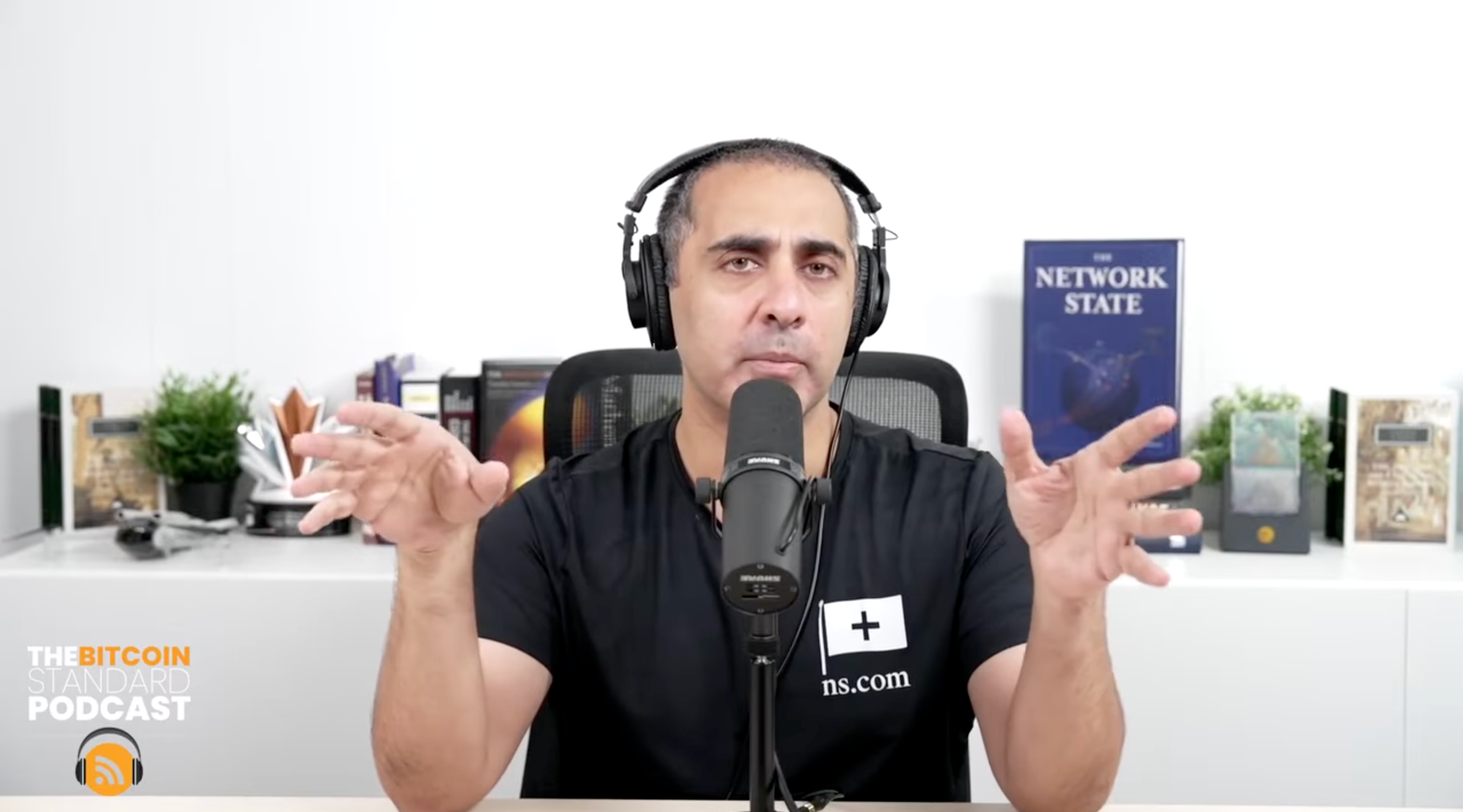
Here is a summary of the conversation between Saifedean Ammous and Balaji Srinivasan, exploring the intersection of the Bitcoin Standard and the Network State.
Introduction: The Convergence of Hard Money and Digital Sovereignty
The interview begins with a mutual acknowledgment of how the concepts of the "Bitcoin Standard" and the "Network State" are intrinsically linked. Balaji Srinivasan defines the Network State not as a fantasy, but as a concrete progression: a highly aligned online community that crowdsources territory to eventually gain diplomatic recognition. He visualizes this as "populating the land from the cloud." Just as tech companies like Google or distinct cultural groups like "Chinatowns" establish physical nodes globally, a Network State would establish a decentralized country connected by the internet and a shared blockchain ledger.
Srinivasan explains that we are moving from the era of the "coercive state" to the "subscription state." In a world of hard money (Bitcoin), governments cannot print wealth to fund wars or inefficiencies; they must operate like service providers (e.g., Dropbox or Hilton) where citizens opt-in voluntarily.
The Geopolitical Inversion: Soviet America vs. Capitalist China
A significant portion of the discussion focuses on a controversial geopolitical thesis: the roles of the United States and China have flipped since the Cold War.
Srinivasan argues that American Keynesianism has become indistinguishable from late-stage Soviet Communism. He describes the US economy as a "zombie economy" propped up by the Federal Reserve. He likens American money printing to "communism for wimps"—where instead of shooting citizens to seize assets, the state dilutes their wealth silently through inflation. He cites the hollowing out of American institutions, describing the US as a "Potemkin village" where brands like General Motors or Harvard exist in name but have lost their substance and vitality.
Conversely, both Ammous and Srinivasan agree that China, despite its communist branding, currently operates more like a capitalist entity. Ammous points out that the Chinese central government holds significantly less debt than the US federal government and that Chinese manufacturing is disciplined by international markets. Because China cannot export inflation (it must sell actual goods to get dollars), it retains a connection to physical reality that the US has lost. Srinivasan adds that China’s local governments compete economically, similar to corporate franchises, creating a system that rewards production over financialization.
The Collapse of the Dollar and "American Anarchy"
The conversation shifts to the inevitable end of the fiat dollar system. Srinivasan presents a grim "American Anarchy" scenario. He argues that the dollar is the only remaining bond holding the "Disunited States" together. Once hyperinflation renders the dollar worthless, the tenuous connection between Democrats and Republicans will snap.
Srinivasan predicts a radical realignment:
- Democrats will align with Chinese Communism. having lost the ability to print money, the American Left will look to the "competent authoritarianism" of China to restore order and maintain the administrative state.
- Republicans will evolve into Bitcoin Maximalists. No longer able to rely on "America First" (since the American state has failed), the Right will embrace hard money, decentralization, and libertarian sovereignty.
Srinivasan argues that a currency collapse leads to a vacuum of security, citing the chaos of post-Soviet Russia as a precedent. He fears a "Mad Max" scenario where supply chains break and violence erupts, suggesting that only centralized power (like China) or highly organized network states can restore order.
Ammous offers a more optimistic counter-narrative. He argues that the "Mad Max" dystopia is actually the current reality under fiat—characterized by homelessness, crime, and high time preference. He believes the death of the dollar would be a "German Miracle" moment (referencing Germany's rapid recovery after price controls were lifted in 1948). In Ammous's view, removing the "money printer" eliminates the funding for endless wars, bureaucracy, and corruption. He posits that without the distortion of inflation, society would naturally reorganize into more productive, peaceful structures because people would be forced to engage in honest trade.
Governance: Monarchy vs. Techno-Democracy
The two authors debate the ideal political structure for a post-fiat world.
Saifedean’s Case for Monarchy:
Ammous advocates for a return to monarchy, arguing that kings operate with a lower time preference than democratic leaders. He views a kingdom as a "family business"—a king wants to preserve capital and stability for his grandchildren, whereas a democratically elected president has a short-term incentive to loot the treasury before his term ends. Ammous suggests that in a Bitcoinized world, people might voluntarily choose to live under monarchies that offer security and stability, rejecting the chaotic short-termism of 20th-century democracy.
Balaji’s Case for Techno-Democracy (The Social Smart Contract):
Srinivasan pushes back, proposing a synthesis of Right-wing efficiency and Left-wing legitimacy called "Techno-Democracy." He agrees that "democracy within states" (voting for representatives) is broken, as seen in the one-party rule of California (Democrats) or the gerrymandering of Red states. Instead, he advocates for "democracy between states."
His model relies on exit over voice. In a Network State, every citizen signs a "social smart contract" upon entry. This is a cryptographically verifiable agreement that outlines exactly what the government can and cannot do. If the citizen disagrees with the governance, they vote with their feet and leave. This creates a market for governance where leaders are accountable not through ballot boxes, but through the retention of their population. This validates the "consent of the governed" while maintaining the efficiency of a CEO-like executive.
Historical Parallels and Future Trajectories
Srinivasan categorizes the future into two rising powers replacing the American Empire: China (centralized, physical control) and the Internet (decentralized, digital sovereignty).
Ammous draws parallels to his new book, The Gold Standard, an alternative history where a Bitcoin-like gold clearance system is invented in 1910. In this scenario, the technology allows citizens to rug-pull central banks during WWI, ending the war early by bankrupting the combatants. This reinforces his belief that technology (Bitcoin) simply facilitates a return to sound, traditional economic principles.
Srinivasan agrees but frames it as a tension between Primitivism (the proven past) and Futurism (the technological possibility). He acknowledges that Ammous's "meat and water" approach—sticking to what has worked for thousands of years—is correct 90% of the time. However, he argues that the 10% of the time when technology breaks tradition (e.g., aviation, the internet, Bitcoin) drives human evolution.
Practical Application: The Network School
The interview concludes with Srinivasan sharing his current project: a "startup city" near Singapore. He is gathering founders from 100+ countries to live in a co-located community, proving that you can populate a physical territory from a digital network. This serves as a prototype for the Network State: building a high-trust, high-capacity community online and then "printing it" into the real world.
Ultimately, the conversation highlights a shared conviction: the fiat experiment is failing. Whether the future looks like Ammous’s collection of sovereign monarchies or Srinivasan’s constellation of Network States, both agree that the solution lies in exiting the legacy system and building alternatives based on hard money and voluntary association.