Biblical Family Tree
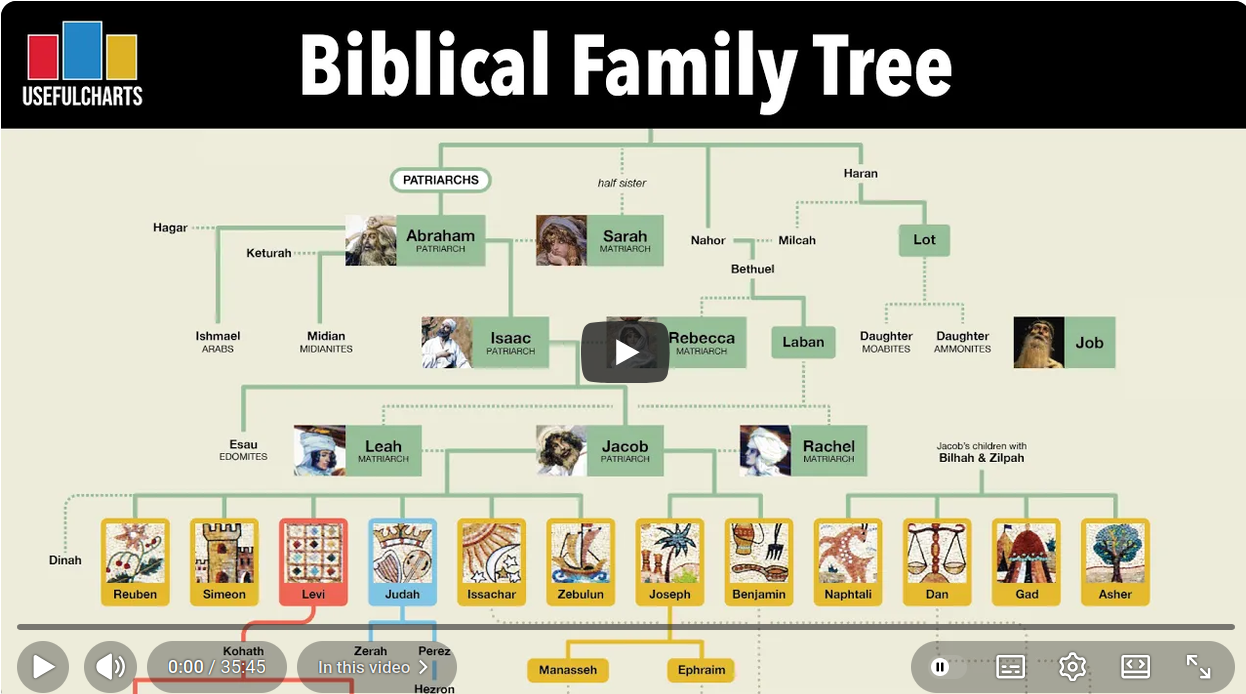
This is a transcript of a video by Matt Baker (UsefulCharts) presenting the entire biblical family tree from Adam and Eve to the time of Jesus, using a new version of their biblical family tree chart (available as a poster). Below are the significant points and lists, drawn strictly from the transcript content.
1. Origins: Adam to Noah
- Adam and Eve are presented as the first humans created by God.
- Their first two children were Cain and Abel; Cain killed Abel out of jealousy.
- A third son, Seth, is born, and the biblical line continues through Seth.
- Seth married one of his sisters (Adam and Eve had many unnamed sons and daughters); subsequent generations presumably married cousins.
- The presenter explicitly states he is not debating literal vs literary interpretation — he follows the tree as described in the Bible.
- Seth → Enosh → (seven generations later) → Noah.
- Noah built the ark to survive the Great Flood. Only eight people survived: Noah, his wife, their three sons, and the sons' wives.
- Noah's three sons: Shem, Ham, and Japheth.
Noah's Sixteen Grandsons
| Son | Number of Sons | Notable Grandsons (Nation Correspondences) |
|---|---|---|
| Shem | 5 | Arphachshad (line followed by the Bible) |
| Ham | 4 | Mizraim (→ Egypt) |
| Japheth | 7 | Javan (→ Greece) |
- Most of the sixteen grandsons' names match nations of the Near East (e.g., Asshur → Assyria, Mizraim → Egypt, Javan → Greece).
2. The Line of Shem to the Patriarchs
- Arphachshad → Selah → Eber (Eber possibly the basis for the word "Hebrew").
- Five generations down from Eber: Terah, living in Mesopotamia (modern-day Iraq), father of Abraham, Nahor, and Haran.
- Haran dies in Mesopotamia; the rest of the family (including Haran's son Lot) migrates to the Land of Canaan (modern-day Israel and Palestine), promised to Abraham.
- Terah dies in Syria; Nahor settles there. Abraham and Lot continue to Canaan.
Abraham's Family
| Wife/Concubine | Key Child(ren) | Notes |
|---|---|---|
| Sarah (also his half-sister) | Isaac (born when Sarah was 90) | Abraham's main heir |
| Hagar (Sarah's servant) | Ishmael | Ancestor of the Arabs |
| Keturah (third marriage) | Several sons, including Midian | Ancestor of the Midianites |
- Isaac marries Rebecca — granddaughter of Nahor, making her Isaac's first cousin once removed.
- Isaac and Rebecca have two sons: Jacob (later renamed Israel) and Esau.
- Abraham, Isaac, and Jacob are known as the three patriarchs.
3. Related Peoples Groups
| People Group | Biblical Ancestor |
|---|---|
| Moabites and Ammonites | Lot |
| Edomites | Esau |
| Midianites | Midian (son of Abraham and Keturah) |
| Arabs | Ishmael (son of Abraham) |
- Per Islamic tradition, Muhammad descends from Ishmael; Jesus descends from Isaac — hence Judaism, Christianity, and Islam are called Abrahamic religions.
- Job is mentioned as fitting somewhere in the patriarchal period, though the Bible is unclear on his exact connection to the tree.
4. Jacob's Twelve Sons → The Twelve Tribes
- Jacob marries Leah and Rachel (daughters of Laban, Rebecca's brother — making them Jacob's first cousins). He also has children with their servants Bilhah and Zilpah.
- Each of Jacob's twelve sons becomes the progenitor of one of the Twelve Tribes of Israel.
- Colour-coding on the chart: red = Levi, blue = Judah, yellow = all other tribes.
- Joseph (firstborn of Rachel) is sold by his brothers, ends up in Egypt, and becomes second-in-command under the pharaoh.
- The pharaoh is unnamed, but context suggests a connection to the 15th Dynasty (the Hyksos, a Semitic group ruling the Nile delta).
- In Egypt, Joseph fathers Ephraim and Manasseh — the tribe of Joseph is thus counted as two tribes.
- A famine drives Jacob's entire family to Egypt, where they reunite with Joseph. The Israelites eventually become enslaved.
5. Moses and the Exodus
- Moses (tribe of Levi) leads the Israelites out of Egypt; his brother Aaron becomes the first Israelite High Priest.
- Key events: parting of the Red Sea, giving of the Ten Commandments.
- The pharaoh is unnamed; two most likely candidates:
- Thutmose III (if following the timeline literally)
- Rameses II (if going by context)
- The Israelites wander the desert for 40 years; Moses dies before entering Canaan.
- Joshua (tribe of Ephraim) leads the Israelites into Canaan, conquering and dividing the land among the twelve tribes.
- During this period, judges rise as needed; famous ones include Gideon, Deborah, and Samson.
- The Merneptah Stele (commissioned by Pharaoh Merneptah, son of Rameses II) contains the oldest extra-biblical reference to the People of Israel.
6. The Monarchy Period
- Samuel (tribe of Levi, a prophet) anoints Saul (tribe of Benjamin) as the first king.
- God is unhappy with Saul; Samuel secretly anoints David (tribe of Judah).
- David serves Saul as a musician, kills Goliath, befriends Saul's son Jonathan, and marries Saul's daughter Michal.
- After Saul and Jonathan die in battle, David becomes king — initially only of his own tribe (Saul's son Ishbosheth rules the rest), but David eventually defeats Ishbosheth and rules all twelve tribes.
- David makes Jerusalem his capital. He lusts after Bathsheba, has her husband killed, and marries her. Their son Solomon succeeds him.
- Ruth (a great-grandmother of David, originally from Moab) is one of only four women mentioned in the Gospel of Matthew as an ancestor of Jesus.
Solomon
- Reigns for 40 years; credited with writing much of the Book of Proverbs (David credited with many Psalms).
- Built the First Temple in Jerusalem, starting construction in the fourth year of his reign — 36 years before his death (a number the presenter flags as significant for dating calculations).
- Described as the wisest man to ever live.
7. The Divided Kingdom
After Solomon's death, Israel splits into two kingdoms:
| Kingdom | Location | First Ruler | Ruling Dynasty |
|---|---|---|---|
| Kingdom of Judah | South | Rehoboam (Solomon's son) | House of David (continuous) |
| Kingdom of Israel | North | Jeroboam (tribe of Ephraim) | Multiple dynasties (unstable) |
- 930 BCE — the year both Rehoboam and Jeroboam begin their reigns. This is the earliest biblical date virtually all scholars agree on (religious and secular), because dates and people from this point can be verified by sources inside and outside the Bible.
- Example: 1 Kings 14 mentions Pharaoh Shishak, matched to Egyptian records of Shoshenq (reigned 943–922 BCE).
- The chart uses BCE/CE instead of BC/AD, reflecting standard academic practice.
8. Kings of the Northern Kingdom (Israel)
The northern kingdom is highly unstable, with frequent usurpations:
- Jeroboam → son Nadab
- Baasha (usurper) → son Elah
- Zimri (kills Elah) → killed by Omri
- Tibni (rival, probably related to Zimri) — Omri prevails
- Omri — builds the new capital at Samaria
- Earliest king of Israel or Judah confirmable by an extra-biblical source (Mesha Stele, c. 840 BCE, from Moab).
- Assyrian records call Israel "the land of the House of Omri."
- Ahab (Omri's son) — married to Jezebel (Phoenician princess); prophet Elijah is active during his reign.
- Conflict with the Kingdom of Aram-Damascus (modern Syria).
- Tel Dan Stele (commissioned by King Hazael of Aram-Damascus) describes defeating Jehoram (son of Ahab) and Ahaziah (House of David) — the only extra-biblical reference to David, though it gives no biographical details.
- Jehu (possibly a different branch of the House of Omri) — the only king of Israel or Judah with a contemporary depiction: the Black Obelisk shows him bowing to Shalmaneser III, indicating Israel became an Assyrian vassal.
- Four descendants of Jehu, then five final rulers before Samaria is destroyed by the Assyrians in 722 BCE.
- Shalmaneser V conquers Samaria.
- The Bible also mentions "King So" of Egypt — almost certainly Osorkon IV, last pharaoh of the 22nd Dynasty.
9. Kings of the Southern Kingdom (Judah)
- Ruled continuously by the House of David.
- At least one intermarriage with the House of Omri: Jehoram (Rehoboam's great-great-grandson) marries Athaliah, daughter of Ahab.
- After deaths of Jehoram and their son Ahaziah, Athaliah seizes the throne, killing all other claimants. Ahaziah's infant son Joash is hidden until age 7, when the high priest overthrows Athaliah and restores the House of David.
- Hezekiah (five generations after Joash) — a major king who faces the Assyrians under Sennacherib.
- Sennacherib fails to conquer Judah, partly due to Pharaoh Taharqa (called Tirhakah in the Bible, King of Kush) and partly due to Hezekiah's preparations (new walls and an underground water tunnel — both confirmed by archaeology).
- Prophet Isaiah is active and is a member of the royal family and Hezekiah's father-in-law.
- Manasseh and Amon — described as evil kings.
- Josiah — restores Judah; the kingdom flourishes as Assyria declines.
- High Priest Hilkiah (descendant of Zadok, the original high priest of the First Temple).
- The Ketef Hinnom scrolls (oldest copy of a biblical text ever found, dating to around Josiah's time) include verses from Numbers 5:24–26.
- Josiah is killed by Pharaoh Necho (Necho II) of Egypt.
- Three of Josiah's sons and one grandson reign before Jerusalem and the First Temple are destroyed by Nebuchadnezzar of Babylon in 586 BCE.
- Final high priest of the First Temple: Seraiah (Hilkiah's grandson).
- Key prophets during this period: Jeremiah and Ezekiel (both priests).
- Ezekiel, Jeconiah, Daniel (a nobleman), and many elites are exiled to Babylon.
10. Babylonian Exile and Persian Period
- Cyrus the Great of Persia conquers Babylon and allows the exiles (now called Jews) to return to Jerusalem and rebuild the temple (the region now called Judea).
- Most of the Hebrew Bible is written during the Babylonian and Persian periods. The chart includes a timeline of when each book was likely written (per modern critical scholarship).
Waves of Returnees
| Wave | Leader(s) | Role | Appointed By |
|---|---|---|---|
| 1st | Sheshbazzar (son of Jeconiah) | Governor | — |
| 1st (priest) | Joshua (grandson of Seraiah) | First High Priest of the Second Temple | — |
| 2nd | Zerubbabel (son of Shealtiel or Pedaiah, both sons of Jeconiah) | Governor | — |
| 3rd | Ezra (priest/scribe) | — | Artaxerxes I |
| 4th | Nehemiah | Governor | Artaxerxes I |
- Esther: the Persian king in her story is named Ahasuerus, which doesn't match any known Persian king precisely, but is usually assumed to be Xerxes I.
This marks the end of the Hebrew Bible (Old Testament).
11. The Intertestamental Period
- Alexander the Great conquers the Persians. After his death, the empire splits into four main parts; two key dynasties emerge:
- Ptolemies (based in Egypt) — initially rule Judea
- Seleucids (based in Syria) — later rule Judea
The Maccabean Revolt
- Triggered when Seleucid king Antiochus IV replaces Jewish sacrifices with sacrifices to Zeus.
- Initially led by Mattathias; after his death, his son Judah (nicknamed Maccabee, "the Hammer") recaptures the temple and restores sacrifices, becoming the new high priest.
- The family becomes known as the Maccabees (also Hasmoneans).
- They eventually serve as both high priests and monarchs — first as princes (Simon, Hyrcanus I), then as kings (starting with Aristobulus I).
- The Sanhedrin (a legislative body) is formed during this period, led by the Zugot (a pair of leaders):
- Nasi (roughly "President")
- Av Beit Din (roughly "Vice-President")
- A civil war between Hasmonean brothers Hyrcanus II and Aristobulus II leads to Roman intervention; Judea becomes a Roman client state.
- The Herodian dynasty replaces the Hasmoneans — Herod the Great marries one of the last Hasmonean princesses. The monarchy and high priesthood are split; high priests now appointed rather than inheriting the role.
12. Jesus: Genealogy and Context
- Jesus is born during the reign of Herod the Great.
- Mary and Elizabeth (mother of John the Baptist) are related; per Catholic tradition, Mary's mother was Anne, presumably a sister of Elizabeth's mother, making Mary and Elizabeth first cousins and Jesus and John the Baptist second cousins.
Genealogies of Joseph (Jesus's Adoptive Father)
| Gospel | Father of Joseph | Line Through David | Key Features |
|---|---|---|---|
| Matthew | Jacob | Solomon → kings of Judah | Three sets of 14 names; skips generations (e.g., Ahaziah, Joash, Amaziah — jumps Jehoram to Uzziah); replaces Asa with Asaph and Amon with Amos (probably stylistic nods to the Prophets and Writings sections of the Hebrew Bible) |
| Luke | Heli | Nathan (a previously unknown son of David) | 77 names (= 7 × 11); adds extra generations between Hezron–Amminadab and Arphachshad–Selah; usually considered Mary's ancestry (though some argue the opposite) |
- Both genealogies trace back to Zerubbabel. Matthew provides roughly half as many names between Zerubbabel and Jesus as Luke does, suggesting Matthew may have omitted generations (he is known to skip generations elsewhere).
- Matthew is confirmed to skip generations — the Ahaziah/Joash/Amaziah omission is an explicit example from the transcript.
13. Herodian Dynasty After Herod the Great
- Herod's kingdom is divided into four parts, each ruled by a tetrarch.
- Herod Archelaus gets Judea (the main part); rules 10 years, after which the monarchy is abolished and Judea becomes a Roman province ruled by a governor.
- By the time of Jesus's crucifixion, Pontius Pilate (Roman governor) sentences him to death.
- The Herod connected with the beheading of John the Baptist is Herod Antipas (not Herod the Great or Archelaus), who married his niece Herodias.
- The Judean monarchy is briefly restored about a decade after Jesus's death: Agrippa I (called "Herod" in Acts), then Agrippa II (called "Agrippa" in Acts).
14. Jewish Scholarship Figures
- Gamaliel — a Jewish teacher mentioned in Acts; Paul studied under him before his conversion.
- Hillel — Gamaliel's grandfather; an important Jewish scholar living just before Jesus. His teachings are often contrasted with Shammai (who lived at the same time).
- Hillel served as Nasi of the Sanhedrin; Shammai served as Av Beit Din.
15. Final Events on the Chart
- Destruction of Jerusalem and the Second Temple in 70 CE.
- The leader of the Sanhedrin at this point is Simon (son of Gamaliel). Both he and the final high priest are murdered during the destruction.
- Oversight of Jewish law passes to Yohanan ben Zakkai, who establishes the first rabbinical school in Yavne.
- Babylonian Exilarchs — a line of men in Babylon (later Baghdad) who led the Jewish community as senior heirs of the House of David, tracing descent from Zerubbabel. Records of their existence extend to 1258 CE.
16. Dating Systems Compared
Christian Literalist Dates (top left of chart)
Starting from the agreed date of 930 BCE and counting backwards using biblical numbers:
| Event | Date (BCE) | Biblical Basis |
|---|---|---|
| Rehoboam and Jeroboam begin reign | 930 | Agreed by all scholars |
| Solomon begins building the Temple | 966 | 930 + 36 years |
| The Exodus | 1446 | 1 Kings 6:1 — temple started 480 years after Exodus |
| Israelites enter Egypt | 1876 | Exodus 12:40 — 430 years in Egypt; Genesis 47:9 — Jacob was 130 |
| Jacob born | 2006 | Isaac was 60 when Jacob was born |
| Abraham born | 2166 | Abraham was 100 when Isaac was born |
| The Flood | 2458 | Genesis 11 — Abraham born 292 years after the Flood |
| Creation of Adam and Eve | 4114 | Genesis 5 — Noah born 1056 years after Adam; Noah was 600 at the Flood |
Note: different Christian literalists may produce slightly different dates depending on counting methods, but creation is generally placed around 4000 BCE.
Jewish Traditional Dates (top right of chart)
Based on the year 70 CE (destruction of the Second Temple) and Jewish tradition:
| Element | Duration | Notes |
|---|---|---|
| Second Temple stood for | 420 years | |
| First Temple stood for | 410 years | |
| Gap between temples | 70 years | |
| Total | 900 years | Places temple construction at 830 BCE |
- Counting back 480 years from 830 BCE gives 1310 BCE as the traditional Jewish date for the Exodus.
- Key difference: rabbis interpret Exodus 12:40 as referring to time in Egypt AND Canaan (not just Egypt), cutting a further 215 years off the timeline.
- This places Abraham's birth at 1815 BCE.
- Using Genesis 5 and 11: 390 years back to Seth's birth, 500 more to Noah's birth, and 1,056 more to creation.
- Traditional Jewish date of creation: 3761 BCE.
Hallucination Check
All points above are drawn directly from the transcript text. No external facts have been added or inferred beyond what Matt Baker states in the video. Where the presenter expresses uncertainty or notes debate (e.g., the pharaoh of the Exodus, the identification of Ahasuerus, whether Luke's genealogy is Mary's), this has been preserved. Where the presenter himself notes that the Bible does not name certain figures (Noah's wife, the pharaohs of Joseph and the Exodus), this has also been noted.