Bitcoin has won

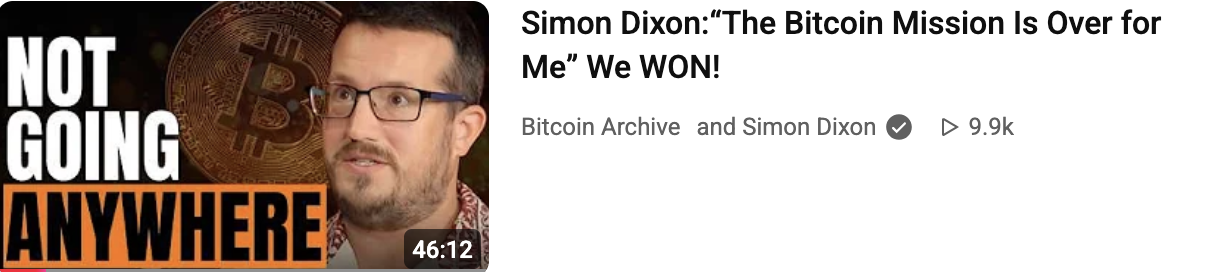
1. The headline: the Bitcoin "mission" is over
Simon's central argument is that the original fight — Bitcoin versus the banks — has been won, and that the banks have conceded.
- He says Bitcoin still does the three things he needs: he can earn in it, spend it, and the 21-million cap and decentralisation hold. "As long as it does that, then I think the mission of what I originally got involved with, of us versus the banks, is kind of over."
- The banks' response, in his framing: "We couldn't defeat it. The blockchain thing is just tokenisation and surveillance. Bitcoin is not going anywhere, so let's just make as much money from it as we can and let's get as much in our custody as we can."
- He is explicit that podcast commentary no longer moves the needle: "There used to be a time when what we would say would influence things. We're so beyond that now."
- The new mission: help as many people as possible self-custody safely, buy more each month, think long-term, and avoid scams, side projects and hacks.
2. Why short-term price action is unpredictable (and why it doesn't matter to him)
- "In the 15 years that I've been involved, there's no consistent story" — Bitcoin's correlation shifts between gold, tech stocks, and financial-system stress.
- Price manipulation has migrated from exchanges to Wall Street and hedge funds: "Short-term you ain't going to be able to predict that. You're not in the right rooms... you're not in those WhatsApp groups."
- On the "Jane Street 10 a.m. dump" theory, he invokes the Cantillon effect: those with access to the money printer get capital and information first, and Jane Street is "an intelligence-connected hedge fund" with "superior information flow and capital flow."
- He accepts short-term manipulation exists but separates it from the long-term thesis.
3. The four things that could actually break the thesis
He names the convergence risks that would put the 21-million cap in question:
- All Bitcoin custodied by a few players (he names BlackRock and Coinbase);
- No competing developer teams, with the community co-opted by corporate funding;
- Mining centralised into one control structure;
- Blocks so large that cheap node operation dies and node counts keep falling.
"I believe there's strategies by powerful forces to try and achieve those" — but nothing yet has changed his long-term, intergenerational view.
4. The petrodollar and the "financial industrial complex" (FIC)
Dixon's framing of the current macro picture:
- The old bargain: oil priced in dollars → surplus nations buy US Treasuries → they sit inside the Federal Reserve system → the yield/interest on that debt funds military contractors → foreign bases in the Middle East. "And if you stop doing that, then you're suddenly subjected to a covert war."
- He argues it is now unravelling — as Archie puts it, there is "no formal petrodollar treaty in place like there was for decades." Dixon: "Yes, that is a fact."
Historical chain he lays out
| Period | Event and significance |
|---|---|
| 1950s | Egypt cast as the "Iran" of its day: Suez choke point, nationalist push to nationalise oil |
| 1956 | Lavon Affair — Israeli false flags blamed on Egypt to keep Britain in the region |
| Post-war | Britain bankrupt and off gold; sterling convertible to dollars but not gold; US-aligned forces selling gilts to crash the pound |
| Peak | US holds roughly 20,000 tonnes of gold — about 75% of world supply, accumulated via both world wars and the Depression |
| 1967 | Six-Day War; Israel takes Gaza, West Bank, parts of Egypt and Syria — the territory behind the "Greater Israel project" |
| 7 Oct 1973 | Yom Kippur War; US backs Israel, which becomes dependent on the US military-industrial complex |
| 1971 | Nixon closes the gold window |
| 1974 | Petrodollar agreement: price oil in dollars, buy Treasuries, host bases |
He notes the date coincidence: 7 October 2023 fell exactly 50 years after 7 October 1973. He also flags the Vietnam/Tonkin false flag and France and Switzerland demanding gold (US holdings falling from 20,000 to 8,000 tonnes), plus his personal suspicion of "double book" accounting between the Fed and Treasury — explicitly labelled as opinion.
The current unwind
- Yields at all-time highs because foreign holders are slowly selling Treasuries — Cayman Islands, Japan, China, Europe, the UK. The UK is singled out for a highly leveraged, Roadblock-managed private pension system; the Cayman Islands "is not a state."
- Japan now offers domestic yields, so the yen carry trade that funded Cayman hedge-fund buying of US debt is breaking.
- Eurodollar arrangements are being renegotiated — the UAE received an FX swap line.
- The petrodollar is being renegotiated because America is now an exporter, while Europe remains dependent — "Europe's being destroyed."
5. Who wins and who loses from the wealth transfer
| Crushing it | Being crushed |
|---|---|
| Oil and energy producers/refiners | Borrowers and anyone refinancing debt |
| Bond issuers and buyers ("Big Oil and finance") | Energy consumers — truckers, farmers, SMEs |
| Defence/military-industrial complex: record orders and share prices | The US nation-state: draining reserves, buying oil dearer, deeper in debt |
| AI, surveillance and tech | Small business, facing M&A roll-up by big business |
| Investment banks: M&A and trading desks reportedly ~30% higher profits | Europe, most acutely |
- His summary: "Socialising losses, privatising gains... socialism for the wealthy and capitalism for the rest."
- Tariffs: another wealth transfer, borne mainly by small importers who lack big business's leverage and global footprint. Small businesses are now getting refunds, the issue will be contested in court, and the net effect was to make America "a very unstable place to do business" and to accelerate multipolarity.
- AI is the counterweight: a genuine productivity, disinflationary force offsetting some of the inflation.
- He is sceptical of Trump's pre-midterm redistribution rhetoric ($5,000 payments, state stakes in AI firms): "Wealth is in charge, so wealth will always win. In my sense, the rest is rhetoric."
6. Middle East: MIC out, FIC in
- Oman is the country to watch. Neutral, regionally connected, Western ties, active in stablecoins and programmable rails, and it has integrated central banking with Iran.
- Sanctions pushed Iran's trade off the Egypt, Turkey and Syria routes into Oman and China — "and you never hear anything about Oman." China was simultaneously filling the world's largest oil reserves.
- Syria: off the terrorist list, sanctions relief, World Bank talks, Visa and Mastercard opening up — "the FIC is coming in as the MIC is going out."
- Iraq: a military exit, but the government still needs Fed permission to receive oil money — "a military exit, a FIC acceleration."
- Yemen: Saudi/UAE "good cop, bad cop" posturing, UAE escalation then retreat, which paved the way for Houthi gains. The Houthis are behaving as an autonomous agent positioning for integration into Yemen's political system and armed forces, with control of a strategic choke point as their own interest. Resolution expected soon; the sequencing (UAE, Saudi, Houthis) is "very telling."
- Mecca pact (Turkey, Pakistan, Saudi Arabia): he calls it "quite theatrical" and "optics," but significant signalling; he predicts Syria and Egypt may join.
- On propaganda: "The propaganda is just too much on every side to really know the truth." He follows shipping satellites, but notes oil is easily relabelled — Iranian crude can surface as Russian after sanction relief.
- Hormuz: the flow never stops; the cost of insuring and delivering it changes. Winners are insurers, refiners, producers and transit states (Russia, possibly India).
His directional predictions
- A US exit from the region, an end to the MIC "forever war," defence agreements and FIC entry, with China as the stabilising financial power — "I'm still very bullish on where this is headed." He concedes his timing has been "very off."
- Iran will sign some form of agreement or MOU and align with China. He rates Iranian strategic calculation highly, contrasting it with the Western "cartoon" portrayal.
- World War III is "impossible" — strategic interdependence makes it infeasible; "this only ends in a deal."
- The Russia–Europe front runs for a very long time, because MIC/FIC benefit from duration; Russia gains leverage by fragmenting NATO; European military manufacturing gets privatised.
- Israel is a MIC node becoming a "thick node" — a privatised military whose Greater Israel leverage feeds reconstruction contracts. He sees an Israeli "identity crisis" as China's importance grows, evidenced by the Greece–Cyprus deal where 25% of manufacturing and the IP stay in Greece.
- A Palestinian state will exist — his timeframe is roughly five years — because Saudi normalisation is optically impossible without one. Whoever rebuilds sets the order; external funding for Iran's reconstruction would be reframed as reparations, and Hormuz transit fees were floated as a substitute for formal reparations.