Bitcoin Standard Launch
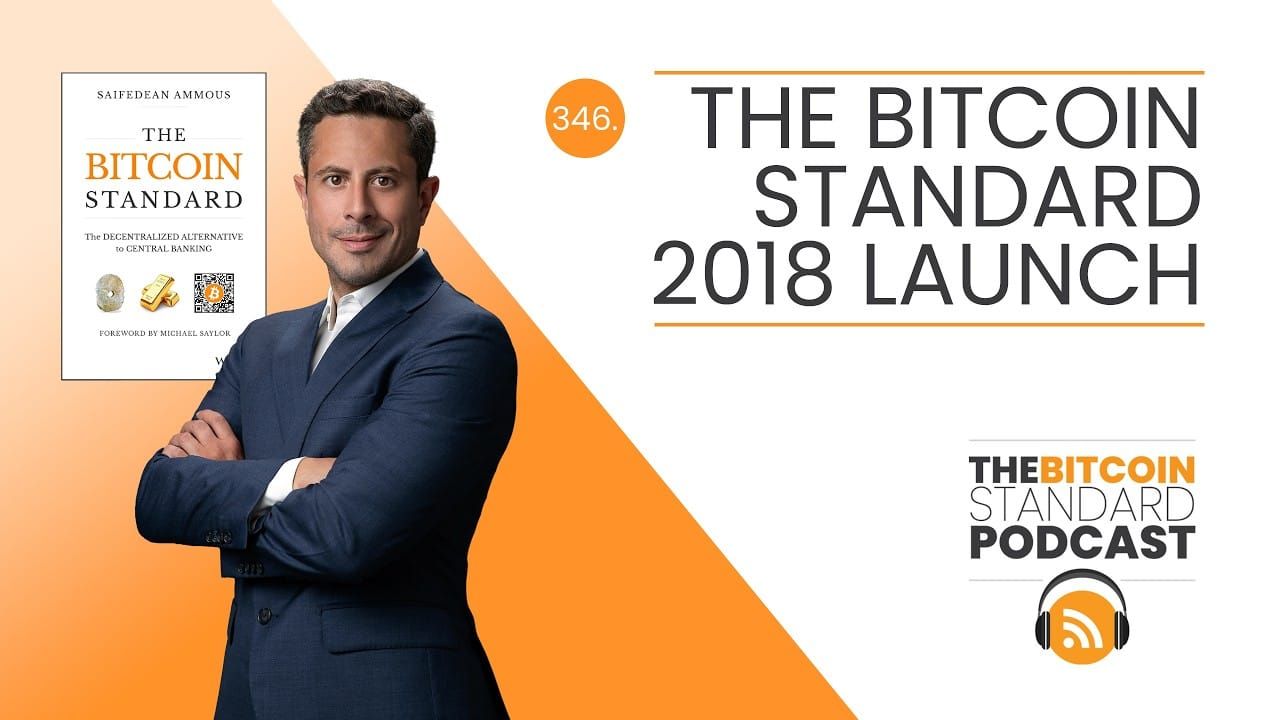
Overview: A book-launch talk and Q&A given in Vienna, hosted by Bitcoin Austria. Ammous chose Vienna as the first stop of his book tour because of his intellectual debt to the Austrian School. The talk presents the central thesis of The Bitcoin Standard — that Bitcoin is emerging as a new monetary standard — followed by an extended on-stage discussion and audience Q&A.

The core argument of the talk
1. What makes something money? Hardness of production
- The first seven chapters of the book barely mention Bitcoin, because they deal with money in general and the history of money.
- The key factor determining whether something becomes money is that it is hard to produce.
- If money is easy to produce, others produce more of it, supply rises, the price crashes, and it becomes a useless store of value.
- If money is hard to produce, people store value in it, the price rises, and others cannot easily produce more to bring the price down.
- Historically, the best monies were always the hardest to make: rare seashells where they were scarce, cattle, limestone, and similar goods — always with some physical or political mechanism restraining supply growth.
- When several monies interact, the hardest to produce almost always survives, because those who save in the easy money lose their wealth over time.
2. Why gold became money
- Gold has the lowest supply growth of all metals, for two reasons:
- It is very rare in the earth.
- It does not corrode or "ruin", so the current stock has been accumulated over thousands of years. Even a rise in production is only a small fraction added to a vast existing stockpile.
- Gold's supply grows about 1–2% per year, regardless of price — nobody could ever guarantee such a low growth rate.
- Human psychology plays a part, but so does natural market selection: those who choose better money end up with more wealth over the long run.
3. Government monies follow the same pattern
- Major world currencies (US dollar, euro, Swiss franc) grow around 3–7% per year; crisis-prone currencies grow at 10–50% or more, and lose value quickly.
- People migrate towards the harder currencies.
4. Why Bitcoin matters
- Within about four to five years, Bitcoin will have the lowest supply growth of anything ever used as money — and it will be reliably lower.
- Current Bitcoin supply growth is around 4% per year (roughly double gold), but it will fall below gold and eventually stop.
- This is why Bitcoin "refuses to go away" despite negative press (electricity use, etc.) — it is simply better, harder money.
- Extrapolated 50 years out, Bitcoin's supply grows only about another 20%; extrapolating the euro, dollar or yen over the same period yields multiples of 500–1,000%.
- Bitcoin is not optional. The West Africa "glass bead" example illustrates this: glass beads were money because they were hard to make locally; when Europeans could mass-produce them, they shipped them to West Africa to buy goods — the beads became known as "slave beads" and the Africans' money collapsed. An easy money is always destroyed by a harder one.
5. The first strictly scarce liquid asset
- Ammous argues the common notion of scarcity is misunderstood: the quantity of copper, iron, oil, etc. is not limited by how much exists on earth, but by human time — the cost of diverting effort from other needs. Supply could rise, but only at great cost.
- He cites the economist Julian Simon: the only truly scarce resource is human time.
- Bitcoin is the first liquid asset whose supply is strictly scarce — not divisible/transportable like a Mona Lisa, but usable for payment.
- Money is a technology for preserving the fruits of labour across time; inflation of the money supply is an inefficiency in that technology.
6. Time preference (Chapter 5)
- Time preference = how much people value the future versus the present.
- A money that evaporates discourages saving, encouraging high time preference (present-oriented, immediate gratification).
- The ability to save shifts behaviour towards low time preference, which Ammous says initiates the process of civilisation — citing economist Hans-Hermann Hoppe on investing, capital accumulation and long-term thinking.
- Comparison of 19th-century vs 20th-century Europe: changes in music, art, architecture and savings rates are not coincidental. He argues fiat money's continuous devaluation pushes society towards high time preference, and Bitcoin may reverse this.
- Illustration: money appreciating at 5% per year doubles in ~15 years; money losing 5% per year halves in ~15 years. You are far likelier to save with the appreciating money.
7. Protection against government abuse
- Bitcoin offers protection against confiscation and inflation.
- Short term, it saves lives (e.g. escaping Venezuela); longer term, its deeper impact is making it harder for governments to finance themselves through inflation, because citizens everywhere gain an exit strategy that is harder to crack down on than dollars or gold.
8. Scaling and the gold-standard analogy
- On-chain scaling is impractical; growth comes from second- and third-layer solutions.
- Payment providers, exchanges and gambling sites batch transactions, so most Bitcoin transactions today are cleared off-chain — the blockchain is a settlement layer.
- Under the gold standard, physical gold moved rarely; thousands of transactions occurred per ounce via paper and bank accounts.
- Bitcoin is not a replacement for Visa/Mastercard consumer payments (10 minutes per confirmation; several confirmations needed). The valid comparison is with interbank settlement.
- The gold standard failed because gold clearance became centralised in a few banks, then one bank per country, making it easy for governments to take over.
- Bitcoin's advantage: final settlement, harder than gold, transmittable halfway around the world in under an hour for roughly $1 in fees — even at $100,000 per transaction it would still beat moving large gold payments (referencing Germany's gold repatriation from the Federal Reserve).
- Vision: instead of one global central bank, Bitcoin could support thousands of "central banks" doing final clearance, given the network's capacity of at least half a million transactions per day.
Q&A highlights
On writing the book
- He had followed Bitcoin for years; laughed at around 2012–2014, then everyone wanted explanations in 2015–2017. He wrote ~1,000–1,500 words a day and finished almost all of it in two months (~100,000 words).
On mainstream reception
- Mainstream largely ignores the book. He dismisses "professional Bitcoin bashers" (naming Nouriel Roubini) and deliberately wrote without diplomacy: "I'm not running for election."
On hyperbitcoinisation
- He does not expect a sudden collapse of all other monies. Expects a gradual transition, analogous to newspapers adapting to the internet. He cites Hayek: economics allows pattern predictions, not dated predictions.
On deflationary wages and unions
- Wages need not fall; instead prices fall, so real wages rise.
- On unions: the threat arose from earlier inflationary policy; Britain's post-WWI refusal to return to gold at the old parity depressed wages, and inflation was used to raise them. He characterises Keynesianism as giving workers "bigger numbers" rather than more purchasing power.
- The 19th-century deflationary era (the "La Belle Époque") saw the greatest spread of modern civilisation, electricity, sewage and disease elimination — deflation was not a problem.
On the economics profession
- He argues the profession is captured by central banks — the US central bank funds roughly $4 billion a year in research and grants; fewer than ~10 US monetary economists are not reliant on Fed funding. "You can't convince a man of something if his salary depends on the opposite of it."
- He studied for a PhD at Columbia University and found Austrian economics more convincing. Keynesianism survives because it is what those in power want to hear; the US was already practising it in 1931–32 before Keynes published.
On Milton Friedman
- Friedman the propagandist (wage/price controls) is better than Friedman the economist. Friedman discussed Bitcoin only as untraceable cash, not as a monetary system. His monetary theories reduce to money-supply management (including an algorithmic fixed growth rate still controlled by government). Ammous says Austrians regard the mathematical method as somewhere "beneath astrology and near tarot cards."
On fiat/Bitcoin coexistence
- They coexist now, but "money wants to be one." Multiple monies only persist through government enforcement. Example: by the end of the 19th century, silver was demonetised worldwide in favour of gold.
- If governments ban Bitcoin, that is the best possible advertisement: it demonstrates they cannot stop it (a new block every 10 minutes regardless), and drives people away from banks that refuse to serve Bitcoin users.
- Analogy: Bitcoin is like gunpowder — not optional or a luxury. Governments are adversarial, competing with each other, and may eventually conclude "if you can't beat them, join them" (as 19th-century governments needed gold in the treasury). Central banks may already be considering this.
- He compares the trajectory to the internet: once dismissed as a haven for criminals, it outgrew that.
On why Bitcoin and not altcoins
- The value proposition is not fast/cheap transactions — it is an unalterable, uncontrollable monetary supply (21 million).
- If anyone could change it, "throw my book away." Bitcoin's strength is demonstrated by the repeated failure of influential figures to change even small metrics over 7–8 years.
- The "child raised in the jungle" analogy: a coin that grew up decentralised becomes formidable; a coin with a foundation or leader can be changed at will.
- Ethereum: a foundation that can change anything (repeated hard forks).
- Ripple: centralised; billions of tokens held aside by its operators.
- Bitcoin Cash: created by changing the software, so trivial to change the supply next.
- The onus of proof is on altcoins to demonstrate immutability. If they cannot, there is no point to the expensive blockchain — a centralised currency would be more efficient.
- Bitcoin will win because it is harder, not because it is decentralised; decentralisation is what locks in that hardness.
- The SegWit distinction: it was a soft fork (backwards-compatible; older nodes still sync with Bitcoin), unlike Bitcoin Cash's hard fork requiring everyone to move.
On inequality
- Bitcoin solves government-mandated inequality — those with access to the money printers gaining at the expense of producers.
- Eventually the only way to obtain Bitcoin is to produce value for others; early holders will sell as prices rise. He calls the Marxist focus on inequality the attitude of "the child who always wanted to play with other people's toys."
- Time preference decides who holds: many early holders sold, lost or spent their coins.
On anonymity
- Not feasible on the first layer — the blockchain is a permanent public record, and analytics will improve. He argues Monero and Zcash are "extremely misguided" for building anonymity on a blockchain.
- Privacy is better achieved on second and third layers (e.g. anonymous banks/payment processors).
On second layers and money-supply dilution
- A concern raised: could second layers dilute supply as private banknotes did under gold?
- His counterpoint: Bitcoin's transparency means a provider's holdings are publicly trackable. If a provider issues more claims than coins held, its claims trade at a discount, defeating the purpose. Mt. Gox taught the lesson: don't accept zero-confirmation or unaudited second-layer payments.
On market cap
- Market cap is meaningless: one could create a coin with trillions of units and a fabricated valuation. Thousands of coins are created daily with tiny liquidity. In easy-money conditions, a small team can appear to conjure a "$100 million" coin.
- Bitcoin competes not with altcoins but with the dollar, euro, Swiss franc, IMF SDRs and gold for international settlement.
On Satoshi's coins / "hidden inflation"
- Satoshi's holdings are at most ~1 million coins (~5%). Even if spent, it would not affect Bitcoin fundamentally; a price crash would simply offer cheap coins.
On Hayek's Denationalisation of Money
- He is unconvinced: a commodity-basket currency would drive production of the basket goods (e.g. 30% copper would spur copper production until its value fell). He speculates Hayek's scheme may have been a "Trojan horse" for a free market in money that gold would win anyway.
On other blockchain use cases
- He wrote a 2014 paper arguing the only use case for blockchain technology is digital cash, and likely only Bitcoin.
- Proposals for stock markets, identity, real estate or health records on-chain do not hold up. A blockchain can only move its own native token trustlessly, and the token must be native to reward miners. Examples resemble "Nigerian prince" emails.
- "It's astonishing — I've never seen anything get so much funding with so little output."
On government cryptocurrencies (crypto euro/dollar)
- He thinks they are unworkable by design. Cryptocurrency validity is determined cryptographically and monetary policy algorithmically — precisely the two powers central banks exist to control (transaction clearing and money supply). A central bank building such a currency would be self-defeating; if they truly wanted to neuter themselves they would just use Bitcoin. The euro is already ~70–80% digital, so adding cryptography would be a "meaningless gimmick" or would disempower central banks.
On "how to kill Bitcoin"
- Most feared attacks (e.g. 51% attack) fail because they run against the economic incentives of too many people. The only credible threat he identifies: return to a 19th-century gold standard with cryptographic security — gold's ~6,000-year first-mover advantage and broad familiarity might undermine Bitcoin's demand. He doubts it would kill Bitcoin, and doubts governments would ever try it.
People and works cited in the talk
| Person / Work | Context |
|---|---|
| Julian Simon | Only truly scarce resource is human time |
| Hans-Hermann Hoppe | Low time preference initiates civilisation |
| Friedrich Hayek | Pattern (not dated) predictions; Denationalisation of Money (critiqued) |
| Milton Friedman | Discussed Bitcoin's cash aspect; monetarism critiqued |
| John Maynard Keynes | Keynesian economics critiqued; unions/wages |
| Nouriel Roubini | Named as a "professional Bitcoin basher" |
| Andreas Antonopoulos | Audience reference ("rats' sewer" remark); spoke in Vienna the same day |
| Bitcoin Austria | Host of the event |
| Germany / Federal Reserve | Gold repatriation example |
| Mt. Gox | Lesson on zero-confirmation and second-layer trust |
| Ammous's own works | The Bitcoin Standard; The Fiat Standard; Principles of Economics; a 2014 paper on blockchain use cases |