Book burning today
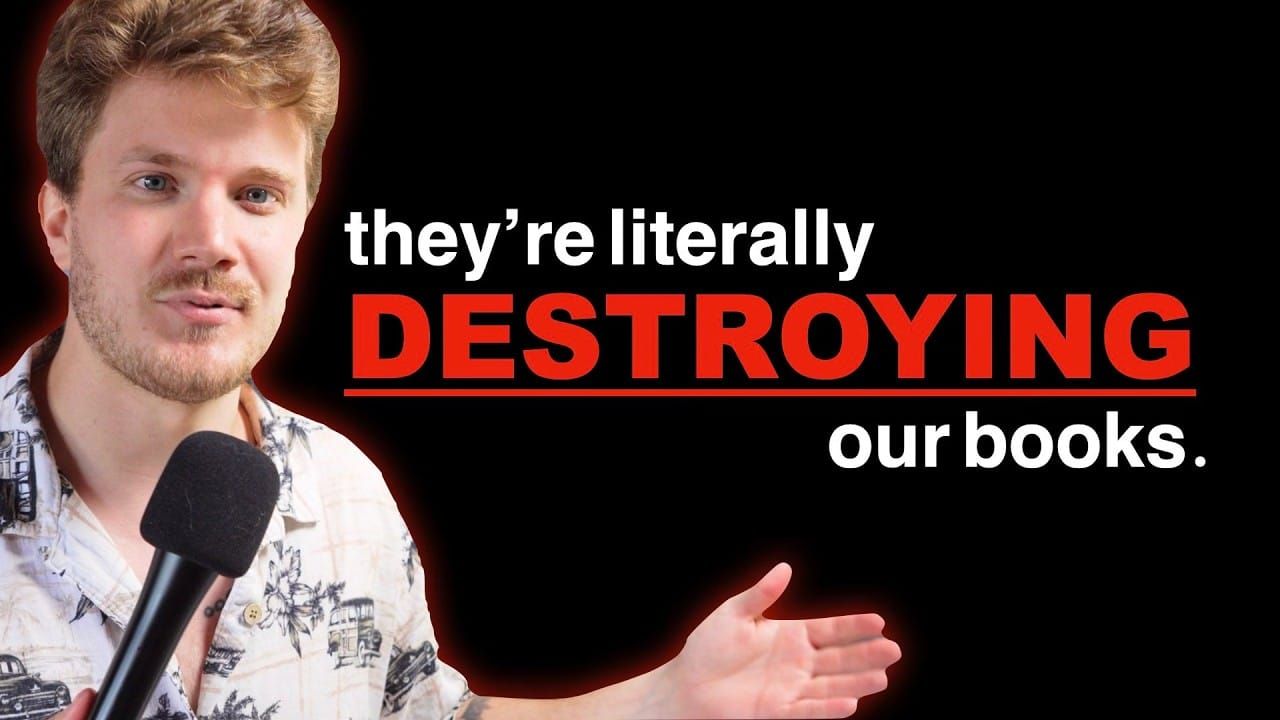
This is a transcript of a Fantasy News YouTube episode hosted by Daniel Greene. The episode's main subject is the industrial-scale destruction of physical books by AI companies — primarily Anthropic — to obtain training data.

Significant Points (in order of appearance)
1. The Core Allegation — Destructive Book Scanning by Anthropic (Lines 7–26)
Daniel alleges that AI labs, specifically Anthropic (maker of Claude, which he phonetically spells "Clawude"), are:
- Bulk-buying millions of rare and out-of-print books
- Slicing them up, scanning the pages, and then pulping/shredding the physical remains
- Potentially destroying the last remaining copies of certain texts
Factual verification: This is broadly confirmed by multiple sources. Court filings unsealed in connection with a copyright lawsuit against Anthropic revealed that the company used hydraulic-powered cutting machines to remove page blocks from books procured from resellers, then scanned them with industrial imaging equipment, and destroyed the originals. The scale was described as "millions of books". One source states over 2 million books were destroyed.
2. The Internal Document & Secrecy (Lines 17–22)
Daniel quotes an internal Anthropic document as stating:
"project Penma [sic] is our effort to destructively scan all the books in the world. We use a soft code name for it because we don't want it to be known that we are working on this. This document is visible to all Anthropic employees, but you should avoid talking about it in public areas and the fact that we are working on this should not be shared to anyone outside Anthropic."
Factual verification: This quote is confirmed by reporting. The Dallas Express and El Solitario both cite this internal document language, referencing the project's stated goal to "destructively scan every book in the world" and the instruction to avoid discussing it publicly. Separately, Futurism reported that unsealed documents showed Anthropic leadership was aware the practice "would look bad".
3. Bookseller Testimony (Lines 27–36)
Daniel cites two bookseller sources:
- Source 1 (quoted from "Tech News"): A small bookseller who says it benefits them financially and clears old inventory, particularly overseas and foreign-language books — but they dislike the end use and that uncommon books are being pulled.
- Source 2: A bookseller who reports going from 20–40 rare book orders per week to now receiving hundreds.
Factual verification: These align with reporting from the original investigations. The bookseller quote matches language from coverage of the story.
4. Daniel's Personal Stake & Disclosure (Lines 38–44)
Daniel discloses a personal bias: he is an author awaiting a payout from the Anthropic copyright lawsuit settlement, as his books were among those used to train Claude without permission. He states he expects to receive approximately $4,000 (line 60).
He characterises this as: after losing the previous court case for digitally stealing books, Anthropic pivoted to bulk-buying and physically destroying books as a legal workaround — reasoning it would be "more time-consuming" and cheaper to just buy and destroy physical copies.
Factual verification: Anthropic was indeed sued by authors for copyright infringement, and the case was settled. Court filings confirm Anthropic hired Tom Turvey, former head of partnerships for Google Books, in February 2024, and the strategy of buying physical books was designed to leverage the first sale doctrine as a legal shield. However, note that the court actually ruled the practice legal as fair use — Daniel does not mention this legal outcome in the transcript.
5. The Access Problem (Lines 45–53)
Daniel makes a key ethical argument: the scanned content is not made publicly available. Unlike, say, a digital library that democratises access after destroying physical media, the scans are put "behind a curtain" — only Anthropic's AI benefits, and the content is behind a paywall. This is presented as the crucial distinction that makes the destruction worse.
6. Criticism of ISBNDB (Lines 54–66)
Daniel names ISBNDB (one of the largest book databases) as complicit, accusing them of deliberately offering bulk book sales to AI companies. He argues this is as bad as or worse than digital theft, because:
- The original creators still receive no credit or profit
- A middleman gets paid
- The physical books are destroyed
- The scanned content is not made publicly available
Factual verification: Confirmed. ISBNDB advertises bulk book sourcing for AI training, offering orders of 1,000 to 1,000,000 books at a time, with NDAs to keep buyers anonymous, and even suggests describing the practice as "digital preservation".
7. Government Failure & Broader Critique (Lines 67–111)
Daniel delivers an extended editorial/rant covering:
- Government inaction: He asks where the government is, criticising it for failing to protect cultural knowledge and instead spending "trillions of dollars in pointless wars."
- Anti-AI philosophy: He argues AI products discourage thinking, processing, and creativity, and that capitalism has decided "effort is bad."
- Environmental concerns: He mentions AI data centres that "poison the water and air" (line 89).
- Characterisation as "violence": He frames the book destruction as "an act of violence against people" — a removal of cultural resources accumulated over millennia.
- Criticism of tech billionaires: He names Elon Musk and Mark Zuckerberg (transcribed as "Mark Zuckle"), Peter Thiel (referencing his naming of the Palantir company, transcribed as "Palunteer"), and calls out billionaires who claim to love science fiction while behaving like the villains in those stories.
- Dune parallels: He references Frank Herbert's Dune, particularly the concept of "real people versus not," arguing that billionaires misread Herbert's critique as endorsement.
8. Channel Promotion (Lines 112–121)
The episode closes with promotion of Daniel's Dune Mega Summary series, available to channel members and Patreon supporters, with instalments released every couple of weeks before eventual public release — following the model he used for Wheel of Time.
Key Lists Extracted from the Transcript
Entities Named or Criticised
| Entity | Role / Mention | Spelling in Transcript | Correct Spelling |
|---|---|---|---|
| Anthropic | AI company destroying books; maker of Claude | "Enthropic" (line 40) | Anthropic |
| Claude | Anthropic's AI assistant | "Clawude" (line 35) | Claude |
| ISBNDB | Book database facilitating bulk sales to AI companies | ISBNDB | ISBNdb |
| Tom Turvey | (Not named in transcript) Former Google Books head hired by Anthropic | — | Tom Turvey |
| Elon Musk | Criticised as a "soulless glob" | Elon Musk | Elon Musk |
| Mark Zuckerberg | Criticised alongside Musk | "Mark Zuckle" | Mark Zuckerberg |
| Peter Thiel | Criticised for naming Palantir | "Peter Teal" / "Palunteer" | Peter Thiel / Palantir |
| Dario Amodei | (Not named in transcript) Anthropic CEO | — | Dario Amodei |
Key Claims vs. Verified Facts
| Claim in Transcript | Verified? | Notes |
|---|---|---|
| AI companies are destroying millions of books | ✅ Confirmed | Court filings confirm multi-million scale |
| Specifically targeting rare books | ⚠️ Partially | Reports confirm rare/out-of-print books are affected, though some analysis disputes the framing of how "rare" the books actually are |
| Internal document about "destructively scan all the books in the world" | ✅ Confirmed | |
| Anthropic lost a previous lawsuit for stealing books | ⚠️ Nuanced | The case was settled; the court also ruled the physical book destruction legal as fair use — a detail Daniel omits |
| ISBNDB offers bulk book sales to AI companies | ✅ Confirmed | Up to 1 million books per order, with NDAs |
| Scanned content is not made publicly available | ✅ Confirmed | Content is used for training only; not democratised |
| Daniel is an author awaiting ~$4,000 payout | Plausible | He is an author; specific figure unverified but consistent with settlement context |
| Booksellers went from 20–40 to hundreds of rare book orders weekly | ✅ Plausible | Consistent with reporting on bulk order surges |
| Data centres poison water and air | ⚠️ Editorial | Environmental concerns about AI data centres are widely reported but this is stated as assertion, not with cited evidence |
Notable Direct Quotations from the Transcript
On billionaire sci-fi fandom (lines 101–106):
"I see all of these billionaires constantly say how they love the sci-fi greats when everything I've ever seen them do aligns them with the bad guys of those stories."
Framing as violence (lines 84–87):
"What is being done here on this incredible scale in my opinion is an act of violence against people. It is genuinely a removal of resources of cultural creation that we all and our ancestors literally for millennia have put together."
The access argument (lines 45–49):
"It's not like uploaded in a database where hey we destroyed the physical media but now it's digitally available democratised for all. And instead it's put behind a curtain that only its AI can benefit from."
Bookseller quote (lines 28–32):
"It benefits me financially as well as clearing out old inventory that is otherwise unlikely to sell. I've been well suited for these sales with inventory from overseas and foreign language books. On the other hand, I don't like the end use, and I don't like that uncommon books are being pulled."
The internal document (lines 17–22):
"project Penma [sic — Panama] is our effort to destructively scan all the books in the world. We use a soft code name for it because we don't want it to be known that we are working on this."
Summary
Daniel Greene's transcript covers a genuinely significant and verified story: AI companies, led by Anthropic, have engaged in the industrial-scale destruction of physical books to obtain training data, with internal documents showing awareness of the reputational risk and an explicit goal to "destructively scan all the books in the world." The involvement of ISBNDB as a bulk book broker is also confirmed.