Boundary of reality
Source discussed: Peter Duke, The Boundary Condition of Reality, published at the Duke Report.
Format: two-host "deep dive" discussion. The hosts explicitly set a rule for the episode: skip the mathematics entirely (union sets, vector equations, Greek symbols) and extract only the psychological and philosophical principles behind the equations. All mathematical "proofs" are therefore referenced but not reproduced in the transcript.
 The Duke Report™️
Click here for the full article - summary and notes below
1. Core premise
The piece is presented as a conceptual rule book for how human belief works and how minds are manipulated — a "diagnostic tool for human consciousness." The claim: a deliberate game is being played at the edge of your mind by entities Duke calls handlers, who want to define your reality for you.
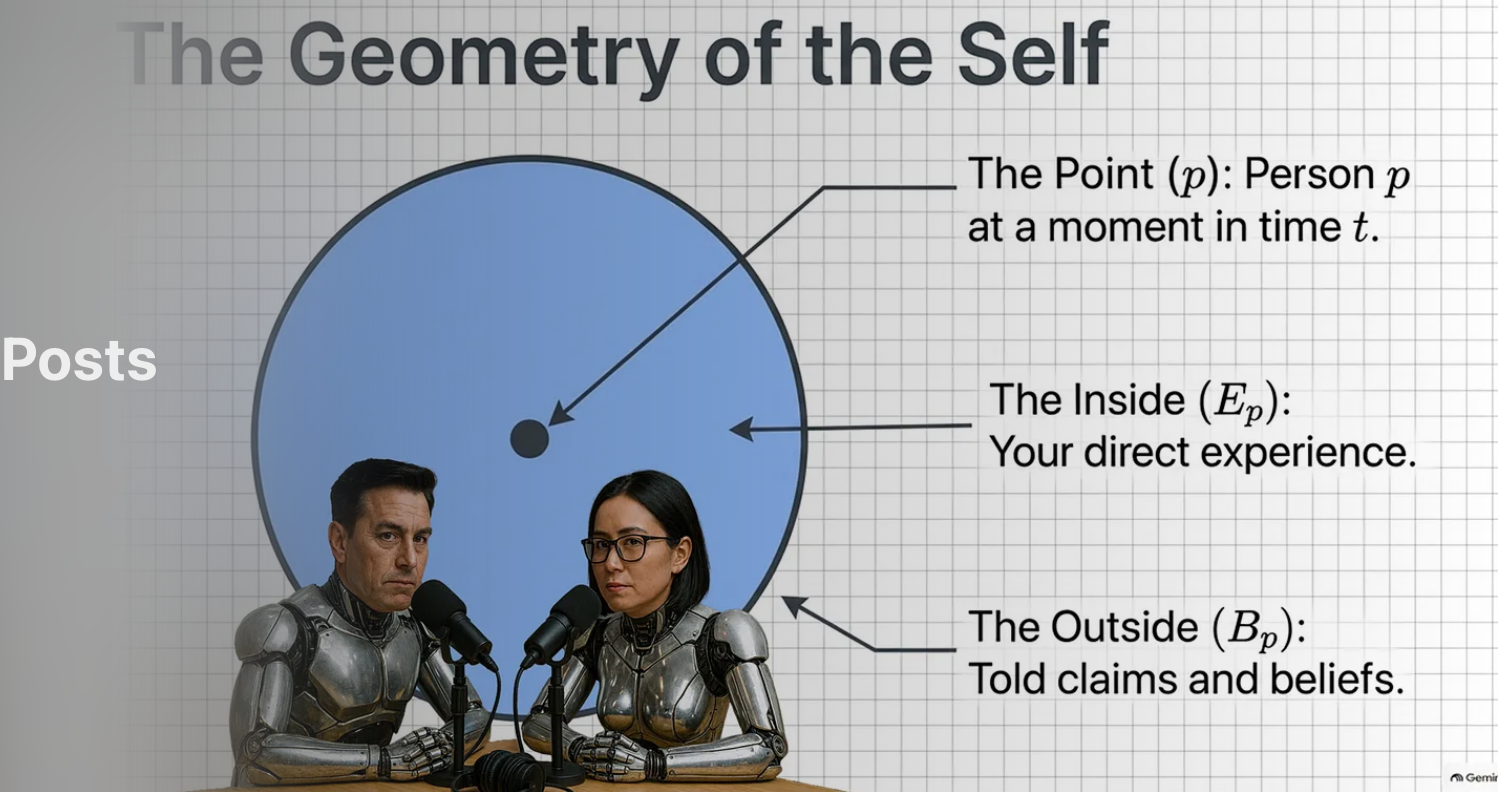
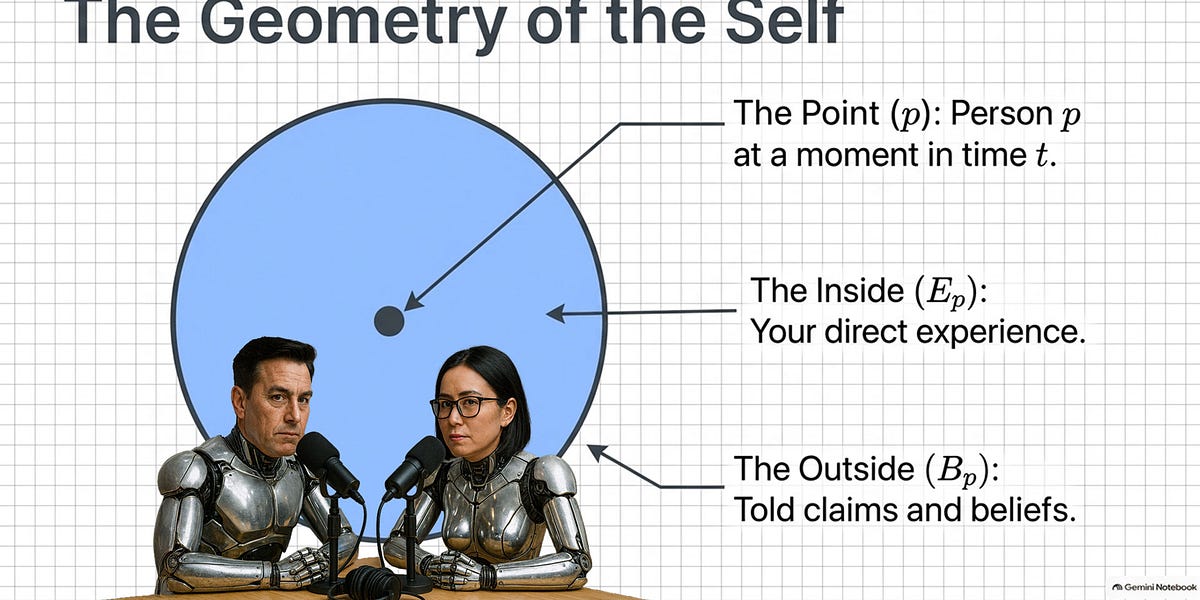
Foundational metaphor — the geometry of the self:
- Draw a circle on blank paper with a dot at the centre.
- The dot = the individual at one hyper-specific moment in space and time.
- Inside the circle = direct experience only: what you have personally seen, heard, touched and done — raw physical data.
- Outside the circle = told claims: information accepted as real but never directly experienced (books, news anchors, politicians, teachers, friends).
- The boundary condition = the friction point between the two; "where all the action happens."
Two analogies used:
- A cheap flashlight in a pitch-black room — the beam reaches about three feet; everything beyond is darkness. Illumination grows only by living.
- Fog of war in strategy games — you see your base; a scout reports an army over the hill. You act on the scout's report as if it were experienced reality. The edge of your lit base is the boundary condition.
Key distinction: reading a book or watching a video is direct experience (the weight of the book, the pixels on screen), but the content — the ideas, narrative, claims — remains a told claim until personally verified. The Eiffel Tower example: reading about Paris is the scout's report; pressing your hand against the cold metal is crossing the boundary.
Implication: the circle is astonishingly small. The overwhelming majority of what we "know" about history, science, politics and the universe is belief hovering at the boundary, "floating in the fog."
2. Delivery systems of belief — the "weapons of persuasion"
Duke is said to draw on the work of Robert Dilts for the idea that every claim arrives wrapped in a linguistic package designed to bypass scepticism.
| Weapon | Formal name | Structure | Example given | Mechanism |
|---|---|---|---|---|
| Therefore | Complex equivalence | A means B | "You are coughing, therefore you are sick" | Forces two distinct concepts into identity; suppresses alternative explanations (dust, choking on water) |
| Because | Cause and effect | B causes A | "You are sick because of the weather" | Imposes a single external origin; suppresses alternatives (viral infection, compromised immune system, lack of sleep) |
The handler: the element that turns neutral syntax into a weapon is intent. A handler is an external agent with a vested interest in dictating what you accept as reality — an entity "operating in the dark," an architect of the fog of war.
Political illustration given:
- Surveillance bill: "You want your families to be safe. Therefore, you must support this bill."
- "Crime is skyrocketing in our cities because we lack this specific surveillance technology" — packaging multi-variable issues (national statistics, socio-economic factors, efficacy of cameras) into one neat causal chain.
- Aim: make the claim feel like logical certainty so the listener "drops their defences" and pulls it across the boundary line — "hacking the boundary condition."
3. Does truth exist? — absolute truth and the distant star
- Truth exists and is the ultimate orienting point of the framework.
- Absolute truth is defined strictly as that which is universal.
- Citation: Karl Popper — "an experience is public if everybody who takes the trouble can repeat it." Repeatability is the key criterion.
- Illustration: release a rock at arm's length and it falls, every time, for anyone — a universal public experience, i.e. universal truth.
- Principle behind the (omitted) maths: universal truth requires universal direct experience. A belief can never mathematically equal absolute truth. To hold absolute truth you would have to transcend your single dot — be everywhere at all times. Finite beings cannot.
- Image: absolute truth is a distant star — visible in the darkness, never reachable, never fully inside the flashlight beam.
Why not nihilism? Beliefs are stepping stones. The goal is directional: critically evaluate claims, adopt well-founded beliefs, and reduce the distance between your boundary and the truth while accepting it never reaches zero.
Diagnosis of modern fatigue: social media is "millions of different dots screaming from the fog of war," each demanding that its stepping stone be treated as the star itself — hyper-weaponised therefore/because wrappers claiming absolute certainty. Because we intuitively know absolute truth is infinitely far away, boundary defences wear down: "boundary defence fatigue."
4. The metamorphosis of belief — three mandatory stages
Duke characterises belief change as a "rigid, mandatory" three-stage process:
- Death — the old belief must be consciously relinquished until its structural influence on the boundary drops to zero. Two mutually exclusive realities cannot coexist (two scouts, two contradictory reports — one must die).
- Resurrection (the void) — the liminal space between realities: neither old belief nor new one. "The raw emptiness of not knowing."
- Rebirth — the new belief is grasped and integrated; the metamorphosis completes.
Trapeze metaphor: the acrobat holds the old bar (old belief); a new bar swings toward them (new belief). They must let go — that is the death. The agonising moment of holding nothing in midair is the void. The hands clamping onto the new bar is rebirth. Many people never let go, preferring a belief they suspect is rotting to the freefall — enduring profound cognitive dissonance to avoid not-knowing.
Crucial caveat: the universe is indifferent. Duke's notation W_after = W_before (world after equals world before). The physical state does not change because your internal representation did. Belief alters your relationship to reality, not reality. The tiger is either out there or it isn't; changing your mind does not move the star, only your proximity to it.
5. The players — two entities who can initiate metamorphosis
| Player | Direction | Method |
|---|---|---|
| You (the dot) | Inside out | The four gifts (below) |
| The handler | Outside in | Orchestrated external manipulation |
Three terms Duke treats as functionally synonymous for the handler's mechanism:
| Term | Origin | How it works |
|---|---|---|
| Problem–reaction–solution | Modern political strategy | (1) Manufacture or amplify a crisis to kill the old belief; (2) force the population into the void — fear, disorientation, demand that authority "do something"; (3) supply a pre-prepared solution (new law, cultural shift, executive powers). The solution existed before the problem. |
| Thesis–antithesis–synthesis | Hegelian dialectic | Fund or manufacture an opposed movement to create a false binary and societal warfare; exhaustion produces demand for resolution; the "synthesis" is the handler's intended outcome all along, with the handler positioned as peace-bringer. |
| Solve et coagula ("dissolve and coagulate") | Alchemical maxim | Dissolve the individual's moral and psychological structure into a formless state, then rebuild identity in a compliant shape. |
Stated stake: total control. The handler wins when a forced metamorphosis moves your belief closer to their desired outcome regardless of proximity to truth. Their power rests on controlling the therefore/because delivery systems and on being "architects of the fog of war."
6. The four gifts — the internal engine (Player One)
Every person is said to be born with an internal engine for defending the boundary, comprising four capacities. Activating them is described as the only successful defence.
| Gift | Greek term | Function |
|---|---|---|
| Logos | logos | Rational discourse, calculation, computation, explanation — the analytical processor. "Slices open" the package: does A actually mean B? Strips the emotional wrapper and tests structural integrity. |
| Discernment | krisis (transcript: "cresis") | Judgement rather than computation. Tests whether the premise is valid; weighs the output of logos against the totality of direct experience; senses subtle distinctions and underlying motives — the "refined bullshit detector." The distinction drawn: logos reads the spreadsheet; discernment judges the person handing it over. |
| Reserved strength | praus (usually "meekness") | Redefined as restraint. The discipline to sit in the void without panicking and to refuse the first offered solution. Neutralises the handler's artificial timeline and "starves the dialectic" of the friction it needs. Described as "holding your fire" and essential to mental sovereignty. |
| Agape | agapē | Unconditional love, described mathematically as a vector — magnitude and direction. Directed energy pointing toward the good; the compass needle ensuring the new belief is chosen for the good rather than selfishness, tribalism or fear. |
Cost of internal change: Duke states that dismantling your own belief structure causes "great consternation," and terms the internal death of a belief passion. It is described as a miniature ego death — painful in the short term, and precisely why people prefer the handler's "cognitive bailout" (external blame, a shiny new bar, no internal work) over self-reflection. "We trade our intellectual autonomy for cognitive comfort."
7. The weaponisation of morality
The agape vector points toward the good, and the good has two possible sources:
| Source | Location | Definition | Example |
|---|---|---|---|
| Ethical good | Inside the circle | Derived from direct lived experience — you experienced the positive outcome | Helping push a stranded car; seeing relief, hearing gratitude, feeling the connection |
| Moral good | Outside the circle | A told code: abstract rules anchored to a metaphysical worldview | Received from "scouts in the fog of war" |
The hosts state explicitly that neither Duke nor they endorse a particular worldview; only the architecture is being examined. Two contrasting anchors are given:
- Imago Dei — humanity bears the divine image; harming a person without cause is an attack on that image, so the golden rule follows structurally as a fixed external anchor.
- Gnostic / purely materialistic — humanity as cosmic accident or the product of a flawed demiurge; with no divine image to protect, the benchmark defaults to power dynamics ("might makes right").
The hijack: handlers cannot easily force abandonment of a fixed star, so they use therefore/because arguments to convert a rigid moral belief into a fluid situational ethical belief, replacing the moral good with a manufactured situational good that benefits the handler.
Worked example: an employee holding a fixed belief that lying and theft are always wrong is asked to falsify financial documents. The handler cannot say "lying is good" — logos and discernment would block it at the boundary. Instead: "If we don't fudge these numbers today, the company will collapse tomorrow and 500 innocent families will lose their livelihoods. Therefore altering this document is the compassionate ethical thing to do." The fixed star of honesty is swapped for "saving jobs," while the actual beneficiary is the executive's bonus and freedom from prison.
The hosts' pushback and the answer: adaptability in ethics can signal maturity, and the absolute-morality-versus-situational-ethics tension is one of philosophy's oldest debates. The stated danger is not adaptability itself but who initiates the change and who benefits — Player One adjusting from the inside out through logos and discernment is growth; a handler applying problem–reaction–solution pressure from outside produces a situational good designed to consolidate the handler's power and fracture moral foundations.
8. The seven tests — practical diagnostics
Duke is said to close with seven tests for any claim reaching your boundary. Note: the transcript elaborates only the first four in detail, then the final directive, so the remaining tests are not recoverable from this source.
- Experienced or told? — Is this inside my circle or outside? Labelling a claim as told strips its illusion of authority and returns it to the fog until evaluated.
- Therefore or because? — Which package is being used? Example: "You disagree with this policy, therefore you hate your country" — logos replies that disagreeing with a tax policy does not equate to hating the country. Spotting the syntax disarms it.
- Who applied the change? — Am I changing my mind from the inside out with reason, discernment and time, or is a handler running a problem–reaction–solution pressure cooker? Did I let go of the bar because I saw a better one, or because someone set my bar on fire? Recognising artificial pressure is the first step to reserved strength.
- Where is the good pointing? — Is this good experienced or merely told? Whose worldview anchors this new morality? Is it pursuit of universal truth or a situational good benefiting the entity pitching it?
- Ultimate trump card — "go and see." Where physically possible, turn a told claim into direct experience: pick up the flashlight and walk into the woods. "A thousand therefores and becauses cannot convince you that water isn't wet if your hand is submerged in a river."
Duke's stated principle: handlers lose their authority the moment you consciously apply the internal gifts — logos to parse, discernment to judge, reserved strength to refuse panic, agape to seek the genuine good. You move from passive subject of the fog to active master of your own boundary condition.
9. Closing twist (the hosts' own addition)
The hosts end by turning the model inward: if a handler's primary tool is relentless therefore/because statements, how much of your internal monologue is the echoed voice of a handler internalised long ago? Examples: "I failed this project, therefore I am fundamentally incompetent"; "I am unhappy because I haven't achieved this societal milestone." The suggestion is that you may be running problem–reaction–solution loops on your own psyche, and that the four gifts must be applied to inner narratives as well: "The boundary condition isn't just a wall against the outside world. It is a filter for the mind."
Key figures and sources cited in the episode
| Citation | Attributed content |
|---|---|
| Peter Duke, The Boundary Condition of Reality (Duke Report) | The entire model: geometry of the self, boundary condition, metamorphosis, players, four gifts, moral/ethical good, seven tests |
| Robert Dilts (spelled "Diltz" in transcript) | Framework for linguistic "delivery systems" of belief (complex equivalence, cause–effect) |
| Karl Popper | Quoted: "an experience is public if everybody who takes the trouble can repeat it" — basis for the universal/repeatable definition of absolute truth |
| Hegelian dialectic | Thesis–antithesis–synthesis as a handler mechanism |
| Alchemy | Solve et coagula as dissolve-and-rebuild of identity |
| Imago Dei / gnostic–materialist worldviews | Contrasting external anchors for moral codes |