Celia Farber
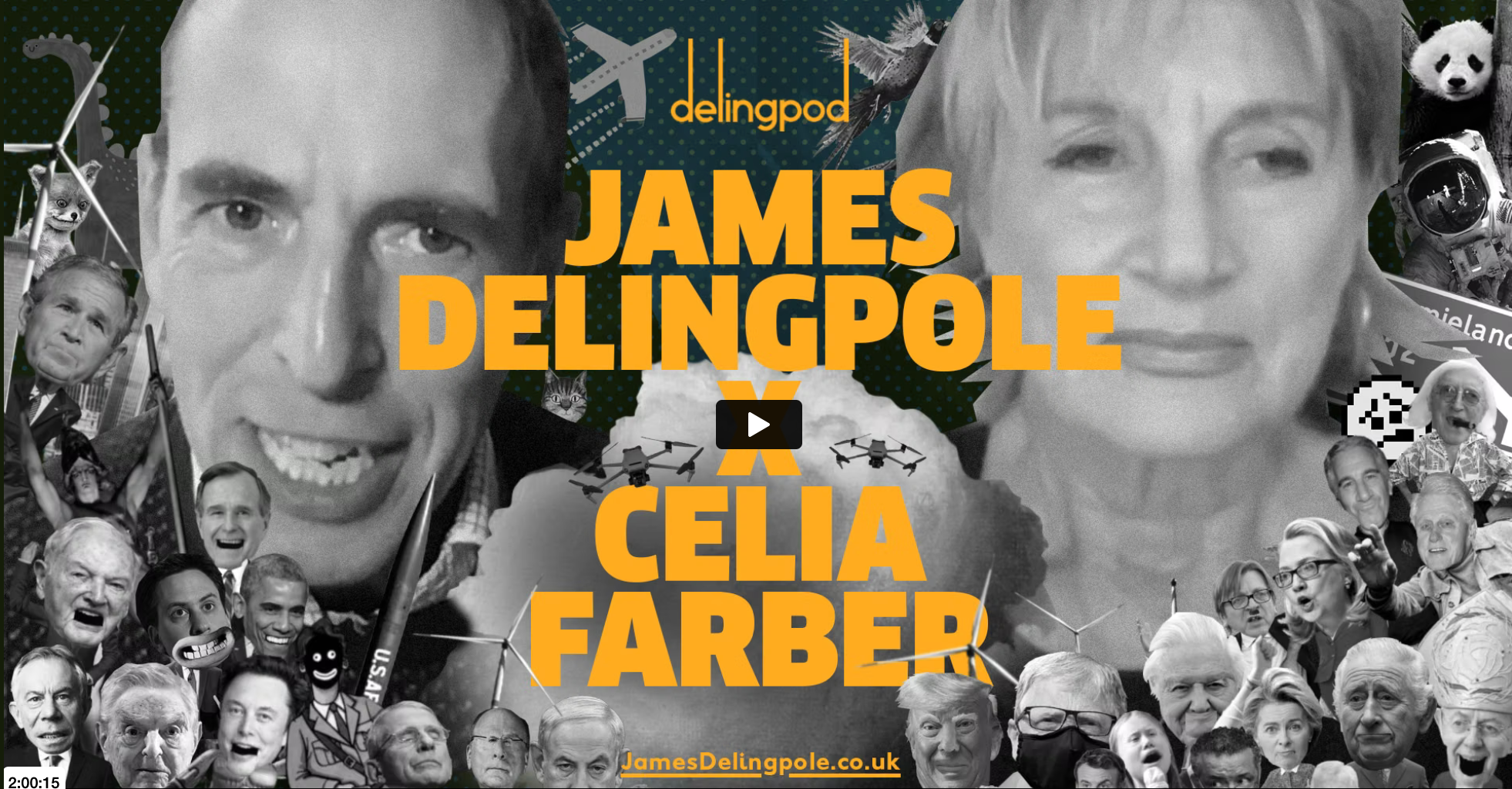
Two journalists who began in mainstream print — Delingpole at The Daily Telegraph and The Spectator, Farber at Spin — compare notes on being expelled from that world. Farber's account of the Harper's AIDS exposé and its aftermath dominates the first half; the second half widens into disputes inside the "awake" movement, spiritual warfare, and a set of shared conspiracy convictions (music-industry occultism, Sweden as a social-engineering laboratory, space as a psyop). Delingpole's framing throughout is "scapegoating" and "the moral priesthood of the newsroom"; Farber's is "portals" and demonic attack.
 James Delingpole
Click to listen to the podcast - notes and summary below
1. Leaving the herd
- Delingpole's thesis: the mainstream media is held together less by shared facts than by a shared moral language — who may be condemned and for what. Punishment is not for being wrong but for breaking the code. He cites René Girard on scapegoating (transcript: "Rene Girard") and Aristotle's "friends of equal virtue".
- Farber's counter-thesis: the enforcers are not cynical insiders; many sincerely believe they are keeping "bread on the table" and chaos at bay. She argues the herd signals danger instinctively, "like formations of birds", and that friends fall silent to protect their own social fabric — an informed choice, not a moral failing.
- Two matching "third rails": climate scepticism for Delingpole, AIDS for Farber. Farber's line: "You had no reason to know what you would later learn until you picked up the third rail."
- The cost, in Delingpole's case: he has not attended the Spectator garden party — "the social high point of my year" — for about six years, despite still being invited, because he no longer knows what to say to people he once regarded as moral and intellectual equals.
- What they say they miss: the craft camaraderie, deadlines, gossip and rivalrous admiration, plus the mid-career economics. Delingpole's starting salary at The Telegraph in 1989 was £22,000 — comparable to a trainee investment banker — enough to buy a London house and write novels in the mornings. "You couldn't do that now."
- Farber on money as a taboo: journalists were expected to conceal poverty ("don't let them know that you're hurting", her father advised during the two-year Harper's process). She notes Hunter S. Thompson named poverty as his most painful early memory.
2. The AIDS story — how it began
- Farber joined Spin as an NYU student on an internship-for-credit scheme, having switched from journalism to classics; she dates her arrival to 1985.
- She says she initially accepted the official panic (government advertising, "tertiary transmission", the dentist), then found an interview with Peter Duesberg in the gay weekly New York Native and pitched it.
- Her immediate editor spurned the idea ("don't ever bring this up again"), so she went to the publisher, Bob Guccione Jr., son of the Penthouse founder — the "standalone cowboy publisher" theory of editorial independence. She had already recorded the Duesberg interview.
- The pitch became a column, "Words from the Front", which she describes as sometimes a 10,000-word feature rather than a column, requiring travel across Africa. External sources date the column to 1987 and give its end date as either 1995 or 1997 [1][2][3].
- Guccione Jr.'s reported rationale: "AIDS is the Vietnam of our generation."
- She insists the early dissident network was not a movement — no funding, no coordination — but "a set of lunatics that found each other", with counterparts in London, New York and continental Europe. She likens it to the later COVID dissent.
3. The Harper's article and the backlash
- Farber's "Out of Control: AIDS and the Corruption of Medical Science" was published in Harper's in March 2006 [4][5] — she says "2004" in the transcript, which is an error (see reference check below).
- Her description: an 11,000-word investigation of the NIAID (National Institute of Allergy and Infectious Diseases) under Anthony Fauci, two years in the making and four months of fact-checking; edited under Lewis Lapham's "composition" regime, built from "voices, texture, leads, pauses".
- Her stated aim was craft, not virology: "I don't write about science… I'm not a scientist." She collected the "lamentations" of figures inside American biology and virology as the field shifted "from classical to woke".
- She describes the response as a ritual abattoir: not "you were wrong" but "you are the stupidest, a corpse is smarter than you", plus lawsuits. Her illustrative headline — that Columbia Journalism Review said "Harper's has committed suicide by publishing me" — does not match the record (see below).
- Her father's reaction and his own media career are discussed; she names him implicitly as Barry Farber, the late-night New York radio host (see reference check).
4. The attack from inside the dissident camp
This is, by her account, the more damaging half.
- After Harper's, she was attacked by figures within AIDS dissidence, including a "gay dissident community" critic who circulated a message to several hundred people calling her "an embarrassment to the dissident community" and "atrocious on the science".
- Her reply: she never claimed scientific authority; the charge was a category error, judging her by a game she wasn't playing.
- She says the same "frequency" recurred for years — all-caps screeds whenever she appeared anywhere — and that this, not the Fauci apparatus, "shattered my psyche".
- Her generalisation: the health-freedom movement is rife with "Stasi types" who crave control more than anyone she met in mainstream media; she roots this in the absence of history, hierarchy and editorial discipline. Delingpole agrees, describing a "Bolshevik Red Army ant" tendency and "animal farm" dynamics.
- Farber's diagnosis: "seeking the truth about something doesn't mean they are better people." Hence her prescription of truth plus goodness plus beauty, and her rule, borrowed from Chekhov, of writing anything except a condemnation.
5. The transition question: was she ever a "normie"?
- Farber rejects the premise. Her mother, a Swedish former Pan Am flight attendant, warned her about elite child abuse from the age of six and screened Rosemary's Baby for her; Farber says she believed her. Her mother took the children to Sweden and kept them there for roughly eight years.
- She is careful here: her mother had suffered a head injury, and Farber distinguishes genuine perception from confabulation — the person who "knows everything about everything we know about" and also reports a green man in the wall.
- Her father: a polyglot radio broadcaster from the South, said to have broken Russian code during the Korean War, later a late-night host, and — in her account — a man with an innocent, "lamb-like" side who was nevertheless the subject of her mother's alarm. She says his divorce lawyer was Roy Cohn. She explicitly exonerates him from the Epstein-world milieu.
- Her account of Sweden: a pilot social-engineering "dollhouse", soft-totalitarian, spiritually devastated, decades ahead of the Anglosphere on family severance and on feminism; she cites Roland Huntford's The New Totalitarians (1971) [6] and the Law of Jante (Jantelagen), which she glosses as a levelling taboo on ambition — a teacher reportedly summoned her mother because she had expressed "ambitiousness". She also claims she was recruited into the Communist youth movement at twelve.
6. Culture, occultism and "the dark"
Delingpole steers; Farber supplies recollection and caveats.
- Bob Guccione Sr.: Farber hazards, hedged repeatedly, that he was a self-made maverick rather than a "wired" insider, that Penthouse published early AIDS dissent (she credits Gary Null's articles there), and that Guccione died having lost his fortune. She contrasts him with Hugh Hefner, whom both treat as CIA-linked.
- Hunter S. Thompson: Delingpole raises the allegation, sourced to Kirby Sommers, of Thompson's involvement in a snuff film with Jack Nicholson. Farber says she knows no more than that reporting but finds it "of a piece": she traces his early romantic letters, then a break — possibly around the Hell's Angels period, when he was beaten and witnessed a gang rape — and invokes demonic possession as the mechanism.
- Adrenochrome: noted as Thompson's having introduced the substance into public print (Fear and Loathing in Las Vegas).
- Leonard Cohen: Farber says she has written on his links to Hydra and MK-Ultra-adjacent circles, and cites a reader who grew up on the island as a playmate of a child Cohen allegedly abused.
- Peter Grant / Led Zeppelin: Farber recounts an anecdote from a Grant interview about a Scottish castle where a woman — deliberately unnamed by both — froze a room with a gesture and shattered a man's hand "like glass", with the rebuke that it would teach him what he did with that hand. She reads it as a rare mainstream eyewitness account of black magic. She also repeats the claim of a small fixed number of adepts "keeping the system together" (five in North America, three in England; she mentions a figure near 24 globally). This anecdote is unverified — I could not corroborate it; Jimmy Page's Scottish property, Boleskine House on Loch Ness, is a manor rather than a castle, and the woman is not named in the transcript.
- Aleister Crowley / Anton LaVey (transcript: "Anton LeVe"): Farber allows she is unsure how much was genuine power and how much self-mythology, but suspects Crowley "sacrificed a lot of people". Both repeat that Crowley was MI5 and that LaVey was an intelligence asset.
- Popular culture as programming: The Stepford Wives and Ira Levin more broadly; Star Trek and Gene Roddenberry ("a Satanist", Delingpole asserts); and Delingpole's own position that "space is the final psyop" and the moon landings are doubtful — Farber praises his moon-landing essay as writing that "carries you".
7. Spiritual practice and protection
- Farber: recently began praying the rosary (two days at the time of recording), using a rosary bought in Ciudad Real, Spain; she describes feeling "delivered from oppression" within 48 hours, and says she is not a Catholic and not baptised.
- Delingpole: recites Fr Chad Ripperger's Deliverance Prayers, formerly Derek Prince's, and reads roughly 35 Psalms a day.
- Farber's practical list: avoid accusatory people; refuse to be recruited into others' agendas; cold showers; vinegar, salt and mopping as housekeeping; cultivating kindness and forgiveness and dismantling pettiness. She names accusation itself as the entry point she guards hardest.
- Her concept of "portals": apparently technical debates (notably "no virus") that function as spiritual traps. She declines to name names or re-litigate the AIDS science.
- Both criticise secular-materialist gatekeepers within the dissident sphere ("boring twats", in Delingpole's phrase) who police only what can be documented.
8. What a "replacement world" might look like
- Prompted by Delingpole: if the present order is satanic and predatory, what comes next, and do the behaviour patterns visible among the "awake" bode ill?
- Farber's answer: truth-seeking is not a character credential; single-minded truth pursuit without goodness and beauty "can lead to some very ugly and bad behaviour". She calls bullying the thing she hates most, and notes she judges trustworthiness by "frequency" within seconds — a claim Delingpole thanks her for.
- Delingpole's coda: he distrusts anyone whose seriousness shades into violence-by-boredom, and he describes the early anti-lockdown marches as a rave-like euphoria that has since soured into status competition among minor writers and podcasters.
Where to find her: The Truth Barrier, celiafarber.substack.com.
References
- Celia Farber (4%) ↩︎ ↩︎
- Serious Adverse Events: An Uncensored History of AIDS (5%) ↩︎ ↩︎
- Serious Adverse Events: An Uncensored History of AIDS - Celia Farber ... (10%) ↩︎
- Out of control, by Celia Farber - Harper's Magazine (3%) ↩︎ ↩︎
- HIV/AIDS denialism (5%) ↩︎ ↩︎ ↩︎
- The New Totalitarians (12%) ↩︎ ↩︎
- Cbs-Motion: 0 Yes & NO (4%) ↩︎
- Reporter Says Critics Defamed Her|After Report on AIDS in ... (5%) ↩︎
- Farber v Jefferys (2011 NY Slip Op 51966(U)) (4%) ↩︎
- Barry Farber - Wikipedia (12%) ↩︎
- Barry Farber (13%) ↩︎
- HIV Denial in the COVID Era - PMC - NIH (5%) ↩︎
- Errors in Celia Farber's March 2006 article in Harper's Magazine (5%) ↩︎
- Errors in Celia Farber's March 2006 article in Harper's Magazine - NATAP (8%) ↩︎
- Harper’s - Columbia Journalism Review (5%) ↩︎