Channel Stuffing

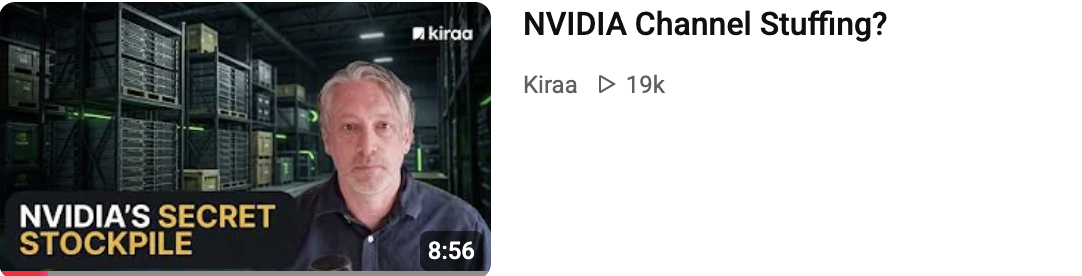
Dr. Errol Brandt, founder of Kiraa (an enterprise AI company), uses a personal experience of revenue manipulation to explain channel stuffing, then applies the idea to Nvidia's current GPU sales [1][2].
The core idea
- "Profit is an opinion, but cash is fact." Revenue is usually treated as the cleaner number because it sits closest to cash; profit relies on subjective judgements.
- Accounting has drifted from talking about profit to talking about EBITDA (earnings before interest, tax, depreciation and amortisation). Charlie Munger, Berkshire Hathaway's vice-chairman, dismissed it — the transcript drops the word, but Munger's actual phrase was "bullshit earnings" — and Brandt agrees.
- Revenue is usually more reliable, but not always — which is the point of the video.
Brandt's own experience: "charge and hold"
- At an unnamed listed company, one region was booking revenue on goods still sitting in the warehouse.
- The internal name was "charge and hold": the customer was invoiced, ownership passed "on paper", but the stock never physically left the warehouse. (The standard accounting term for this pattern is bill and hold.)
- Under international accounting standards, revenue is recognised when ownership/control transfers — normally clean-cut, e.g. once goods are unloaded into the customer's warehouse.
- Here the customer "owned it on paper, but didn't really control it" — nothing stopped the company dispatching the goods to someone else.
- The auditors objected, rightly. The process had to be changed to satisfy the requirements.
What channel stuffing is
- A manufacturer pushes more stock into the distribution channel than the end market actually wants — distributors, wholesalers, retailers, customers.
- The manufacturer books the sale; results look great.
- How buyers are persuaded to take unwanted stock:
- longer payment terms
- extra discounts
- free warehousing
- informal "gentleman's agreements" that are never declared
- The effect: sales are pulled forward — "you borrowed from the future." You hit this quarter's number and next quarter's results are worse, so you must do it again, but bigger. Sales shows a "beautiful hockey stick right at period end."
Why it happens: Goodhart's Law
- Named after Charles Goodhart, an economist who advised the Bank of England.
- "When a measure becomes a target, it ceases to be a good measure."
- Rewarding revenue makes people maximise revenue — good up to a point, then harmful.
- The whole financial system is wired this way: sales bonuses are paid on revenue; executive bonuses on earnings; share prices rise on beating earnings guidance. "We've turned measures into targets at every level. And then we get surprised when the measures stop telling the truth."
The Nvidia allegation
- Brandt cites a report by Ed Zitron, whose work he admires.
- Zitron's estimate: $200–300 billion of Nvidia's GPUs are sitting in warehouses or in data centres with no power.
- Zitron also said he believes at least a million Blackwell GPUs are being warehoused.
- The trigger is Amazon's "early rack receipt" programme: previously AWS did not pay for servers (i.e. the GPUs inside them) before arrival — normally a deposit, then payment on delivery. Now Amazon reportedly pays and takes receipt earlier.
- Zitron's inference: Nvidia has effectively said "if you want these in future, take them immediately" — a scarcity mechanism. He notes the contradiction: if chips arrive months before installation and everyone is taking far more than they need, what exactly is scarce? He calls it "classic Jensen Huang nonsense."
- "Jensen jail": The Wall Street Journal quotes Adam Fisher, a partner at Bessemer Venture Partners, saying some smaller cloud providers fear losing chip allocations if they stop buying Nvidia's full stack — insiders' term for this is "Jensen jail." Fisher stressed that not every provider sees it this way, and most say Nvidia supplies exactly what they need. Brandt is explicit that this is a fear reported by some customers, not a documented policy.
Brandt's framing and caveats
- He does not claim to know the allegation is true — "I'm simply reporting what I've heard" — but says it closely matches his own experience of channel stuffing.
- He hopes PricewaterhouseCoopers, Nvidia's auditor, is asking the same questions; if not, "they might also be in a world of pain."
- His parallel: sales reps booked sales to hit bonus targets while stock sat on the floor with someone else's name on it. Even if the customer genuinely wanted the goods, "the optics look really bad."
- If Zitron is "even half right", quarterly revenue targets and the share price rest on those numbers, and the pressure is fear of losing your place in the queue — powerful if you believe Nvidia is "selling shovels in the biggest gold rush in history."
- His own view: he is not convinced Nvidia, data centres, or LLMs are as big as people think; he sees the future as on-device.
The takeaway
Goodhart's Law — when a measure becomes a target, it ceases to be a useful measure. That is a real problem for companies that look at revenue numbers and assume growth continues forever.
Sources cited in the monologue
| Source | What it provides |
|---|---|
| Ed Zitron (report/podcast) | $200–300bn of GPUs warehoused or unpowered; ≥1m Blackwell GPUs; Amazon's early rack receipt programme [3][4] |
| The Wall Street Journal | Adam Fisher (Bessemer) on "Jensen jail" and allocation fears |
| Charles Goodhart | Goodhart's Law |
| Charlie Munger | Dismissal of EBITDA as a measure |
| PricewaterhouseCoopers | Nvidia's auditor (Brandt's hope that they are probing this) |
References