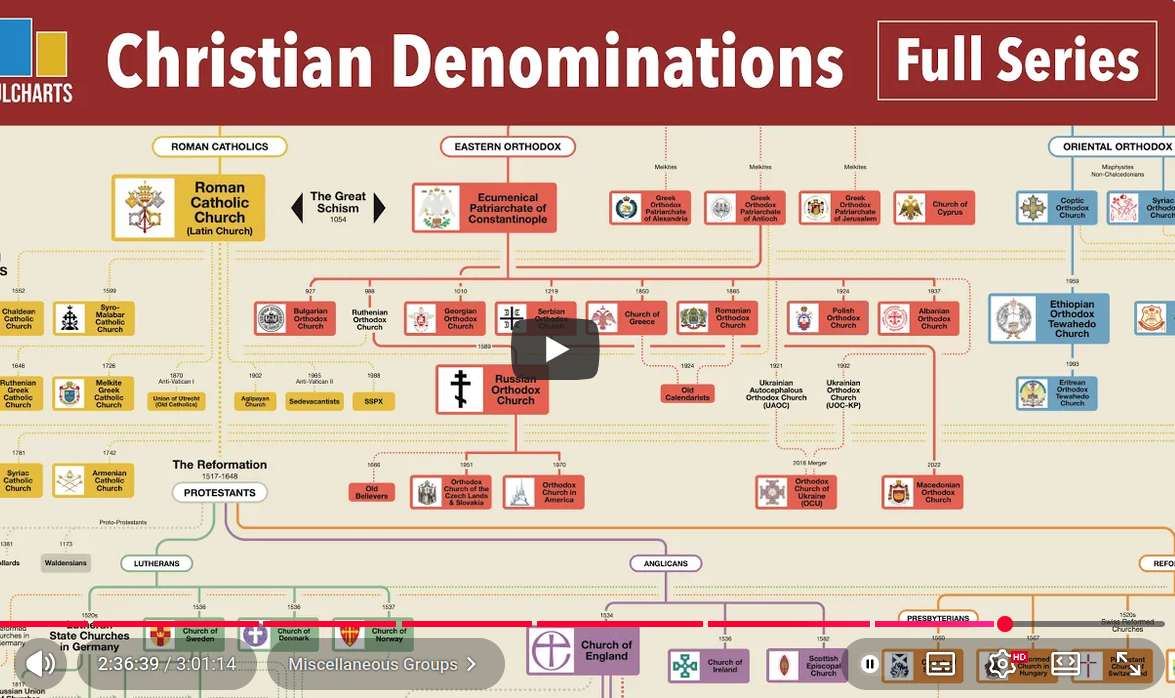
This is a transcript of an eight-part video series by Matt Baker (of UsefulCharts), presented as a single comprehensive video tracing the family tree of Christian denominations from ancient Israelite religion to the present day. Below is a structured review of the significant points and lists, drawn entirely and faithfully from the transcript content.
Skip to time-codes if you prefer: 00:00:00 - Origins & Early Schisms, 00:21:42 - Roman Catholics & Eastern Orthodox 00:47:01 - Lutherans, Anglicans & Reformed, 01:07:21 - Anabaptists & Quakers 01:27:20 - Baptists & Methodists, 01:52:48 - Mormons, Adventists & JWs 02:17:43 - Pentecostals & Charismatics, 02:35:51 - Miscellaneous Groups
Chapter 1: Origins & Early Schisms
Ancient Israelite Religion (c. 1000–600 BCE)
Two competing views are presented:
Biblical/literal view: God revealed himself to Abraham; Israelites enslaved in Egypt; Moses led them to Canaan; a kingdom was established and split into two (Israel and Judah). Disobedience led to destruction — Israel fell to Assyria, Judah to Babylon.
Academic/secular view: Israelites were likely a subset of Canaanites who survived the Bronze Age collapse, forming a tribal confederation that evolved into the Kingdom of Israel. Originally polytheistic, some priests advocated henotheism (worship of one God without denying others' existence). The Kingdom of Israel was conquered by Assyria, but Judah and Jerusalem's First Temple became the new centre, growing increasingly monotheistic. Judah fell to Babylon; the First Temple was destroyed; elites experienced the Babylonian Exile (c. 586–516 BCE).
Second Temple Judaism
After Persia conquered Babylon, Jews returned and rebuilt the temple (Second Temple). Key influences:
Zoroastrianism (Persian religion) likely influenced ideas of Satan and an "end of the world" where good triumphs over evil.
Hellenism (Greek culture) also shaped Jewish thought.
Four Main Sects of Second Temple Judaism
Sect
Description
Sadducees
Elites, including temple priests; most open to Hellenism; became extinct after 70 CE
Pharisees
Associated with everyday people; scribes and scholars of Hebrew scriptures; the only sect to survive — became the rabbis, the roots of modern Judaism
Essenes
Most mystical; lived apart from mainstream society; interested in angels and a spiritual Messiah; probably produced the Dead Sea Scrolls
Zealots
Wanted real-world political change — to overthrow Rome and re-establish Jewish independence
Destruction of the Second Temple (70 CE)
This was pivotal for both Christianity and Rabbinic Judaism:
Christianity adapted by focusing on Jesus as the new spiritual high priest and his sacrifice as a replacement for temple sacrifices.
Rabbinic Judaism adapted by emphasising Torah study and synagogue prayer.
Three Early Branches of Christianity (post-70 CE)
Branch
Key Features
Fate
Jewish Christians (Ebionites/Nazarenes)
Kept Jewish practices (circumcision, dietary laws); revered Jesus as spiritual leader but not divine
Went extinct; likely influenced Islam
Pauline Christians
Mostly Gentiles; followed Paul's teaching that Jesus's death and resurrection introduced a new covenant superseding Jewish law
Became mainstream Christianity
Gnostics (Valentinians, Sethians, etc.)
Believed the physical world was bad and only the spiritual mattered; emphasised Jesus's divinity, downplayed humanity; claimed secret knowledge (gnosis)
Died out; Mandaeism may trace roots to them
Key Dates and Councils
Date
Event
Significance
313 CE
Edict of Milan (Constantine & Licinius)
Gave Christianity legal status; protected from persecution
325 CE
Council of Nicaea
Produced the Nicene Creed; distinguished mainstream from fringe Christianity
380 CE
Edict of Thessalonica (Theodosius I)
Made Nicene Christianity the state religion of the Roman Empire
431 CE
Council of Ephesus
First major split within Nicene Christianity — Church of the East broke away (Nestorianism)
451 CE
Council of Chalcedon
Oriental Orthodox Churches split away (Miaphysite vs. Chalcedonian Christology)
Arian vs. Nicene Christianity
Arian Christianity (Arius): Jesus was made by God and is subordinate; Holy Spirit distinct from Father and Son. Found mainly among Germanic tribes (Goths, Vandals, Lombards). Faded over time.
Nicene Christianity: Father, Son, and Holy Spirit are co-eternal; God is one essence, three persons.
The Pentarchy
Five key centres of Christianity, each led by a patriarch:
Rome
Constantinople
Alexandria
Antioch
Jerusalem
Oriental Orthodox Churches (Miaphysite)
Believe Jesus had one nature (a mix of divinity and humanity), versus Chalcedonian churches which believe Jesus was one person with two natures. Members include:
Coptic Orthodox Church (Egypt) — patriarch: Tawadros II (also uses the title Pope)
Syriac Orthodox Church (Syria) — patriarch: Ignatius Aphrem II
Armenian Apostolic Church
Ethiopian Orthodox Tewahedo Church — became independent from Coptic Church in 1959; ~40 million members; largest Oriental Orthodox church; led by Patriarch Mathias
Eritrean Church — independent from Ethiopia in 1991
Malankara Orthodox Syrian Church (India) — independent since 1912
Assyrian Church of the East
Traces roots to the Church of the East; based primarily in Northern Iraq; led by Patriarch Awa III; ~400,000 members.
Chapter 2: Roman Catholics & Eastern Orthodox
The Great Schism (1054)
Two main disputes:
Papal authority: Rome claimed the pope had authority over the entire church; Constantinople viewed the pope as merely "first among equals."
The Filioque: Catholics/Protestants say the Holy Spirit proceeds from the Father and the Son; Eastern Orthodox say He proceeds from the Father only.
Note: Both churches trace origins to the first century — they were united until 1054, not "started" then.
Eastern Orthodox Church
Sees itself as a single church but divided into 15 autocephalous churches (each self-governing).
Patriarch of Constantinople (currently Bartholomew I) holds special precedence as "first among equals" / Ecumenical Patriarch.
Initially five autocephalous churches (four pentarchy patriarchates plus the Church of Cyprus).
Key Autocephalous Churches and Dates
Church
Year Became Autocephalous
Bulgarian Orthodox Church
927
Serbian Orthodox Church
1219
Russian Orthodox Church
1589
Church of Greece
1850
Romanian Orthodox Church
1885
Macedonian Church
2022
Russian Orthodox Church is by far the largest; led by Patriarch Kirill of Moscow.
Ukraine situation: Three churches existed (UAOC, UOC-MP, UOC-KP); in 2018, they merged into the Orthodox Church of Ukraine (OCU), recognised by Constantinople but not Moscow. ~80% of Ukrainian Orthodox Christians belong to the OCU. Moscow broke communion with Constantinople over this. Kirill supports the war in Ukraine; Bartholomew opposes it.
Roman Catholic Church
Over 1 billion members (>50% of all Christians).
The Latin Church is one of 24 churches comprising the Roman Catholic Church; the other 23 are Eastern Catholic Churches.
Organised into provinces, dioceses, and parishes, led by bishops, archbishops, and parish priests.
Pope Francis is the current pope (Bishop of Rome).
Vatican I (1870): Declared papal infallibility (only for ex cathedra statements). Dissenters formed the Old Catholic Church (Church of Utrecht).
Vatican II (1960s): Decided mass could be in local languages. Dissenters became Sedevacantists (believe the papal office has been vacant since Vatican II).
Eastern Catholic Churches (10 largest highlighted)
Chaldean Catholic Church — from 1552 schism in the Church of the East
Syro-Malabar Catholic Church (India) — Eastern Syrian traditions
Syro-Malankara Catholic Church (India) — Western Syrian traditions
Ukrainian Greek Catholic Church — largest Eastern Catholic Church, ~5 million members
Ruthenian Greek Catholic Church — broke away from Serbian Orthodox Church
Armenian Catholic Church — from Armenian Church
Coptic Catholic Church — from Greek Orthodox Patriarchate of Alexandria
Three churches from the Greek Orthodox Patriarchate of Antioch
Jerusalem: Eastern Orthodox, Catholic (Latin), Armenian
Rome: Pope Francis
Constantinople: Bartholomew I (Eastern Orthodox); also an Armenian patriarch
Corrections from comments
Maronite Catholics were independent and affiliated with Rome in the 1100s (after the First Crusade), not a breakaway from Eastern Orthodox.
Coptic and Syriac Catholics broke away from Oriental Orthodox patriarchates, not Eastern Orthodox.
Georgian Orthodox Church has deep roots to 1010, not merely stemming from Russia.
Added Old Believers (broke from Russian Orthodox Church in 1666 over reforms).
Chapter 3: Lutherans, Anglicans & Reformed
The Protestant Reformation (1517)
Started when Martin Luther published his Ninety-five Theses, challenging the Catholic Church.
Proto-Protestants
Group
Founder
Period
Notes
Waldensians
Peter Waldo
12th century
Lived in poverty; believed anyone could preach; still exist in Italy; now part of Reformed branch
Hussites / Moravian Church
Jan Hus
Pre-Luther (Bohemian Reformation)
Moravian Church still exists; adopted Lutheran pietism features
Lollards
Inspired by John Wycliffe
Medieval
Early English bible translator
Three Initial Branches of Protestantism (plus a fourth)
Branch
Key Figure
Notes
Lutheran
Martin Luther
Sola fide (faith alone), sola scriptura (scripture alone)
Anglican
King Henry VIII
Church of England broke from Rome in 1534
Reformed
John Calvin
Predestination; TULIP acronym; includes Presbyterian, Congregational
Anabaptist
(Radical Reformation)
Covered separately in Chapter 4
Lutherans
Luther's key ideas: sola fide (justification by faith alone, not good works) and sola scriptura (Bible as ultimate authority, not pope or church).
Luther was declared a heretic; protected by German princes. Some states adopted Lutheranism from ~1521.
Scandinavia: Denmark, Sweden, and Norway aligned with Lutheranism in the 1530s; only the Church of Denmark remains an official state church today.
Prussian Union of Churches (1817): Merged Lutheran and Calvinist churches in Prussia; led to migration of German Lutherans to the American Midwest.
US Lutheran denominations: Conservative Lutheran Church–Missouri Synod and liberal Evangelical Lutheran Church in America (ELCA); also smaller Wisconsin Evangelical Lutheran Synod (most conservative).
Germany: After WWII, the Evangelical Church in Germany (EKD) formed in 1948; largest Protestant denomination in Continental Europe; includes both Lutherans and Calvinists.
Second largest Lutheran denomination worldwide: Mekane Yesus Church in Ethiopia (founded by Swedish missionaries).
Anglicans
Church of England established 1534 when Henry VIII broke with Rome over his marriage annulment.
Same churches/priests continued; they simply stopped reporting to the pope.
Archbishop of Canterbury is spiritual leader (currently Justin Welby) — "first among equals," not a pope.
Head of the Church of England is the monarch (currently Charles III).
Church of Ireland: State church 1536–1869; most Irish remained Catholic.
Church in Wales: Independent since 1920.
Episcopal Church (USA): Split from Church of England when American colonies broke away; "episcopal" means led by bishops.
Anglican Communion: 42 autonomous churches; third largest division within Christianity (after Catholicism and Eastern Orthodoxy). Two largest after Church of England: Church of Nigeria and Church of Uganda.
Potential schism: Western churches (UK, US, Canada, Australia) support blessings for same-sex couples; Global South Fellowship of Anglican Churches (including Nigeria, Uganda) voted in February 2023 to no longer recognise the Archbishop of Canterbury. Anglican Church in North America split from Episcopal Church / Anglican Church of Canada; in communion with Global South but not Canterbury.
Reformed (Calvinist)
Associated with John Calvin; often summarised by the acronym TULIP (Five-Point Calvinism), though not all Calvinists hold strictly to all five points.
Core difference: belief in some form of predestination.
Dutch Reformed Church (1571): Main Protestant church in the Low Lands for 400+ years; spread to South Africa. In 2004, merged to form the Protestant Church in the Netherlands.
Huguenots (France): Persecuted minority; most now belong to the United Protestant Church of France.
Church of Scotland: Led by John Knox to embrace Calvinism and Presbyterianism (government by presbyters/elders).
Presbyterian Church (USA): Formed from splits and mergers; the 1861 Civil War split created the PCUS (Southern), reunited in 1983 as PC(USA). Conservatives split earlier to form the Presbyterian Church in America.
Congregationalism: Each local church is independent; state religion in Massachusetts, Connecticut, New Hampshire. Harvard, Yale, and Dartmouth were founded by Congregationalists. In 1957, merged with the E&R Church to form the United Church of Christ.
Chapter 4: Anabaptists & Quakers
Ten Largest Christian Communions Worldwide (infographic)
Rank
Communion
Approx. Members
1
Catholic Church
~1.35 billion
2
Eastern Orthodox Church
~200 million
3
Anglican Communion
~80 million
4
Reformed Churches
~80 million
5
Methodists
~80 million
6
Lutheran World Federation
~80 million
7
Assemblies of God (Pentecostal)
—
8
Oriental Orthodox Churches
—
9
Baptist World Alliance
~48 million
10
Seventh-day Adventists
~22 million
If all Pentecostals united, they would rank above the Eastern Orthodox Church as the second largest.
If all Baptists united, they would rank just above the Anglicans.
Originally called themselves "Brethren"; started in Switzerland ("Swiss Brethren").
Three Original Anabaptist Groups
Group
Founder
Notes
Mennonites
Menno Simons
Largest branch; spread in the Dutch Republic. Most modern Mennonites have no extreme technology restrictions
Amish
Jakob Ammann (1693 schism from Mennonites)
Reject almost all modern technology; use horse and buggy. Exception: Beachy Amish use Internet (restricted)
Hutterites
Jacob Hutter
Spread to Austria and further east; live communally; allow more colourful clothing; some use cell phones
Later Anabaptist groups: Apostolic Christian Church (1832, Samuel Froehlich) and Bruderhof (1920, Eberhard Arnold).
Mennonite Brethren: Formed in Russia under Radical Pietist influence; later migrated to North America.
Mennonite Church USA: Formed 2002 from merger of two main conferences.
Pietism
Emerged late 1600s–early 1700s; emphasised "religion of the heart" over theology.
Radical Pietists established new groups: Schwarzenau Brethren (German Baptists/Dunkers), led by Alexander Mack; main denomination: Church of the Brethren.
Other Pietist-derived churches (not Anabaptist/"peace churches"): Evangelical Church of America and Evangelical Covenant Church — from Scandinavian free churches.
Quakers (Religious Society of Friends)
Founded by George Fox; name from his admonition to "tremble (quake) at God's word" (Isaiah 66:2).
Distinctive: emphasis on the Inner Light — every person can experience God from within; traditional meetings are unplanned and silent.
English Separatists included Quakers, Baptists, Diggers, Enthusiasts, Ranters, Seekers, and Muggletonians — only Quakers and Baptists survive.
Pennsylvania founded 1681 by Quaker William Penn; allowed all religious groups.
Flushing Remonstrance (1657): Letter from settlers in Flushing, Queens, asking that Quakers and all religious groups (including Jews and Muslims) be allowed to worship — set the stage for the First Amendment.
Quaker Schisms
Group
Description
Hicksites (1827, Elias Hicks)
Liberal; early abolitionist; Underground Railroad. Descendants: Friends General Conference (most liberal)
Wilburites
Slightly more conservative than Hicksites
Gurneyites
New direction — planned services, pastors, mainstream beliefs. Descendants: Friends United Meeting (largest); some in Evangelical Friends Church (more conservative)
Quaker Oats was not founded by Quakers — the founder chose the name for its association with integrity. Actual Quaker-associated product: chocolate — Cadbury's, Rowntree's, and Fry's were all founded by Quakers.
Chapter 5: Baptists & Methodists
Baptists
Originated from English Separatists in the 1600s; founders: John Smyth and Thomas Helwys (former Anglicans who moved to Holland, encountered Anabaptists, adopted believer's baptism).
Better seen as an offshoot of Anglicans rather than Anabaptists (despite sharing believer's baptism).
Landmark Baptists hold the "Trail of Blood" hypothesis: Baptist tradition traced to the first century through fringe movements (Paulicians → Bogomils → Cathars → Waldensians → Anabaptists → Baptists). Most scholars reject this; these groups likely practised Gnosticism.
Paulicians: Armenia, 600s
Bogomils: Bulgaria, 900s
Cathars: Southern France, 1100s
Two Early Types of Baptists
Type
Theology
Particular Baptists
Calvinist
General Baptists
Non-Calvinist
Baptists follow congregationalist governance — each congregation is independent.
First Great Awakening (from c. 1730s): Marked the start of Evangelical Christianity — focus on individual conversion ("born again"), repentance, missionary work. Led by preachers like Jonathan Edwards.
The Particular/General distinction became less important; most became Missionary Baptists; those opposed to mission boards became Primitive Baptists (very small minority; Westboro Baptist Church was associated, though removed from chart later).
Major Black Baptist Denominations (US)
Denomination
Year
Notes
National Baptist Convention USA
1895
Largest historically black church in America
National Baptist Convention of America (NBCA)
1915
Split from NBC USA
Progressive National Baptist Convention
1961
Martin Luther King Jr. was a member; more progressive
National Baptist Missionary Convention of America
1988
Split from NBCA
Major White Baptist Denominations (US)
Denomination
Notes
Southern Baptist Convention (SBC)
~14 million members; largest Protestant denomination in the US; conservative
American Baptist Churches USA
Formerly Northern Baptist Convention; liberal
National Association of Free Will Baptists
General/Non-Calvinist Baptists
American Baptist Association
Landmark Baptist group
Baptist Bible Fellowship International
Largest Independent Baptist group; Jerry Falwell's original affiliation
Conservative Baptist Association (now Venture Church Network)
Split from ABC in 1947 as too liberal
Cooperative Baptist Association
Split from SBC as too conservative
Converge (formerly Baptist General Conference)
Roots in Scandinavian free churches
UK Baptists: Most belong to Baptists Together; Seventh Day Baptists originated in the UK.
Methodists
Founded by John Wesley, his brother Charles Wesley, and George Whitefield — all former Anglicans. Name from the "Holy Club" at Oxford where members methodically pursued Christian living.
1739: Began open-air preaching after contact with Moravians; attracted working-class people.
John Wesley's theology: Salvation available to all; emphasised the "second work of grace" (entire sanctification — transformation into a more holy person). Whitefield's theology was Calvinist.
US Methodist Denominations
Denomination
Notes
United Methodist Church (UMC)
Formed 1968 (Methodist Church + Evangelical United Brethren Church); second largest US Protestant denomination after SBC. Recently schism over gay/lesbian clergy ordination; in 2022, the conservative Global Methodist Church was formed; 1,000+ congregations have left UMC
African Methodist Episcopal (AME)
Formed in Philadelphia, early 1800s
AME Zion Church
Formed in New York, early 1800s
Christian Methodist Episcopal Church
Formed in the South after the Civil War; formerly "Colored Methodist Episcopal Church"
Wesleyan Church (1843)
Holiness Movement aligned; conservative
Free Methodist Church (1860)
Holiness Movement aligned; conservative
UK: Methodist Church of Great Britain formed 1932 from merger of Wesleyan Methodist Church with smaller denominations.
Salvation Army: Roots in British Methodism; Holiness Movement aligned; founded 1865 by William and Catherine Booth; ministers called "officers" with military-style ranks.
United Church of Canada (1925): Merger of Methodists, Presbyterians, and Congregationalists; largest Protestant denomination in Canada.
Uniting Church of Australia: Similar merger of Congregationalists, Presbyterians, and Methodists.
Church of South India: Merger of Anglicans, Methodists, and South India United Church (Congregationalists + Presbyterians); largest Protestant denomination in South Asia.
Mostly US-based; more non-Christians converted for the first time (due to Enlightenment ideas spreading).
Many new churches sought to restore the "true church" — hence Restorationism.
Stone-Campbell Restorationists
Founded by Barton Stone and Thomas Campbell (both originally Presbyterians); sought a primitive form of Christianity.
Stone's followers called themselves "Christians"; Campbell's followers called themselves "Disciples of Christ."
Merged in 1832; split in 1906:
Group
Feature
Churches of Christ
No instruments in worship
Christian Churches
Instruments allowed
Christian Churches further split in 1968: liberal Christian Church (Disciples of Christ) vs. conservative loose network (Christian Church / Church of Christ).
Seven Mainline Protestant Denominations (US)
Evangelical Lutheran Church in America
Episcopal Church
Presbyterian Church (USA)
United Church of Christ
American Baptist Churches USA
United Methodist Church
Disciples of Christ
"Mainline" = older, more liturgical, more liberal, focused on social justice; from churches found along the "main railway line" in early America. Contrasted with "mainstream" (dominant/conventional) and with Evangelical churches.
Latter-day Saints (Mormons)
Founded by Joseph Smith, who claimed to have found and translated the Book of Mormon — a third testament equal in authority to the Old and New Testaments.
LDS theology is non-Nicene: rejects the traditional Trinity; Father, Son, and Holy Spirit are three distinct beings.
Smith assassinated in 1844 at age 38, causing splits.
Major Mormon Groups
Group
Leader/Notes
Church of Jesus Christ of Latter-day Saints (main LDS)
Led by Brigham Young to Utah; ~17 million members worldwide
Community of Christ (formerly RLDS)
Led by Joseph Smith III (1860–1914); liberal; Nicene theology
FLDS (Fundamentalist Latter-day Saints)
Formally established 1984; practises polygamy; current leader in prison
Adventists
Name from focus on the Second Advent (return of Jesus).
William Miller taught Jesus would return in 1843 (revised to 1844) based on calculations from the Book of Daniel. When this failed, it was called the "Great Disappointment."
Two camps emerged: those who kept revising dates, and those who believed something did happen in 1844.
Adventist Groups
Group
Notes
Seventh-day Adventists
~22 million members; observe Sabbath (Saturday/Friday sundown); founded with Ellen G. White (prophetess, 150+ books). Doctrine: in 1844, Jesus moved into the heavenly Holy of Holies and began the Investigative Judgment
Advent Christian Church
First-day adventists (small)
Church of God Seventh Day
Did not accept Ellen G. White's teachings
Jehovah's Witnesses
~8 million members; founded by Charles Russell (originally "Bible Students"); predicted 1914 as end of world; believe 1914 began the "last days." Non-Nicene — similar to Arianism (Jesus was created, not co-eternal); prefer "Jehovah" for God's name
Worldwide Church of God
Founded by Herbert W. Armstrong (split from Church of God Seventh Day); non-Nicene; known for Plain Truth magazine and World Tomorrow TV show. In mid-1990s, abandoned non-mainstream ideas, embraced Nicene Christianity, renamed Grace Communion International. Dissenters formed United Church of God
Branch Davidians
Split from Davidians (who split from Seventh-day Adventists); 1993 Waco standoff with FBI — 86 deaths including David Koresh
Plymouth Brethren
Different from Anabaptist Brethren; originated in UK as a split from Anglicanism.
John Nelson Darby (founder of Exclusive Brethren) became the father of Dispensationalism — a theological framework dividing history into six dispensations plus one to come:
Grew out of Methodism; key idea: entire sanctification can occur instantaneously (promoted by Phoebe Palmer in mid-1800s).
Holiness Denominations
Denomination
Notes
Wesleyan Methodist Church (1841)
Formed when main Methodist church failed to oppose slavery; supported women in ministry; ordained Antoinette Brown Blackwell (first female US minister)
Free Methodist Church (1860)
Broke away over pew rental to the rich, among other issues
Salvation Army (1865, UK)
William and Catherine Booth
Church of the Nazarene (1908 merger)
Originally "Pentecostal Church of the Nazarene"; dropped "Pentecostal" when the word came to mean speaking in tongues. Did not become Pentecostal
Wesleyan Church (1968)
Wesleyan Methodist + Pilgrim Holiness Church
Church of God (Anderson, Indiana)
Holiness; does not allow speaking in tongues
Christian & Missionary Alliance (1897)
From Higher Life movement (Keswick, England)
Pentecostals
"Pentecost" = "fiftieth"; refers to the Jewish festival of Shavuot, 50 days after Passover, when the Holy Spirit descended (Acts).
Speaking in tongues: Pentecostals believe this can be either a human foreign language or a heavenly/angelic language (citing 1 Corinthians 13).
Three works of grace (early Pentecostal teaching):
Justification (born again)
Entire sanctification (made holy)
Baptism of the Holy Spirit — evidenced by speaking in tongues
Charles Parham first connected speaking in tongues with baptism of the Holy Spirit; William J. Seymour is credited as founder of Pentecostalism through the Azusa Street Revival (1906, Los Angeles).
Azusa Street was remarkable for racial integration during the Jim Crow era — blacks, whites, immigrants, Native Americans all attended.
Major Pentecostal Denominations
Denomination
Notes
Assemblies of God (1914)
Largest Pentecostal denomination; holds "Finished Work" doctrine (justification and sanctification occur simultaneously — two-stage, not three)
Church of God in Christ
Mostly black
Church of God (Cleveland, Tennessee)
From Camp Creek Holiness Church split
Church of God of Prophecy
From same split
IPHC (International Pentecostal Holiness Church)
Merger of Fire-Baptized Holiness Church + Pentecostal Holiness Church
Pentecostal Assemblies of the World
Main Oneness Pentecostal denomination (non-Nicene — reject Trinity; God is one person: Jesus)
United Pentecostal Church International
Split from Pentecostal Assemblies of the World and merged
Foursquare Church (1923)
Founded by Aimee Semple McPherson; four squares = Jesus as Saviour, Baptiser, Healer, King. Early faith healer; controversial 1926 disappearance
Apostolic Church
Grew from Welsh Revivals (1904–1905); originated outside the US
Oneness Pentecostals are placed in the non-Nicene box (reject the Trinity).
Pentecostals as a whole now make up the second largest group within Christianity after Roman Catholics.
Fundamentalist vs. Modernist debate: Late 1800s–early 1900s advances in science, archaeology, and textual criticism led to a divide. "Fundamentalists" (from the 1910 book The Fundamentals) emphasised literal Bible interpretation. Pentecostals and Baptists tended fundamentalist; mainline denominations tended modernist.
Charismatics
Started in the 1960s as a "second wave" of Pentecostalism; mostly led to people within existing denominations (Anglican, Catholic, etc.) embracing Pentecostal-style worship — "Pentecostalism-light."
Speaking in tongues may or may not be present; focus on spiritual gifts (Greek charisma = gift).
Largest charismatic church: Universal Church of the Kingdom of God (Brazil).
Non-denominational churches are often best classified as charismatic. Examples: British New Church Movement (UK), Calvary Chapel (founded by Chuck Smith, breakaway from Foursquare Church; associated with 1960s "Jesus freaks"; founded Maranatha! Music).
Chapter 8: Miscellaneous Groups
Unitarian Universalism
Merger of Unitarianism and Universalism (1961 → Unitarian Universalist Association).
Unitarianism (small u): rejects Trinity/divinity of Jesus; in US, grew from Congregationalism; American Unitarian Association formed 1825.
Universalism: belief that all humans will ultimately be saved (no hell); Universalist Church of America formed 1793.
Shown as a black and white symbol (like Judaism and Islam) — non-Nicene, arguably no longer part of Christianity.
Other Notable Groups
Group
Founder
Notes
Metropolitan Community Church
Troy Perry (1968)
Founded for gay/lesbian Christians; performed first public same-sex marriages in the US (from 1969); still within Christianity (trinitarian)
Catholic Apostolic Church / Irvingian Church
Edward Irving (Scotland)
Restorationist-like; focused on Second Coming; mostly died away; replaced by New Apostolic Church (splinter 1863, Continental Europe)
Two by Twos
William Irvine (Scotland)
Preachers in pairs ("go-preachers" / "tramp preachers"); no salary, no home; secretive, no official name; some called "Cooneyites" (after Edward Cooney); non-Nicene
Christadelphians
John Thomas
From Greek Christou Adelphoi ("brothers and sisters in Christ"); connected to Stone-Campbell movement; non-Nicene
Metaphysical Groups
Group
Founder
Notes
Swedenborgians / New Church
Emanuel Swedenborg (d. 1772)
Humans become angels/demons after death; spirits guide us; church established in England 1787; most famous member: Johnny Appleseed (John Chapman)
Spiritualism
Influenced by Swedenborg + Franz Mesmer (mesmerism/animal magnetism)
Contacting spirits of dead relatives; popular mid-1800s; National Spiritualist Association of Churches (1893)
New Thought movement
Phineas Quimby
Connects 19th-century metaphysical ideas with ancient philosophy
Unity Church
Charles and Myrtle Fillmore (1889)
God as divine energy; thoughts can change reality
Church of Christ, Scientist (Christian Science)
Mary Baker Eddy (1879, patient of Quimby)
Material world/sickness is illusion; healing through prayer, not medicine. Publishes The Christian Science Monitor (Pulitzer Prize-winning, unbiased news). Not related to Scientology
Non-Nicene Asian Churches
Group
Founder
Notes
Iglesia ni Cristo
Felix Manalo (Philippines)
Now run by grandson Eduardo Manalo; claims to be descendants "from the East" (Isaiah 43:5); claims to be the only true church
Unification Church (Moonies)
Sun Myung Moon (Korea)
Moon claimed to be second coming of Jesus; mass weddings. After Moon's death (2012), power struggle; son Hyung Jin Moon formed Rod of Iron Ministries (US; gun rights; rifles in rituals)
World Mission Society Church of God
Ahn Sahng-hong (Korea; ex-Seventh-day Adventist)
Believes Ahn was the Second Coming of Jesus / God the Father / Holy Spirit; his wife Zahng Gil-jah is "God the Mother"; now eclipses Unification Church in Korea
Christianity in China
~5% of population, but by sheer numbers China ranks ~7th most Christian country (higher than Italy and Greece).
Officially only two churches: Three-Self Patriotic Movement (Protestant coalition) and Catholic Patriotic Association (Roman Catholic, forced to reject papal authority in 1957).
Underground Catholic Church exists; in 2018, China and the Holy See agreed the pope signs off on bishop appointments.
Major house church networks: Born Again Movement, Fangcheng Fellowship, China Gospel Fellowship.
Local Churches (established pre-Communist Revolution by Watchman Nee; connected to Plymouth Brethren); after Nee's imprisonment, Witness Lee continued in Taiwan and US, founding Living Stream Ministry.
African-Initiated Churches
Church
Founder
Notes
Zion Christian Church
Engenas Lekganyane (South Africa)
Name from Zion, Illinois (founded by John Alexander Dowie); now run by grandson Barnabas; largest denomination in South Africa
Eternal Sacred Order of Cherubim and Seraphim (ESOCS)
Moses Orimolude (1925, Nigeria)
Largest "white garment church" / Aladura church in Nigeria
Redeemed Christian Church of God
Josiah Olufemi Akindayomi (Nigeria)
Pentecostal; currently led by Enoch Adeboye
Kimbanguist Church
Simon Kimbangu (1921, DRC)
Kimbangu imprisoned by Belgian authorities for preaching black liberation; eventually seen as incarnation of the Holy Spirit (non-Nicene)
Rastafari
(Jamaica, 1930s)
Haile Selassie (Emperor of Ethiopia) seen as re-incarnation of Jesus; evolved into separate religion (shown as black and white symbol)
Messianic Jews
Come "full circle" — Jewish Christians, like the very first Christians.
No direct, continuous line between early Jewish Christians and modern Messianic Jews; early Jewish Christians who accepted Nicene Christianity were absorbed into the mostly Gentile church.
The Hebrew Christian movement began in the 19th century; Hebrew Christian Alliance of America established 1915, later renamed Messianic Jewish Alliance of America (largest Messianic Jewish organisation).
Messianic Jews fully accept the Trinity and Nicene Christianity (shown within the main chart).
According to all branches of Rabbinic Judaism (Reform to Orthodox), Messianic Jews are Christians, not Jews. A Jew who converts to Christianity is no longer considered Jewish, though a Jew who stops believing in God altogether remains Jewish (Judaism is tribal).
Concluding Note
The series concludes by directing viewers to UsefulCharts.com to purchase the finished chart as a poster. The narrator (Matt Baker) notes his personal journey: raised in the Worldwide Church of God, later attended Assemblies of God and Anglican churches, became an atheist/agnostic, then converted to Judaism — while holding an undergraduate degree in Christian theology and a PhD in Religious Studies, enabling him to teach about Christianity from an academic perspective.