Criminal Lagarde
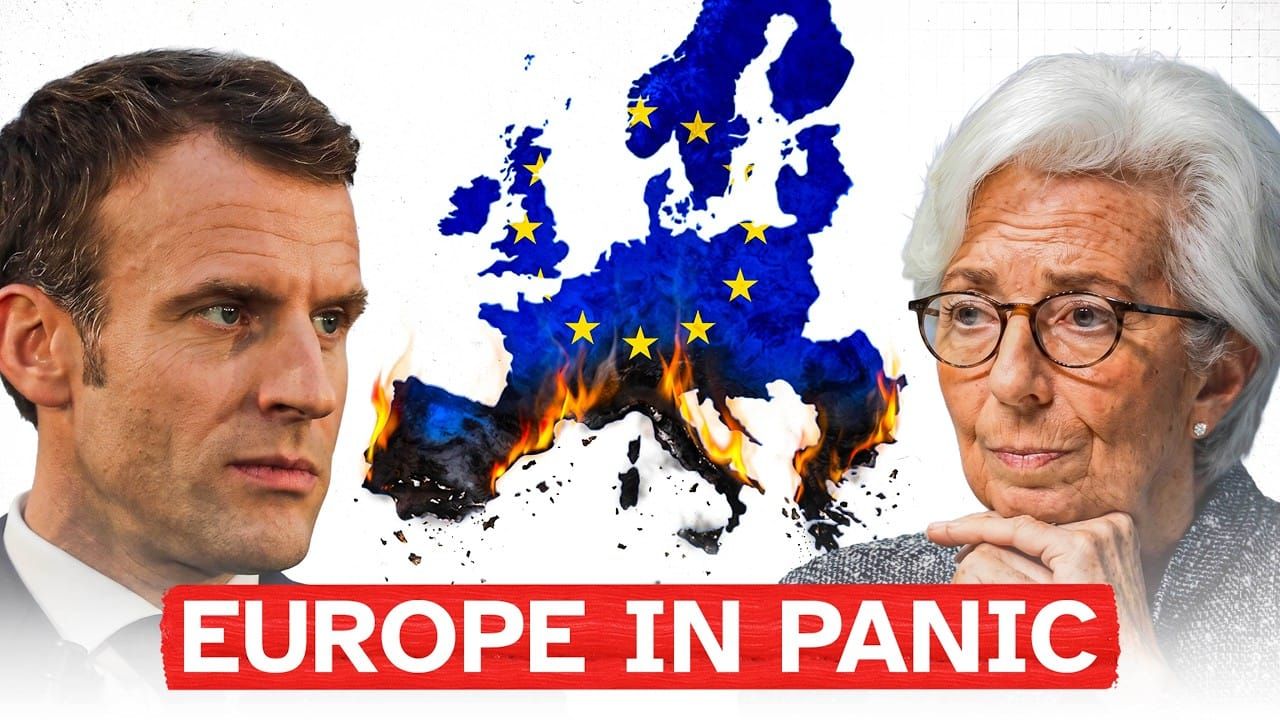
Christine Lagarde announced at the end of October that she will step down as ECB President on 7 February 2027, roughly nine months before her term expires on 31 October 2027 [1] [2]. Her exit coincides with two other senior vacancies, so three of the most powerful jobs in European finance are being filled in one round — through a process the video argues is being stitched up before French voters get a say.
The official reason
At her press conference Lagarde said she wants:
“the freedom of speech, the freedom of expression, and the freedom to engage on matters that are not monetary policy matters.”
The video’s rebuttal: she runs the institution that sets the price of money for the entire eurozone — shaping mortgage costs in Madrid and corporate borrowing costs in Munich — and after seven years her complaint is that the role muzzles her. (Reuters reported her saying “I don’t think that I can remain neutral” [3].)
Theory one: she is leaving an economy she couldn’t fix
- German industry pays more for energy than US or Chinese competitors, and part of that is self-inflicted: the post-2022 scramble to rebuild gas supply, plus EU carbon pricing under the ETS, added a homemade surcharge.
- Result: chemicals, metals and carmakers are restructuring, cutting back and relocating.
- On the day of her announcement the ECB held the deposit rate at 2.5% (confirmed: 2.50%, after a 25bp rise in September) [4] [5], flagging upside inflation risks from energy alongside downside growth risks — the combination central bankers dread.
- The 2024 Draghi report on competitiveness diagnosed the problem; implementation has been “sluggish, to put it politely”, slowed by political fragmentation.
- Lagarde’s consistent line: structural reform is for national governments, not the ECB. The video’s charge: Brussels writes the rules and Frankfurt sets the money, but neither accepts responsibility for the outcome.
Theory two: France — the problem the ECB is dreading
- Public debt around 120% of GDP; deficit above 5% a year.
- In late October the 10-year borrowing cost hit 5.14%, described as a 24-year high, with the spread over Germany at ~175bp — the widest since 2011 (see caveat below).
- Politics: Macron has no majority; the minority government under Sébastien Lecornu is deadlocked on the budget; Fitch and Moody’s both have France on negative outlook; the economy shrank 0.1% in Q3 while the wider eurozone grew.
- The ECB’s tool for this is the Transmission Protection Instrument (TPI), which can buy a country’s bonds to cap its borrowing costs — but only for states complying with EU fiscal rules, avoiding severe imbalances, with sustainable debt and sound policies.
- France is under an excessive deficit procedure, so it fails the entry tests for its own safety net. Northern creditor members would resist bending the rules for France, since that would reward the country that cannot pass a budget.
- The Lagarde angle: she is French, served as finance minister under Sarkozy, and in December 2016 a French court found her negligent over a €404 million state payout to Bernard Tapie — no penalty, no criminal record. A French ECB president signing off on a French rescue would be toxic in Berlin and The Hague; refusing one would be unforgivable in Paris. Leaving early means she is not holding the pen when the decision lands.
Theory three: the succession is being carved up before French voters decide
France elects a president in April and May 2027. Had Lagarde served to October, her successor would have been chosen with a new French president — possibly from the National Rally (Le Pen) — at the table. Leaving in February hands the pick to Macron, Friedrich Merz and other EU leaders while Macron still holds power.
| Post | Departure | Reported allocation |
|---|---|---|
| Presidency | Lagarde, 7 Feb 2027 | Spain or the Netherlands |
| German board seat | Isabel Schnabel, 3 Jan 2027 (to the IMF) | Germany keeps the seat |
| Chief economist | Philip Lane, 31 May 2027 | France |
Named candidates in the video: Pablo Hernández de Cos (former Bank of Spain governor), Klaas Knot (former Dutch central bank chief), Nadia Calviño (EIB president), plus a Bundesbank name (garbled in the transcript — see caveats). Reporting confirms the race has narrowed to Knot and de Cos as the only two nominees [6] [7].
Fallout in France: the National Rally accuses Macron of locking down institutions before losing power, and Mélenchon’s camp is equally angry — two movements that agree on nothing agreeing on this.
Her record, as the video frames it
- 12 March 2020: with markets in pandemic freefall, Lagarde said the ECB was “not here to close spreads” — triggering a historic Italian bond sell-off and a full-blown panic, after which the ECB launched PEPP to buy bonds.
- “Transitory” inflation: the ECB insisted the 2021–22 surge would pass; it didn’t.
- July 2022 – September 2023: rates raised by 4.5 percentage points, deposit rate from −0.5% to 4% — the fastest hiking cycle on record. Late to spot inflation, then hard on the brakes, with households and businesses absorbing the pain.
- Digital euro: in preparation phase; Parliament and Council are in trilogue negotiations; pilot eyed for 2027, possible first issuance around 2029 if the law passes. The video’s verdict: economies drowning in debt, industry struggling, leaders “busy figuring out how to reinvent the euro as an app”.
The closing argument
The ECB’s identity rests on independence from politics, yet its top jobs are being shared out “like cabinet posts” with national quotas and a deadline set by incumbents racing the French vote. Lagarde is rumoured to be in line to lead the World Economic Forum (WEF) — consistent with her stated desire for a platform. She told La Croix that running for French president was “not a good idea”: freedom of speech, yes; facing voters, no. The through-line: the officials who made the errors never pay a price, while the German worker whose plant is restructured, the family paying more at the till and the French taxpayer covering higher interest do.
References
- ECB President Lagarde to step down on 7 February 2027 (8%) ↩︎
- ECB President Christine Lagarde to step down in February 2027, nine ... (13%) ↩︎
- ECB's Lagarde steps down, saying she can't remain ... (6%) ↩︎
- Monetary policy decisions - European Central Bank (29%) ↩︎
- European Central Bank keeps key interest rate on hold at 2.5% (4%) ↩︎
- Central banking veterans Knot and de Cos in race to ... (5%) ↩︎
- ECB President Race Narrows to Knot and De Cos as Only ... (6%) ↩︎ ↩︎
- French 10-year government bond spread vs Germany ... (12%) ↩︎
- OAT-Bund Spread: French Bond Stress and the Euro 2026 (10%) ↩︎
- ECB's Schnabel quits to join IMF, setting in motion a board reshuffle (7%) ↩︎