Crucifixion of the Typhonian
Overview
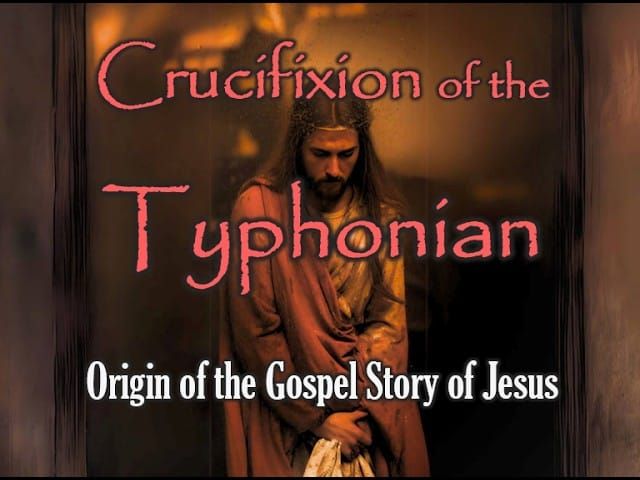
This is a lengthy YouTube presentation by Jason of Archaix. The core thesis is that the Gospel story of Jesus is literary rather than literal history — a composite of earlier Greek, Egyptian, and Gnostic traditions — and that the Church of Rome deliberately "carnalised" (made physical) what was originally a spiritual teaching. The title references the Typhonian theme: the ancient Egyptian figure Typhon, linked to the Phoenix, human sacrifice, and sun-darkening phenomena, which Jason argues underpins the crucifixion narrative.
Below are the significant points and lists, drawn faithfully from the transcript.
Jason's Personal Position
- Jason states he is "washed in the blood of the lamb," "twice baptised," a "son of the living God," and that he lives by the tenets Jesus taught — yet he is "equally convinced that the entire Jesus narrative was literary, not literal history." He insists these two positions are not contradictory.
- He emphasises his education is only to eighth grade, but he is "very well read," and that all the data he presents is publicly available.
The Central Argument: The Gospels Are Authorless and Composite
- Jason contends the Gospels of Matthew, Mark, Luke, and John "stand alone in the historical record for being absolutely authorless for hundreds of years." Unlike the works of Homer, Herodotus, Plato, Aristotle, and others — whose authorship is established through mutual citation and chains of custody — the Gospels have no such attestation in the first century.
- He describes the Gospels as "compositions, soups made of all the best ingredients," built from older source material (the "Q" document / sayings source) and expanded over time with additional motifs.
The Greek Literary Context
- Jason lists a wide array of Greek and Roman authors whose works are well-attested centuries before the Gospels, arguing that none of them connect to or corroborate the Gospel narrative. These include Homer (Iliad, Odyssey), Hesiod (Theogony, Works and Days), Aeschylus (Oresteia, Prometheus Bound), Sophocles (Oedipus Rex, Antigone), Euripides (Hippolytus, Medea, Bacchae), Aristophanes (The Birds, The Frogs, Lysistrata, The Clouds), Herodotus (Histories), Thucydides (History of the Peloponnesian War), Xenophon (Anabasis, Hellenica, Memorabilia), Plato (Republic, Apology, Symposium, Phaedo, Critias, Timaeus), Aristotle (Posterior Analytics, Nicomachean Ethics, Politics, Poetics, Metaphysics, Rhetoric, On the Soul), Diodorus Siculus (Bibliotheca historica), Strabo, Plutarch (Moralia, Parallel Lives), Apollonius of Rhodes (Argonautica), Euclid (Elements), Pindar (Victory Odes), Ovid (Metamorphoses, Ars Amatoria, Fasti, Heroides, Tristia), Virgil (Aeneid, Georgics, Eclogues), Horace (Odes, Satires, Epistles), Cicero (De Republica, Deiotarus, Catilinarian Orations), Livy (History of Rome), Tacitus (Annals, Histories, Germania, Agricola), Suetonius (The Twelve Caesars), Juvenal (Satires), Seneca the Younger, Marcus Aurelius (Meditations), Apuleius (The Golden Ass), Polybius (Histories), Julian the Apostate, and Ammianus Marcellinus.
The Amphitheatre / Stage Play Theory
- Jason's original theory (stated as his own, developed over ~3 years) is that the Gospel narrative originated as a Samaritan/Greek stage play performed in amphitheatres. He argues:
- The Gospels have a strongly episodic, scene-like structure — short, self-contained units separated by transitional verses that function like curtain-closings between acts.
- The Passion narratives are "especially theatrical, featuring betrayal, trials, crowd scenes, and high-stakes climax — ideal for staging as the final acts of a play."
- The Book of Acts is itself named using the theatrical term "acts."
- Greco-Roman theatres existed throughout Judea and Samaria in the first century (e.g., Herod the Great built a prominent theatre at Caesarea Maritima, still visible today).
- Multiple competing versions of the Jesus story circulated orally and theatrically before any canonical text was fixed.
Absence of First-Century Evidence
- No archaeological evidence: No works of art, paintings, engravings, sculptures, relics, or artifacts — "not even the early Christian catacombs provide any evidence of a gospel account" — dating before 150 AD.
- No numismatic evidence: Coins commemorated great events in the Mediterranean world, but there are no coins commemorating Christ or Jesus in the first and second centuries AD.
- No Christian manuscripts survive from the first century AD.
- No pilgrimage sites: Not a single site in Jerusalem is connected to Gospel events until the Middle Ages. No early Christians made pilgrimages to sites associated with Jesus's life.
Silence of Contemporary Authors
Jason argues that numerous first-century writers who were alive during Jesus's alleged lifetime make no mention of him or the supernatural events associated with the crucifixion (sun darkening, earthquake, resurrected dead). These include:
| Author | What They Wrote | Why Their Silence Is Significant |
|---|---|---|
| Suetonius | The Twelve Caesars | Does not mention Jesus or associated events |
| Tacitus | Annals, Histories | The "Christus" reference is argued to be a later forgery (appears only in copies after the 14th century; no early Christian apologist cited it) |
| Josephus | Antiquities of the Jews | The Testimonium Flavianum is "often considered to have been altered by later Christian interpolations"; does not describe miracles or supernatural events |
| Philo of Alexandria | Writings on the Logos | A Jewish philosopher in Alexandria, alive during Jesus's time, wrote extensively on Jewish affairs — no mention of Jesus, miracles, or crucifixion. Notably, Philo wrote about the Logos (the Word) as a spiritual concept, not a person |
| Pliny the Elder | Natural History | Had an entire book on phenomena including eclipses, sun-darkening, earthquakes; died 79 AD with decades to learn of the Jesus story — no mention |
| Seneca the Younger | Philosophical works | No mention of Jesus |
| Justus of Tiberias | Jewish history | A Jewish historian of the first century — no mention of Jesus |
| Pliny the Younger, Martial, Juvenal, Plutarch, Dio Chrysostom, Celsus, Pomponius Mela, Quintilian, Epictetus | Various works | None knew of a Gospel story |
The Paul Problem
Jason devotes a major section to arguing that the Apostle Paul's 13 epistles do not prove a historical Jesus. His numbered points include:
- Paul never mentions any of the four Gospels in his epistles, nor in the Book of Acts.
- Paul never quotes anything Jesus said — no sayings, no parables, no teachings.
- Paul does not mention historical facts about Jesus: no dialogue with Pilate, no Caiaphas, no Sanhedrin, no Herod, no Judas, no trial, no scourging, no crown of thorns, no sun darkening (only mentioning Jesus lived during Pilate's reign, which Jason suggests could be an interpolation).
- Paul wrote nothing of Jesus's bodily resurrection — "to Paul, Christ was resurrected in the spirit."
- Paul's epistles never mention a single parable of Jesus, nor any miracles or acts.
- In Paul's writings there is no Bethlehem, no Nazareth, no virgin birth, no parents, no magi, no John the Baptist, no Judas, no betrayal, no Sermon on the Mount.
- Paul was unknown to the first Christian chronicler Justin Martyr (~140 AD), nor to Ignatius (107 AD) or Polycarp (108 AD).
- Not one Jewish writer at the time mentions Saul/Paul — not Josephus, not Philo, no rabbinical records, not the Talmud.
- Paul's epistles are not mentioned in the Book of Acts.
- Before 144 AD, Paul's writings are not found mentioned anywhere — they first appear in the letters of Marcion, a student of Gnosticism.
- The life and acts of Paul mirror three individuals: Apollonius of Tyana, Flavius Josephus, and Orpheus. Jason argues Paul's missionary journeys, route to Tarsus, journeys to/from Antioch, trip to Arabia, miracles at Ephesus, journey to Athens and Corinth, disciple named "Lycaon" (Luke), trial in Rome, 17 years preaching to Gentiles — all derive from Philostratus's account of Apollonius of Tyana. He notes "Paul" in Latin (Paulus) and "Apollonius" in Greek are the same name, and that both Paul and Orpheus had a companion named Timothy.
- Some scholars hold that Paul never existed — he is a church fabrication whose epistles are forgeries first entering the record around 125–140 AD via Marcion.
The Church Caught Forging Texts
- Eusebius (church father) wrote a work titled "How it may be lawful and fitting to use falsehood as medicine and for the benefit of those who want to be deceived" — Jason presents this as evidence the Church openly sanctioned deception.
- The Donation of Constantine — a document giving the Roman Church authority over European monarchies — was exposed as a forgery by Lorenzo Valla, who noticed it quoted from the Latin Vulgate, which did not exist when Constantine died.
- List of forged early church documents Jason identifies:
- The Letter of Pontius Pilate to Tiberius
- The Gospel of Pilate (Acts of Pilate / Gospel of Nicodemus)
- The Epistle of Jesus to Abgar
- The correspondence of Paul and Seneca
- The Apocalypse of Peter
- The Acts of Paul and Thecla
- The Gospel of Thomas / Infancy Gospel of Thomas
- The Acts of Andrew
The Apologetics Argument
- Christianity uniquely gave rise to apologetics — a whole genre of defensive scholarship — because, Jason argues, the earliest Christian writers were "heavily defensive" from the start, trying to convince readers the story was true. No other religion in the ancient world "had to begin so prominently on the defensive."
- The scholar Acharya S (real name Murdoch) is cited as noting church fathers were "compelled to create forged texts and long rebuttals."
- Porphyry and Plotinus were contemporary scholars who accused Christians of inventing texts. Jason calls them "the Archaics of the day." Their criticisms necessitated the apologetic response.
Early Church Fathers' Own Admissions
- Justin Martyr (first Christian historian, writing within 100 years of the alleged crucifixion) wrote that "our Lord's miracles are preserved by tradition alone, but those of Apollonius [of Tyana] are more numerous and actually manifested in present facts." Jason stresses this means Justin himself did not believe the miracles of Jesus were historically recorded.
- Hierocles (proconsul under Diocletian, ~303 AD) wrote a book called Philalethes (Lover of Truth) exposing the Gospel of Jesus as a fraud modelled directly on the life of Apollonius of Tyana — published ~1,750 years ago.
- Augustine of Hippo (~430 AD) wrote that by his time there was no authentic portrait of Christ and absolutely no knowledge of his appearance. He also wrote: "I should not believe in the truth of the gospels unless the authority of the Catholic Church forced me to do so."
- Irenaeus of Gaul (first of the apostolic fathers) "fervently insisted that Jesus was 50 years old and had not been crucified, claiming that this emerging belief [in a crucified younger Jesus] was heresy."
The Spiritual vs. Physical Jesus
Jason's theological position is that Jesus's message was entirely spiritual and that the Church erred by attaching it to physical events:
- John 4:24: "God is a spirit, and they that worship him must worship him in spirit and in truth."
- John 6:63: "It is the spirit that quickeneth; the flesh profiteth nothing."
- Matthew 12:28: "If I cast out devils by the spirit of God, then the kingdom of God has come upon you" — Jason argues this shows the kingdom was already present, before any crucifixion.
- Matthew 11:7–8: "I will have mercy and not sacrifice" — Jason argues Jesus explicitly rejected the sacrificial framework that the crucifixion narrative imposes.
- John 18:36: "My kingdom is not of this world."
- The Sermon on the Mount and kingdom of God is within you teaching require no physical crucifixion, resurrection, or ascension.
- To "imprison a spiritual paradigm within the materium [material world] is the ultimate gaslighting."
The Phoenix Symbolism
This is the climactic section of the presentation:
- The phoenix was a well-known symbol in the first century AD, mentioned 21 times by 10 authors: Ovid, Cornelius Valerianus, Pliny the Elder, Lucan, Martial, Pomponius Mela, Seneca, Statius, Claudian, and Pliny the Younger.
- The phoenix had two layers of meaning:
- A natural/cosmological phenomenon: The sun darkens for 2–3 hours, rocks fall from the sky, the sky turns red, the moon turns blood-red, violent earthquakes occur — a cycle Jason calls the "Phoenix cycle," linked to the ancient Egyptian figure Typhon.
- A human/cultural title: A person who disappeared and returned after a very long journey was called a "phoenix" — an endearing title of respect. Jason argues this is what Jesus was: a man who returned from a long journey (17 missing years), and was thus a phoenix.
- The phoenix was associated with Heliopolis (city of the sun) in Egypt, where the mansion of the phoenix housed the important Benben stone, which had "the keys to resurrection."
- The earliest Christian fathers explicitly linked Jesus to the phoenix:
- Clement of Rome: "Let us consider the wonderful sign of the resurrection of the Lord Jesus Christ. For just as the phoenix is born from its own ashes, so too our Lord Jesus Christ, having been raised from the dead, shall rise us also." He also wrote that the phoenix returned at the completion of its 500th year.
- Tertullian (De Resurrectione Carnis): explicitly compared the phoenix's cyclical rebirth to Christ's resurrection.
- Origen of Alexandria: discussed the phoenix as a metaphorical representation of Christ's triumph over death.
- Lactantius (De Ave Phoenice): explicitly connected the phoenix to Christ's resurrection.
- St. Ambrose: "The phoenix which is said to be born from its own ashes is a symbol of the resurrection of Christ who rose from the dead on the third day."
- St. Augustine (City of God): "The phoenix, which is said to be born of its own ashes, is a symbol of the resurrection of Christ."
- However, all traces of the phoenix were removed from the canonical Gospels (Matthew, Mark, Luke, and John contain no phoenix references). Jason argues the Church wanted resurrection to be a Christian theme, not an ancient Greek/Egyptian one — but the earliest fathers "didn't get the memo."
- The "500 witnesses" to Jesus's ascension is argued to be borrowed from the 500-year cycle of the phoenix.
- Jason shows two volumes of a book titled The Phoenix (published 1707) from his personal library, which he says is about how the true spiritual individual is a phoenix — drawing the parallel to Jesus's teaching that "the kingdom of God is within you."
Forged Sun-Darkening Accounts
- Pilate's Report to Tiberius Caesar (a known forgery) describes the sun being "altogether hidden," the sky dark during day, the moon "like blood," and Dionysius the Areopagite supposedly saying "either the author of nature is suffering or the universe is falling apart." Jason argues Dionysius neither wrote nor said any such thing — the account was a Phoenix event from the past, contorted to serve the crucifixion narrative.
- Eusebius cited a pagan historian named Phlegon of Bithynia who allegedly wrote in Olympiads that the sun darkened and an earthquake destroyed the city of Nicaea. Scholars have found no trace of Phlegon — either he was a Church invention, or the Phoenix event he recorded was real but from an earlier time period, and the text was destroyed to allow Eusebius (a "known forger and liar") to use it with impunity.
The Typhonian Connection (Final Section)
Jason reads citations from a 1740 book (Universal History from the Earliest Account of Time to the Present) to establish the Typhon-phoenix-human-sacrifice chain:
- Typhon was the last of the "gods" in Manetho's chronology, who "reigned immediately before the flood and perished therein." The name Typhon signifies a "deluge or inundation" — the Egyptian priests called the sea "Typhon."
- Typhon was red-haired: Red oxen were sacrificed because of their resemblance to Typhon; men with red hair were sacrificed at the tomb of Osiris. Strangers were the usual victims (since few Egyptians had red hair), which Jason links to the Greek fear of Egyptians kidnapping red-headed Greeks (especially Macedonians).
- Human sacrifices at Heliopolis: Men were sacrificed at Heliopolis (site of the mansion of the phoenix) — three burnt alive each day during the dog days, their ashes scattered. These victims were given the epithet "Typhonian."
- Amosis (Ahmose) is said to have abolished this practice, substituting waxen images for human victims — but they were still called "Typhonians."
- The Esau/Jesus connection: The Talmudists called Rome and Italy "the bloody empire of Edom." The text states "the soul of Esau passed into that of Jesus of Nazareth" — and Esau was known for having red hair. Jason argues this connects the red-haired Typhonian sacrifice tradition to the Jesus narrative.
- Venus, Cupid, and Pisces: Venus and Cupid fled from Typhon by taking the form of fishes and were translated into the zodiacal sign of Pisces — another astrotheological nod linking Typhon to the Christian fish symbol.
- Osiris and Jesus: "At length Osiris returned back into Egypt" — Jason parallels this with Jesus's flight into Egypt, arguing the Osiris/Typhon mythological cycle is the template.
Nazareth / Nazarene
- Jason argues Nazareth never existed as a geographical place. "Nazareth" is a corruption of "Nazarene" — a sect/group (similar to the Essenes), a Jewish ascetic movement. Later Christian officials, not understanding the term, invented Nazareth as a location.
The Maccabean "Jesus" (167 BC)
- The Talmud refers to a Jesus who was stoned or hung for inciting anti-Jewish sentiment — but Jason argues this is not the Gospel Jesus, rather a figure from the Maccabean revolt of 167 BC, whose opponent was a traditionalist named Judas. He calls it "a hell of a coincidence" that this earlier Jesus (a Greek Jew) was killed by a Judas — a parallel to the Gospel narrative.
Key Lists from the Transcript
Books Jason References from His Library
- The Historical Jesus and Mythical Christ — Gerald Massey (1880s)
- The Secret in the Bible, The Crucifixion of Truth, The Twin Deception — Tony Bushby
- The Bible's Most Embarrassing Moments
- History of the First Council of Nicaea
- Gnostic Jesus / God-Man Myth
- Birth of the Christian Religion, The Origins of the New Testament — Alfred Loisy
- The Devil's Pulpit (Vols. 1 & 2) — Rev. Robert Taylor
- Mushrooms in Mankind (impact of mushrooms on human consciousness and religion) — James Arthur
- History of the Christian Religion to the Year 200 — Charles Wait (~130 years old)
- History of the Christian Religion and Church During the First Three Centuries — Dr. Augustus Neander
- Jesus Christ, Son of God: Ancient Cosmology and Early Christian Symbolism
- God Man: The Word Made Flesh
- The World's 16 Crucified Saviours — Kersey Graves
- The Christ Conspiracy: The Greatest Story Ever Sold — Acharya S (Murdoch)
- The Light of Egypt: Science of the Soul and Stars — Thomas Burgoyne
- Natural Genesis (Vols. 1 & 2) and Ancient Egypt: The Light of the World (Vols. 1 & 2) — Gerald Massey
- The Phoenix (Vols. 1 & 2, 1707)
- An Universal History from the Earliest Account of Time to the Present (Vol. 1, 1740, 1,147 pages)
First-Century Authors Who Mention the Phoenix (10 authors, 21 mentions)
- Ovid
- Cornelius Valerianus
- Pliny the Elder
- Lucan
- Martial
- Pomponius Mela
- Seneca
- Statius
- Claudian
- Pliny the Younger
Church Fathers Who Linked Jesus to the Phoenix
- Clement of Rome (Epistle to the Corinthians)
- Tertullian (De Resurrectione Carnis)
- Origen of Alexandria
- Lactantius (De Ave Phoenice)
- St. Ambrose (De Spiritu Sancto)
- St. Augustine of Hippo (City of God)
Notes on Transcript Quality and Hallucination Risk
This is an auto-generated subtitle file with extensive transcription errors throughout. Many proper names are garbled (e.g., "Hessi" for Hesiod, "A skylus" for Aeschylus, "your urripes" for Euripides, "Thusidites" for Thucydides, "Xenopon" for Xenophon, "Cesero" for Cicero, "Sutonius" for Suetonius, "Cynica" for Seneca, "Pho" for Philo, "Ply" for Pliny, "Youubius/Yubius" for Eusebius, "Marchon" for Marcion, "Phost Stratus" for Philostratus, "Irenus" for Irenaeus, "Hieroclesles" for Hierocles, "Porefree/Pfrey" for Porphyry, "Plotton/Plotus" for Plotinus, "Manathos" for Manetho). Where the intended name is unambiguous from context, I have used the correct form. Where meaning is genuinely uncertain, I have flagged it.
On hallucination: I have confined this review strictly to what appears in the transcript. I have not introduced external facts, dates, or claims not present in the text. Where Jason makes historical claims (e.g., "no Christian manuscript has survived from the first century," "the Donation of Constantine was exposed by Lorenzo Valla," "Nazareth did not exist as a place"), these are presented as Jason's claims — not verified by me. Some of these are matters of genuine scholarly debate; others (such as the Tacitus forgery claim or the complete non-existence of Nazareth) are fringe positions that mainstream scholarship does not endorse. The transcript reflects Jason's presentation of his research and arguments, not an established academic consensus.