Dancing Shiva
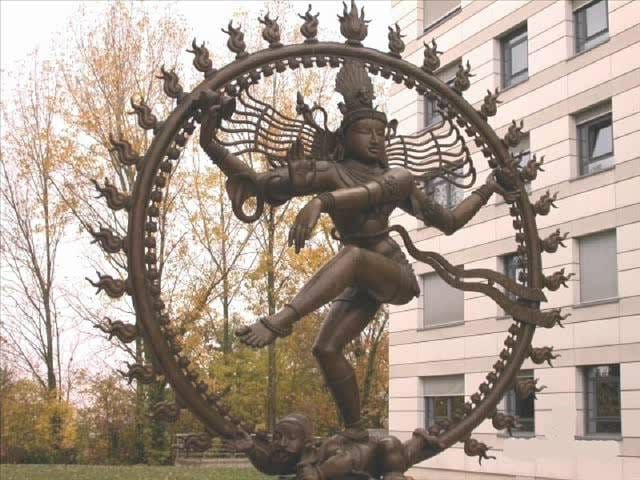
Aldous Huxley argues that Western civilization has never produced anything as comprehensive as the Dancing Shiva (Nataraja)—a bronze statue from South India depicting Shiva with four arms, one foot raised, dancing within a flaming circle.
The Symbolism of the Circle
The figure stands within a great circular halo with flames extending outward. This represents:
- Mass, energy, space, and time
- The material world in its all-embracing totality
The Four Arms and Their Meanings
Huxley details the extraordinary symbolic content of Shiva's four arms:
- Upper right arm: Holds a small drum—the drum of creation that summons things into existence
- Upper left arm: Holds fire—the force of destruction
- Lower right hand: Raised in the gesture "Be not Afraid"—affirming that despite everything, it is all right
- Lower left hand: Points downward at his feet
The Two Feet: Psychology and Liberation
The foot placement carries profound psychological meaning:
- One foot planted firmly on the back of a repulsive dwarf named Muyaka (or Muyalaka), who represents the ego—Shiva must break the back of the ego
- The other foot raised against gravitation, symbolizing spiritual contemplation and liberation
Huxley emphasizes: "If you don't break the back of the ego, you're lost, and if you don't practice contemplation, there will be no Liberation for you".
The Hair of the Yogi
Shiva's long hair streams out to the limits of the universe, symbolizing how yogic contemplation includes everything.
Leela: The Play of Manifestation
The manifestation of the world is called Shiva's Leela (his play). Huxley notes this is "an immense manifestation of play"—Shiva sends his reign upon the just and unjust alike, existing beyond good and evil.
The Cemeteries: Dancing in Misery
A surprising and darker manifestation is Bhairava, another form of Shiva who dances in cemeteries. This serves to remind us that:
- The dance of life isn't always jolly
- Shiva dances equally in misery, death, and life/delight
- This must be accepted, and only through the "lifted foot" of contemplation can we accept it.
Compatibility with Modern Science
Huxley finds it remarkable that this ancient symbol is "completely compatible with the modern scientific idea"—it includes:
- Mass, energy, space, and time
- The concept of infinite energy dancing timelessly and forever through the world
- The dance extending through human mentality itself.
The Outrage of Sentient Existence
Huxley captures a paradox: the world is felt as a kind of outrage because the play continues even inside ourselves—sentient beings who suffer—yet simultaneously, the raised hand declares "everything is finally all right in spite of everything".
The Buddha Connection
Huxley explicitly links this to Buddhism: "As Buddha says, I show you sorrow and the ending of Sorrow"—the ending of sorrow achieved by putting your foot on the back of the dwarf (ego) and raising the other foot into contemplation.
Western Symbolic Poverty
Huxley concludes with a striking critique: "It's a shame we don't have any good symbols like this" in the West. He considers the Christian cross "fairly good" but deficient—it fails to account for:
- The cosmic side of life (mass, energy, space, time)
- The importance of contemplation.
The Human Mind as Symbolic Instrument
Huxley closes by reflecting that the human mind exists to manufacture symbols to manage immediate experience. He questions whether scientific, realistic symbols can replace comprehensive religious ones, admitting uncertainty about whether this could ever appeal to great numbers of people.