DHH coming for Mac
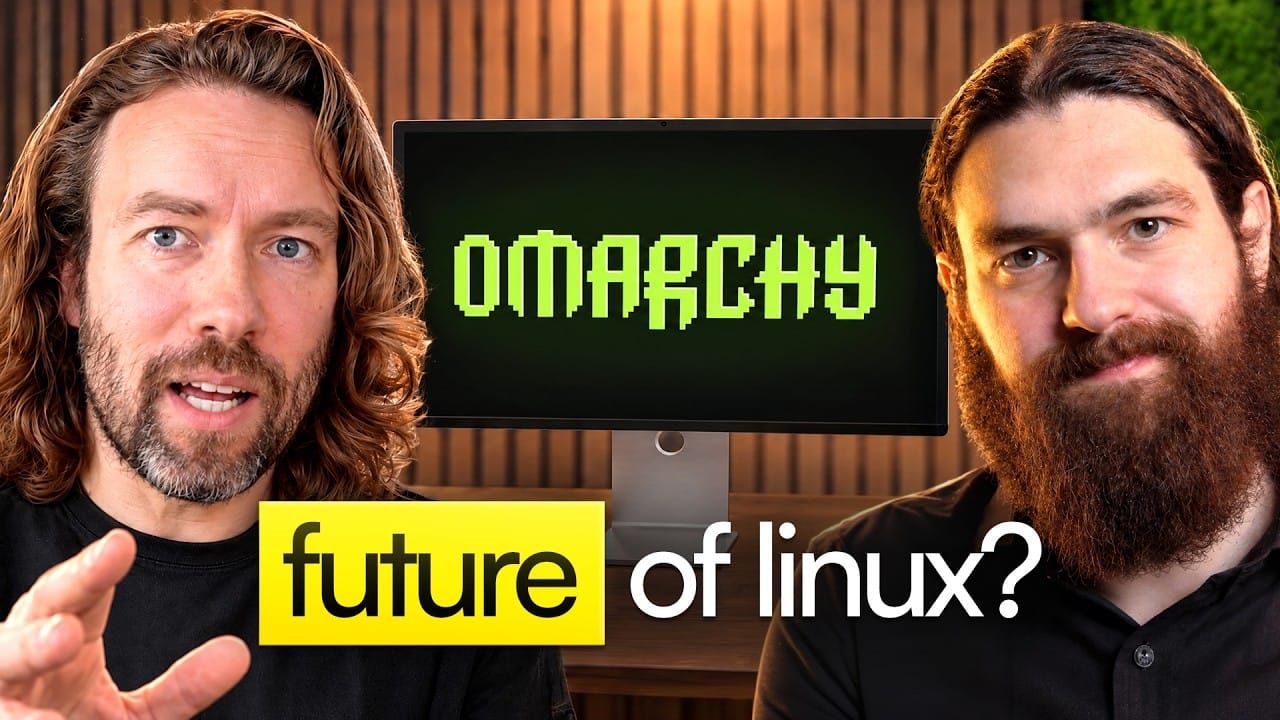
Host Mischa opens by saying he has previously made "fairly critical videos about Omarchy" but describes himself as "a man who likes to have strong opinions weakly held". He cites the project's momentum — over $20 million raised, a security team being set up — and calls it "something truly unique" in the history of desktop Linux. That framing sets up the interview as a reassessment rather than a puff piece.
What is happening in the project right now
- DHH says "everything all at once" is going on, with many sub-projects inside Omarchy; he spends roughly 16 hours a day on it.
- The distinctive claim is a marriage of art and engineering: historically Linux has had strong engineers who "weren't always the best at colour coordination", while Omarchy tries to bridge that gap.
- The Omarchy Quattro release makes the OS malleable for non-programmers — "you can now mutate your malleable operating system into becoming whatever you want it to be". In the first three weeks, 3,000 plugins/mini-apps were created, many by people who had never programmed.
- He wants to retire the term "vibe coding", arguing its negative connotations no longer fit the capability of current models.
- Community culture is explicitly part of the product: he contrasts the old RTFM ("read the fucking manual") norm with a space where newcomers who "know nothing" are helped enthusiastically, and where people are "not Debbie Downer all the time".
Why Linux, and why now — the personal arc
| Stage | What happened |
|---|---|
| Childhood | First computer an Amstrad CPC 464 in 1984; earlier time on a neighbour's Commodore 64; first game Yie Ar Kung‑Fu; "just this deep love of the computer" |
| 20 years on Mac | Liked Apple's taste and instincts, but objects to its shift from empowering users to "controlling the whole flow, having your toll booth sit in front of all software distribution, collecting 30% of the whole damn economy" |
| The break | hey.com in 2020 — Apple tried to kill it unless DHH handed over 30% of revenues. Even then he couldn't picture an alternative, because he thought the only option was Windows, which he found "just worse" |
| The blind spot | ~25 years of Linux on the server, but the desktop community seemed to him indifferent to fonts, colour, curated defaults and ease of install |
| First move | Ubuntu, then heavy personalisation → the dotfiles project Omakub, used for about a year |
| The unlock | YouTube videos from TypeCraft and ThePrimeagen led him to Hyprland on Arch. Arch was "a Lego set dumped on the floor and then an invitation to build your own Millennium Falcon" — but that was the point: "if I want the perfect computer, I have to start from the smallest Lego blocks". Ubuntu gave him "Duplos, not Legos" |
| Progression | Dotfiles → custom ISO → own mirror → own package repository → a full distribution (version 3) |
The AI inflection point: he dates the shift to Opus 4.5 on 24 November last year, with things becoming "pure magic" over the following three to four months. He says he has not written a line of serious production code for about four months, because agents now write code "arguably better the majority of the time". He advocates running models adversarially — letting Codex and others critique each other. Linux suits this because models are pre-trained on ~40 million lines of kernel code, and "I have not had a single issue with Linux in probably since November that an agent couldn't fix" — including the old problem of cryptic errors and passive-aggressive forum answers.
The "agentic OS" thesis
- Windows and macOS are described as hostile to the idea: Windows requires agents to move a cursor and click ("totally archaic"); Apple's security posture makes mutation hard.
- Linux is the natural fit: "everything is a CLI, everything is a config file, everything can be scripted… therefore, everything can also be debugged and evolved."
- He argues much of the Linux world is neutral at best and actively hostile at worst — naming GNOME and Asahi and projects whose articles of incorporation say "no AI, write it all by hand". Hence: "we actually have a moral obligation to deliver Omarchy for the people who do want an Agent operating system."
The three missing ingredients
He frames Omarchy as only now possible because three things converged:
- Software — tiling window managers existed since i3 in the early 2000s, but Hyprland was the first with the poise, style and bezier animations he could live with. Quickshell is now "just as important", powering the unified shell that enables plugins and agentic extensions.
- Hardware — laptops were the "walk in the desert" after Apple's M-series; Intel Panther Lake, released in the last 12 months, finally makes Linux laptops competitive.
- Agents — the piece that only arrived after a year of work on the distro.
Add the "Linux prophecy" — "the year of Linux on the desktop", foretold at a conference in 1999 — and he argues the pieces now line up: "It's a shitty prophecy if you make it and then next year it comes through. But if it's a prophecy that's literally been around for 20 years… then it's worth fulfilling."
Ambition: escape velocity, not world domination
- Mission one is the perfect computer for himself; mission two is enough people to sustain it — his metaphor is escape velocity: not 2, not 10, "probably can't even do it with a thousand, but you can do it with 10,000. You certainly can do it with 100,000."
- He wants Omarchy to stay "an acquired taste", like coffee, champagne or 80% dark chocolate — and jokes that even the hard-to-pronounce name is part of the filter.
- Target: 20–30% market share. He notes macOS sits around 15% globally and perhaps 25% in the US, and that the last new desktop OS to move the pie chart that much was Windows 95 — a quarter of a century ago. Linux is "solidly third" at somewhere between 5% and 12% depending on the source. "If we could just beat the Mac… now is the window. The window's been closed for 30 years."
- Children are a key audience: the iPad teaches consumption, not computation. He cites the C64, where you had to type
LOAD"*",8,1to start a game — friction that taught you the machine. "It's an entirely adult thing to believe that a tiling window manager is difficult" — children have no such preconceptions.
Marketing, money and momentum
- He criticises the technical community's "instinctual aversion to marketing" — the belief that anything slick or colour-coordinated must be vacuous. "I'm transferring my enthusiasm because I genuinely hold it."
- He does "the retail politics of evangelism" on X — replying to accounts with 17 followers as readily as 17 million — and registered wecanfixeverything.com as a statement that no paper cut, dependency or incompatibility can't be cured "with enough tokens, intensity and momentum".
- On fundraising: he doesn't need money personally but knows it accelerates projects and opens doors to Intel, AMD and Nvidia; commercial partners are already on board. "I haven't even the faintest clue how we're going to spend the $20 million… but if we could raise 20, why not 50? Why not 100?" Scale also signals permanence: a year ago Omarchy "was just DHH's dot files".
Technical roadmap
- Plugins into core: a substantial share of the 3,000+ plugins should ship in the box.
- The Arch wiki as failure state: "If you have to write down a workaround… you should put in the work to just fix the bug." No more "my Bluetooth didn't work, go look at a wiki" — "let's put it all in the box. Perfect compatibility with everything."
- Vintage Intel Macs first: full compatibility back to roughly 2009 (the earliest that can run GPU-accelerated tiling window managers) — perhaps 50–100 machine permutations with differing Wi‑Fi, Bluetooth and Nvidia chips. Then Lenovo, Dell, "everything". His inspiration is the retro-gaming/emulation community's obsession with "perfect mint condition" coverage of entire ROM libraries.
- Voice modes are coming: talk to the computer and it changes — his example is asking for a top-bar widget tracking a sports team from Aarhus that only a community website covers.
- Perfect CJK input out of the box, among many other parallel projects.
Security — the substantive core of the second half
- Security has been the number one priority since the Quattro launch, which is partly why new features have been slower: "I wanted to make sure that the underpinnings we had were solid."
- The security team was the first team incorporated after the core team. He points to hires including a Linux kernel maintainer responsible for part of the PCI subsystem with a kernel-hardening background (named in the transcript as Kristoff), and Outfoxxed of Quickshell, who "has a lot of opinions about how to write secure systems".
- He rebuts a perceived contradiction: critics call Omarchy "just dot files" while also claiming unique vulnerabilities, when the stack is standard OpenSSL, the standard kernel and so on. One genuine example he concedes: an insecure default option in the kitty terminal.
- Responsible disclosure goes to security@omarchy.org; there is a security credits page. His anecdote: the first responsible discloser was a Cloudflare intern who shortly afterwards received a permanent job offer — framing contribution as CV-building. Irresponsible disclosure on X is also welcomed in effect: "I thank them, too", since many findings turned out to be upstream issues affecting all distributions.
- He mentions talks with a provider of cybersecurity-specific models on the agentic side, on the day of recording.
- Blunt about the stakes: if Omarchy becomes "Windows 95" in the pejorative sense, "it's all for nothing".
On the AUR (a back-and-forth worth recording):
- Correction of the record: Omarchy ships nothing from the AUR and updates nothing from it. The Arch repos plus the Omarchy repo are the guaranteed set; the AUR is an opt-in, presented with a review interface (Alt‑D shows the build).
- AUR has ~117,000 packages, many by volunteers, designed in "a naive era — kind of like the original email protocol", with no hardening of the distribution network. DDoS-driven outages were the original reason Omarchy moved off AUR dependencies, standing up its own mirror and repository instead.
- He defends the principle: NPM, RubyGems, crates and Go all carry equivalent risk, and "NPM still runs every fucking major website in the world". Agents are as good at finding security issues as at exploiting them, so "we have a straight path to a modern version of the AUR".
- The host suggests a first-use warning dialogue. DHH pushes back: "I don't actually care so much for attempts. I care for results… People have been trained that if they want to use their computer, they just click OK until the software appears." He accuses Apple of hypocrisy here, having run the PC-versus-Mac ads mocking Windows pop-ups and now generating 17,000 of its own.
- The end state is full package sovereignty: "a foundational distribution that depends on no one for nothing" — bootstrapping on Arch today, self-hosting builds tomorrow. "I don't know when the last time a true foundational distro appeared, but we're making one."
Omarchy Kids
- Children will not have sudo, so they cannot install packages.
- Planned controls: a whitelisted DNS, time limits or time nudges, parents set up as administrators, plus dedicated wholesome kids' themes.
- "I want Omarchy to be a place that parents can trust" — but for adults, freedom stands: "once you're an adult and you own your own computer, it is my belief you should be able to do whatever the hell you want with that… I'm selling you a fork and a spoon."
- The governing metaphor: a town with a sheriff (Omarchy/Arch repos) and, clearly demarcated beside it, the Wild West (AUR).
- A Discord channel with hundreds of people is already working on the kids' edition, technically and artistically.
- He also concedes the tension with his own childhood — running an Elite BBS at 14 and trading pirated software.
Closing remarks of note
- He argues podcasts beat X for nuance: "on X we have 240 characters… what people want to see is a dead body in the streets", so positive security news doesn't travel, while a found vulnerability does.
- Links given: omarchy.org (portal, plus omarchy.org/security for the disclosure policy and team) and dhh.dk for his commercial work, Rails, Basecamp and books.