Electro-episoded in 2025
At a Glance
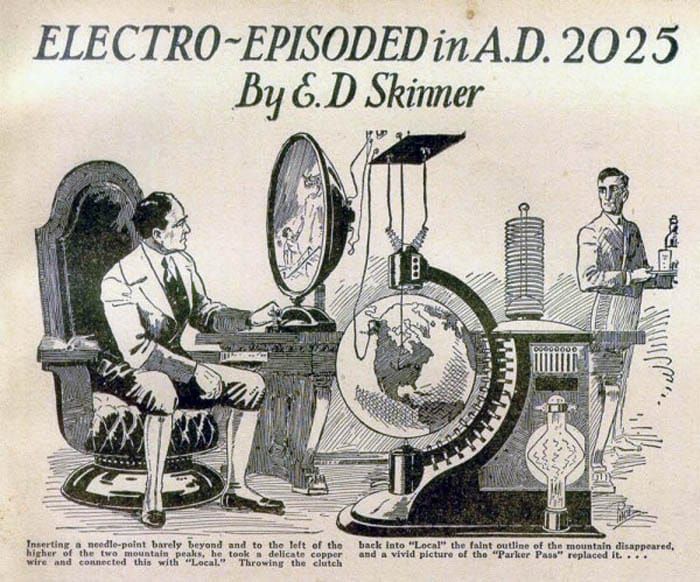
- Title: Electro-episoded in A.D. 2025
- Author: E. D. Skinner (Edward D. Skinner)
- Published: 1936
The book is freely available here on Gutenberg Project:
 Skinner, E. D.
The World of A.D. 2025: A Technocratic "Utopia"
The novel presents a future world that, on the surface, appears to be a perfect utopia. By the year 2025, humanity has achieved:
- A World Government: A single, global state has eliminated war and national conflict.
- Technocratic Rule: Society is managed by a benevolent council of "World Scientists" who make all decisions based on logic and efficiency.
- End of Social Ills: Poverty, crime, and disease have been eradicated through scientific planning.
- Advanced Technology: Citizens enjoy futuristic marvels like personal air-cars, automated food production, and widespread "televisors" (a common trope in early sci-fi).
However, this stability comes at a tremendous cost: the complete suppression of individualism.
The Core Concept: "Electro-episoding"
The title refers to the central mechanism of social control in this new world. "Electro-episoding" is a form of mind control or psychological re-conditioning.
- What it is: A process using a combination of electricity, hypnosis, and psychological suggestion to alter a person's memories, personality, and desires.
- Its Purpose: When a citizen displays "atavistic" or undesirable traits—such as ambition, passion, romantic love, or any form of non-conformity—they are sentenced to be "electro-episoded." The procedure effectively erases their individuality and re-programs them to be a compliant, happy, and productive member of the collective.
This concept makes the novel a clear precursor to the more famous dystopian themes of mind control seen in works like Nineteen Eighty-Four.
Plot Summary (without major spoilers)
The story follows a young man named Tom Jones. In a world that prizes conformity, Tom is a natural-born individualist. He is restless, questions authority, and feels emotions that are considered dangerous and obsolete by the ruling scientists.
His main transgression is falling in love with a woman, an act of passionate, exclusive attachment that is strictly forbidden in this collectivist society. His "anti-social" behavior is detected, and he is targeted for electro-episoding.
The bulk of the novel chronicles Tom's struggle against the system. He must decide whether to submit to the procedure and lose his identity or to fight for his right to be an individual, even if it means becoming an enemy of a world that believes it has achieved perfection. The plot revolves around his attempts to escape his fate and perhaps even spark a rebellion against the sterile, emotionless "utopia."
Key Themes
- Individualism vs. Collectivism: This is the central conflict of the book. It pits the value of the individual spirit, with all its messy emotions and desires, against the perceived good of a stable, conflict-free society.
- The Dangers of Technocracy: The novel is a cautionary tale about placing too much faith in a ruling class of "experts." It warns that a society governed purely by logic and science, without regard for human emotion and spirit, can become a prison.
- Free Will and Mind Control: Skinner explores what it means to be human when your very thoughts and feelings can be erased and rewritten by technology.
- Critique of Utopian Ideals: Published during the Great Depression and the rise of totalitarian ideologies (like Communism and Fascism), the novel critiques utopian schemes that promise perfection at the cost of personal freedom.
Historical Context and Significance
- Comparison to Brave New World: The book was published four years after Aldous Huxley's Brave New World (1932) and shares many similar themes: a scientifically managed society, the suppression of emotion and family, and technological conditioning. However, Skinner's novel is generally considered less sophisticated in its prose and philosophical depth.
- Pulp Style: The writing style is very direct and often didactic (preachy), which was common for science fiction of the era that wasn't published in the major sci-fi magazines. It's more focused on the ideas than on literary artistry.
- Rarity: Electro-episoded in A.D. 2025 was not a commercial success and had a very small print run. It is now extremely rare and considered a valuable collector's item for fans of vintage science fiction.
In summary, "Electro-episoded in A.D. 2025" is a historically significant but largely forgotten American dystopian novel. While not a literary masterpiece, it's a prime example of 1930s anxieties about technology, social engineering, and the potential loss of individualism in a rapidly modernizing world. For a genre historian, it's a fascinating look at how these themes were developing before they were perfected by later, more famous authors.