Epistemology - good to know
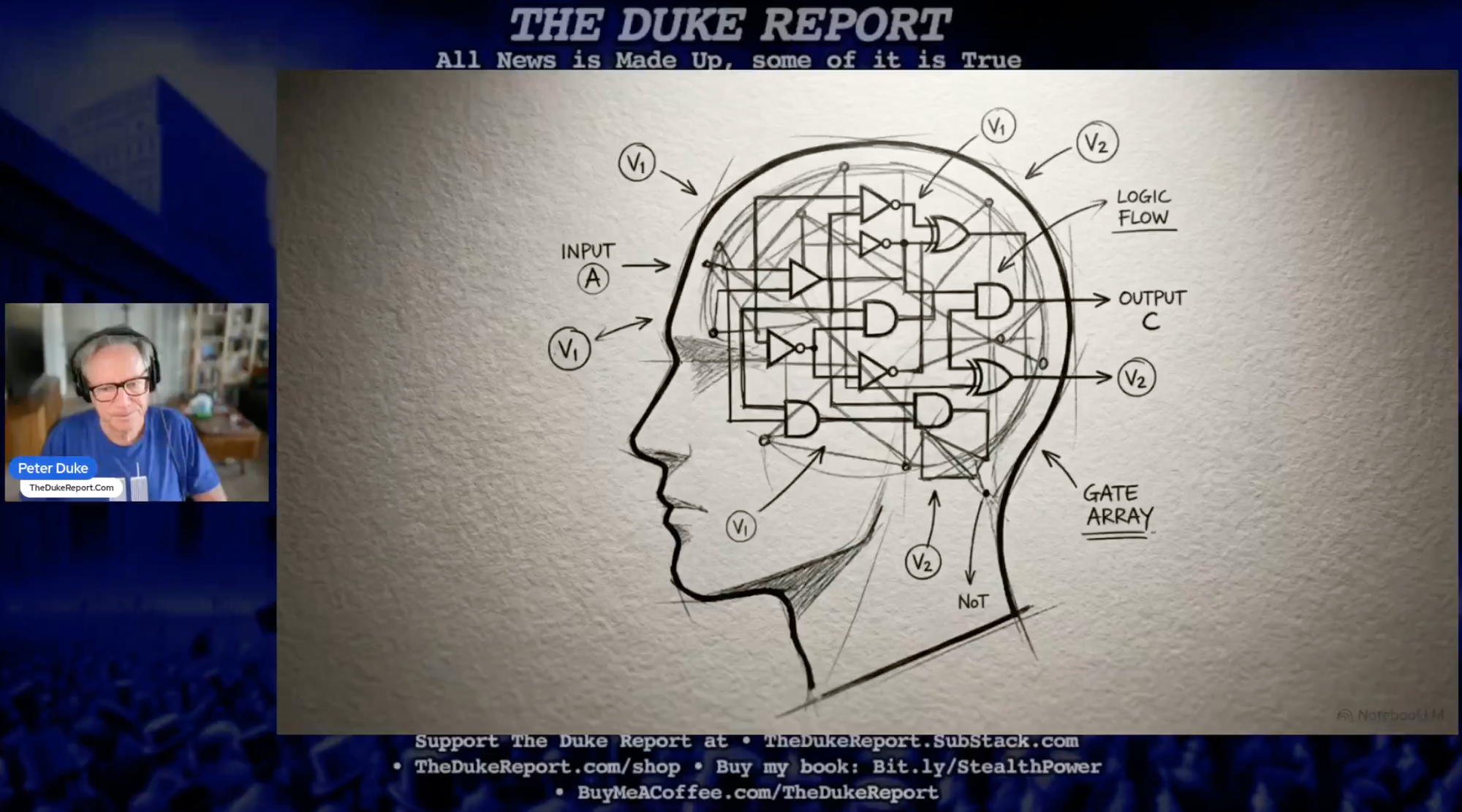
A ~75-minute live-stream episode of The Duke Report in which Peter Duke presents his article "The Architecture of Belief." He defines "epiwar" as epistemological warfare — "the battle to define how you know what you know" — and argues that all psychological warfare, "mind war" and psy-ops (e.g. MKUltra) are subsets of controlling the methodology by which people determine what is true.
 The Duke Report™️
Click to read and listen to the full explanation
1. The central thesis
Humans never interact with reality directly; they operate on abstract linguistic maps of reality. Language compresses a rich, multi-dimensional experience ("deep structure") into a narrow, linear string of words ("surface structure"). This compression is governed by three structural rules that can be weaponised to construct false realities, but because they are grammatical they leave structural artefacts that can be algorithmically recovered.
2. The "metamodel of epistemological recovery"
Duke presents the NLP metamodel as the toolkit for auditing how language has been manipulated. He frames the explainer video (lines 75–170) as the formal statement of the framework.
3. A "missing" curriculum
Duke argues the classical trivium and quadrivium are incomplete. He proposes adding three disciplines he believes get a person closer to reality than the traditional seven:
- Linguistics
- Epistemology ("how do you know that?")
- Ontology
He claims the 10 metamodel patterns (deletion, distortion, generalisation) cover the ~3,000 logical and scientific fallacies catalogued on "the Ethical Skeptic" website, making them simpler and faster to learn.
4. The "map is not the territory"
Attributed to Alfred Korzybski, taught to Stuart Chase. Unconscious people mistake their map for the territory. Duke links this to the Greek word syniadesis, which he treats as the Greek form of "consciousness" — the ability to recognise that you have a frame.
5. The "logos" nominalisation — Duke's origin story
The nominalisation that "really got me started" is the translation of the Greek logos in John 1:1. He argues logos is an active process (conveying ideas through language) but was frozen into the static noun "the word" — a political translation decision he traces to the Council of Nicaea.
6. The Chomsky "misdirection" thesis (speculative)
Duke advances a self-described "gut feeling": that Manufacturing Consent was promoted to make Chomsky famous for something other than Syntactic Structures (1957), the foundational book for NLP, so that people doing background checks wouldn't examine it. He explicitly flags this as speculation — "a finger in the air… I don't have substantive proof on this."
7. Cause-effect and complex equivalence — the two patterns
Duke credits Matteo Morelli for telling him he only needs to learn two patterns, used together:
- Cause-effect — "A causes B" / "this happened because that happened"
- Complex equivalence — "this means that"
He says politicians rarely speak without saying "A caused B because C."
8. Robert Dilts's "Sleight of Mouth" — 14 reframes
Dilts, a student/associate of Grinder and Bandler, identified 14 ways to dismantle a cause-effect / complex-equivalence statement. Duke gives four worked examples against the statement "protesting against genocide in Gaza means someone is anti-Semitic":
- Challenge the implied causation — how does a position on a military action produce a position on an entire ethnicity?
- Counter-example — has anyone protested a military action and remained sympathetic to the associated people?
- Chunking up — does opposing any government's military policy make a person hostile to the associated ethnic group? (step out of the false dichotomy and reframe)
- Apply to the self — does supporting military operations in Gaza make someone anti-Palestinian? (complete inversion)
9. The "render unto Caesar" example — metamodel in the New Testament
Duke's self-described "most important point": the red-letter New Testament conversations of Jesus are interrogative in nature and specifically target deletion, distortion and generalisation. The Pharisees + Herodians set a double bind (answer "yes" → lose the Jewish base; answer "no" → reported as a seditionist). Jesus reframes by asking a question — a "metaframe / sleight of mouth" example he says is ~2,000 years old. His conclusion: Dilts, Grinder, Bandler, Chomsky, Korzybski and Chase did not invent these techniques; they documented them.
10. Robert Lifton — techniques at scale
- Loaded language — e.g. the communist accusation of a "bourgeois mentality," a nominalised, invisible process used to imprison and kill.
- Thought-terminating clichés — "trust the science," "it is what it is": short phrases used to stop thinking, deployed on an industrial scale. Duke treats "conspiracy theorist" as the contemporary equivalent, used to shut down critical thinking about moon landings, atomic weapons, 9/11, vaccines, pandemics, assassinations and chemtrails.
11. The double bind applied globally
Duke frames "take the vaccine or lose your job" as a double bind applied to ~8 billion people, documented by Gregory Bateson. His contention: societal-level double binds produce schizoaffective disorder at a population-wide level, citing Matthias Desmet as having "his own version of it." He speculates (flagged as "high-octane speculation") that A24 is a "psychological warfare movie studio" designed to trigger dissociative states, using the film If I Had Legs I Would Kick You as an example.
12. Liberty vs. freedom
- Liberty — external; freedom bestowed by someone with power over you (etymology: the "Liberty cap," which he theorises is a foreskin symbol).
- Freedom — internal; something you take for yourself; inalienable per the Declaration of Independence.
He credits Guido Preparata for confirming the Latin-based languages use libertad, not a distinct "freedom" word.
13. Pharisees and Freemasons
Duke claims Pharisee derives from an Aramaic root (P-A-R-A-S) meaning "to divide and measure" — which he says immediately explains the Freemasons' compass and square: the compass draws a boundary (inside/outside), the square measures what fits. Both Pharisees and Freemasons "delineate boundary conditions and then defend those boundary conditions" — the same need-to-know compartmentalisation used by the CIA. He names Ben Shapiro as a contemporary practitioner of this pattern.
14. "Testament" etymology
Duke claims testament relates to testes — "I swear this is true on my balls, on my ability to procreate as a man," citing the Abraham story of placing a hand under the thigh!
15. The net message — logos as the untakeable thing
The one thing "the oligarchy cannot take away from us is our logos." The kingdom of God is within you; you can't opt out of your logos — you can only be talked into not using it. He draws the parallel to the end of The Wizard of Oz: Dorothy always had the power; she just had to exercise her agency / "synodesis."
16. Education: knowing vs. thinking
Duke's closing argument: the point of the education system for at least 120 years (possibly originating with Francis Bacon) has been to train people to know things rather than to think. Jeopardy, daytime television, standardised testing and "No Child Left Behind" all reinforce memorisation over the active process of thinking.
17. Q&A highlights
- How to get people to think: ask questions that create cognitive dissonance, while building rapport. Recommends Dilts's Sleight of Mouth (vols. 1 and 2). The foundational epistemological question: "How do you know that's true?" (illustrated with the Cernovich / Scott Pelley 60 Minutes exchange). Notes belief change can take ~three days, paralleling the Resurrection.
- AI and dark NLP: believes Chomsky/Bandler/Grinder work is implicit in LLMs; ChatGPT and Claude "for sure know Robert Dilts's 14 patterns." Says he built a Chrome plug-in that highlights deletions/distortions/generalisations in any web text. Warns troll farms likely use LLMs to mass-produce reframes.
- Epstein: says Epstein was "a pyramid head on an incredibly large operation" that is still fully operational.
- Manipulation and intent: the difference between Jesus and Tony Robbins is intent. Using metamodel questions toward a preconceived outcome is manipulation; if the intent is agape (love, freeing the other person), it is aligned with God; if not, it is aligned with sin ("Satan just means the opposer").
- Best way to wake people up: Matthew 18:20 — "where two or more are gathered." Get one or two people together for coffee and ask them questions; more than ~11 people and "bad things can happen."
Key lists extracted verbatim from the transcript
The three linguistic compression mechanisms (from the explainer video)
- Deletion — crucial relational information left out entirely (e.g. "they made a mistake" → ask who specifically? what specifically?)
- Distortion — presenting subjective interpretation as objective fact; most significant form is nominalisation (freezing a dynamic process into a static noun: inform → misinformation; inquiring → the science)
- Generalisation — stretching a limited set of variables to a universal scope (e.g. "people always let me down")
The metamodel recovery interrogatives
how, what, who, when, where, why
The three added disciplines Duke proposes for the trivium/quadrivium
- Linguistics
- Epistemology
- Ontology
The intellectual lineage Duke traces (chronological)
Korzybski → Bateson → Chomsky → Lifton → Bandler → Dilts → present day
The four Sleight of Mouth examples given (against "protesting genocide in Gaza means someone is anti-Semitic")
- Challenge the implied causation
- Counter-example
- Chunking up (step out of the frame and reframe)
- Apply to the self (inversion)
Lifton's two at-scale techniques
- Loaded language (e.g. "bourgeois mentality")
- Thought-terminating clichés (e.g. "trust the science," "it is what it is")
Accuracy check (to guard against hallucination)
A few of Duke's attributions check out cleanly against the sources; a couple are contested or overstated. Flagging these so the review doesn't launder his claims:
- ✅ Stuart Chase, The Tyranny of Words (1938), drawing on Korzybski — confirmed. The 1938 Harcourt, Brace edition exists, and reviewers explicitly note Chase "borrows" from Korzybski's general semantics, including levels of abstraction [1][2].
- ✅ Robert Dilts, Sleight of Mouth, 14 patterns, targeting cause-effect and complex equivalence — confirmed. Multiple NLP sources state Dilts modelled Bandler's argument skills and produced 14 original patterns that specifically disrupt complex-equivalence and cause-effect structures [3][4].
- ✅ Gregory Bateson, double bind theory, schismogenesis — confirmed. Bateson and colleagues first stated double-bind theory in the 1950s (the 1956 paper "Toward a Theory of Schizophrenia"); Bateson also coined schismogenesis [5][6].
References