Forks in August
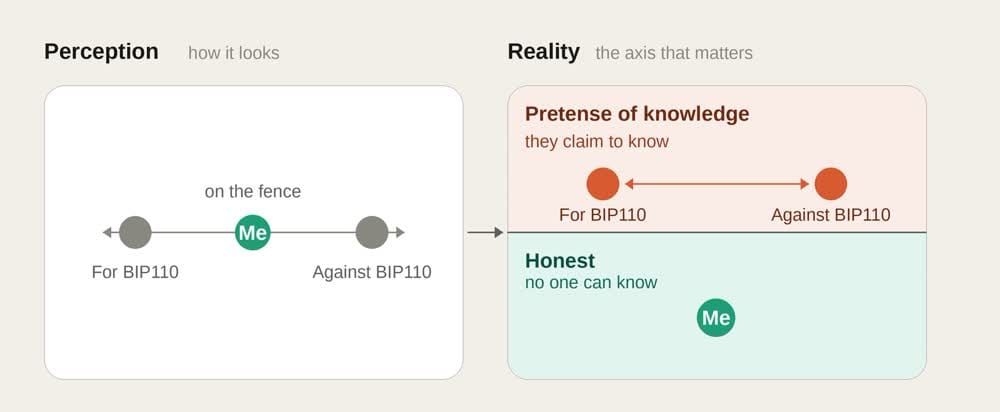
As background and introductions, read this excellent article by Jimmy Song.

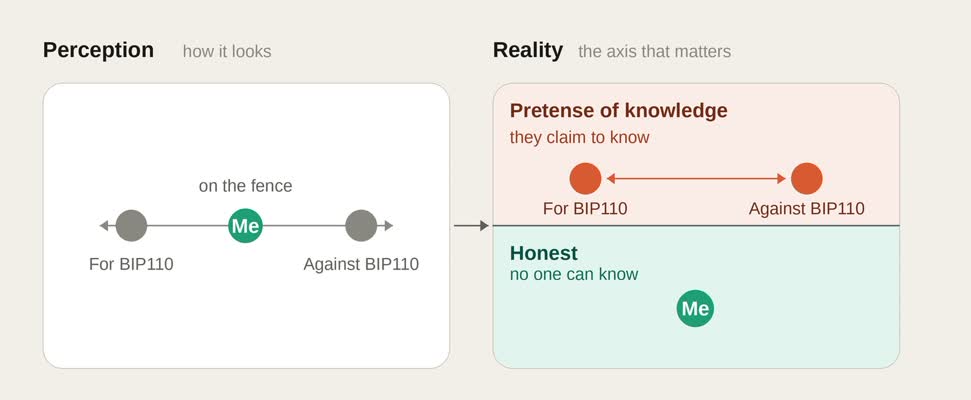
A most interesting analysis by Jimmy Song
1. BIP-110 "Reduced Data Temporary Soft-fork" (RDTS) — early August 2026
- Author: Dathon Ohm (draft proposed December 2025)
- Activation window: Mandatory signaling begins at block 961,632 (estimated August 7, 2026), running through block 963,647
- Purpose: A 1-year temporary soft fork aimed at restricting Ordinals-style arbitrary data inscriptions at the consensus level. Restrictions automatically lift after 52,416 blocks
- Mechanism: Uses a modified BIP9 deployment with a lowered 55% miner signaling threshold (instead of the usual 95%). If that threshold isn't met naturally, enforcing nodes will reject any block in the mandatory window that fails to signal bit 4
- Status (late June 2026): Miner signaling is around 0.31–0.80% — far below the 55% threshold — raising concerns about a potential persistent chain split. Adam Back and Jameson Lopp have called the activation parameters reckless and technically flawed
2. eCash hard fork (Paul Sztorc) — August 2026
- Proposer: Paul Sztorc (LayerTwo Labs CEO, long-time Drivechain advocate)
- Target: Block 964,000, August 2026 - Mechanism: A near-copy of Bitcoin Core using the same SHA-256d mining algorithm, with a one-time difficulty reset at launch. BTC holders receive eCash tokens 1:1 based on balances at the fork block (hold 4.19 BTC, get 4.19 eCash)
- Key feature: Activates BIP300/BIP301 Drivechains — a sidechain architecture Sztorc first proposed in 2015. Seven Layer 2 Drivechains are reportedly ready for deployment at launch
- Controversy: Sztorc has framed it as both an "exit plan" and a pressure tactic — he says he'll call it off if Bitcoin Core activates BIP300/301 before August, which is considered unlikely. The proposal has drawn strong criticism from the Bitcoin Core community, with some developers calling it a "theft" or "hazardous airdrop," though the fork does not actually move Satoshi's BTC
- Institutional angle: This would be the first major fork where the largest holders are ETF sponsors, corporate treasuries (e.g., Strategy's ~818,334 BTC), and regulated custodians rather than retail — creating novel questions about how forked assets must be handled under ETF prospectus language
Recently Completed (for context)
Bitcoin Cash "Layla" upgrade — May 15, 2026 (completed)
The BCH network underwent its scheduled annual hard fork on May 15, 2026, implementing four CHIPs (Bitcoin Cash Improvement Proposals): P2S (Pay to Script), Bounded Looping Operations, Functions, and Re-Enable Bitwise Operations — giving the BCH "Bitcoin VM" support for loops and functions for more complex smart contracts
Things to keep in mind
- Bitcoin forks historically fail to gain meaningful traction (Bitcoin Cash, Bitcoin Gold, Bitcoin SV, etc.), and developers have explicitly warned that the eCash airdrop should not be treated as "free money" [8:1][12]
- Splitting forked coins is risky — using a "coin-splitter" tool exposes your private keys and BTC to potential theft. Never enter seed phrases into untrusted software.
- BIP-110 is technically a soft fork but the very low miner support and mandatory-signaling enforcement mechanism make an actual chain split a real possibility — worth watching closely around August 7.
- Timelines are block-height-based, not date-based, so the "August" estimates can shift if block production deviates from the ~10-minute average.
If you hold BTC and care about claiming any forked coins, the standard advice applies: control your own private keys (not on an exchange) well before the fork block, and wait for the dust to settle before interacting with splitter tools.
The Risk of a "Separate Minority Chain" — How It Would Unfold
The Core Mechanism
When a UASF-style activation like BIP 110's mandatory signalling kicks in, two sets of nodes are running different rules. BIP 110 nodes will reject any block that doesn't signal bit 4; non-BIP 110 nodes will accept those same blocks. If miners don't overwhelmingly comply with the signalling requirement, the network diverges into two separate blockchains — each with its own history from the split point forward [1].
Jameson Lopp explains the consequence bluntly:
"This greatly increases the chances of a 'chain split,' in which there are 2 competing chains vying to be 'the real Bitcoin.' During a chain split scenario you should expect the entire ecosystem to grind to a halt as a result of uncertainty around which fork will win and resulting double-spend risks." [1:1]
Adam Back's prediction is even more specific: with miner signalling at only ~0.3% of hash power as of late June 2026, he says there is "virtually no chance" the proposal achieves activation through consensus. Instead, he predicts supporters would simply "fork off and find out" — creating a low-hashrate minority chain while Bitcoin continues operating unchanged on the original chain [2][3].
How It Would Appear: A Timeline of Events
Phase 1 — The Split Point (Block ~961,632, ~August 2026)
BIP 110's mandatory signalling begins. From this block onward, BIP 110-enforcing nodes reject any block that doesn't signal bit 4 [4]. If the vast majority of miners (who control ~99.7% of hash power) ignore this requirement:
- The original chain continues normally — miners produce blocks every ~10 minutes, non-BIP 110 nodes accept them.
- The BIP 110 chain stalls — its nodes reject those blocks and must wait for a miner (any miner) to produce a block that does signal bit 4.
Phase 2 — The Difficulty Wall
This is the most critical mechanical problem. Bitcoin adjusts its mining difficulty only every 2,016 blocks (~2 weeks). If the BIP 110 chain captures only a tiny fraction of hash power, its blocks will take enormously longer to produce — potentially hours, days, or even weeks per block — until the next difficulty retarget [5].
As Bitcoin.com warned during the 2017 BCH fork era:
"A minority chain with a minuscule amount of hashrate that goes up against bitcoin's current difficulty will have a tough time surviving. It means that the hashrate minority will have to wait for 2016 blocks until the difficulty can be adjusted. With no mining power, a chain in this state facing bitcoin's difficulty could very well come to a screeching halt." [5:1]
Bitcoin Cash survived this only because its developers implemented an Emergency Difficulty Adjustment (EDA) — a special algorithm that rapidly lowered difficulty outside the normal 2,016-block cycle [5:2]. BIP 110 does not include such a mechanism. The BIP 110 chain would use Bitcoin's standard difficulty adjustment, meaning it could face weeks of near-paralysis before blocks speed up.
Phase 3 — Exchange Halting
Exchanges are the first to react. Lopp warns the "entire ecosystem" will "grind to a halt" [1:2]. In practice, this means:
- Exchanges freeze BTC deposits and withdrawals to avoid crediting coins from the wrong chain.
- Trading may continue on existing balances, but no new deposits can be confirmed — because exchanges cannot determine which chain's confirmations are valid.
- This happened during the 2017 BCH/BSV hash war: Coinbase suspended BCH trading and took weeks to enable withdrawals of the new BSV coin [6].
Phase 4 — Replay Attacks and Double-Spend Risk
After a split, the same UTXOs exist on both chains. A transaction signed and broadcast on one chain can be "replayed" (copied) onto the other chain, because the signatures are valid on both [7].
This means:
- If you send 1 BTC on Chain A, an attacker (or anyone observing the transaction) can broadcast the same signed transaction to Chain B, spending your 1 BTC on that chain too — without your consent.
- This is a form of unintended cross-chain double-spending [8].
- Users may accidentally transact on the wrong chain, leading to permanent losses [9].
Phase 5 — Security Vulnerability of the Minority Chain
A low-hashrate chain is trivially vulnerable to 51% attacks. If the BIP 110 chain has, say, 1% of Bitcoin's total hash power, then any miner controlling even a small fraction of the original chain's hash power could rent or redirect enough hash power to overpower the BIP 110 chain entirely [10].
This enables:
- Deep reorganisations — an attacker secretly mines a longer chain and then publishes it, erasing transactions that were previously confirmed.
- Double-spending on the minority chain — the attacker can spend coins, get confirmations, then rewrite the history.
- Complete chain destruction — a sufficiently motivated attacker could render the minority chain unusable.
Jimmy Song noted this risk during the 2017 UASF debate: "Whoever has the minority hashing power chain may get attacked and their fork will be less stable, less usable and risk having an embarrassing or..." outcome [11].
Historical Precedents — What Actually Happened
| Fork | Year | Outcome for Minority Chain |
|---|---|---|
| Bitcoin Cash (BCH) | Aug 2017 | Survived only due to Emergency Difficulty Adjustment; became a permanently separate altcoin with a fraction of BTC's value and hash power [5:3] |
| BCH → BSV split | Nov 2018 | "Hash war" between BCH (ABC) and BSV; exchanges halted trading; BSV became a separate, low-value chain [6:1] |
| BIP 148 (UASF) | Aug 2017 | No split occurred — miners blinked and signalled via BIP 91 before the deadline [12] |
| SegWit2x | Nov 2017 | Cancelled before activation — no chain was produced [13] |
The critical difference: BIP 148 worked because it was a credible threat that miners took seriously — major exchanges, businesses, and node operators signalled intent to run it, and miners chose to comply rather than risk a split [12:1]. BIP 110, by contrast, has ~0.3% miner signalling and lacks the broad ecosystem backing (exchanges, wallet providers, major businesses) that made BIP 148's threat credible [1:3].
What Happens to Ordinary Users
| Scenario | What It Means for You |
|---|---|
| You hold BTC on an exchange | Deposits/withdrawals frozen for days or weeks; you cannot move your coins until the exchange determines which chain is "real Bitcoin" [1:4] |
| You hold BTC in your own wallet | Your coins exist on both chains simultaneously. Any transaction you broadcast may be replayed on the other chain without your knowledge [7:1] |
| You run a BIP 110 node | You follow the minority chain. Your node sees the original chain's blocks as invalid. You may wait hours or days for each block confirmation [5:4] |
| You run a standard node | You follow the original chain, which continues normally. You may not notice anything happened unless you check |
| You're a merchant | You cannot reliably accept payments — you don't know which chain your customer's transaction will settle on, and confirmations may be unreliable on both chains during the uncertainty period [1:5] |
| You're a Lightning Network user | Channel states depend on on-chain transactions for enforcement. If the chain you're watching stalls or reorganises, your channels may become unsafe to keep open — you might not be able to force-close or punish a cheating counterparty |
The Most Likely Outcome (Based on Current Data)
With miner signalling at 0.3% and prominent figures like Adam Back and Michael Saylor publicly opposing the proposal [2:1], the most probable scenario if BIP 110's UASF mechanism triggers is:
- The original Bitcoin chain continues essentially unchanged — ~99.7% of hash power keeps mining it.
- A BIP 110 minority chain emerges with negligible hash power, producing blocks extremely slowly (potentially hours or days apart) until difficulty adjusts.
- Exchanges freeze all BTC movements temporarily, causing market uncertainty and possible price volatility.
- The BIP 110 chain becomes a de facto altcoin — listed separately on exchanges (if at all), with its own price far below BTC's, similar to how BCH or BSV became separate assets [2:2].
- Most BIP 110 supporters eventually abandon the minority chain and return to the original chain — or hold both, treating the BIP 110 coin as a separate speculative asset.
Back's summary is concise: the proposal's supporters would simply "fork off and find out", creating a low-hashrate minority chain while Bitcoin continues operating unchanged [2:3].
Why BIP 148 Succeeded Where BIP 110 May Fail
| Factor | BIP 148 (2017) | BIP 110 (2026) |
|---|---|---|
| Miner signalling at deadline approach | Rising — miners were feeling the pressure | ~0.3% — near zero [1:6] |
| Exchange/wallet backing | Broad — major businesses signalled intent to run UASF nodes | Limited — no major exchange or wallet has publicly committed |
| Credible threat | Yes — miners believed a split would happen and complied via BIP 91 [12:2] | Weak — with ~0.3% hash power, miners face little pressure to comply |
| Prominent opposition | Minimal from major industry figures | Adam Back, Michael Saylor, and multiple developers publicly opposed [2:4] |
| Outcome | No split — SegWit activated cleanly | Split appears likely if UASF triggers |
The key insight: a UASF only works as a credible threat. BIP 148 never actually split the chain because miners capitulated. BIP 110's problem is that, without enough economic weight behind it, miners have no incentive to comply — and the UASF becomes not a threat but an actual fork, producing the very minority chain its critics warn about.
References
- BIP-110 Pushes Bitcoin Toward August Fork Deadline With Only 5 EH/s Signaling (26%) ↩︎ ↩︎ ↩︎ ↩︎ ↩︎ ↩︎ ↩︎
- Adam Back Rejects BIP-110 as 'Technically Defective' (12%) ↩︎ ↩︎ ↩︎ ↩︎ ↩︎
- BIP-110 Supporters Push for Activation as Adam Back Warns of... (6%) ↩︎
- BIP-110 / Knots Designed To Fork Off From The Beginning (and fail) (2%) ↩︎
- Fork Watch: The Chain With Less Hashrate Could Come to a Screeching Halt (22%) ↩︎ ↩︎ ↩︎ ↩︎ ↩︎
- Updated: What to Expect During the Bitcoin Cash Hard Fork (5%) ↩︎ ↩︎
- How Do Replay Attacks Impact My Assets after a Blockchain Split? (7%) ↩︎ ↩︎
- What Are the Security Implications of Replay Attacks after a Blockchain ... (1%) ↩︎
- What is What is a fork in blockchain? Exploring chain... | CoinTracker (2%) ↩︎
- BIP-110 Pushes Bitcoin Toward August Fork Deadline With Only... (5%) ↩︎
- UASF BIP148 Scenarios and Game Theory | by Jimmy Song - Medium (4%) ↩︎
- BIP 148 (UASF) | LearnBitcoin (8%) ↩︎ ↩︎ ↩︎
- Major Bitcoin Forks: What Split the Chain and What Changed (1%) ↩︎