Four regime changes
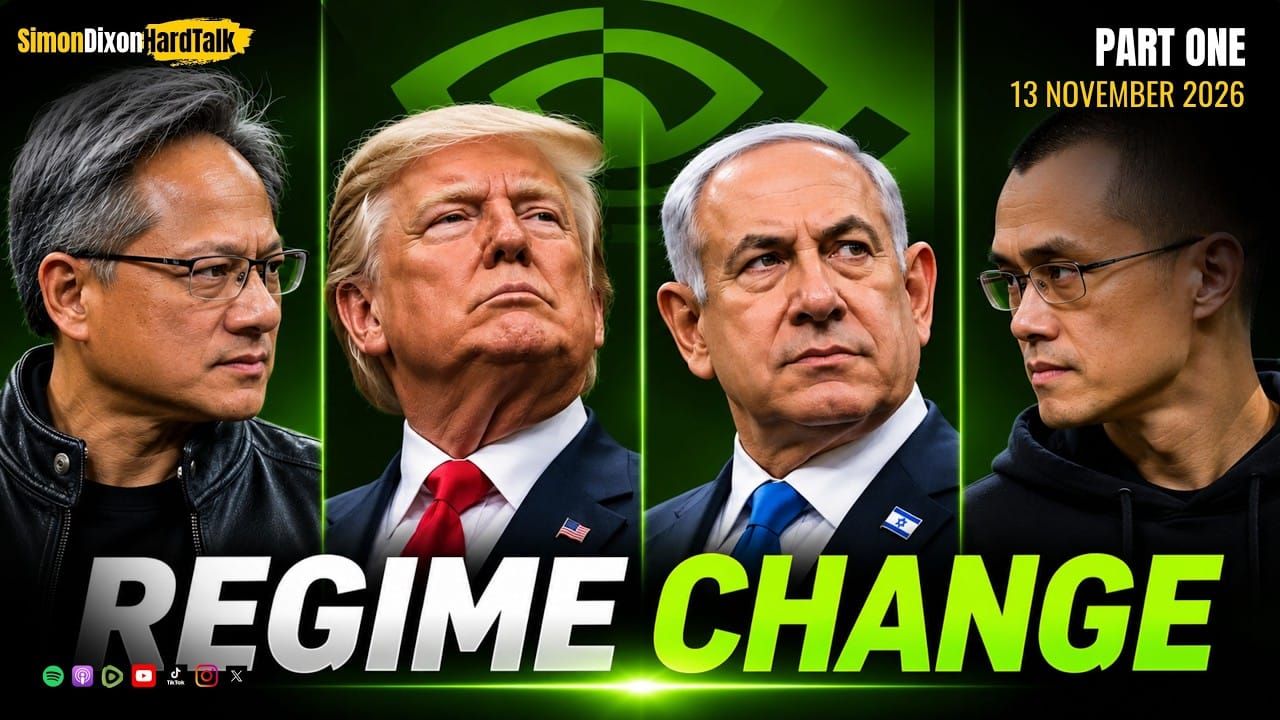
After roughly four to five weeks off air, Dixon returns to argue that four "regime changes" have been set in motion — two corporate (Nvidia, Binance) and two at country level (the Trump administration/United States, Netanyahu's Israel) — and that these are not separate stories but one coordinated struggle between three power blocs competing over the emerging technocratic "global control grid". His central thesis: the headlines are a deliberate information flood designed to radicalise and divide the audience, and only "following the money" through the power complexes reveals what is actually happening.
1. The framework: three power complexes
Dixon sets out his model before analysing any of the four events.
| Complex | Character | Relationship to the state |
|---|---|---|
| Financial industrial complex (FIC) | Retail banks (create money via lending), investment banks (securitisation/financialisation), asset managers, central banks | In the West, government answers to the complexes |
| Technical industrial complex (TIC) | The "Magnificent 10" (formerly seven — Microsoft, Apple, Meta, Google, Nvidia, plus SpaceX, and soon Anthropic and OpenAI), Palantir and other military-tech firms | Global in nature; an AI arms race "partnership" between China and private capital |
| Military industrial complex (MIC) | Defence contractors, intelligence agencies, covert operations | More nationalistic; funded by state budgets as well as capital markets; the FIC can "rent" the MIC when it needs a war |
Key points he makes about this structure:
- In China the complexes are subordinate to the government (he notes the CPC/CCP naming point); in the West the government is subordinate to the complexes and lobbies.
- The FIC is the most powerful and is global, hosted in the US because the dollar is the world reserve currency — hence vast capital inflows into US equities and debt subordination via Treasuries.
- Asset managers are pivotal: BlackRock, State Street and Vanguard hold board seats, and roughly 60 people vote on around 127,000 resolutions a year. Dixon says Aladdin, BlackRock's risk/scenario technology, is used on approximately $25 trillion of capital, alongside about $15.3 trillion of assets the firm manages.
- The system privatises gains into stock markets and socialises losses onto government debt, producing a K-shaped economy; "the more crisis, the better", since every crisis concentrates wealth upwards.
- Military-industrial business models come in three flavours: genuine defence (protection-racket style, as in Perkins's Confessions of an Economic Hit Man), destroy-and-rebuild, or the "forever war" (he cites Afghanistan: 20 years, roughly $2 trillion spread across budgets).
- He explicitly rejects the idea that politicians are simply incompetent: "they're not idiots… they're serving lobby power", and a politician who does not serve it "gets regime change".
The psychological operation argument
Dixon opens by warning that following minute-by-minute news keeps you "stuck in the fog of war", where "every headline is somebody else's propaganda". He argues there is a deliberate flooding of information to overwhelm people and push them into pre-built ideological boxes (far right, radical left, "the Jews rule the world", "the Muslims are invading"), because a radicalised, headline-hopping population is easier to capture into a "technocratic control grid". His advice: follow the money, ask why a source wants you to believe something, and guard your attention.
2. The Nvidia "regime change"
This is the longest section and the episode's centrepiece.
The trigger. He plays clips announcing that Jensen Huang is out as Nvidia CEO, framing it as an operation he had called in real time on X, for which he says he was dismissed as a conspiracy theorist.
Why Nvidia is exposed.
- Nvidia sits at the intersection of all three complexes and was the world's largest company by market capitalisation at roughly $5 trillion (since corrected, with Apple back at number one).
- Huang owns only about 3–4% of shares and has no supermajority voting rights — unlike Musk, Palantir and Meta — making him "ripe for regime change".
- The board has 11 members, 10 of them independent, and in his hierarchy founders and executives answer to the board, which answers to capital.
The underlying factional conflict. Dixon argues the TIC and FIC wanted Huang to stay, because they want revenue, higher valuations and a strong IPO pipeline (he cites SpaceX's listing at $1.75 trillion, Trafigura's reported $2 trillion ambition, and OpenAI's private-market valuation of about $1.4 trillion with its IPO delayed). The MIC, aligned with Israel, wants export controls maintained and escalation over Taiwan. China's share of Nvidia's business has, he says, drifted from significant to roughly zero, while chips reach China indirectly — Malaysia buying far more than it needs through private companies, Singapore paying for exports landing in Malaysia.
The mechanism he describes.
- Reputation destruction via alleged affairs — one with a person he describes as an alleged Chinese spy connected to the Malaysia–Singapore–China flows, one with a senior Nvidia employee, and reportedly a third. He stresses that intelligence had this material for about a year, and that "whether it's true or not, it doesn't matter" — it can be weaponised either way.
- A PR-driven share-price crash, giving the MIC leverage and a narrative about export controls and the AI arms race.
- A conspiracy-theory debating season in which everyone blames their preferred villain.
- Corporate-governance grounds (conduct/HR policy breaches) so the board can act, followed by Huang stepping down.
- A replacement acceptable to capital — he notes Trump suggesting Tim Cook-type professional management rather than a founder with voting control.
His conclusion: "It looks like the MIC just won the operation", using Nvidia's boardroom as the battleground — while the FIC remains hedged across every outcome. He flags that the CFO had been negotiating a $6–7 billion acquisition of an Israel-connected military-technology company, bringing Unit 8200-linked executives and additional MIC-aligned board influence into the firm.
3. The Trump / US regime change
- Dixon traces Trump's funding and alignment: Musk (TIC), the Mellon banking family (FIC), Miriam Adelson (MIC/Israel), and covert funding routes he links to the UAE investment into Binance and Gulf sovereign wealth funds via Affinity Capital Partners (an investor in an Israeli insurance and pension fund).
- His read: Trump's largest long-term financial interest lies with the Gulf, so he is structurally more FIC/TIC than MIC — hence the oscillation between export controls and negotiated deals.
- He points to a "blue wave" in the midterms weakening Trump, and to JD Vance — "Palantir-groomed", Thiel-funded, a TIC node — being positioned as the 2028 "president of peace" who can take credit for a Middle East settlement, with Marco Rubio as the MIC-aligned alternative.
- The Trump ledger, as Dixon presents it: the GENIUS Act and stablecoin regulation (programmable money for the control grid); DOGE handing data to Palantir and SpaceX; the tariff war that drove the world into regional blocs; the Epstein files release weakening the dollar and the Iran war strengthening it again; and "cashing in" for the remaining two years.
- Geopolitically, he argues the US is retreating "through the Strait of Hormuz" into a regional power — explicitly comparing it to the British Empire after Suez — doing "its half" of TIC/MIC/FIC alongside China.
4. The Netanyahu / Israel regime change
- He claims record Arab turnout in the Israeli elections, yielding (by his estimate, which he asks viewers to correct) around 17–20 seats, split across parties, against the 61 needed for a coalition.
- His long-standing prediction, restated: a Palestinian state will eventually be created — not for justice, which he says Palestine lacks the power to obtain, but because Saudi normalisation requires it. He ties this to Trump's "Board of Peace", tokenised Palestinian land, and a leaked Tony Blair-linked reconstruction plan that reportedly includes an Elon Musk data centre and a new regional bridge.
- The three conditions he says he identified years ago for ending the Middle East forever war: Iran–Saudi normalisation, a Palestinian state, and the exit of US bases.
- His mechanism for Israel's transition from an MIC/TIC node to a FIC/TIC node: privatisation and listing of state defence assets — Elbit already listed on Nasdaq, Rafael still state-controlled — with the FIC gaining influence through Phoenix Capital, Affinity Capital, BlackRock/State Street/Vanguard and Israeli ETFs. Israel's debt-to-GDP has risen, he says, from 60% to 70% at higher interest rates, loading the government up and pressuring Netanyahu.
- On Iran: he describes the repeated seven-point plan as effectively unchanged before, during and after the war, because the FIC wants Iran opened up, the TIC needs energy, and the MIC profits from the tension. Iran's leverage comes from armed groups in Yemen, Gaza and Lebanon; the IRGC (controlling banking, military, ports, with 90% of oil sales going to China) prefers the status quo, while reformists want normalisation brokered through Beijing.
- On the petrodollar: he describes its components as the Treasury market, OPEC and arms purchases funded by Treasury yields, plus Gulf currency pegs to the dollar — now eroding because China is the actual buyer of Gulf and Iranian energy.
- On Syria and Venezuela: he calls both "very easy" regime-change operations, and highlights Scott Bessent sanctioning banks in Egypt, Turkey and the UAE, the UAE leaving OPEC and obtaining an FX swap line, and Oman (unsanctioned, integrating banking with Iran) joining Visa/Mastercard and SWIFT.
5. The Binance regime change
- The sequence he lays out: Israel and IDF-linked entities demand seizure of Palestinian, Lebanese and Turkish accounts (which he characterises as "financial genocide"); Binance is taken down by the DOJ for money laundering allegedly benefiting Iran, Hezbollah and Hamas; CZ serves four months; the DOJ settlement requires a US government-appointed compliance controller; KYC surveillance expands dramatically; then a $6.3 billion hack is attributed to North Korea's Lazarus Group, with about $3 billion recovered via stablecoin seizures (Circle, Tether) and $1 billion covered by Binance's SAFU fund — leaving roughly $2 billion, which he pointedly compares with the $2 billion UAE investment in Binance equity.
- That $2 billion, he says, flowed through USD1, the stablecoin of World Liberty Financial, whose shareholders he identifies as the UAE, the Trump family and the Witkoff family — Witkoff being the Middle East envoy. Shortly afterwards, Nvidia chips went to the UAE and Binance received a UAE licence.
- He also links the earlier crypto consolidation to FTX (a "fake node" to pull Bitcoin away from self-custody), Celsius (whose co-founder he says worked in the Israeli Prime Minister's Office), a Bancor DAO-linked hack involving Netanyahu's niece and nephew, and Michael Saylor's Bitcoin treasury company with alleged intelligence-community staffing.
- Sentence comparison he draws: Sam Bankman-Fried 25 years, Alex Mashinsky 12 years, CZ 4 months — contrasting terrorism-financing and money-laundering exposure with the fact that banks rarely jail executives for financial fraud, "they just do the crime and pay the fine".
- His warning: AI-driven hacking of hardware wallets and self-custody setups, plus wrench attacks and data breaches. He recommends simply running Bitcoin Core on a laptop and holding keys yourself.
6. Closing argument
Dixon frames the whole picture as decentralisation versus centralisation: a global technocratic control grid built by the TIC, integrating the MIC and FIC through stablecoins, programmable money, cyber-security and robotic warfare, alongside a multipolar world of regional blocs managed by the FIC and destabilised by war in Europe. His practical conclusion is individual: control your own data and keys, allocate capital deliberately, boycott where you can — "you only control yourself". He announces his book, A Game of Money, for January 2027, and hands over to Part Two: his interview with John Perkins, author of Confessions of an Economic Hit Man (2004), titled "Confessions of Two Economic Hit Men". He also cites The Grip of Death by an author he names as "Michael Rau Bau" (most likely Michael Rowbotham) — a book he says exposed IMF mechanics, after which, he claims, the author disappeared.
ELI5 summary:
Recall that the world is run by three big clubs:
- Money club – banks and investors, who want to make money from everything.
- Tech club – huge companies like Nvidia, Google and Palantir, who build the clever machines.
- Army club – weapons makers and spies, who make money from wars and fear.
Dixon says these clubs fight each other to control the future, and that politicians mostly do what they're told. He also thinks the news floods us with scary stories on purpose, so we get angry and divided instead of asking who benefits.
He then looks at four "regime changes" — big shake-ups:
- Nvidia – its boss Jensen Huang lost his job. Dixon says Nvidia's boardroom became a battleground between the clubs. His claim: the army club won, using rumours about Huang's private life and a share-price crash to push him out.
- Trump and America – Trump is pulled between the money and tech clubs (who want deals) and the army club (who want control and conflict). America is shrinking back to being one big regional power, a bit like Britain after Suez.
- Netanyahu and Israel – Dixon predicts a Palestinian state will eventually happen, not out of fairness but because Saudi Arabia won't make peace without one. Israel is being pushed to become more about money and tech, less about war.
- Binance – the crypto exchange got punished, then a huge hack happened, and Dixon thinks the numbers line up suspiciously neatly with Gulf money and Trump-linked crypto.