Francis O'Neill
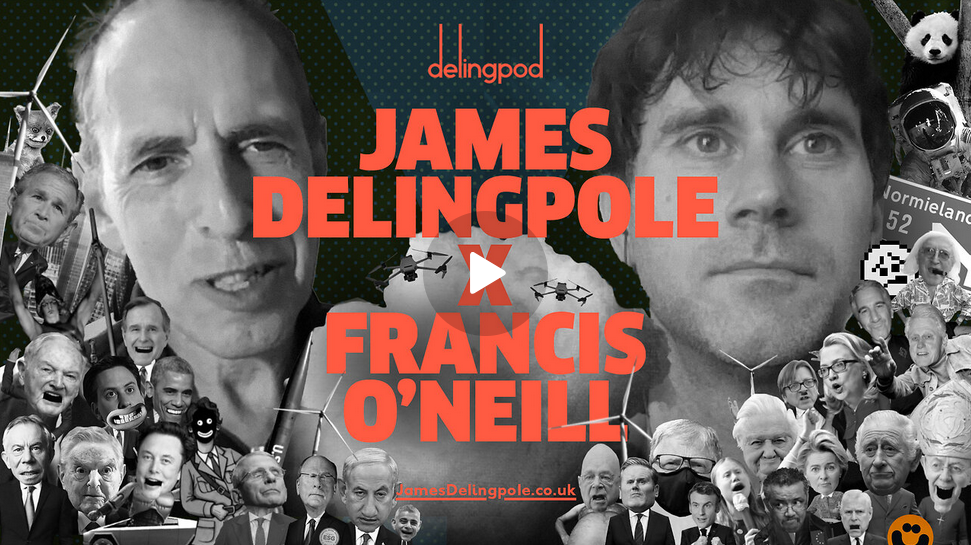
The interview begins with personal reflection on grief and mortality. James's father has recently died, and he describes the disorienting experience of wanting to share news with someone who is no longer there, and the shift from being "the kid" to "the grown-up" in the family pecking order. Francis empathises, sharing that both his parents are still alive — they recently celebrated their 50th wedding anniversary — but he's becoming increasingly aware of the passing of time.
Infiltration of the "Awake" Movement
This is the interview's central and most striking theme. Both men express deep dismay at how heavily infiltrated the alternative/truth movement is. Key points:
- Francis describes being "painfully aware" of infiltration, noting that even he — with experience from the 9/11 truth movement — has been surprised by how many people he interacted with as genuine turned out to be infiltrators. He says: "they must have been laughing at me when I was saying these things on podcasts".
- Deception operates through the unexpected. Francis gives examples of unlikely COVID vaccine promoters:
- A page-three girl (Leilani Downing)
- A black Instagram fitness/bodybuilding guru who posted about getting his COVID shot — someone you'd expect to be in the "pure natural health" camp
- The general point: "Deception works by deceit. So if you can recognise it, then it's not going to work."
- An unnamed "ex-medic" podcaster in awake circles who publicly says all vaccines are bad, yet published a lengthy Substack article endorsing vaccination as prophylaxis for meningitis — an article Francis believes was AI-generated. Francis and James see this as a tell: someone who publicly takes the "right" position but then subtly undermines it in writing.
De-racination and the Natural Life
Francis articulates a worldview that humans were meant to live close to the land — building homes, growing food, rearing and slaughtering livestock — rather than becoming "sustainability consultants" or engaging in usury. He argues:
- Self-sufficiency makes you hard to compromise: "if you were able to sustain yourself then it's very difficult to be compromised. What do you need from anyone?"
- The process of slaughtering animals gives reverence for food and may discharge aggression, making for a more peaceful society.
- James agrees, sharing that nobody loves the fox more than hunting people — they want healthy fox populations; only the mangy, old, or livestock-predating foxes are killed, and that is part of a divinely ordained natural balance.
- Both men describe being de-racinated from traditions, the land, and God's creation over the last century, turned into "automatons" — a process they believe is deliberate.
Organised Sport as Freemasonic Control
Francis raises a provocative argument that football clubs were introduced as Freemasonic tools for divide and rule:
- Every city got at least two major clubs (Everton vs Liverpool, Man U vs Man City) to divide populations.
- Before organised sports, young men would have learned hunting, self-defence, archery, swordsmanship — skills that made them capable of defending themselves and their property.
- Organised sport replaced these with ball skills, whilst simultaneously weapons were confiscated and forbidden, producing a population that "don't know how to defend themselves and they can't grow anything and they can't hunt."
James's David Icke tell: James recounts raising the Freemasonic football connection with David Icke before a live event, expecting Icke to agree enthusiastically. Instead, Icke "didn't want to talk about it" and sort of denied it. James found this bizarre for someone billed as the world's leading conspiracy theorist.
Witch-Hunting and Division Within the Truth Movement
James expresses discomfort with the current trend of Substack voices acting as "witch finder generals" — particularly those targeting UK Column's funding model. Francis agrees this is a difficult balance but insists:
- No alternative media outlet should be above question.
- The whole deception of lockdowns and psychological operations worked because people trusted people they shouldn't have trusted.
- "If there are reasonable questions, then we require reasonable answers."
UK Column Specifically
Francis raises questions about Marcel Yanke, a German businessman with a 20% stake in UK Column whose involvement was initially secret. He also notes:
- He applied for work at UK Column after losing his studio post-lockdown; Debbie Evans replied warmly but he never heard back from the (male) directors.
- A man called Montgomery Tom joined the Yellow Boards and within two minutes was working for both UK Column and Together — two organisations that had kept Francis at arm's length.
- Montgomery Tom is described as "a pound shop Charlie Kirk" who sits outside universities with a desk to debate people, and whose profile was amplified by mainstream outlets like The Spectator.
The Ed the Techie / Bobmor Elephant
Francis raises what he calls a "huge elephant in the room" concerning Bobmor (Bob, the cartoonist) and Ed the Techie:
- Ed Ed the Techie was an apparently obscure figure who:
- Defended the Lucy Connolly story (which Francis and others see as a psychological operation)
- Attacked Mary for exposing its alleged fakery
- Did a podcast with Sergeant Grumpy (an actual policeman) with ~100 views
- Recently died, prompting a disproportionate eulogy from Bob
- Anomalies Francis highlights:
- The man died at 5am; by 7pm Bob had produced a cartoon, written a eulogy, and announced the death to Twitter before the family did
- Bob doesn't normally celebrate other people on his Twitter — he mainly shares his own work
- Ed the Techie was "on the wrong side of lots of things" and was trying to shut down questioning of the Lucy Connolly story
- When Francis and others questioned the eulogy, they received massive pushback — more than when discussing far more sensitive topics like dead babies or school shootings
- Francis concludes: "Once the operation is done, then it doesn't matter anymore… when the operation is not finished and they haven't achieved their goals, then it's precious"
- Bobmor's art sales: Francis tallied Bob's painting sales at approximately £1,125,000 (paintings alone, before prints and books). He questions whether the conspiracy community — a small market — can genuinely sustain prices comparable to old masters' works on paper, suggesting this could be a mechanism for funnelling money.
- James's response is measured: he loves Bob, says Bob has never wronged him, and frames his position as "I will speak about anyone without fear or favour… I can't make categorical accusations or conclusions. I found the explanations to be unsatisfactory."
Abby Roberts Arrest — Anomalies
Francis recounts witnessing Abby Roberts' arrest at the COVID Inquiry, identifying multiple anomalies:
- Security allowed them behind the cameras when previously they'd been moved on instantly
- The policeman escalated rather than de-escalated, effectively daring her to swear so he could arrest her
- Instead of removing her quickly (standard procedure), they let her pontificate to the media who formed a ring around her
- She was offered a minibus instead of a police van after claiming claustrophobia — unusual accommodation
- When Francis went to Holborn police station, they had no record of her — they didn't know who he was talking about
- The next day, Abby and Charlotte (another figure Francis distrusts) seemed "very heightened" and were "enjoying themselves and laughing a lot" — not what he expected from someone who'd just been held overnight
- Charlotte took a photo of Francis and posted it on the internet before he got home
Francis now questions whether Abby was ever actually at the police station, saying: "now that you don't trust somebody, you don't know any part of their story is true or not."
Darren Nesbitt / The Light Newspaper
Francis notes that Darren Nesbitt from The Light newspaper posted on Substack calling James "classic MI5 and very odd in a not good way." Francis and James both raise questions about The Light:
- How could one man set up and print a newspaper during the darkest days of lockdown and distribute it so quickly?
- The name has Freemasonic connotations
- It carries gold investment adverts — unusual for a conspiracy publication
- Headlines are sometimes so extreme they seem designed to repel normies rather than convert them
David A. Hughes ("Academic PhD Guy")
Francis expresses deep scepticism about David A. Hughes:
- He flaunts his PhD — credentials only valued in the corrupt system the movement opposes
- He came for both Francis and James with critical articles
- He ran a GoFundMe for his disabled child's chair (£3,000) but kept it open until he'd raised £15,000
- Francis questions how a man with a disabled child and a university job could ditch that job to rely on Substack income — either very principled or very well-supported
- James notes Hughes did important work exposing Reiner Fuellmich and Marcel Yanke, creating a paradox: how can someone be both a "wrong 'un" and do genuinely important work?
Francis's framework: "Disinformation is 95% true, otherwise no one will believe it."
Other Notable Figures and Patterns
Francis identifies recurring patterns among suspected infiltrators:
- Prolific output — they don't have to worry about work because they're being paid
- Sympathetic backstories — sick children, bereavements — that make them difficult to question without appearing heartless
- Cross-promotion networks — Abby Roberts, Fiona Rose Diamond, Debbie Hicks, Trudy (amplified by the BBC for suicide awareness despite being a vocal dissident) — they share and amplify each other's content
- Provocative public behaviour — sandwich boards, sit-down debates at universities (Montgomery Tom style) — designed to discredit the cause
- Deletion of evidence — Abby deleted all her Substack comments and Twitter posts when challenged, a tactic Francis says mirrors 9/11 truth infiltration methods
Francis's Assessment of James
Francis tells James he's "the last man standing" that he doesn't have major questions about, because:
- All the people who came from GB News, Talk Radio, GNC — he doesn't trust any of them
- Even figures like Desmond Swayne, Charles Walker, Peter Hitchens flipped and endorsed the vaccine after initially opposing lockdowns
However, he raises two mild queries:
- James sometimes seems to push a Christianity vs. Muslims polarity
- James's "maverick flippancy" — giving attention to topics like Paul McCartney or pandas — could be used by enemies to discredit all his claims by association (the "David Icke problem": if the same person says the Queen is a lizard AND the jab is dangerous, normies dismiss everything)
James defends his position: everything should be questionable from first principles, including the true purpose of the Beatles (Tavistock Institute, generational division, drug encouragement, family breakdown), and he argues this is as important as vaccine scepticism.
Key Principles Francis Articulates
- "The only reason we have been deceived in the past is because people have been able to deceive us."
- Infiltration isn't "bickering" — "this is where the rubber meets the road."
- When supposed friends publicly insult you online, then pretend to be friendly in person, "you know there's a deception taking place."
- Being attacked by people with no obvious reason to attack you is itself a tell — "there's no reason to come for me."
- He reserves the possibility that some people simply see things differently rather than being controlled, but the questions must be asked and answered.
Closing
James finds the conversation depressing and worries it will create more division — precisely what he fears the enemy wants. Francis acknowledges his discomfort but stands by the necessity of asking questions. They agree to discuss lighter topics next time, though Francis quips that "My Little Pony and Teletubbies" are probably mind control too.