Gen-Z is the dumbest
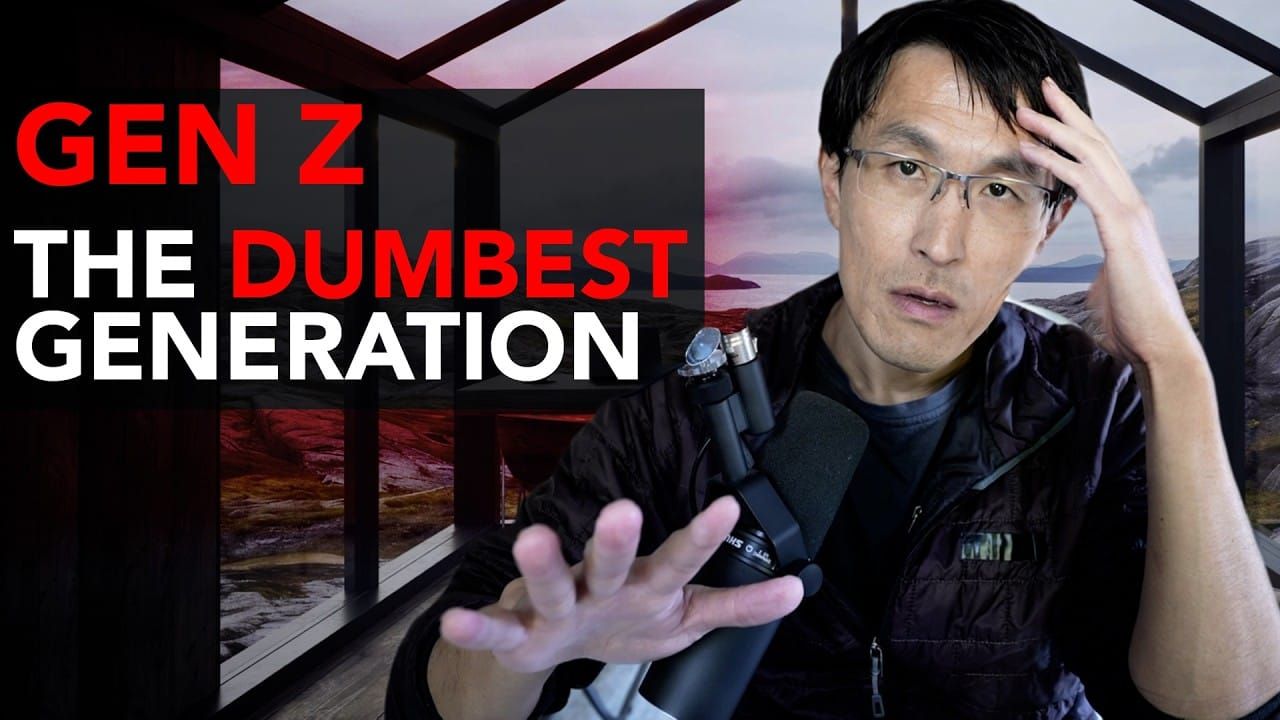
TechLead opens with a provocative claim: Gen Z is 'now being called the dumbest generation,' citing a 'top neuroscientist' to assert that this is 'the very first generation who did worse in school than the generation before them.' He frames the argument across three interlocking forces — declining cognitive performance, accelerating AI commoditisation of intelligence, and the widest generational wealth gap in recorded history — and concludes that society is entering a 'post-intelligence era' where taste, looks, and 'aura' matter more than intellect.
1. The Cognitive Decline of Gen Z
TechLead argues that Gen Z underperforms 'on basically every cognitive measure,' listing the following areas of decline:
- Attention
- Memory
- Literacy
- Numeracy
- Executive function
- General IQ
He adds that 'most of these young people are actually overconfident about how smart they are,' summarising the dynamic as: 'the smarter people think they are, the dumber they actually are.' [Lines 4–9]
Key academic data points
| Claim | Detail cited in transcript |
|---|---|
| UC San Diego admissions | One in eight admitted students 'cannot do middle school math' — they 'cannot do fractions' [Lines 36–38] |
| Scale of increase | 5 years ago only 30 students could not do fractions; now it is 900 — 'almost a 30x increase' [Lines 38–39] |
| Grade inflation | 'Some of these kids had 4.0 GPA, perfect academic grades' yet still could not do middle-school maths [Lines 39–40] |
| Professor response | 'More than 500 UC professors signed a letter begging for the SATs to make a comeback' [Lines 43–44] |
| National 12th-grade maths | 'Just hit the lowest levels ever recorded. Almost half of seniors are below basic level' [Lines 45–46] |
| Reading habits | 'Young adults are averaging under six books a year. Half of Americans read zero' [Lines 47–48] |
2. The AI Singularity and Commoditisation of Intelligence
TechLead states that the situation is 'about to get a lot worse' because 'the AI singularity [is] now upon us.' He lists a rapid-fire series of model releases 'this week':
- Meta — Muse Glimmer (an 'OpenWeight Model')
- OpenAI — 'GBD 5.6' and '6 cyber for cyber security'
- xAI — Grok 4.6, 'taking on Frontier models'
- DeepSeek — V4 Pro
- Google — Gemini 3.7 Flash, 'just 3 weeks after having announced 3.6 Flash'
- Alibaba — open-weights Qwen 3.8 Max
- ZAI — GLM 5.3
His core thesis: 'Intelligence is fast becoming commoditised. Its value [is] quickly dropping to zero' — or 'about 20 bucks a month,' the cost of a chatbot subscription that can produce 'any essay, any mathematical proof, any analysis, any line of code written for you on tap.'
The 'nerds' narrative
TechLead argues that 'for 70 years, being the smart kid was the one way out,' but that 'this entire career path just got automated.' He delivers a pointed jab: 'It's the first time in history a class of people paid for their own replacement and called it a funding round' — a reference to tech investors funding the very AI tools that displace knowledge workers.
The MIT brain-atrophy study
He cites an MIT study in which students were placed in groups and asked to write 'three different ways: using just their brain, using Google search, or ChatGPT.' Findings as described:
- The ChatGPT group 'showed way lower brain activity'
- They 'could not even remember what they wrote because they didn't write it themselves'
- 'That laziness stuck around in their brains even after the AI was taken away'
He draws a parallel with his own experience, admitting: 'anytime I feel my brain starting to work a little bit, I feel a little bit of that mental stress. I think, you know what, just use the AI.
The Mexico university cheating scandal
TechLead cites 'Mexico's biggest university' moving its entrance exam online for the first time, with 160,000 students and an AI proctor watching via webcam. He reports:
- 'The top scores 5xed [five-folded] than normal'
- 'Analysts figured roughly half may have cheated by pointing their questions at the chatbot just outside of the frame'
- '58,000 students may have to now retake the exam in person on paper'
He highlights the irony: 'an AI proctor was used to catch humans using AI. The machines were just fighting each other and the students were the operators.'
3. Social Media 'Brain Rot' — The Decade Before AI
TechLead is careful to note that 'before ChatGPT even existed, the brain rot was already a decade deep in with social media influencers, TikTok, Instagram, infinite scrolling. That was the original digital crack.' He identifies curiosity as 'the first thing it destroyed,' because scrolling is 'a one-way feed served tube into your brain. You receive but you never ask and you never respond.'
Observations on Gen Z behaviour
- 'Nobody reads books anymore. Nobody researches things anymore'
- '41% of Gen Z search social media before Google'
- 'For them, the research is watching TikTok'
- 'You'll notice more people still scrolling TikTok and Instagram rather than asking ChatGPT questions' on a lunch break
- Gen Z 'do not ask questions and they do not respond to questions really either'
He quantifies the exposure: 'if you do this 7 to n hours a day every single day then you can imagine the wreckage.'
4. Employability and the Workplace
TechLead argues that 'employers are calling Gen Z unhirable,' citing several workplace complaints:
- Most Gen Z hires 'don't even know what they would talk about with co-workers' — they were 'the co [COVID] generation'
- Professors 'literally beg their classes for any questions at all' but receive only 'that dreaded Gen Z stare, the same kind of look you get when you're staring at a feed waiting for it to load'
- 'Most companies say their recent grad hires were unsatisfactory'
- 'Most say they fire Gen Z hires within just a few months'
- The 'number one complaint' is communication — 'Gen Z gets four times as many complaints about communication than Gen X'
He also warns that Gen Z employees may be 'more interested in trying to look [snatched] and aura-mog you and then record their employment on camera in order to expose your company or business for likes rather than to actually do a decent job.'
5. The Rational Market Response — Looks Over Brains
TechLead offers a provocative economic re-interpretation of Gen Z's behaviour. He argues their choices are not purely stupidity but a market response:
- 'They realise their grades were inflated and mostly fake. Whereas likes are instant, public, quantifiable, and real'
- 'Apps like Instagram and Tinder paid out with real social currency'
- 'The rational play most people realised was to stop trying to look smart, but to rather look good on camera'
- He lists the resulting behaviours: 'looks-maxing, aura-mogging, jawline routines'
6. The AI Industry's Financial Unsustainability
TechLead challenges the notion that AI is creating broad opportunity. He asks: 'Where is the app boom anyway? Where's that Cambrian explosion of world-changing new apps and websites?' He observes that 'I don't see anybody using ChatGPT or cloud agents ordering pizza.' Key claims:
- 'These AI companies are losing a lot of money still'
- 'OpenAI reportedly lost over $20 billion last year'
- 'The whole industry is running on circular deals where it seems investors are paying out other investor funds'
- 'The goal is to IPO in order to get the retail investors to backstop the whole thing'
7. The Economic Picture — Graduate Unemployment and the Wealth Gap
Graduate outcomes
- '42% of recent grads are unemployed or underemployed' — 'the worst number since 2020'
- 'Being smart used to be scarce and useful. Now it's abundant and decorative'
- 'Entry-level jobs are being fed to the machine'
- 'The labour force participation rate [is] at nearly a 50-year low'
The generational wealth gap
| Generation | Share of US wealth (as cited) |
|---|---|
| Boomers | 'Roughly half of all wealth in America, around $90 trillion' |
| Millennials + Gen Z combined | 'Around just 11%' |
He summarises the frustration: 'You can work all day, study hundreds of textbooks, grind it out, outthink everybody, and still lose to some guy whose only strategy was being born in 1974.'
8. TechLead's Provocative Conclusion — The 'Post-Intelligence Era'
TechLead closes by arguing that conventional strategies — getting a degree, building a startup, 'doing 10,000 hours of anything' — may no longer be the highest-ROI moves. Instead, he suggests half-jokingly that 'the highest ROI move is just calling grandma every Sunday,' because 'maybe this is the generation where we go back to understanding that real wealth cannot be earned. It is inherited, stolen, or married into — pick one.' He insists 'the one thing you cannot do is outthink it.'
His final thesis: 'In a post-intelligence era, what matters most? Taste, looks, aura. Maybe Gen Z's got it right.' He leaves the audience with an open question: 'In a post-intelligence era, what are you going to value?'
Key Themes at a Glance
- Cognitive decline is real and measurable — Gen Z scores lower than their parents across attention, memory, literacy, numeracy, executive function, and IQ.
- Grade inflation has eroded credibility — students with 4.0 GPAs cannot do middle-school maths; grades are 'a fictional story.'
- AI is commoditising intelligence — its value is 'dropping to zero,' at roughly '$20 a month,' automating the path that 'nerds' relied on for 70 years.
- Brain atrophy is demonstrable — the MIT study showed lower brain activity in ChatGPT users that persisted even after AI was removed.
- Social media 'brain rot' preceded AI — a decade of infinite scrolling destroyed curiosity first; 41% of Gen Z search social media before Google.
- Gen Z's behaviour is a market response — when grades are fake but likes are 'instant, public, quantifiable, and real,' the rational move is to optimise for appearance, not intellect.
- The AI industry is financially unproven — OpenAI allegedly lost over $20 billion; the sector runs on 'circular deals' aimed at IPOs.
- The wealth gap is structural — Boomers hold ~$90 trillion (~50% of US wealth); Millennials and Gen Z combined hold ~11%.
- The 'post-intelligence era' rewards taste, looks, and aura — TechLead provocatively suggests Gen Z may have instinctively adapted correctly.
- Self-promotion — the Tech Lead Pro segment pitches a paid crypto/DeFi community claiming members earn 'thousands of dollars per day.'
All figures, claims, and quotations above are drawn directly from the transcript text. TechLead's assertions — particularly regarding cognitive data, OpenAI's losses, and wealth-gap statistics — are presented as he stated them and have not been independently verified here.