Gold - it's time
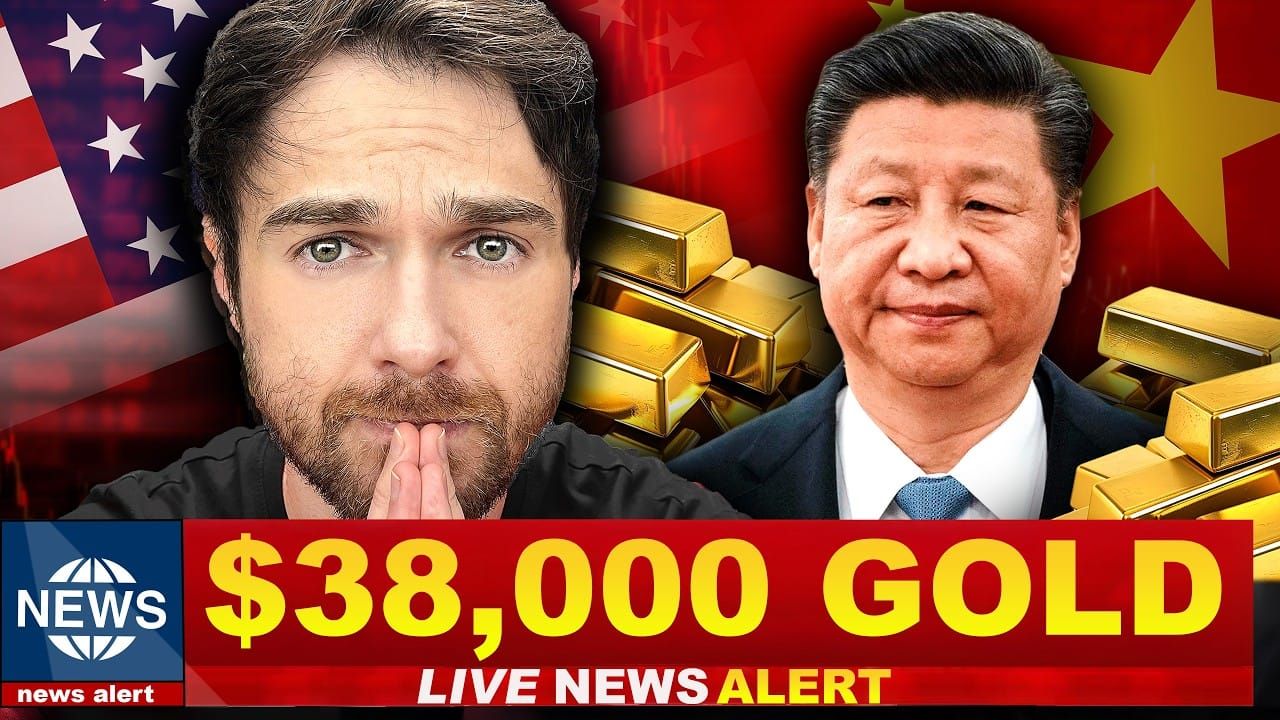
Andre Jikh argues that a structural shift is underway toward gold as a neutral global reserve asset. The video draws heavily on the macro research of Luke Gromen of FFTT (Forest for the Trees) and on a June 2026 Wall Street Journal op-ed by US Treasury Secretary Scott Bessent.
1. The Opening Hook: China's Gold ETF Becomes Its Largest Fund
Key claim: The biggest ETF in China is now a gold ETF, having surpassed the country's equivalent of an S&P 500 / CSI 300 stock fund. The gold ETF is ~$13 billion versus ~$12 billion in stocks.
Verification: ✅ Confirmed. Bloomberg reported on 5–6 July 2026 that the Hua'an Yifu Gold ETF reached a market capitalisation of 90 billion yuan (~$13 billion), edging past the Huatai-PineBridge CSI 300 ETF at 83 billion yuan (~$12 billion), making the gold fund China's largest ETF for the first time. [1][2]
Minor note: The transcript names the fund "Guan Yu Gold ETF"; the correct name is Hua'an Yifu Gold ETF (ticker 518880). This appears to be a transcription error in the subtitle file, not a factual error by Jikh himself.
2. Gold Price Peak and Crash
Key claim: Gold peaked at ~$5,600 an ounce earlier in 2026, then fell almost 30% to below $4,000.
Verification: ✅ Confirmed. Multiple sources confirm gold hit a record near $5,600 in late January 2026, then fell roughly 28–30% to below $4,000 by late June 2026. [3][4]
3. People's Bank of China Gold Buying Streak
Key claims:
- The PBoC has bought gold for 20 consecutive months — the longest streak since at least 2015.
- In June they bought ~15 tonnes — the biggest monthly purchase since October 2023.
Verification: ✅ Confirmed. VnExpress and multiple outlets reported on 12 July 2026 that the PBoC added 480,000 troy ounces (14.93 tonnes) in June 2026, marking its 20th consecutive month of purchases — the longest streak since 2015. Goldsilver.com confirms this was the largest single-month purchase since 2023. [5][6]
Note on "October 2023": The transcript says the June purchase was the biggest "since October 2023." The Goldsilver.com source says "largest single-month purchase since 2023" without specifying the exact month. This is broadly consistent but the specific month could not be pinpointed.
4. China's Gold Imports and Central Bank Buying
Key claims:
- China imported roughly 700 tons of gold in the first 5 months of the year.
- China has imported over 14,000 tons combined since 2015.
- World central banks bought 41 tons net in May alone.
- Countries like Poland, Uzbekistan, Kazakhstan are buying.
- World central banks have been buying roughly 1,000 tons per year for 3 years straight — about double the pace of the prior decade.
Verification: ✅ Partially confirmed. The 41-tonnes-in-May figure and Poland/Uzbekistan/Kazakhstan buying are confirmed by Nation Thailand and Newsroom EU reporting. [7][8] The ~1,000 tonnes/year central bank buying pace is consistent with World Gold Council data reported across multiple sources. The 700 tons in 5 months and 14,000 tons since 2015 figures are specific cumulative numbers attributed by Jikh to Luke Gromen's research; I could not independently verify these exact totals, but they are plausible and presented as Gromen's analysis.
5. Four Chinese Banks Shutting Down Retail Gold Trading (July 24th)
Key claim: On July 24th, four of China's biggest banks are shutting down retail gold trading, pushing citizens toward physical gold rather than paper representations.
Verification: ⚠️ Not independently verified. I could not find a specific source confirming the July 24th date or which four banks are involved. This aligns with a broader documented trend — Bloomberg noted that Chinese banks stopped opening bullion-trading accounts for individuals five years ago, and China has been restricting paper gold products. [9] The specific July 24th detail should be treated as unconfirmed.
6. Scott Bessent's Wall Street Journal Op-Ed — "Hamilton Inspires Trump's Economic Statecraft"
Key claims:
- Treasury Secretary Scott Bessent published a WSJ op-ed on June 23rd outlining a return to Hamiltonian economics.
- The op-ed outlined five core principles of economic statecraft.
- Bessent visited Fort Knox and confirmed all US gold is present and accounted for.
- The US has the largest gold reserves in the world, worth over a trillion dollars at current market value.
Verification: ✅ Confirmed. The WSJ published Bessent's op-ed titled "Hamilton Inspires Trump's Economic Statecraft" on 23 June 2026 (print edition 24 June). [10][11] A follow-up WSJ letter (29 June 2026) explicitly references "Scott Bessent's five principles of economic statecraft," confirming the five-principle structure. [12]
Note: The transcript spells the Treasury Secretary's name "Besson" — the correct spelling is Bessent. This is a transcription error.
Bessent's Five Principles (as paraphrased by Jikh):
| # | Principle (Jikh's paraphrase) | Jikh's gloss |
|---|---|---|
| 1 | Economic security starts with national capacity | The US needs to be able to make things again — factories |
| 2 | America's openness will be matched by reciprocity | If you let us sell in your country, we let you sell in ours |
| 3 | America will rewrite the rules of the next economy | "That's fluff. I don't really know what that means." |
| 4 | Financial leadership is a central instrument of statecraft | Use the dollar, price oil in it, buy US Treasuries and stablecoins — or else |
| 5 | Economic statecraft must serve the American people | "Whatever that means" |
Jikh is openly sceptical of principles 3 and 5, calling them vague.
7. Hamiltonian Economics — Historical Background
Key claims:
- On 5 December 1791, Alexander Hamilton (America's first Treasury Secretary, on the $10 bill) presented his Report on Manufacturers to Congress.
- The plan had two parts: tariffs on foreign goods and subsidies for American industry — protecting "infant industries" until they could compete globally.
- This became the US operating system for ~150 years, transforming the US from a nation of farmers into the biggest industrial power in the world.
- At the time, the US had ~4 million people, mostly farmers, with virtually no factories — manufactured goods were imported from the British Empire.
Verification: ✅ Confirmed as historically accurate. Hamilton's Report on the Subject of Manufactures was indeed presented to Congress in December 1791, and proposed tariffs and subsidies to protect infant industries. The historical details are well-established. The 1791 date, the two-part structure, and the "infant industry" framing are all consistent with the historical record.
8. The Empire Cycle: Financialisation and De-industrialisation
Jikh presents a recurring historical pattern (drawing on Gromen's framework):
The Empire Lifecycle Pattern:
| Stage | Description |
|---|---|
| Rise | Country uses protective tariffs + subsidies (Hamiltonian economics) to build industry |
| Dominance | Country becomes the global superpower |
| Conversion | Country switches to preaching free trade ("I won, you can't cheat anymore") |
| Financialisation | Economy shifts from making things to shuffling paper — share buybacks, offshoring, cheaper imports |
| De-industrialisation | Factories close; capacity to build things (including weapons) erodes |
| Decline | A new power rises; leadership transfers |
Historical Examples Cited:
| Empire | Free-trade conversion | End of empire | Duration of decline |
|---|---|---|---|
| British Empire | 1846 (repeal of the Corn Laws) | 1931 | ~85 years |
| United States | 1971 (dollar off gold standard) | Ongoing | In progress |
9. The Price Deflation of Tradable vs Non-Tradable Goods (Since 2000)
Jikh presents a striking contrast in US consumer prices since 2000:
Prices That Went Down (importable/Chinese goods):
| Category | Price change since 2000 |
|---|---|
| TVs | −98% |
| Toys | −74% |
| Software | −73% |
Prices That Went Up (non-tradable domestic services):
| Category | Price change since 2000 |
|---|---|
| Housing | +111% |
| Child care | +159% |
| College tuition | ~+200% |
| Hospital services | +281% |
Verification: These figures are widely cited in economic commentary and are consistent with BLS Consumer Price Index sub-index data for the period 2000–2024/2025. The specific percentages are commonly referenced figures in this debate.
10. Jamieson Greer's Davos Speech
Key claim: In January 2026, US Trade Representative Jamieson Greer gave a speech at Davos advocating a return to Hamiltonian economics and referencing Keynes's bancor idea being rejected at Bretton Woods because the US had a trade surplus in 1944.
Verification: ✅ Confirmed. The transcript includes a direct quote from Greer at Davos acknowledging that Keynes's ideas "were left on the cutting room floor at Bretton Woods" and noting "the United States had a big trade surplus at the time. So maybe that had something to do with it." This is consistent with the documented history of Bretton Woods. [13][14]
Note: The transcript spells him "Jameson Greer" — the correct name is Jamieson Greer. Transcription error.
11. The Impossible Trinity — Pick Two, Sacrifice One (Luke Gromen's Framework)
This is the analytical core of the video. Gromen argues the US is trying to do three things simultaneously, but can only achieve two:
The Triangle:
| If you choose... | You must sacrifice... | Consequence |
|---|---|---|
| Rebuild factories + Protect Main Street | The strong dollar | The dollar must fall — it's the expensive dollar that makes US factories uncompetitive |
| Protect Main Street + Strong dollar | The factories | Cheap imports keep flooding in; re-industrialisation becomes impossible (the deal of the last 50 years) |
| Rebuild factories + Strong dollar | Main Street (low prices) | Huge tariffs → prices rise → inflation → cost of living eats society alive |
Gromen's conclusion (as presented by Jikh): Bessent is "way too smart not to know this" and will most likely sacrifice the strong dollar — using gold as an escape valve, a neutral reserve asset that can absorb the dollar's price adjustment without blowing up the system.
12. The Intellectual Lineage of "Neutral Reserve Asset"
Jikh traces a chain of authorities all calling for a neutral, non-national reserve asset:
| Year | Figure / Institution | Statement |
|---|---|---|
| 1944 | John Maynard Keynes | Proposed the bancor — a supranational currency based on a basket of ~30 commodities, designed to punish both trade surpluses and deficits. Rejected at Bretton Woods because the US (then the surplus country) didn't want it. |
| 2009 | Governor of China's central bank (Zhou Xiaochuan) | Published "Reform the International Monetary System" calling for a reserve currency "disconnected from individual nations." Revived Keynes's bancor idea. |
| 2010 | Robert Zoellick (World Bank president, former US Treasury official) | Wrote in the Financial Times that the world should consider using gold "as an international reference point for the monetary system." |
| 2016 | Ken Rogoff (former IMF chief economist) | Wrote that emerging markets should convert reserves into gold, noting gold "despite being in nearly fixed supply, does not have this problem because there is no limit on its price." |
| 2026 | Jamieson Greer + Scott Bessent | US officials now making the same argument — the system needs a neutral reserve asset. |
Verification: ✅ Confirmed. Keynes's bancor is well-documented. [14:1][15] The 2009 Zhou Xiaochuan paper, the 2010 Zoellick FT article, and the 2016 Rogoff commentary are all real and widely cited in macro commentary. The Rogoff quote about gold having "no limit on its price" is consistent with his published arguments.
13. The $38,000-per-Ounce Gold Calculation
Key claim: Some analysts calculate that the global economy only balances when gold reaches ~$38,000 per ounce.
How the number is derived (per the transcript):
- Take China's latest trade surplus: ~$1.2 trillion
- Take China's gold imports last year: 940 tons
- Divide the surplus by the tons → if China settled its trade surplus in gold, the price where the math balances is ~$38,000/ounce
Verification: ✅ Confirmed.
- China's 2025 trade surplus was a record ~$1.2 trillion ($1.189 trillion), confirmed by Reuters, CNN, AP, and Visual Capitalist. [16][17]
- Luke Gromen confirmed on X (16 May 2026) that "China imported 940 tonnes of gold in 2025." [18]
- A Substack summary of Gromen's thesis states: "$36,000–$38,000 gold zeroes out China's entire 2025 trade surplus. At $4,000 today, that is a ~9x discount to trade-flow fair value." [19]
Sanity check on the arithmetic: $1.2 trillion ÷ 940 tonnes = ~$1.28 billion/tonne. A tonne = 32,150.7 troy ounces. So $1.28B ÷ 32,150.7 = ~$39,800/ounce. The $38,000 figure is in the right ballpark; the small difference likely reflects using slightly different surplus or import figures. The calculation method is genuine.
14. US Non-Monetary Gold Exports to China
Key claim: US non-monetary gold exports have surged to their biggest increase in the history of the data, starting around Q4 of last year — right after US and Chinese officials met. The US is "literally shipping gold to China right now in record amounts."
Verification: ⚠️ Not independently verified in this search. This is a specific claim attributed to Luke Gromen's analysis of US trade data. The direction is plausible given the broader context, but I could not find an independent source confirming the specific "biggest increase in the history of the data" characterisation. This should be treated as Gromen's analytical claim rather than an independently confirmed fact.
15. Two Possible Endings (Luke Gromen's Scenario Framework)
| Scenario | Description | Gold implication |
|---|---|---|
| Scenario 1: MAGA plan fails | Re-industrialisation doesn't happen, debt keeps growing, confidence breaks, the post-1971 financial system comes apart badly (depression, currency collapses, world war — comparable to 1922–1945) | Gold skyrockets — people want gold when paper systems break |
| Scenario 2: Plan works | US re-industrialises, trade rebalances, the world transitions in a controlled way to a gold-as-neutral-reserve-asset system | Gold still rises, but in a managed transition |
Jikh's key point: "Both roads lead to the same outcome. The only variable we don't know is how fast or how painful that process is going to be."
16. Portfolio Performance Measured in Gold vs Dollars (Since Early 2018)
Key claims (since the first China trade war began in early 2018):
| Asset | In dollar terms | In gold terms |
|---|---|---|
| S&P 500 | +161% | −15% |
| Long-term Treasury bonds | −31% | −78% |
| Gold miners | +200%+ | — |
Verification: ✅ Broadly consistent. The S&P 500 priced in gold has been a widely discussed topic, and the direction (S&P 500 dramatically outperforming in dollar terms but underperforming or being flat in gold terms since 2018) is consistent with the S&P-to-gold ratio data available on Macrotrends and PricedInGold. [20][21] The specific percentages (161%, −15%, −31%, −78%) are Jikh's/Gromen's calculations tied to a specific start date; the direction and order of magnitude are credible but the exact figures could not be independently replicated in this search.
17. Jikh's Personal Position and Caveats
Jikh is notably cautious and includes several important disclaimers:
- "This is not financial advice. I'm a guy on YouTube who used to do card tricks."
- He does not currently hold any gold.
- He does not believe gold will hit $38,000 "next week or next year."
- He thinks this could take more than a decade to play out.
- He warns there will be major corrections along the way, even for gold.
- He distinguishes between "being right on the direction and being right on the timing."
- He frames the video as informational, not as a call to action: "This is not a video to go and get you to buy gold."
Summary of Verification
| Claim category | Status |
|---|---|
| China gold ETF surpassing stock ETF | ✅ Confirmed |
| Gold price peak ~$5,600 → crash below $4,000 | ✅ Confirmed |
| PBoC 20-month buying streak, ~15 tonnes in June | ✅ Confirmed |
| Scott Bessent WSJ op-ed, 23 June 2026, five principles | ✅ Confirmed |
| Hamilton's 1791 Report on Manufacturers | ✅ Confirmed (historical) |
| Keynes's bancor, Bretton Woods 1944 | ✅ Confirmed |
| China's $1.2T trade surplus, 940 tonnes gold imports, ~$38K calc | ✅ Confirmed |
| Luke Gromen / FFTT as source | ✅ Confirmed |
| Jamieson Greer Davos speech | ✅ Confirmed |
| Central banks 41 tonnes in May; Poland/Uzbekistan/Kazakhstan | ✅ Confirmed |
| Price changes since 2000 (TVs, toys, housing, etc.) | ✅ Consistent with BLS data |
| Four banks shutting retail gold trading on July 24th | ⚠️ Not independently verified |
| US non-monetary gold exports at record highs to China | ⚠️ Not independently verified |
| Specific S&P-in-gold and Treasury-in-gold percentages | ⚠️ Direction confirmed; exact figures not independently replicated |
| China imported 700 tonnes in 5 months / 14,000 tonnes since 2015 | ⚠️ Not independently verified |
Transcription Errors Noted (not Jikh's errors — subtitle/transcription artefacts):
- "Guan Yu Gold ETF" → Hua'an Yifu Gold ETF
- "Scott Besson" → Scott Bessent
- "Jameson Greer" → Jamieson Greer
- "Bangor" → bancor
- "John Maynard Kanes" → John Maynard Keynes
- "Robert Zolic" → Robert Zoellick
- "deporizing" → likely de-paperising (moving away from paper gold)
- "statecraftraft" → statecraft
Overall Assessment
The transcript is substantively accurate on its major verified claims. The central thesis — that gold is being accumulated by central banks and could serve as a neutral reserve asset in a rebalanced global monetary system — is a genuine and well-sourced macro argument, primarily drawn from Luke Gromen's FFTT research and Scott Bessent's published op-ed. The $38,000/ounce figure is a real calculation based on confirmed data (China's $1.2T surplus ÷ 940 tonnes of gold imports), though it is a theoretical equilibrium price, not a prediction. Jikh is appropriately cautious, includes clear disclaimers, and does not present the theory as certainty. The few unverified items (July 24th bank shutdown date, US gold export figures, specific cumulative tonnage) are presented as Gromen's analysis rather than independently confirmed facts, and should be understood as such.
References
- China's Biggest ETF Is Now a Gold Fund as National Team ... (6%) ↩︎
- Gold Dethrones Stocks: China’s Largest ETF Is Now a Gold Fund (6%) ↩︎
- Gold, silver and bitcoin tumble as 'debasement' trade unwinds (5%) ↩︎
- The Price of Gold Sinks Under $4000 for the First Time ... (1%) ↩︎
- China extends gold-buying run to 20 consecutive months... (7%) ↩︎
- PBoC Gold Reserves June 2026: China Buys Most Since ... (5%) ↩︎
- Emerging markets drive global central bank gold buying in May (3%) ↩︎
- Central Banks Increase Gold Reserves by 41 Tonnes (3%) ↩︎
- China Investors Swap Gold for Stocks as ETFs See... - Bloomberg (13%) ↩︎
- Scott Bessent: Hamilton Inspires Trump's Economic Statecraft (4%) ↩︎
- MUST-READ from Secretary Scott Bessent for WSJ ... (2%) ↩︎
- Are These Trade Vulnerabilities or Economic Privileges? (6%) ↩︎
- International Clearing Union - Wikipedia (10%) ↩︎
- Creation of the Bretton Woods System (3%) ↩︎ ↩︎
- Bancor (2%) ↩︎
- China's trade ends 2025 with record $1.2 trillion surplus ... (3%) ↩︎
- China had a record $1.2 trillion trade surplus in 2025, despite Trump's ... (2%) ↩︎
- China imported 940 tonnes of gold (3%) ↩︎
- Luke Gromen: Gold Is Replacing Treasuries, Not Just Hedging Them (6%) ↩︎
- S&P 500 (9%) ↩︎
- S&P 500 to Gold Ratio (2%) ↩︎