Gordon Hahn
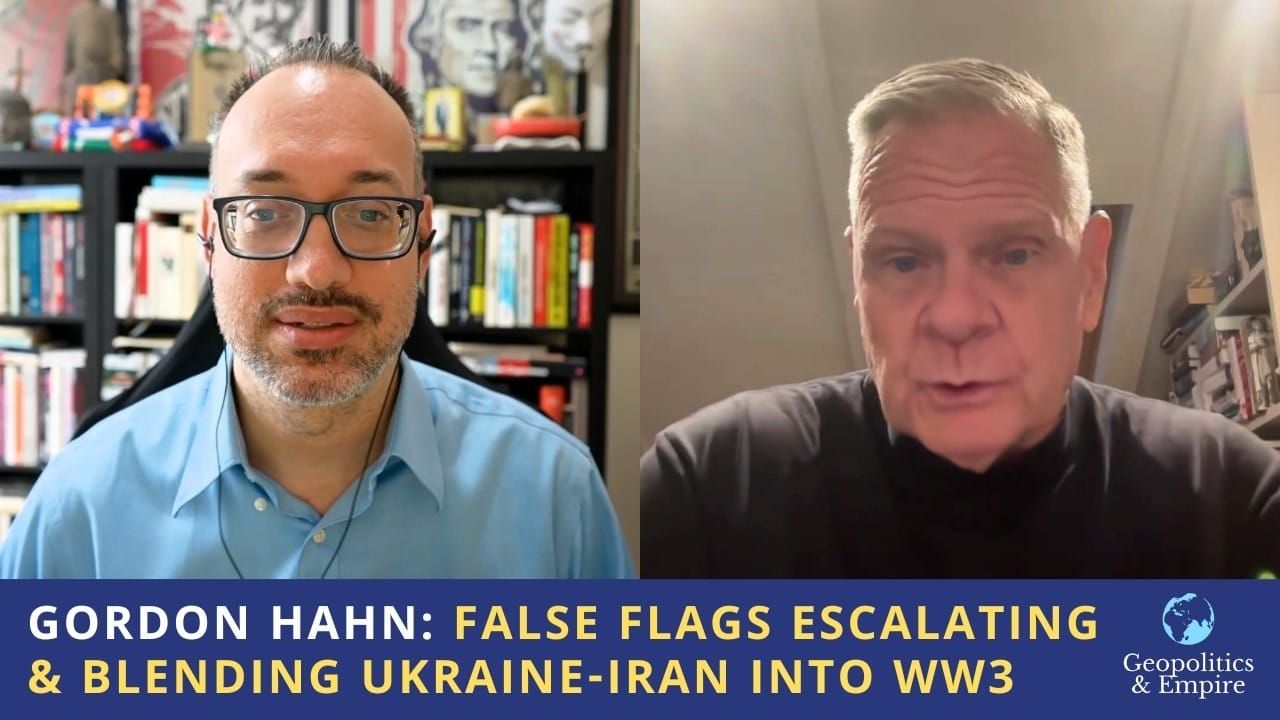
Podcast: Geopolitics and Empire (interview with Gordon M. Hahn). Hahn is an expert analyst at Corr Analytics [1], has taught at Boston, St. Petersburg State, Stanford, San Jose State and San Francisco State universities and the Middlebury Institute of International Studies, and has authored around half a dozen books on Russia and Ukraine. His work now focuses mainly on the war and on Russian culture, as the conflict has crowded out other topics. His links: gordonhahn.com (hundreds of older articles) and gordonhahn.substack.com (new articles).
1. Ukraine is "on the ropes"
- Western media focus on Ukrainian strikes on Russian oil refineries, but on a daily basis — especially over the past month — Russia has been pounding Ukrainian infrastructure and warehouses. Hahn cites figures of 60–90% of the country's warehouses destroyed, possibly all by winter.
- In Kryvyi Rih (Zelensky's hometown), the three largest employers are all down and remaining enterprises are running at ~25% capacity.
- Add attacks on oil refineries, natural gas, the electricity grid and distribution centres, and Hahn expects Ukraine's economy to be crippled through the winter.
2. European escalation — and its contradictions
Hahn describes panic in parts of Europe and a desire to escalate in the US "deep state" and neoconservative community:
- Talk of German remilitarisation and a massive EU defence programme.
- Lithuania adopting a law ending its ban on the placement of nuclear-capable equipment (possibly nuclear weapons — Hahn says this needs checking).
- France planning to extend its nuclear umbrella; Macron's forward-basing plan would allow nuclear-capable aircraft on foreign soil — potentially French nuclear-capable warplanes on Russia's border.
- Latvia reportedly buying cruise missiles from Britain with an ~800–900 km range, able to reach Moscow.
- Belarus: talk of a new 10,000-troop US base, though 10,000 US troops are already there — Hahn reads this as a Trump election ploy.
Countervailing factors:
- Weak public support for real escalation — evidenced by AfD victories in two German state elections and demonstrations in five European countries against the draft.
- Europe lacks the industrial capacity to mass-produce weapons; 3–5 years to build up, making the "ready for war by 2030" target unlikely.
- Severe EU budgetary constraints — Brussels is reneging on ~$90 billion pledged to Ukraine.
- Ukraine itself is ~$24 billion short on the past year's budget, with a larger deficit expected next year.
Hahn's conclusion: because Europe spent 20–30 years promoting an anti-militarist outlook, leaders must now make a distant war seem to affect people directly — ratcheting up warmongering and Russophobia amid contradictions ("Russia can't beat Ukraine, yet can conquer all Europe"). Either they undermine their own republican values or risk losing elections to the AfD. He suspects the real driver is a "big game" on the brink — to raise defence budgets, control populations and win elections — which risks stumbling into a war nobody wanted.
3. Conscription, civil liberties and public opinion
- The host notes UK figures (Jacob Rees-Mogg and a Labour MP on GB News) saying anti-war "thought criminals" in England could go to jail; Croatia is restoring conscription; Germany is restoring conscription and restricting young men from leaving without permission.
- The host cites Austrian analyst Velina Tchakarova — an Austrian-Bulgarian geopolitical strategist [2] — who complained about looming gas/electricity rationing and EU calls to cut energy demand, while calling German pupils protesting conscription "crybabies"; he mocks the inconsistency.
- The host raises the West's record of state terror: he personally views the 1999 Moscow apartment bombings as Russian state terror and 9/11 as Western state terror, but argues the West (US/UK/Europe) has done it far more — from Operation Gladio to the FBI manufacturing terror (citing Trevor Aaronson's book, which found every post-9/11 domestic terror case involved an FBI informant or agent). He notes Western talk of nuking Kaliningrad.
4. Blending the war theatres
Zelensky's aim is to draw NATO in by merging the Ukraine war with the Middle East/Persian Gulf war (US–Israel vs Iran).
- The Houthis in Yemen shut down a Saudi pipeline and took control of the Bab el-Mandeb strait, depriving Saudi Arabia of export capacity.
- Zelensky has toured Gulf states offering drones to bind the wars together.
- A Ukrainian drone attacked an Iranian ship in the Caspian Sea, allegedly carrying weapons to Iran during the height of the Iranian conflict (since slowed).
Hahn's analysis of the purpose:
- Micro level: Ukraine demonstrates it is a reliable Western ally, not just a "leech." He argues the West abused Ukraine from the start — pushing NATO expansion, the Maidan coup, exploiting its internal split, treating it as a "sacrificial lamb" for NATO expansion and globalisation.
- Macro level: merging wars would bring NATO countries into the conflict, forcing Russia to disperse resources (Lithuania, Latvia, Estonia, Moldova, Transnistria). If Ukraine fights the West's battles in the Middle East, Russia could counter by getting more involved there — stretching resources further. Ukraine would become one of several fronts, potentially drawing more Western aid. Given Kiev's desperation, changing the configuration is itself the point.
5. False flags
The host's operating assumption: "any strange event is a false flag until proven otherwise." Examples discussed:
- A reported Israel–Saudi airplane incident — Netanyahu warned of it the day before it happened.
- A UK air base incident blamed on "five Iranians" that "makes no sense."
- Cyber-attacks blamed on Iran — recalling Klaus Schwab's earlier talk of a "cyber polygon" attack pinned on Iranian/Russian hackers.
- The Leipzig airport incident: a claimed Russian drone that no one saw flying, described by those familiar as little more than a toy unable to carry much payload — apparently designed to influence the first state election (in which the CDU lost to the AfD) and heighten the Russian threat.
Hahn's response: Ukrainians will certainly try to escalate, but he does not think anyone in Europe currently wants a full-scale NATO–Russia war — those who do lack the political support or courage. The real test would come if Zaporizhzhia, Dnipro (formerly Dnipropetrovsk) and all of the Donbas fell and Russian troops advanced on Kyiv, pushing Ukraine back to the Dnieper as a new border — and, in parallel, if AfD, Le Pen's party and Reform took power in Germany, France and the UK, cutting off funding. That "perfect storm" could provoke a panicked reaction. But it is too early, and "you'd have to be a real madman" — though he wouldn't exclude it.
More likely flashpoint: Moldova. A poor country with no "Kaliningrad situation," where Russia has an ally in Transnistria and the West has an ally in Moldova — playable by either side, possibly with a push from Polish, British or American secret services. (The host notes former Moldovan politician Yuri Roșca has fled Moldova, facing trumped-up charges.)
6. The multipolar order and regional unions
- The host argues the globalist endgame is world government, citing Clarence Streit's 1939 Union Now (Atlantic Union), Andy Burnham's openness to the UK rejoining the EU, a mooted North American Union (Pete Hegseth's "greater North America"), and Putin's Eurasian Union. He sees hegemons competing for countries: Putin told Pashinyan to choose between the EU and the Eurasian Union; Brussels is expanding (Iceland, Canada, Bosnia, Serbia after Vučić stepped down).
- Hahn frames this as the product of the collapsed unipolar order, with new regional configurations (BRICS+, SCO, and a Turkish–Pakistani–Saudi alliance). Absent great-power agreement on rules, power struggles will occur at the seams between blocs.
- Armenia parallel: Hahn recounts how, at the time of the Maidan, Putin offered Ukraine continued Eurasian economic membership or trilateral EU–Russia–Ukraine negotiations if it joined the EU; the EU refused to negotiate; Putin offered $15bn in assistance; Yanukovych balked at the association agreement — which led to war. He sees the same forced choice repeating in Armenia, blaming a lack of statesmanship.
7. US politics and the "split regime"
- Europe is waiting for Trump to leave office, hoping for a more Ukraine-friendly president; the deep state will assist where it can.
- US policy is schizophrenic: Trump episodically sends Kushner and Witkoff to Moscow for negotiations, while the CIA continues supplying intelligence and the software codes needed to fire missiles (e.g. Storm Shadow needs American codes) — making the US "a legal combatant" while Trump claims to seek peace.
- Russians have no trust: Hahn cites Trump reneging on the Anchorage agreement and a long history of broken Western commitments since the Cold War (Minsk, the Maidan agreement, Biden's missile pledge later walked back by Blinken, NATO expansion as the "original sin").
- Hahn judges Trump to lack the courage to stand up to the deep state — a fundamentally split regime.
8. Mood in Russia, Ukraine and Europe
| Place | Hahn's assessment |
|---|---|
| Russia | Still solid support for the "special military operation" (now more a war). Polls showing appetite for talks reflect a wish to win, not opposition to the war. |
| Ukraine | Support for negotiations rising but probably not a majority; polling unreliable where the SBU acts against dissent. |
| Europe | "The floodgates are open" — AfD, Le Pen; the internet gives access to alternative information; a crumbling economy, Ukrainian regime corruption/brutality and the immigration issue breed suspicion of official narratives. |
He adds that Ukraine's frequent internet outages cut off both propaganda and information — making the population harder to control as winter bites.
9. Two issues Hahn is watching closely
- China's material support for Russia. A large summer uptick in fibre-optic cable exports from China, overwhelmingly to Russia (some via third parties to Ukraine) — roughly a tenfold increase — indicating behind-the-scenes support.
- Azov's rise. The neo-fascist Azov movement now fields two corps — the 3rd Army Corps under Andriy Biletsky and the 1st National Guard Corps under Denys Prokopenko — each potentially 50,000 strong (Hahn suspects they are undermanned). It controls media, educational institutions, the director of the Institute of National Memory and media policy. During the recent fighting in north-eastern Donbas around Dobropillia and Lyman (where Russia launched the 2025 Dobropillia offensive and Ukraine deployed the 1st Azov Corps as elite reserves [3]), Azov led a counter-offensive. A meeting of the top military command with Zelensky reportedly included six generals — two of them Prokopenko and Biletsky — making Azov about one-third of the high command. Zelensky awarded Biletsky the Order of Hero of Ukraine. Hahn warns that if the front crumbles and these forces survive, they could turn their bayonets on Kyiv and seize power.
10. Host's closing concerns
- He refers to the EU as the "Fourth Reich" and warns of "civil death" / "social death": EU citizens such as Jacques Baud (ex-NATO) and German journalist Hüseyin Doğru being debanked and cut off from Airbnb, Uber and travel in/out of the EU for "thought crimes" — a phenomenon Edwin Black called the "algorithm ghetto."
- He warns this could spread from Ukraine, while noting that some neo-Nazi extremism in alternative media is promoted by feds — though some genuine radicalisation also occurs.
References
- About (30%) ↩︎ ↩︎
- Velina Tchakarova (36%) ↩︎ ↩︎
- 2025 Dobropillia offensive - Wikipedia (35%) ↩︎ ↩︎