Hardtalk BIP-110 and more
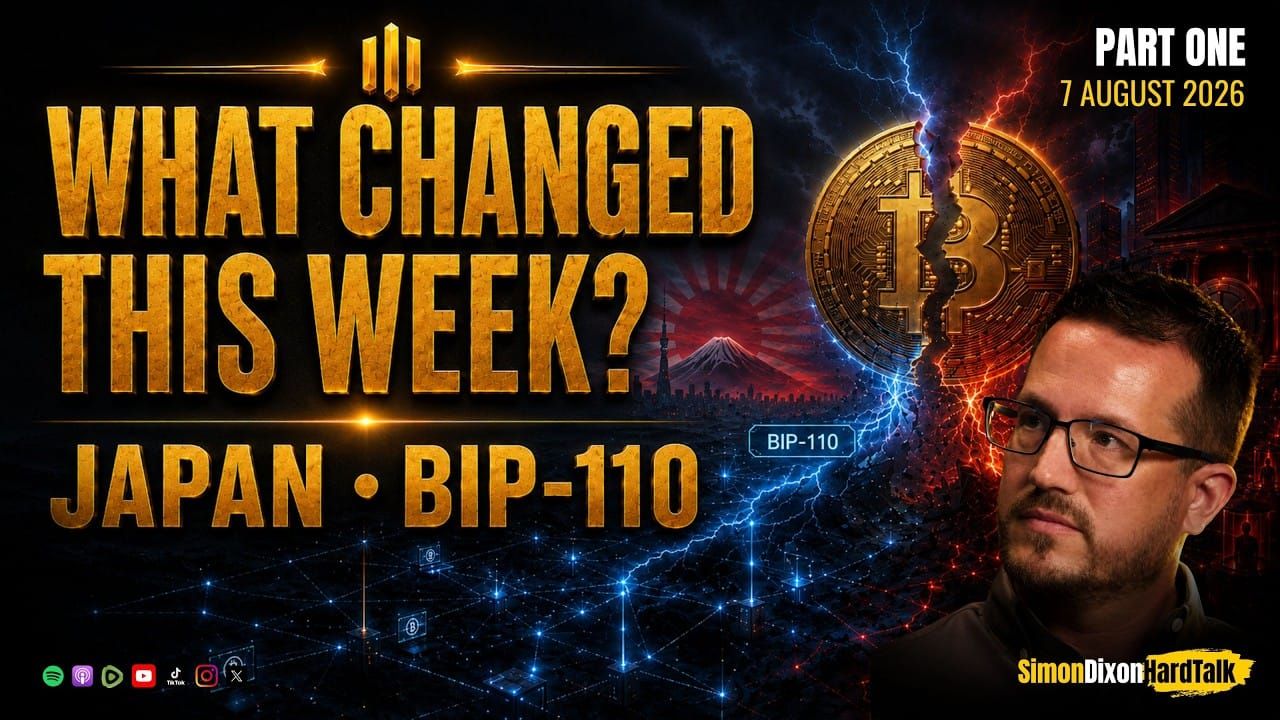
The Big Idea
For decades, America has been the world's banker. Everyone needs US dollars to buy oil, trade internationally, and hold reserves. That gives America enormous power. But right now, the other players are quietly building their own game. Simon Dixon says five things are changing at once — and they're all connected.
The petro dollar: countries used to have to use dollars to buy oil. Now Saudi Arabia is building a new 43-country maritime coalition to protect shipping without American help, and Iran is drafting legislation to price oil in Chinese yuan or even accept Bitcoin. If countries stop needing dollars for oil, demand for dollars drops.
The euro dollar: trillions of US dollars live outside America in foreign banks. That shadow banking system is under stress.
The Japan carry trade: hedge funds borrow cheap Japanese yen (near 0% interest) and invest it in American stocks and bonds for a profit. Japan is now raising interest rates, which breaks that trick. This week Japan intervened to prop up the yen — and the US reportedly joined in — but cleverly, they sold euros rather than dollars, so they wouldn't push American borrowing costs even higher. Dixon sees this as a deliberate, managed operation, not a random market wobble.
The gold story: central banks are steadily swapping US Treasury bonds for gold — like trading IOUs for something solid you can hold.
And Bitcoin: big corporations are trying to lock Bitcoin up in their own vaults instead of letting people hold it themselves.
America's Debt Problem
America owes a colossal amount of money. The interest rate on that debt matters enormously — it's like a credit card bill that grows every month. Dixon says the 10-year Treasury yield is at 4.67% and the 30-year at 5.24%, both well into what he calls the "danger zone" above 4.5%. Yet the stock market keeps hitting record highs (the S&P 500 is at 7,710). Why? Because the government keeps printing money and it flows into equities, especially AI stocks. It looks great on the surface but is unhealthy underneath — Dixon calls this "fiscal dominance."
The Japan Doom Loop
Here's the vicious circle Dixon describes. Japan raises rates. Hedge funds can no longer borrow yen cheaply, so they sell American assets. That selling pushes US interest rates up. Higher rates make America's debt even more expensive to service. That means bigger deficits, which mean more borrowing at those higher rates, which pushes rates up again. It's a dog chasing its tail.
Japan and the Cayman Islands (where many hedge funds are based) are among the largest foreign lenders to the US government. If they pull back, who buys the debt? That's the real question hanging over everything.
The Bitcoin Drama — Two Stories
Story 1: The Coldcard Hack
Coldcard is a brand of hardware wallet — basically a safe for your Bitcoin. A vulnerability in how it generates seed phrases (the master key to your funds) was discovered, potentially exposing around 5,000 users. Dixon's advice is blunt: if you use a Coldcard, move your Bitcoin somewhere safe immediately.
He's also suspicious about the timing. This hack appeared just one week before a critical Bitcoin vote called BIP 110. There was apparently a Reddit case raising the same issue back in 2022, which was ignored. Dixon wonders whether this was deliberate — an inside job, state hacking, or allowed to persist — but he's clear he hasn't reached a conclusion: "I've not reached a conclusion yet. I'm just looking through the incentives."
Story 2: The Bitcoin Civil War
BIP 110 is a proposal that some believe will protect Bitcoin from corporate capture. Starting 8 August 2026, miners must "vote" by signalling in the blocks they produce. Right now only about 2.6% are signalling. If that climbs to 55%, Bitcoin upgrades peacefully. If miners refuse and stay low, there could be a civil war — the network could split into two competing Bitcoins, exchanges might pause trading, and people could lose money in the confusion.
Against BIP 110: Michael Saylor's Strategy (holding ~840,000 Bitcoin), BlackRock (running the IBIT ETF), Adam Back's Blockstream, and Tether (now the largest private Bitcoin miner). Saylor publicly told node operators to "stand down." Strategy and BlackRock have also announced budgets to fund Bitcoin developers.
For BIP 110: regular node operators running Bitcoin software at home, and the Ocean mining pool, which lets individual miners signal support.
Dixon sees a direct parallel with 2017, when ordinary Bitcoin users fought off corporate attempts to change Bitcoin's rules. The same battle is happening again, but with bigger stakes and more powerful players.
Why Custody Matters
Dixon's biggest concern is custody — who actually holds the Bitcoin. If it all ends up at one company, Bitcoin isn't decentralised anymore. It's like a whole town putting their savings in a single bank that takes orders from the government.
The pattern is striking. Strategy's Bitcoin is custodied at Coinbase. BlackRock's ETF Bitcoin is at Coinbase. Even the US government's strategic reserve is at Coinbase. All roads lead to Coinbase. Dixon thinks this is by design.
He also flags some uncomfortable connections — presented as facts and questions, not accusations. A Strategy board member, Karen Shiffa, spent 26 years at the CIA. Cantor Fitzgerald, run by Howard Lutnick, holds a 5% convertible stake in Tether and custodies its bonds. Tether is now buying gold, Bitcoin, and mining operations with the yield from US Treasuries. The Epstein files revealed funding connections to Blockstream. Dixon says: "It's not proof that this is an intelligence op, but you decide."
The Stablecoin Story
Tether is now "too big to fail." It holds massive amounts of US Treasuries as backing for its stablecoin, which means it's effectively helping fund America's debt. The recently passed Genius Act regulates stablecoins, bringing Tether formally into the system. The Clarity Act, which would enable tokenisation of securities, has been delayed over corruption clauses. Dixon sees stablecoins as a bridge to programmable money — digital cash that can be controlled, frozen, or redirected.
What Should You Actually Do?
Dixon gives practical, step-by-step advice:
- If you have a Coldcard, move your Bitcoin somewhere safe today.
- If BIP 110 passes peacefully (55%+ signalling), there's nothing extra to worry about.
- If there's a chain split, don't move your coins. Wait for consensus. Exchanges will likely require more confirmations and may pause trading.
- Keep your Bitcoin in your own custody. If it's on an exchange during a split, they decide what happens — not you.
- Run your own node if you can. That's how ordinary people get a vote in Bitcoin's future.
- Explore multi-signature wallets and generate your own randomness (entropy) for maximum security.
His priority is clear: protect your Bitcoin first, then participate in the governance battle. "If you lose your Bitcoin, then you're out of the battle."
The Bottom Line
Big governments and corporations are quietly rearranging the global money system — oil pricing, debt markets, gold reserves, Japan's interest rates — while simultaneously trying to corral Bitcoin into their own vaults. This week brought a suspicious wallet hack and a brewing Bitcoin civil war that might both be part of that squeeze. Dixon's message: hold your own keys, run your own node, and pay attention. As he puts it: "Nothing is indicating to me that we're moving to World War III. What is indicating to me is a movement towards multipolarity while building a global control grid."
This is Simon Dixon's analysis and interpretation — his framework, his suspicions, his thesis. Some specific claims (board member backgrounds, country counts, company holdings) are as stated in the transcript and haven't all been independently verified. Treat it as a perspective to think about, not financial advice.