Iran War Week 4
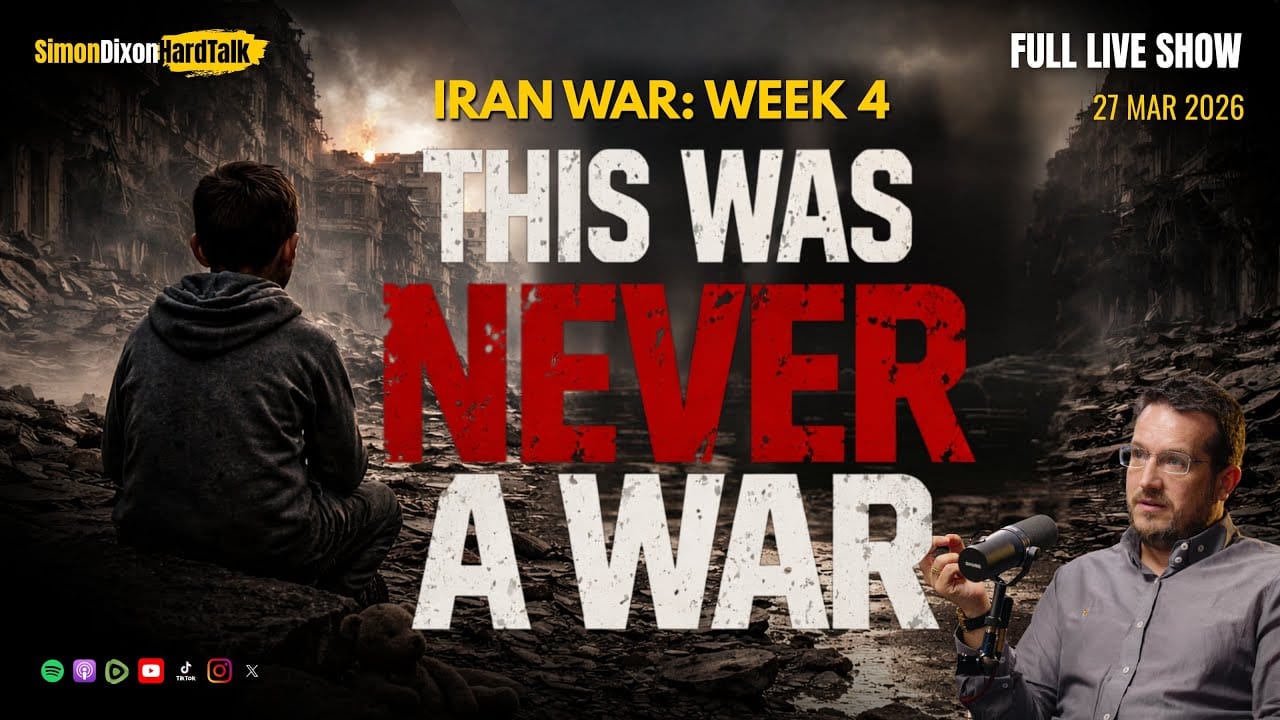
Click below for Simon's full monologue and interview - summary follows.
Part One: “Build Back Better Phase”
Simon Dixon frames week four of the Iran conflict as a transition phase within a broader “global reset.” He argues that prior weeks followed a clear progression: shock (week one), systemic disruption via the Strait of Hormuz (week two), and the emergence of a settlement framework (week three). Week four, in his view, begins the transition toward rebuilding and restructuring global systems.
At the core of his thesis is that this is not a conventional geopolitical war but a coordinated restructuring process involving competing power blocs—primarily the “financial-industrial complex” versus the “military-industrial complex.” He interprets the conflict as a managed transition from a unipolar, US-led system toward a multipolar world shaped by China, Gulf states, and transnational capital.
A key development in week four is the emergence of formal negotiation frameworks. Dixon highlights a US-backed “15-point plan” and Iran’s counter-proposals as confirmation that a settlement phase is underway. He likens this to a corporate merger negotiation: both sides present maximal demands publicly, with the expectation of converging toward a compromise. This contradicts popular narratives of an existential, non-negotiable war.
He emphasizes that markets reacted strongly to these developments, particularly oil prices and bond yields. Threats to Iranian infrastructure caused spikes in oil and yields, while subsequent negotiation signals reversed those moves. Dixon interprets this as evidence of both market manipulation and the growing ineffectiveness of political messaging (e.g., Trump’s announcements) as a tool to control markets.
A central pillar of his argument is the closure of the Strait of Hormuz, which he describes as the “real nuclear weapon” of the conflict. By disrupting a significant portion of global oil and LNG supply, it triggers cascading effects: inflation, supply chain breakdowns, and stress in global financial systems. He draws parallels to COVID, the 2008 financial crisis, and the Ukraine war, noting that the full economic impact typically lags initial events.
Dixon believes the world is already locked into a severe macroeconomic trajectory. Rising bond yields increase the cost of US debt servicing, while higher oil prices drive inflation. This creates a stagflationary environment—low growth, high inflation, and rising unemployment—with limited policy options. He repeatedly stresses that central banks are trapped: they cannot cut rates due to inflation, nor raise them without worsening debt burdens.
He also identifies what he sees as evidence of pre-planning or coordination. LNG contracts, infrastructure investments, and capital positioning were allegedly arranged before the conflict escalated. He interprets this as proof that the war is part of a broader negotiated transition rather than a purely reactive escalation.
Another notable claim is that much of the physical destruction targets older or soon-to-be-replaced infrastructure, while newer strategic assets remain largely untouched. He suggests this resembles “controlled demolition” to facilitate rebuilding aligned with new trade routes and economic structures.
Dixon outlines the likely end-state as follows:
- Iran receives sanctions relief and economic integration.
- The US reduces its military footprint in the Middle East.
- Gulf states, particularly Saudi Arabia, gain regional dominance.
- Israel is economically restructured and weakened strategically.
- Proxy groups (Hezbollah, Houthis, etc.) are integrated into state systems.
He argues that this would transition the region from “forever wars” to “regional stability” under a multipolar framework.
On markets, he warns of an impending global recession driven by energy shortages and financial stress. He highlights the bond market as the key constraint on policy, noting that rising yields threaten mortgages, banking stability, and private credit markets. He describes a potential “doom loop” where higher yields increase debt costs, forcing further instability.
A major theme is wealth concentration. Dixon predicts that, as in previous crises, losses will be socialized while gains are privatized. He sees this leading to increased consolidation of assets by large institutions and further erosion of middle-class wealth.
He also anticipates a “control phase” following the crisis, involving increased surveillance, digital currencies, and behavioral regulation justified by energy shortages and economic instability. This ties into his broader narrative of a systemic transformation toward a more centralized, technologically mediated economy.
Finally, he advises individuals to prepare by accumulating “hard assets” such as Bitcoin (in self-custody) and gold, avoiding leverage, and reducing dependence on traditional financial systems.
Significant or Surprising Points (Part One)
- He claims the war is a negotiated restructuring rather than a genuine conflict between nations.
- The closure of the Strait of Hormuz is described as more impactful than any military strike.
- Evidence of pre-war positioning (contracts, investments) is presented as proof of coordination.
- Markets are portrayed as partially manipulated through political messaging and insider positioning.
- He argues that much of the destruction targets outdated infrastructure, suggesting controlled demolition.
- Predicts inevitable stagflation and a global recession regardless of how quickly the conflict ends.
- Suggests a deliberate shift from military dominance to financial control in the Middle East.
- Claims future policies will push toward surveillance systems, digital IDs, and programmable money.
- Frames crises as mechanisms for wealth concentration and systemic restructuring.
- Advises abandoning traditional finance in favor of self-custodied assets.
Part Two: Interview – Global Reset Debate with Dave Collum
The second section features a discussion between Simon Dixon and Professor Dave Collum, moderated by BTC Sessions. While both agree that a major global reset is underway, they differ in how coordinated and intentional they believe events are.
Dixon reiterates his core thesis: the conflict represents a negotiated transition between global power blocs, particularly involving China, transnational capital (e.g., BlackRock, JPMorgan), and declining US dominance. He argues that the military-industrial complex (aligned with traditional US power) is being superseded by a financial-industrial complex that operates globally and is less tied to national interests.
Collum, by contrast, leans toward a more chaotic interpretation. He acknowledges systemic imbalances—especially in debt, valuations, and financial markets—but questions the extent of centralized coordination. He emphasizes historical patterns where markets eventually correct regardless of planning or manipulation.
A major area of agreement is that the global financial system is unsustainable. Collum highlights extreme overvaluation in markets, noting that valuations have compounded upward for decades and must eventually reverse. He warns of a prolonged downturn similar to Japan’s post-1989 stagnation.
Both discuss the fragility of the private credit and private equity sectors. Collum argues that these markets are already cracking, with liquidity issues masked by gating mechanisms (restricting withdrawals). He sees this as analogous to early stages of the 2008 crisis.
On geopolitics, Dixon maintains that wars are often orchestrated or managed to achieve economic objectives, while Collum is more skeptical but acknowledges that governments and institutions can tolerate large-scale casualties if necessary. They agree that narratives presented to the public often diverge from underlying strategic realities.
Energy remains a central theme. Dixon insists that oil prices must fall for the system to stabilize, implying that a negotiated deal is inevitable. Collum questions whether supply constraints will allow this, noting that energy production is becoming increasingly difficult and expensive.
The discussion also touches on AI and technological control. Dixon views AI as a tool for surveillance and centralization, while Collum focuses more on its economic impact—particularly its potential to accelerate “creative destruction” and destabilize labor markets.
On assets, both discuss gold and Bitcoin. Dixon emphasizes Bitcoin’s role as a self-custodied, borderless asset, especially in crisis scenarios. He cites examples of individuals converting gold to Bitcoin to move wealth across borders. Collum remains more cautious, noting Bitcoin’s correlation with risk assets but acknowledging its potential role.
They converge on the idea that wealth concentration will intensify and that average individuals (“Joe Sixpack”) will bear the brunt of economic adjustment. Collum stresses the political risk of widespread dissatisfaction, suggesting that social unrest could become a significant factor.
The interview ends with a discussion of what would invalidate Dixon’s thesis. He states that a failure to reach a deal (e.g., before a US-China summit) or a major uncontrolled escalation causing humanitarian catastrophe would challenge his model. Collum, meanwhile, focuses on market signals—particularly credit markets—as indicators of systemic breakdown.
Significant or Surprising Points (Part Two)
- Dixon frames the war as a negotiation between China, BlackRock, and JPMorgan.
- Collum argues markets will ultimately override any coordinated plan.
- Both agree private credit markets are already breaking beneath the surface.
- Suggestion that geopolitical events matter less to markets than underlying financial conditions.
- Discussion of AI as both an economic disruptor and a surveillance tool.
- Claim that Bitcoin’s key value lies in self-custody and mobility during crises.
- Collum warns of a long-term market stagnation similar to Japan’s “lost decades.”
- Emphasis on wealth concentration and the declining economic position of the middle class.
- Recognition that public narratives often obscure deeper strategic or financial dynamics.
- Acknowledgment that social unrest could become a major destabilizing force.
Overall, the interview reinforces the central theme: a global transition is underway, but there is disagreement over whether it is tightly orchestrated or emerging from complex, partly uncontrolled forces.