Jeff Booth interview
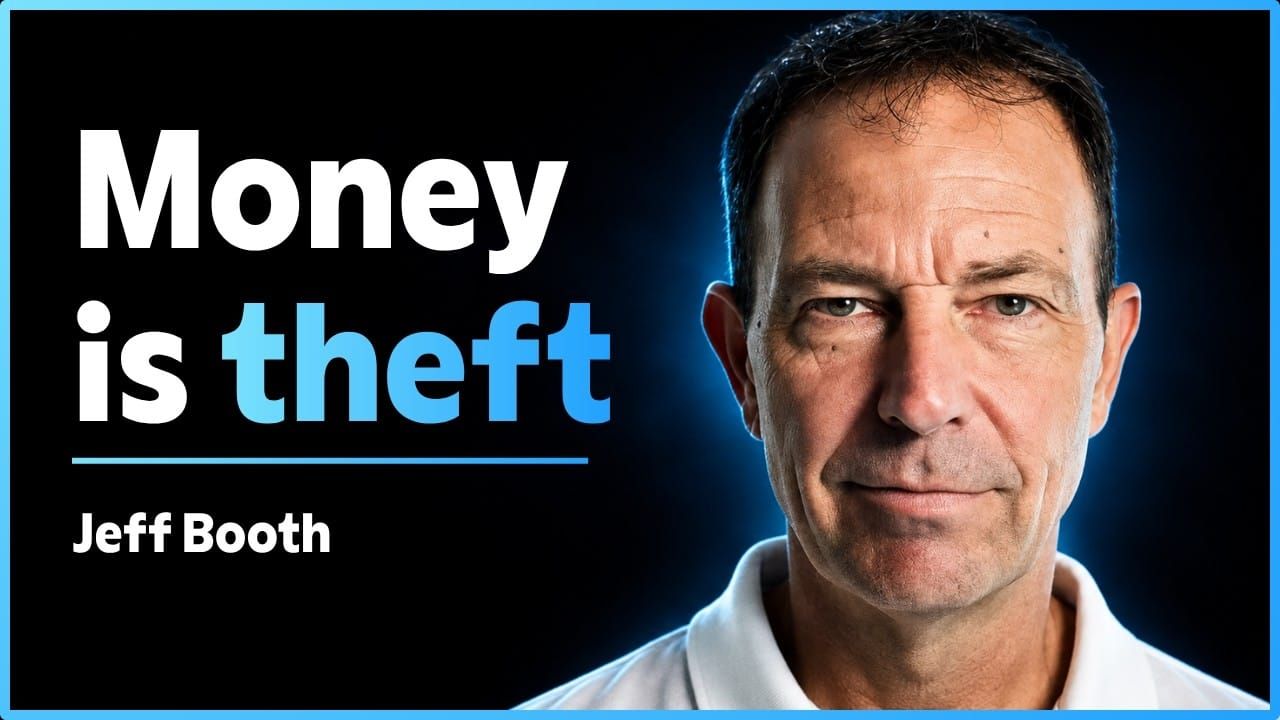
Interview on 51 Insights with host Mark; Jeff Booth is introduced as author of The Price of Tomorrow, co-founder of Ego Death Capital and Orange Juice (buying real businesses with a Bitcoin treasury) and a board member of Core Scientific.
Opening framing: inflation printed hotter than expected, the Fed raising rates, the 10-year Treasury yield back above 5%, the ECB/BoE/BoJ tightening, oil above $100 and the US fighting Iran. Booth's position: none of this changes the destination.
1. The core thesis: the debt is already gone
- A debt-based monetary system must lend more money to stay solvent — and because the “money” is really debt, allowing prices to fall would make the debt insolvent and the money vanish.
- Therefore faster productivity forces faster money printing to pretend the debt is solvent, which shows up as inflation. Every market question people ask is downstream of that system.
- Global debt is $365 trillion. His illustration: pay it back at a dollar a second and it takes “millions and millions… of years” — arithmetically about 11.6 million years. Hence: insolvent.
- Consequence: all asset prices tethered to that debt are only solvent if the debt is solvent, which it isn't. Nothing has been marked to market — not banks, not infrastructure, not households.
- The escape route is debasement at a staggering rate, which centralises assets into very few hands, picks the pockets of populations and drives social division and control. Booth calls this “mathematically certain”; only the timing is unknown.
- He argues people are forced to hold assets only because they cannot store money in money — and every one of those assets is tethered to the same lie.
- Political claim: money “comes from hiding theft from you”. If people accepted that, the best minds would migrate to arbitraging the cheating at the top of the system, and society would decay accordingly.
“If all of money was theft… you would believe it was democracy… It's all the same club and you're not in it.”
2. Bitcoin: money, not an asset
- Framed as the first free market that ever existed: decentralised, secure, unbreakable, capped at 21 million units, portable anywhere, and storable “in your head”.
- Because it cannot be debased, it would price falling prices — which looks baffling from inside a system that measures in debased units.
- He warns that describing Bitcoin as an “asset” is a strategy to keep it inside the system: stablecoins and financial engineering on top, to make holders give up self-custody, at which point it centralises and gets cheated on and repriced like gold.
- If measured only as a dollar trade, it would be captured and fail; the distinction is whether enough people move their time into building the un-coappropriable thing.
- On other assets: “None.” Money that works would be superordinate to all assets because it prices the free market; shorter-horizon opportunities may exist but are subordinate over the long term.
- Pricing Bitcoin in dollars “makes no sense” — his test: look at the BTC price in bolívars or lira, notice how absurd the number looks, then notice you go straight back to measuring in dollars you know are manipulated.
3. Gold versus Bitcoin
| Point | Booth's argument |
|---|---|
| Gold could be revalued | A US revaluation to shrink the debt could take gold to ~$22,000/oz |
| But it centralises | You cannot carry bricks on a plane, so gold gets centralised, a debt system is built on top, and people forget the gold |
| Rules get changed | 1933 confiscation; 1971 repricing when the US could not meet its obligations |
| Bitcoin's difference | Self-custody, decentralised, no one to change the rules — if holders refuse to hand it back to intermediaries |
4. AI: deflation, stranded capex, and the frontier-lab squeeze
- Marginal cost of production of a line of code writing other lines of code is zero, so AI is a deflationary force: “prices fall to the marginal cost of production”.
- Capex mismatch: data-centre buildouts assume a ~15-year payback, but a model that was frontier four months ago now runs locally on his own laptop with no internet. The debt is therefore already impaired; most of the “AI trade” is a productivity trade that cannot repay its financing.
- Why Bitcoin falls in that scenario: holders sell the only liquid thing they own — hedge fund and PE redemptions have stopped, the house is underwater, the AI trade is underwater — while everyone waits for governments to print the system back to solvency.
- Regulatory capture: the frontier labs stoke fear (“AI will kill you”) because regulation serves monopolies; fear produces votes for barriers that let incumbents extract margins.
- Guardrails as back doors: in bug-hunting tests on Bitcoin-adjacent software, frontier models missed bugs and were guardrailed, while open Chinese models (e.g. Kimi 3) found them — his inference being that users cannot see what has been withheld.
- Geopolitics of open source: if all the money and progress sat in US labs, China's rational move is to open-source everything and remove the money. His framing: the real question is not US versus China, but whether anyone should control you.
- Frontier labs likely do not survive open source — investors are applying the 1999 network-effect playbook (Amazon, Google: capture the network, then extract rents forever) to something that will behave more like electricity.
- Core Scientific's strategy: sign long contracts only with counterparties certain to exist in 15 years (e.g. AMD), and position to be a consolidator rather than one of the “neo cloud” intermediaries that are booking revenue on massive losses and will go bankrupt. Railroads and the 1999 fibre buildout produced both winners and a massive overbuild.
5. The internet analogy — why Bitcoin or AI might not end up like Web 2.0
- The 1989 web was built on earlier decisions; a socket for money existed in the original internet design and was disregarded, so broken money was baked in before most people arrived.
- The kernel came from Paul Baran's 1965 work and TCP/IP: communications that could not be shut down even in a nuclear holocaust. ARPANET adopted it, and it strengthened as it grew because it was open.
- Each layer (notably Tim Berners-Lee's World Wide Web) added capability nobody could have forecast in 1969.
- Attempts at controlled alternatives (IBM, OSI, government frameworks) lost because open networks win — they attract more innovation — and they emerge in layers.
- He maps this onto Bitcoin: the base layer is TCP/IP-like; privacy, payments and protocols such as Nostr sit above it, forming “a new internet bound by energy that can't be co-opted”.
- The key difference from Amazon/Google: network effects occur at the protocol level, not the company level — so owning Bitcoin is framed as owning a share of the new internet infrastructure and everything built on it. His caveat: most holders will sell at “a million dollars” and return to the old system.
6. Debt cycles, war and agency
- He concedes the short-run path is very hard to predict because “what drives both of these things is us”.
- The two possible outcomes are binary: more agency, more communication, faster-falling prices — or a complete control system with surveillance and frozen bank accounts.
- Personal admission: he wrote The Price of Tomorrow for his children, yet for years kept his time and energy inside the old system, “empowering the thing I was trying to stop” with every dollar spent and every vote cast. That realisation produced Ego Death Capital and a deliberate reallocation of his time — the one thing nobody can take.
- Preparation advice is therefore not tactical but dispositional: be curious, be adaptable, and apply the “if this, then this” test — if the world is as he describes, would both systems show up the way he says they do?
7. What is coming (next few years)
- Swarms of billions of agents working constantly for free, spun up locally today: a frontier model as coordinator, millions of agents beneath it.
- Gains hitting healthcare, materials science, maths, physics — “miracles from our perception today that were right before our eyes”.
- Human intelligence, “the thing we were the best at”, is being replaced by machines — gradual in employment terms, but industry by industry you will simply choose the hundred-employee-free supplier because it costs less.
- Intelligence then merges into robotics — including tiny micro-robots and swarms — so labour is no longer required for abundance.
- Expect this to “break people's brains”, including politicians and media empires: everyone is “just people making decisions on incentives”, and the old system's incentives are broken.
8. Practical AI advice (open source)
- Ask Claude to build you a local setup, then have a different model (e.g. Kimi 3) audit it, then run adversarial testing across other models.
- Run the best local open model possible: no internet required, works offline or on a plane.
- Use OpenRouter to compare models; iterate and re-audit.
- Booth personally routes data through TinFoil to encrypt what reaches frontier models; he explicitly would not hand everything to a single cloud plan.
- Regular audits matter because every model shows different answers and vulnerabilities.
9. Closing exchange and resources
- Asked whether the dollar is still the world's reserve currency in 2040: “It still might be, but it won't be my reserve currency.”
- He offers a Morpheus wallet address for the show notes, accessed via the Fedi app (private communication and private money on top of Bitcoin), warning listeners to verify the correct app to avoid scams.
Notable quotes
“Do the math on how many years it would take to pay back at a dollar a second… It's insolvent. That means everything tethered to it, all of your asset prices, are only solvent if that thing is solvent, which it clearly isn't.”
“All of the frontier labs [try] to keep you in fear that AI is going to kill you… Regulation always serves a monopoly. There would be no monopoly without regulation.”
“You can store your money in money in Bitcoin. That's the difference. It's money that you can port around in your head.”
“We as humans, we have two choices when we face scarcity: control or innovation… scarcity [is] the pricing signal.”