Joseph Sansone
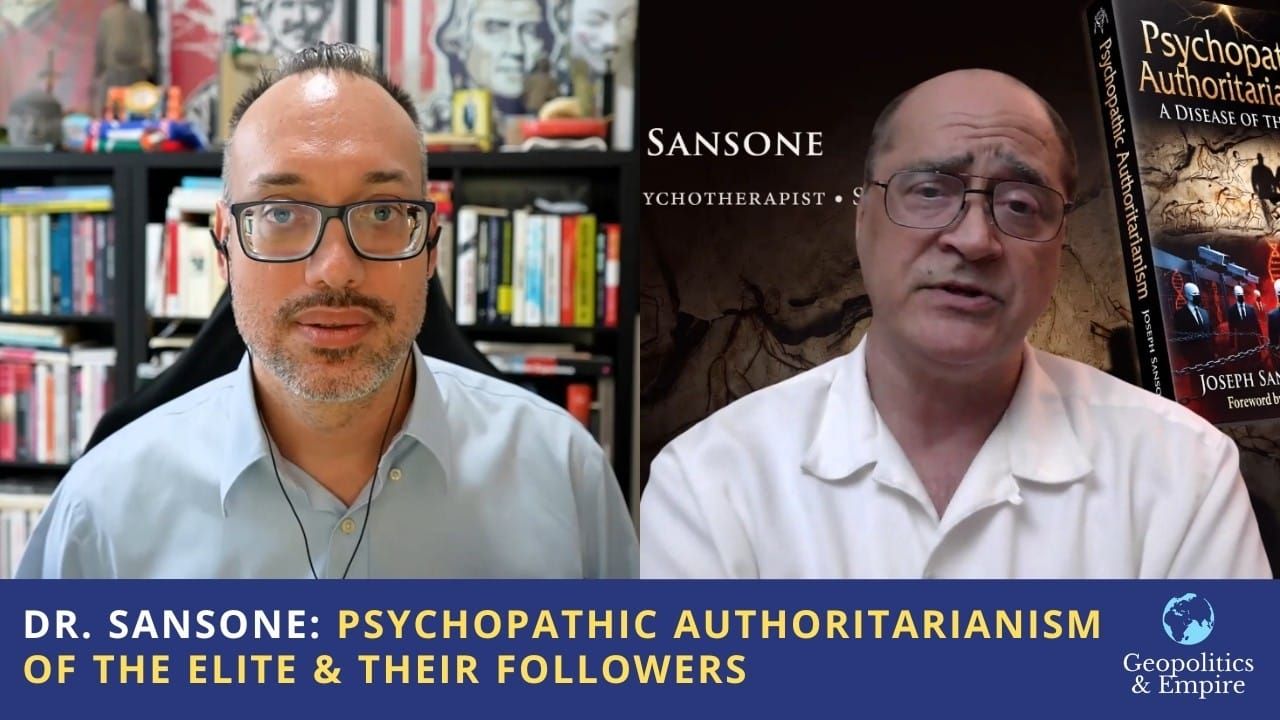
Topic: "Psychopathic Authoritarianism of the Elite & their Followers" (recorded around 30 September / 1 October 2026)
Guest: Dr. Joseph Sansone, M.S., PhD — psychotherapist, human rights advocate, and author of Psychopathic Authoritarianism: A Disease of the Soul (published 11 September 2026) [1]
1. The book and its origin
- Sansone traces the phrase "psychopathic authoritarians" to Dr. Ron Paul's 2012 farewell speech to Congress, in which Paul described the "immoral use of force through government". The phrase "percolated" with Sansone for about a decade.
- He first used it in a 2021 article, describing the "COVIDian cult" of the time, and then adopted the self-description "a psychotherapist opposed to psychopathic authoritarianism" in his writing and interviews.
- He compares his motive to Viktor Frankl's decision to treat his concentration-camp experience as a "laboratory" and write Man's Search for Meaning. Sansone stresses his own book is not autobiographical, but argues "we just lived through this and it's actually still going on in a morphed form".
- Core premise: the recurring question "why would they do this?" is answered once you recognise "they're crazy" — i.e. the behaviour follows a pathology, not ordinary political logic.
2. The framework: what "psychopathic authoritarianism" means
Sansone says he examines the phenomenon at both the individual and the systemic level (the latter "when it reaches a certain threshold"). It combines:
- The Dark Tetrad — sadism, narcissism, psychopathy and Machiavellianism
- Fear and control dynamics that drive the whole system
Book structure
| Part | Content |
|---|---|
| One | Defines psychopathic authoritarianism and the Dark Tetrad |
| Two | Psychological mechanisms of control (social-psychology studies) |
| Three | Globalism as the current manifestation |
| Four | "Disease of the Soul" — philosophical reflections |
The four Dark Tetrad traits as he applies them
- Sadism — mostly latent in ordinary people; he argues the organisers of COVID policy "knew they were poisoning most of the human population with a biological and technological weapon of mass destruction" and "get off on it". He cites everyday sadism (e.g. gatekeepers on a power trip; "soccer mums" chasing unmasked couples), and argues sadism was deliberately "jinxed up"/activated in the public.
- Narcissism — he distinguishes several types:
- Grandiose and malignant narcissists — the "ring leaders"; malignant types are more sadistic and enjoy humiliation.
- Vulnerable (covert) narcissists — attention-seeking but easily manipulated.
- Collective narcissists — group superiority and "us versus them" (e.g. demonising the unvaccinated).
- Communal narcissists — virtue-signalling (posting masked/vaccinated photos).
- Machiavellianism — "the strategic engine… amoral manipulation". His example: the creation of the Federal Reserve, where bankers allegedly hatched the scheme at Jekyll Island and had paid congressmen introduce legislation while publicly opposing it.
- Psychopathy — absence of empathy or emotional connection; he argues such people "have no respect for human dignity" and must mimic normal emotion.
The state as an extension of the ego
- A recurring theme: when people see the state as an extension of their own ego, they "give up their rights" in exchange for vicarious power — compared to a die-hard sports fan living through their team.
- This fuels collective narcissism and the us-versus-them dynamic (he cites both party politics and COVID compliance).
- He argues the culture has shifted in 20–25 years: behaviour once mocked as narcissistic (e.g. a president taking a selfie) is now normalised.
3. Media, dehumanisation and entertainment
- Sansone argues news and film are used to divide people and strip them of empathy.
- His example: the typical action film in which a "wholesome guy" (he cites Hercules-type heroes) is given "a blank check" to kill dozens after a personal tragedy — normalising brutality and dehumanising the audience so they will accept coercive policies ("if you had one shred of empathy… you would never try to put a face diaper on them").
- He hopes readers will also recognise "traces of those qualities" — sadism, narcissism, manipulation — in themselves, since self-awareness makes one less likely to be drawn into authoritarianism.
4. Mechanisms of control (Part Two of the book)
| Mechanism | Detail given |
|---|---|
| Obedience to authority | Milgram shock experiments — a figure in a white lab coat securing compliance |
| Social conformity | Solomon Asch line-judgement study — over a third of participants gave the wrong answer to match the group |
| Counter-evidence | In Milgram, when two others refused, ~90% of subjects also refused; in Asch, one dissenting confederate raised correct answers to ~95% — hence the importance of speaking the truth |
| Cognitive dissonance | He offers a "novel idea": it functions as an anticipatory phase of grief and loss — people pre-emptively reject conflicting information to avoid an identity crisis |
| Learned helplessness | Based on the dog experiments; he says it is widespread in the liberty movement |
| Diffusion of responsibility / bystander effect | Worsened, he argues, by the internet |
| Stockholm syndrome | Identification with the aggressor, tied to the state-as-ego theme |
- He notes a pattern of double standards in media stories designed to trigger emotional (rather than critical) reactions, likening it to 1984's "2 + 2 = 5".
5. Surveillance, AI and the digital control grid
- Flock (and Axon) cameras: he calls them a "severe manifestation of psychopathic authoritarianism" — rolled out from Florida to California despite partisan gridlock, capturing licence plates and vehicle characteristics to build a "blueprint" of movement. Florida's Department of Transportation is reportedly removing them from state highways, but municipalities retain them. He argues they "must all be torn down" and that they could have been used during lockdowns to police people for "getting a breath of fresh air".
- AI as false authority: people treat AI as authoritative; he warns it is biased, "100% confident when it's 100% wrong", and can be manipulated via back doors — raising the risk of fabricated evidence in court.
- Cases cited by the host:
- A US police officer who wrongly and aggressively accused a woman of being an "Amazon porch pirate"; she spent months assembling video evidence to clear herself.
- A Tennessee woman allegedly arrested on a Flock false positive / facial recognition in North Dakota (a state she had never visited), held six months, lost her home, and is reportedly suing for $10 million.
- Sansone's position: "The government doesn't have a right to know who you are, where you're going, or what you're doing."
6. Globalism, technocracy and the "nowhere to go" problem
- Sansone quotes his own book on the uniqueness of the present situation: in the past, a repressed group "simply left and founded a new city-state"; now, because technology touches every aspect of life and enables global tracking and surveillance, "there's nowhere else to go to establish something new and free" — a threat to the species.
- He links this to the technocracy, depopulation and transhumanist/posthumanist agenda, which he says "is real" and which "these people really believe in".
- He argues that precisely because technology centralises everything, decentralisation of all forms of government is more necessary than ever.
- He suggests the outcome being pursued is to "kill most of us, keep some of us around for spare parts and slaves".
- He proposes a two-tier framing: not class conflict but "the sane and the insane" — "the inmates are running the asylum".
7. Money, fuel and 15-minute cities
- Mexico (the host's location) is described as among the first countries to eliminate cash payment for petrol, moving to card, then phone, then potentially facial recognition and eventually an implant or wearable. Sansone: a central bank digital currency "isn't money, it's an allowance", and implies "no private property".
- Fuel scarcity is predicted as a lever of control (rationing by mileage or time of travel via camera networks).
- Barriers/ghettos: the host cites a CBC report from Vancouver on "traffic calming measures" that residents say leave them "barricaded in their own neighbourhood", with similar measures in the UK. Sansone calls this a physical ghetto and "by definition" a step toward the 15-minute city.
8. Fear, courage and resistance
- Sansone: fear "is a false god" and does not serve you; people are afraid of being cancelled, demonetised or of losing access — including to political connections (he notes the example of doctors who gained access via RFK Jr. and now "give them a pass"). He cites a health-education channel whose interview about fibrous blood clots was demonetised despite large view counts.
- Speaking truth is the countermeasure (per the Milgram/Asch dissenter findings).
- He invokes James Madison, Federalist No. 40: the right to revolution is "transcendent"; when government no longer acts as your agent, you have a right to dispose of it. Madison, he notes, did not invent emergency powers during the War of 1812.
- On tactics: "asymmetrical warfare requires asymmetrical resistance"; he does not restrict himself to purely peaceful means, though he expects escalation to happen organically ("it'll just pop like a cork if it gets that bad"). He hopes graduated escalation creates enough fear that elites "back off".
- He argues government "exists because we allow it to exist"; if government does not fear the people, it is a tyranny.
- He recommends working with like-minded people ("like tuning forks") while rejecting collectivism, and stresses creativity and love of freedom as humanity's advantages over "artificial" intelligence — since psychopathic authoritarians "lack creativity… love… empathy".
- He urges self-actualisation: "pretty much every man grew up as a kid dreaming of slaying a dragon. So here's the dragon. Go slay it."
9. Politics and the "manipulation" argument
- Sansone reads current politics as Machiavellian manipulation: e.g. the marginalisation of Pat Buchanan in 1996 and 2000 (he alleges party manipulation in Arizona in 1996), and the media treatment of Ron Paul in 2008.
- He argues that movements that are "really a threat" get shadowbanned, cancelled and algorithmically suppressed — whereas others receive favourable coverage, which he interprets as them being "propped up". He applies this to Trump's administration ("they hand it over to them"), speculating Trump may be blackmailed; he also says Trump is "trying to normalise pathology" (citing Easter remarks and images mocking the Pope and Christ).
- The host notes he is himself shadowbanned and financially strained, and says he will not "toe a line".
- Sansone reports he was involved in passing medical-freedom resolutions in two state parties and in litigation, and laments that others did not replicate the effort: "That's not on me."
10. Closing points and practical information
- Book: Psychopathic Authoritarianism: A Disease of the Soul — available online (Amazon, Barnes & Noble and elsewhere). He avoids physical bookstores, fearing bulk orders followed by returns.
- Where to find him: his Substack/newsletter at JosephSansone.com ("the best place"); he mentions his X account was hacked, and refers to a presence on another platform described as a counter to X (name unclear in the transcript).
- Final message: "Remember what James Madison said in Federalist paper number 40 — the right to revolution is transcendent… Don't buy into these cover stories… just fight for your liberty and for your species."
References and works mentioned in the interview
| Work / source | Referenced by | Notes as given |
|---|---|---|
| The No Asshole Rule and The Asshole Survival Guide — Robert (Bob) Sutton | Host | Workplace narcissism and sociopathy |
| Political Ponerology — Andrew Lobaczewski | Host | "The nature of evil" |
| Man's Search for Meaning — Viktor Frankl | Both | Concentration-camp "laboratory"; the Kapos who were "worse than the Nazi guards" |
| The Creature from Jekyll Island — G. Edward Griffin (author not named in transcript) | Sansone | Federal Reserve origins |
| Milgram obedience study; Solomon Asch conformity study | Sansone | Mechanisms of control |
| Federalist No. 40 — James Madison | Sansone | "Right to revolution is transcendent" |
| Plotinus (Neoplatonist, 200s AD); William James; Cartesian duality | Sansone | "Fields of consciousness" concept |
| 1984 — George Orwell | Host | "2 + 2 = 5" |
| Ron Paul's 2012 farewell speech | Sansone | Origin of the phrase |
| CBC report on Vancouver "traffic calming" barriers | Host | "Barricaded in their own neighbourhood" |
| Edwin Black ("algorithm ghettos") | Host | Predicted the ghetto measures |
References