Lex and Peter
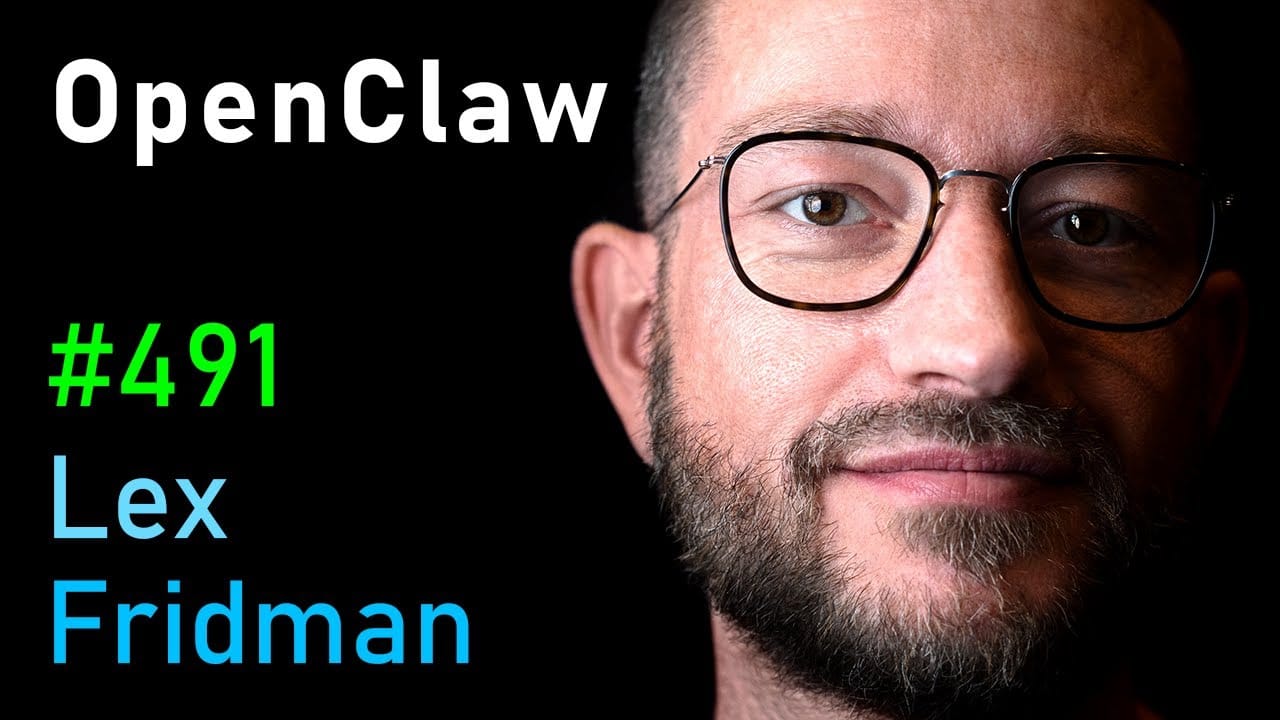
Here is a concise, evidence-based synthesis of Lex Fridman’s conversation with Peter Steinberger about AI agents, OpenClaw, safety, design and the broader social and developer implications. I summarize the main themes, list key points with supporting transcript evidence and call out significant or surprising insights that came up in the discussion.
High-level summary
Peter built OpenClaw as an open‑source, agentic AI assistant that lives on a user’s machine, interfaces via messaging apps (WhatsApp, Telegram, Discord), can access local data if permitted, and can “do things” autonomously. The project grew extremely fast, attracted huge community engagement, sparked debates about safety and AI psychosis (MoltBook), exposed thorny legal/operational naming and security challenges, and crystallized practical lessons about how humans should design, collaborate with, and govern agents.
Key points with supporting evidence
- OpenClaw is an open-source, agentic assistant that “actually does things.”
- Evidence: Peter describes OpenClaw as “an autonomous AI assistant that lives in your computer” and “the AI that actually does things.” It sends/receives messages via Telegram/WhatsApp/Signal/iMessage and can use models like Claude Opus and GPT/Codex variants.
- Rapid prototyping and viral growth: small prototype → massive community response.
- Evidence: Peter built an early WhatsApp:
prototype “in one hour,” then added image support and used it heavily on a trip; Lex notes the repo “took the internet by storm” and reached “over 175,000 stars.”
- Agents can be highly autonomous, even self-modifying.
- Evidence: Peter: “the agent would just modify its own software. People talk about self-modifying software, I just built it.” He also says agents can inspect their harness, documentation, model, and modify behaviour.
- UX matters hugely: conversational, multi-modal access (voice, images) is a phase shift.
- Evidence: Peter highlights the impact of using WhatsApp voice/images: “images seemed important” and the moment the agent displayed a typing indicator and replied to an audio message surprised him—because the agent inferred file type, converted with ffmpeg, used Whisper/OpenAI, and replied.
- The social/community dynamics were central to adoption and creative output.
- Evidence: Peter intentionally made OpenClaw playful/weird (lobster motif, soul.md) and credits community pull requests, memes, and contributions (many first-time contributors, “prompt requests”) for spreading the project.
- Security and risk are real and immediate, but tractable.
- Evidence: Peter repeatedly stresses the danger: “a powerful AI agent with system-level access is a security minefield.” He documents threats (credential storage, remote exposure, prompt injection) and notes mitigations (sand-boxing, allow-lists, VirusTotal scanning of skills, careful configuration and local-only deployments).
- Prompting and workflow are skills—there’s an “agentic curve.”
- Evidence: Peter explains a learning arc from simple prompts → complex agent orchestration → then back to short, precise prompts once the developer reaches “zen.” He calls this the “agentic trap” and emphasizes playing/iterating to learn.
- Models have different personalities and strengths.
- Evidence: Peter contrasts Opus (role-play, trial-and-error, more interactive) and Codex/“GPT-5”-style models (reads more code, more “dry” and reliable). He emphasizes driving the model based on its tendencies.
- Open-source, openness, and community on-boarding are social goods.
- Evidence: Peter values that many non-programmers submitted PRs and learned open-source workflows, calling that “a win for our society.” He resists closing the project or monetizing it in ways that would break community contributions.
Significant or surprising insights
- Self-debugging agents: Peter uses agents to read their own errors and source to fix themselves; this closed-loop of agentic self-improvement emerged organically in development, not just as a theoretical risk or toy.
- Evidence: “Most of it is built by Codex, but oftentimes I... use self-introspection... ‘What error do you see? Read the source code. Figure out what's the problem.’”
- Human prompting often creates the most dramatic agent behaviour in viral demos (MoltBook).
- Evidence: Lex and Peter agree much of the MoltBook viral content was human-prompted art/drama; Peter calls it “art” and “the finest slop.” They note screenshots can be misleading and “AI psychosis” (public fear) became visible even when outputs were orchestrated.
- The paradox of model capability vs. attack surface: smarter models are harder to prompt‑inject (more robust), but their power amplifies potential damage.
- Evidence: Peter: “the smarter the model is, the more resilient it is to attacks... but then the damage it can do increases because the models become more powerful.”
- Naming and community hostility are operational hazards.
- Evidence: The project endured name‑change/legal pressure (Anthropic), domain/account sniping, and coordinated crypto/harassment groups. Peter recounts being “close to crying” and nearly deleting the project.
- The UX of delight and personality (“soul.md”) matters for adoption and trust; people prefer human-feeling agents.
- Evidence: Peter created soul.md and agents.md to infuse personality. He notes that giving agents character made MoltBook outputs more varied and interesting.
Practical takeaways (short list)
- Treat agents as systems: design harness, gateways, sand-boxing, skill directories, memory policies, and model hygiene.
- Learn agent prompting by playing; expect a learning curve (~a week of focused use).
- Favour models/modes appropriate to the task (trial-and-error vs. read‑heavy tasks).
- Prioritize security defaults: private network, credential hygiene, allow-lists, scanned skills.
- Value openness and community while planning for abuse, naming, and operational attack vectors.
Overall, the conversation mixes technical lessons (agent design, security, model choice, workflows) with socio-technical reflections: how to build delightful, accountable agent systems, how communities accelerate progress, and why we must balance speed and safety as agentic AI becomes woven into daily life.