Magick - now you know

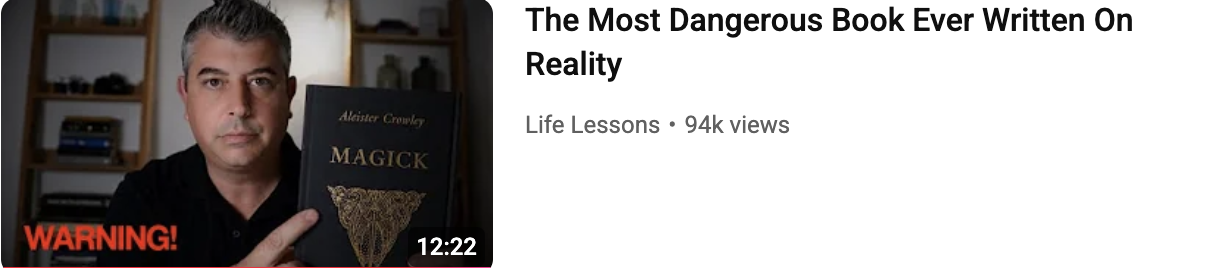
The speaker discusses the book Magick by Aleister Crowley, which he first read nearly 20 years ago. He explicitly cautions viewers against Crowley the man, while arguing that the understanding Crowley reached about how reality responds to the mind is both genuine and important — and that its danger lies precisely in its being true.
Who Was Aleister Crowley? (Significant Biographical Points)
| Detail | Note from Transcript |
|---|---|
| Born 1875 | To a strict, devoutly religious English family where "every pleasure was suspect" |
| Press title | Called "the wickedest man in the world"; he "wore that title like a badge" |
| Self-designation | Called himself "the beast," the number 666 — from the Book of Revelation, a name his mother had flung at him in anger |
| Cultural footprint | Appears on the cover of Sgt. Pepper's Lonely Hearts Club Band; Led Zeppelin's Jimmy Page bought Crowley's old house on the shore of Loch Ness |
| Education & intellect | Cambridge-educated, well-read, fluent in several languages, a published poet |
| Mountaineering | "A mountaineer of genuine accomplishment who attempted some of the highest peaks on earth in an age before modern equipment" |
| Esoteric study | Studied the world's spiritual and esoteric traditions, East and West, "more systematically than anybody of his time" |
The speaker emphasises that Crowley was not stupid or deluded, and that writing him off as a fraud or madman is "the mistake that makes a book dangerous to underestimate."
Crowley's Core Understanding: The Law of Manifestation
The speaker identifies Crowley's famous definition of his life's work as:
"The science and art of causing change to occur in conformity with will."
Stripped of robes, ritual, and incense, this is described as identical to what Neville Goddard, the Hermetic writers, and every teacher in the tradition have described:
- Your inner state is the cause. Your outer experience is the effect.
- Crowley spent years deliberately training and disciplining his attention and imagination, treating his mind "the way an athlete treats their body."
- He tested the principle repeatedly and "watched it deliver" — which is why he never lost conviction.
The Central Warning: The Law Has No Morality
This is described as "the part that most teachings very carefully avoid." The key points:
- The law does not have a morality — it doesn't sit in judgment on whether your intentions are kind.
- It doesn't reward the virtuous or withhold from the wicked.
- It simply takes what you genuinely believe to be true and sets about making it your reality.
- Crowley proved this by aiming his disciplined understanding at things "most of us would regard as objectively dark" — and it worked for him.
Two analogies from the transcript:
- Electricity — will warm a child's bedroom or kill a man in an instant; "it feels nothing either way because it is a force and not a judge."
- Water — will carry your boat or drown you "with the very same indifference."
"It runs the same for a saint as it does for a sinner. It all depends what you're going to feed it."
The Real Warning for Everyday Life
The speaker reframes the danger: it is not about demons or uncontrollable forces. The warning is that:
- The same principle you use deliberately to bring good things towards you is running at full power in every other direction too, all day, every day.
- Manifestation is not something you switch on for ten minutes of visualising and then switch off.
- It never stops and can't stop — you're doing it every waking moment with whatever your mind is resting on.
- The state you inhabit for most of your hours is the state that's being made real.
The Arithmetic Problem (a key list from the transcript)
- We give roughly 10 devoted minutes a day to deliberately imagining the life we want.
- We then hand over the other ~15 waking hours to worrying, grievance, rehearsing the worst, and assuming it probably won't work out.
- The law hasn't failed — "it's working perfectly." We spend 10 minutes instructing it in one direction and 15 hours in the other.
- "You were not failing to manifest. You were manifesting magnificently. You were just pouring all of your power into the very things that you were afraid of."
The Modern Problem: Engineered Fear
The speaker argues the present era makes this harder than ever:
- Pocket devices keep us on a loop of the worst things happening anywhere on the planet — war, financial fear, division.
- The "dominant note being played in our mind hour after hour is fear."
- Fear is easy to believe — it slides in without resistance; it feels realistic, mature, and responsible.
- By contrast, believing in something genuinely good for yourself feels naive, childish, and embarrassing.
- The negative state therefore goes in "completely unopposed" and hardens into lived experience.
The Modern vs. Crowleyan Danger
| Crowley | Most People Today | |
|---|---|---|
| Choice | Chose his darkness deliberately, eyes fully open | Choose darkness by default, with no understanding |
| Mechanism | Left attention plugged into the machine | Same — but engineered by others for profit |
| The law's view | Can't tell the difference — it "only knows what you're holding" | Same |
The speaker notes that our anxiety "is profitable to someone else," and that the law can't distinguish between fear you chose and fear installed in you while you weren't looking. "Most of us are holding dread, calling it being informed."
The Real Teaching: Take Control of Your Inner State
This is described as "the one thing I'm pleading you to do."
- The speaker is explicit that he doesn't say this to shame anyone — almost everything absorbed was absorbed without consent. "You were handed your fears. You didn't ask for them."
- But the moment you understand this, the responsibility becomes yours — it can't be handed back.
- You must become protective about:
- What you allow yourself to dwell on
- What you assume
- What you rehearse in your mind
- What you accept and repeat to yourself as "simply being the way things are"
- Every bit of it is instruction — "received without argument, without judgment, by something that will not debate with you and does not weigh up your worthiness."
- "It simply takes what you give it and builds it. And it's always building."
- "The only question that has ever mattered is what are you handing it to build with?"
The Speaker's Personal Turning Point
- He realised he didn't have a manifesting problem — he had an attention problem.
- He had been doing all the visualising, affirming, and techniques faithfully, but the small portion of the day spent manifesting was "completely wasted" by what he spent the rest of the day thinking about.
- "I was manifesting beautifully. My aim was excellent. I was just pointing it for most of the day at precisely the things I least wanted."
- What turned it around was not more visualising — just guarding those ordinary hours: noticing what he was letting in, nodding along with, and muttering to himself.
Practical Exercise Offered to the Viewer
For the coming week — don't change anything about what you normally do. Just watch what your mind does when it's left alone:
- Notice what you instinctively assume the second the news comes on.
- Notice what you brace for when your phone rings.
- Notice the story you tell yourself about how the week is going and how things tend to turn out.
- Don't fight it and don't judge it — just see it clearly and honestly.
The reasoning: "that running state underneath the practice is the one that's actually been shaping your life." The moment you can genuinely see it for the first time, you can begin to change it.
Closing Line (the thesis distilled)
"The law is never the dangerous part, but being asleep to what you're feeding it is."
Housekeeping Notes from the Transcript
- The speaker acknowledges this video is longer than usual and thanks viewers for staying to the end.
- A new Substack went live "a couple of weeks ago" with a free weekly newsletter — link in the description.
- He closes by thanking viewers for engagement and support and signs off until the next video.