Mind Control - MK-Ultra
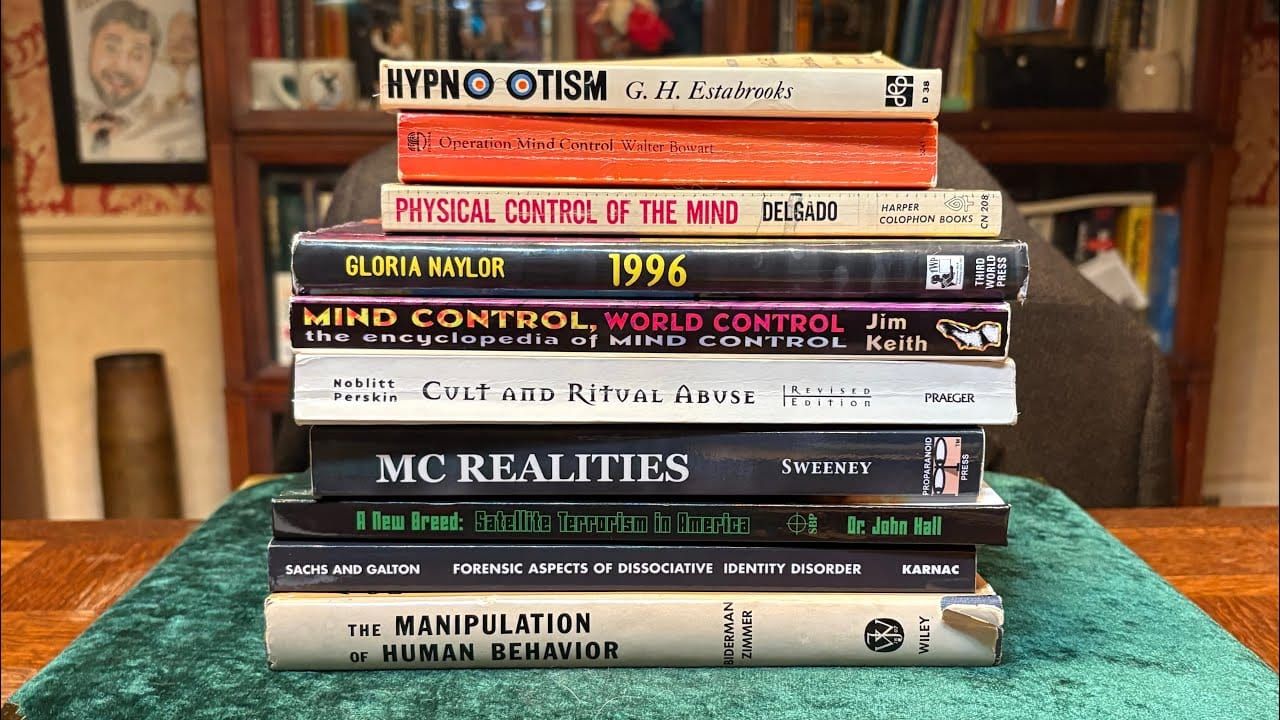
Mind control literature spans decades of classified experiments, covert operations, and survivor testimonies. The following survey distills ten foundational titles, emphasizing the most striking scholarly or eyewitness claims attached to each work.

1. Operation Mind Control (1978) – Walter Bowart
Bowart’s investigative classic is remembered less for its prose than for the backlash it provoked: the CIA allegedly purchased and pulped entire print runs to keep the book from circulation. The author interviews patsies and assassins who claim they were drug-conditioned to kill, then shown “a snapshot of paradise” they could only enter after completing the mission.
2. Hypnotism (1943; rev. 1957) – George H. Estabrooks
Written by an OSS consultant, the volume contains the blue-print for a “super-spy” split into two mutually amnesic personalities—one a loyal American, the other a devoted communist. Because the communist self is unaware it is a fabrication, it cannot be broken by interrogation; Estabrooks called this “the perfect security device”.
3. The Manipulation of Human Behavior (1961) – edited compilation
Described as “the bible of modern interrogation,” this anthology of military-funded essays shaped U.S. torture protocols from the Gulf War to Guantánamo. Though it avoids the lurid extremes of later exposes, it maps the psychological pressure points interrogators exploit when time, not pain, is the weapon.
4. Forensic Aspects of Dissociative Identity Disorder – various contributors
Forensic psychiatrists here treat multiplicity as an iatrogenic wound: deliberately induced through ritualized torture, the disorder becomes a “polite term for the shattered mind” that courts must evaluate. Case files link dissociation to clandestine programming rather than spontaneous trauma.
5. New Breed Satellite Terrorism in America – Dr. John Hall
A quick, first-person chronicle, the book documents the author’s real-time surveillance logs after he and his partner became targets of coordinated stalking and through-the-wall electromagnetic harassment. Hall’s sober, clinical tone—he is a physician—lends credibility to claims often dismissed as delusional.
6. MC Realities (2006) – H. Michael Sweeney
Private investigator Sweeney argues that mind-control tech has migrated from Langley to boardrooms and billionaires’ basements. Blending survivor testimony with open-source patents, he concludes that “the intelligence community is no longer the only customer” for behavior-modification tools.
7. Cult and Ritual Abuse (2000; updated) – Noblitt & Perskin
The authors dismantle the “satanic panic” meme, presenting court-tested evidence that ritual abuse networks use ancient trauma protocols to fracture identity. Their documentation of archaeological continuity—from Mesopotamian priesthoods to modern cults—suggests mind control is “the world’s oldest black science”.
8. Mind Control, World Control (1997) – Jim Keith
Keith’s punchy, “chunked” dossier moves from brain implants to mass-media hypnosis, concluding that free will is a negotiable commodity. Praised as the best single-volume primer, the book underpins every claim with declassified memos and patent numbers, making it an ideal on-ramp for newcomers.
9. 1996 – Gloria Naylor
The acclaimed novelist turns whistle-blower, fictionalizing the year she was targeted with voice-to-skull broadcasts and neighborhood harassment. Because Naylor was already a mainstream literary figure, her grounded account collapses the stereotype that only the marginalized report such abuses; the book is now out-of-print and collectible.
10. Physical Control of the Mind (1971) – José Delgado
Yale neurophysiologist Delgado demonstrated remote-control of a charging bull via a cranial implant, then envisioned a “psychocivilized society” where brain transceivers police aggression. The text is primary-source bedrock: every later discussion of stimoceivers, brain-to-brain interfaces, or trans-cranial behavior policing traces back to these experiments.
Supplementary volumes round out the panorama. Project MK-Ultra and Mind Control Technology reprints actual patents and redacted CIA memoranda, letting researchers watch the jargon evolve from “psychic driving” to “remote brain-computer interface.” The Truth About the False Memory Syndrome Foundation exposes that organization as a public-relations shield for professionals accused of child abuse, showing how “false memory” became a courtroom mantra to discredit ritual-abuse survivors.
Taken together, these works chart a continuum from Cold-War hypnosis labs to 21st-century neuro-surveillance, arguing that mind control is not a speculative horror but an evolving technology—patented, privatized, and increasingly pedestrian.