Nick Hudson: Centralization Is Doomed To Failure
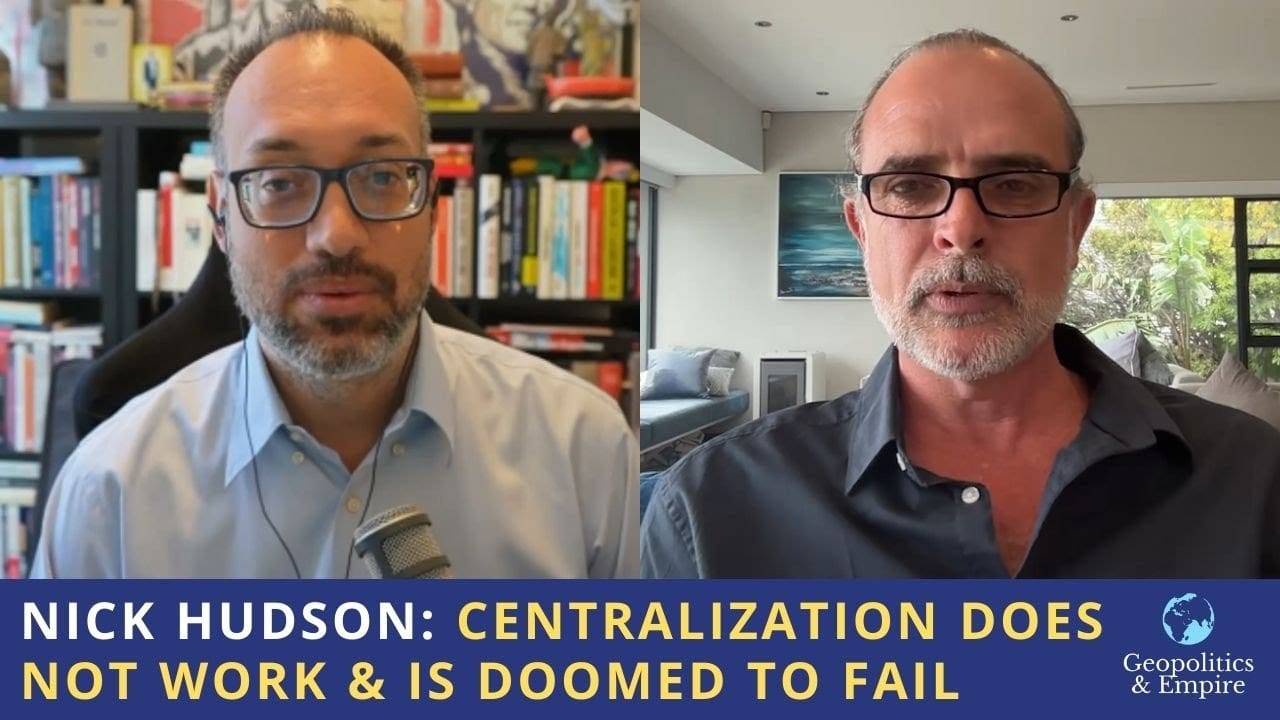
Nick Hudson joins Hrvoje Moric for a wide-ranging conversation that moves from Nick’s personal journey out of private equity into public dissent, through his controversial reading of the 2020–21 coronavirus phenomenon, to broader questions about technocracy, geopolitics, artificial intelligence, and how ordinary people can respond. The discussion mixes personal testimony, historical references, and policy analysis; it emphasizes skepticism about centralized power and the resilience of distributed social systems, while warning against simplistic or monolithic conspiracy narratives.
Overview
Nick explains how, in early 2020, he started investigating the COVID phenomenon as a professionally trained skeptic. Within months he concluded there was a profound mismatch between media messaging and empirical facts, and ultimately decided the whole official narrative was false. From that starting point the conversation examines what Hudson sees as the broader program that COVID enabled: digital identification, surveillance, removal of rights and privacy, and the acceleration of technocratic centralization. They debate whether that program represents a single coherent cabal or many competing power centers and explore how distributed social systems (communities, markets, local vendors) blunt centralized control.
The interview touches on:
- Nick’s intellectual history (private equity background, professional skepticism, earlier exposure to skeptical views after 9/11).
- His conclusion that the COVID episode was an act of information warfare rather than a novel respiratory pandemic.
- The relationship between centralized technocratic projects and older socialist/elite-driven agendas (references to Fabian-like influence and long‑standing plans for supranational governance).
- Geopolitical dynamics (skepticism about BRICS coherence; confusion around recent maneuvers in Iran and Venezuela).
- AI/AGI: Nick rejects imminent emergence of sentience in machines and reframes “AI” as automation and powerful surveillance tools.
- Practical civilian responses: noncompliance, withholding attention and money, rebuilding local social capital, and technical avoidance (de‑Googling, Linux, analog solutions).
Key points they discuss
- Nick’s pathway from investor to public dissident: his private‑equity background gave him a habit of permanent skepticism because PE requires resolving severe information asymmetry. That mindset led him to doubt mainstream COVID claims quickly and then to research and speak publicly despite censorship.
- COVID as information warfare and a “scam”: Nick argues there was no new pandemic respiratory pathogen in 2020 of the kind described by mainstream authorities. He describes the episode as an engineered information operation whose downstream policy effects (lockdowns, mandates, digital passports, expanded surveillance) were the apparent objectives.
- Purpose of the operation: beyond immediate control, the crisis served to “soften” populations for loss of rights and the acceptance of digital surveillance infrastructure (QR codes, apps, biometric IDs). He situates this in a longer history of elite projects to centralize governance and build technocratic institutions.
- Not a single monolithic conspiracy: both hosts caution against overly tidy “one committee runs everything” explanations. Nick stresses the world is multidimensional — competing elites, partisan agendas, error and panic — and that analysts should avoid fabricating unsupported details to fill gaps.
- Geopolitics and BRICS: Nick is skeptical of BRICS as a coherent counterweight. He emphasizes cultural, institutional, and competence differences among BRICS members and doubts a unified geopolitical bloc can rival entrenched Anglo‑American networks without being infiltrated or co‑opted.
- Color revolutions and information operations: the podcast revisits classic techniques of false flags, paid agitators, and information manipulation (citing historical CIA playbooks) and applies them to recent events in Iran and Venezuela, noting many staged or faked elements in published media.
- Centralization vs distributed resilience: a core theme is that highly centralized systems are intrinsically fragile and prone to catastrophic error; distributed, adaptive systems (local markets, communities) are more resilient. The COVID period demonstrated adaptive, decentralized responses in many places despite centralized lockdown policies.
- AI skepticism: Nick insists “AI” is essentially automation and pattern‑matching, not genuine general intelligence or creativity. He argues AGI or sentient machines are extremely unlikely because we lack a theory of human creativity and cannot reproduce the necessary conditions with computational models; meanwhile, the technology is nonetheless useful for surveillance and control by states and corporations.
- Motives and psychology of elites: the discussion distinguishes between systematizing, linear thinkers who genuinely believe big centralized solutions will work, and a more malevolent or self‑interested faction—both groups populate institutions. Institutional selection tends to favor left‑brain, linear thinkers, which encourages brittle decision‑making.
- Civil, non‑violent resistance and practical steps: both guests favor noncompliance, civil disobedience, local organizing, and withdrawing attention and money from predatory platforms and corporations. Practical measures include using de‑Google phones, switching to Linux, shopping locally, building human networks, and holding real assets (property, precious metals).
Significant and surprising points
- The strongest and most controversial claim: Nick says he came to believe by October 2020 that “it was all false:
” — not merely policy mistakes but that the dominant narrative of a novel respiratory pandemic was incorrect and functioned as an information operation. This is a startling conclusion that underpins his entire critique.
- Reframing virology and epidemics: he expresses deep reservations about mainstream virology and epidemiology as disciplines susceptible to manipulation, grouping them conceptually with climate messaging as arenas where elites exploit fear of invisible threats. This is an unexpected and provocative analogy.
- AI is just automation: calling contemporary AI a misnomer and denying realistic prospects for AGI is significant because it undercuts some of the most dramatic dystopian arguments (machines that will decisively run societies). Yet he still warns that automation combined with centralized datasets is a potent surveillance instrument.
- Emphasis on attention over money: Nick ranks withholding attention (disengaging from screens, algorithms, social platforms) even above financial boycotts — a psychologically:
and tactically interesting prioritization not always foregrounded in dissident strategy.
- Historical continuity claim: their account treats 20th‑century projects (e.g., Bolshevik-era foreign involvement, Fabian influence) as directly relevant to contemporary technocracy. Asserting centralization projects are long-standing and ideological roots matter is a notable interpretive stance.
Practical implications and recommendations
- Avoid monolithic explanations; prefer multi‑dimensional analysis and rigorous sourcing.
- Reduce engagement with surveillance platforms: spend less attention/time in algorithmic ecosystems.
- Divest or reduce reliance on the products and services of centralized corporate platforms; support local vendors and analog systems where possible.
- Strengthen local social networks and community institutions (churches, clubs, markets) as adaptive, trust‑based alternatives to centralized governance.
- Use technical countermeasures where feasible: de‑Google/“de‑Googled” phones, open‑source operating systems, physical access tokens instead of biometric/centralized systems.
- Favor non‑violent civil disobedience and principled noncompliance as effective moral and political tools.
Conclusion
The interview is a synthesis of contrarian public health critique, institutional analysis, and grassroots strategy. Its core thesis is that the COVID episode revealed (and accelerated) a long‑standing project of technocratic centralization and surveillance, but that centralization is inherently fragile and that distributed social and economic practices remain the most practical bulwark. The conversation urges skepticism — both toward elite narratives and toward simplistic counter‑narratives — and emphasizes concrete, nonviolent actions citizens can take to protect autonomy and rebuild community resilience.