No sugar coating
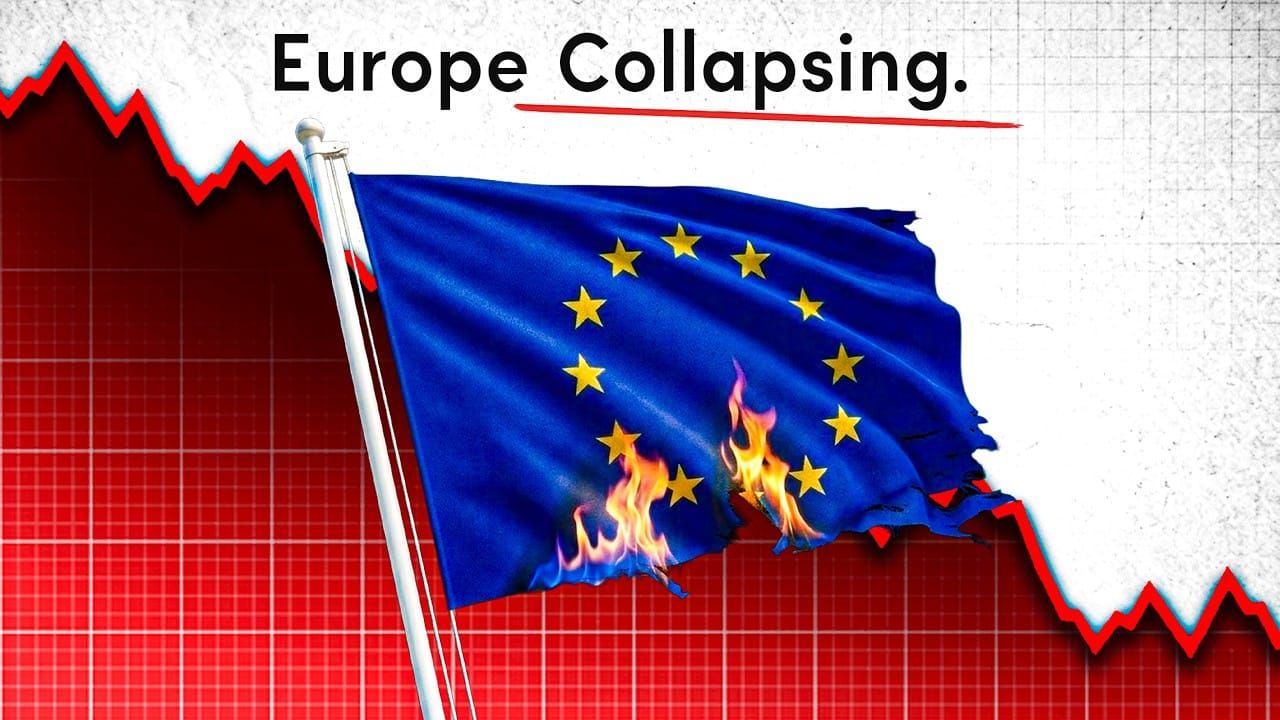
Guy's central thesis is that the EU has been following the same policy recipe that hollowed out much of South America — protecting incumbents, taxing the productive, borrowing against the future, and treating each crisis as a temporary blip — and is now running out of ways to disguise the consequences.
He structures the argument around three main crises: industrial collapse, fiscal paralysis, and the overarching failure to build or invest anything new.

1. Collapse of the Industrial Base (Focus: Germany)
- Nine straight quarters of falling German industrial turnover, with over 120,000 industrial jobs shed in a single year.
- German industry losing roughly 15,000 manufacturing jobs per month, with full-year 2026 decline forecast at a further 100,000 positions.
- Industrial production sitting ~10% below 2018 levels; energy-intensive production down 15% between February 2022 and March 2026.
- Volkswagen ended vehicle production at its Dresden Transparent Factory in December 2025 — the first domestic plant closure in 88 years. CEO Thomas Schäfer called it "absolutely necessary" from an economic perspective. Roughly 20,000 VW employees had signed voluntary departure agreements by mid-2025, part of broader 35,000 job cuts phased through to 2030. Reports suggest a deeper restructuring of up to 100,000 job losses globally and potential closure of four major German plants. VW is shrinking its global production network from ~12 million vehicles/year to 9 million.
- Ford CEO Jim Farley told reporters in Paris (December 2025): "We know we're in a fight for our lives in our industry."
- Relocation to China: BASF cut ~2,800 jobs at Ludwigshafen (the largest chemical site on Earth) and in March 2026 inaugurated a new €8.7 billion complex in Zhanjiang, China. CEO Marcus Kamieth said a BASF not invested in China "would be weaker as a result."
- Other major cuts: ThyssenKrupp cutting 11,000 jobs and shrinking steel capacity from 11.5 million tons to under 9 million; ZF Friedrichshafen planning up to 14,000 German job cuts by 2028.
- Electricity costs: German industrial electricity at 18–20 cents/kWh, versus 8–14 in the US and 7–12 in China.
- Chinese car brands hitting 6.8% of EU passenger car registrations in April 2026 (up from 3.2% a year earlier), with June touching 10%. BYD registrations up 152% year-on-year over the first four months, and up 318% in Germany in the first half.
- New car plants being built in Europe — but they're Chinese: BYD's 300,000-unit plant at Szeged, Hungary (mass production Q4 2026); Xpeng assembling at Magna Steyr in Graz, Austria; Leapmotor building at Stellantis' Zaragoza plant in Spain from August 2026.
- Guy's key point: once a chemical cracker or blast furnace goes cold, it doesn't come back on. Europe is becoming the "assembly floor for China's industrial base," and the flow only runs one way.
2. France's Fiscal Paralysis — "The South American Pattern in Its Purest Form"
| Metric | Figure |
|---|---|
| Public debt (Q1 2026) | 117% of GDP (~€3.5 trillion) |
| Q1 2026 GDP growth | 0.0% |
| Deficit | Still near 5% (within EU excessive deficit procedure) |
| Debt servicing (2020) | €36.2 billion |
| Debt servicing (2026, projected) | €59.3 billion (July revision pushing towards €64 billion) |
| Borrowing in 12 months | Record €310 billion (required emergency legislation) |
- France now spends more on interest payments than on most public services citizens actually use — and that money "buys nothing."
- Credit rating downgrades: Fitch cut France to A+ (September 2025); S&P followed with the same cut (October 2025); Moody's held at AA3 with negative outlook.
- Political chaos: Prime Minister François Bayrou was forced out after losing a confidence vote over his €43.8 billion austerity plan. Sébastien Lecornu became France's fourth PM in under two years. Parliament failed to pass a 2026 budget on time, forcing emergency rollover legislation in January so the Treasury could keep issuing debt. The budget was eventually adopted on 2 February after two no-confidence votes.
- Lecornu in July: "I am sounding the alarm with gravity. We must adopt a budget to avoid pushing the country into the ravine."
- Guy's framing: the numbers demand austerity but the politics make austerity impossible, so the debt simply compounds — the South American pattern in its purest form.
3. The NATO Defence Funding Gap
- NATO data shows an aggregate European shortfall of ~€226 billion against the 3.5% defence target.
- EU members must now fund militaries they spent 30 years neglecting, using money they don't have, in economies that aren't growing.
4. Structural Decline — GDP, Market Cap & the Draghi Diagnosis
- In 2000, the EU accounted for over 21% of global GDP; today it's ~14%. China went from 7% to 20% over the same window; the US was flat at roughly 25%.
- Since 2008, US real GDP has more than doubled; the EU's has grown only ~20%.
- EU GDP per capita has been stuck at roughly 70% of the American level for three decades.
- Zero EU companies in the global top 25 by market cap. Europe's largest listed champions:
| Company | Market Cap |
|---|---|
| ASML | ~$638 billion |
| LVMH | $233 billion |
| Siemens | $214 billion |
| SAP | $209 billion |
- For comparison: Apple alone ~$4.88 trillion; Nvidia ~$4.69 trillion; Alphabet ~$4.05 trillion. America's "Big Seven" collectively exceed $20 trillion — Europe's entire top tier doesn't reach a fifth of that.
The Draghi Report (2024)
- Mario Draghi: "It is a matter of concern that in the last 50 years not a single company in the EU with a market capitalization of more than €100 billion has been set up from scratch." Every large European company was essentially inherited; nothing new gets built because nothing new gets funded.
- Venture capital (2020–2025): €1.33 trillion in the US versus €252 billion in the EU.
- 30% of European unicorns relocated their headquarters between 2008 and 2021, mostly to America.
- Draghi asked for €750–800 billion per year in additional investment. Nearly two years on, implementation is estimated at only ~30%. The capital markets union is stalled, as is the "28th regime" for startups.
- Ursula von der Leyen (September 2025): "Every single member state has endorsed the Draghi report." Draghi subsequently said the problems he identified had actually gotten worse.
- Guy's verdict: Europe produced a perfect diagnosis of its own illness, everyone acknowledged it, and then nobody did anything about it.
5. Energy Crisis — The Coming Winter
- As of late July, EU gas storage at ~55% full; Germany at 46%; the Netherlands at just 35% — all record lows for this point in the season.
- Legal target for 1 November is 90%, but analysts think the realistic ceiling is 75–78%.
- TTF gas closed above €60/MWh several times in the week of 20 July, having traded between €28–40 earlier in the year; fell 8% in a single session on 27 July — volatility driven by the market pricing the Iran war day-by-day.
- The Strait of Hormuz has been contested since 28 February. Iranian strikes damaged Ras Laffan (the largest LNG facility on the planet) in March, with repairs estimated at up to 5 years.
- On 7 July, the Qatari tanker Al Rakayat was hit; Qatar Energy declared force majeure (extended through late September). Qatar Energy has since bought 33 spot cargoes from the US this year (versus just 4 last year) to cover Asian contracts.
- Europe now bids against Asia for the same flexible spot cargoes every winter for the foreseeable future.
- The hypocrisy: short-term Russian pipeline gas was banned from June 2026, yet EU imports of Russian Yamal LNG hit nearly 10 million tons in the first half of 2026 — up 16–18% year-on-year, a record. Europe banned cheaper Russian gas by pipeline only to keep buying more expensive Russian LNG by tanker.
6. Capital Flight & Wealth Taxes
- Euro-area households now hold ~34% of their equity investments in US markets versus ~35% in their own continent.
- Henley & Partners 2025 report: France lost a net 800 millionaires; Germany lost ~400. Italy saw a notable inflow, attracted by its flat-tax regime (€100,000/year on all foreign income regardless of amount earned).
- In countries like France and the Netherlands, taxing wealth rather than income is becoming mainstream fiscal politics — which Guy calls "perhaps the most South American step of the lot."
- The vicious cycle: the productive base shrinks → the deficit doesn't → the state stops taxing what you earn and starts taxing what you have → capital exits → the tax base shrinks further → the deficit widens → the next tax becomes inevitable.
7. Political Polarisation
| Party / Bloc | Polling / Position |
|---|---|
| AfD (Germany) | Up to 29% |
| Rassemblement National (France) | ~36%; Marine Le Pen declared for 2027 |
| FPÖ (Austria) | Won largest share (~29%) in 2024 election; gaining ground since |
| ECR + Patriots for Europe + Europe of Sovereign Nations (EP) | 170–190 seats combined |
- Looming political battles requiring unanimity among governments that can't pass their own domestic budgets: the 2028–2034 EU budget, Ukraine funding, the €185 billion of frozen Russian assets in Euroclear, and who pays to rebuild Europe's militaries.
- Even the 21st sanctions package (adopted 23 July) had to be watered down with a Greek caveat.
- Guy draws the South American parallel: the destabilising force was not one radical government but the permanent back-and-forth between extremes, where each administration reverses the policies of the last and no long-term planning is possible.
8. The Historical Cautionary Tale — Argentina
- In 1930, economic historians place Argentina among the wealthiest nations on Earth — richer per head than France. It had institutions, rule of law, and the assumption that it was simply a rich place.
- Nobody in Buenos Aires woke up one morning and chose decline. They chose one reasonable-sounding decision at a time: protect incumbents, tax the productive, borrow against the future, and view every crisis as a temporary blip.
- Wealth is a continuous flow, not a stockpile. Europe has been living off its history for decades and has grown complacent. The price of that complacency could see it become an economic backwater — a timely reminder that past performance is no guarantee of future returns.
Key Takeaways
- Deindustrialisation is largely irreversible — once heavy industrial assets go cold, they don't restart, and energy costs make European manufacturing structurally uncompetitive.
- France embodies the fiscal doom loop — austerity is numerically necessary but politically impossible, so debt compounds.
- The Draghi report was a perfect diagnosis with ~30% implementation — Europe identified its own illness and then failed to act.
- Energy security is deteriorating ahead of winter 2026, with record-low gas storage, Iran-war-driven volatility, and the irony of banning Russian pipeline gas while buying record Russian LNG.
- Capital and talent are voting with their feet — millionaire outflows from France and Germany, equity investments shifting to US markets, and wealth taxes accelerating the exit.
- Political fragmentation mirrors the South American pattern — polarisation makes long-term planning impossible, and every major EU decision requires unanimity among governments that can't pass their own budgets.
- The Argentina parallel — wealth is a flow, not a permanent endowment; institutions and rule of law alone do not prevent decline if the underlying economics are broken.
All figures and quotations are drawn directly from the transcript provided. No external sources have been consulted; this summary is based solely on the content of the uploaded document to ensure no hallucination.