Not in his image
Key themes:
- Overview of the book and author (John Lamb Lash) - who he is, credentials, background
- Main thesis and central arguments of the book
- The Gnostic cosmology and theology presented (Sophia, the Fallen Goddess Scenario, Archons, Demiurge, Pleroma, Aeons)
- Historical narrative - Christianity's suppression of Gnosticism and pagan traditions
- The Pagan Mysteries and their significance
- The concept of the "Redeemer Complex" and critique of salvation theology
- The murder of Hypatia as a case study
- Modern implications and the 15th Anniversary Edition
- Reception and critical perspectives
- Sacred ecology and connection to Earth
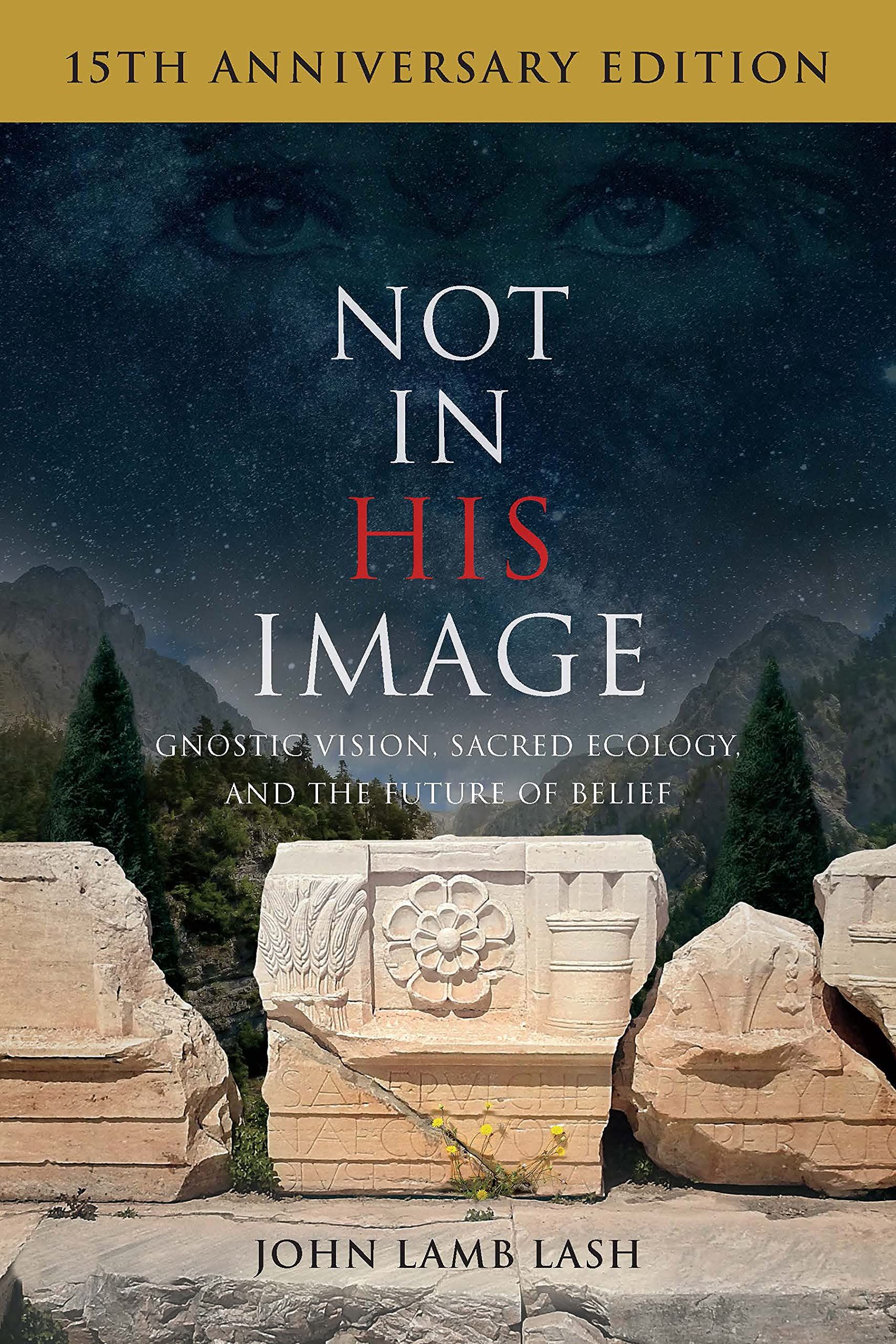
Not in His Image, first published in 2006 and updated in 2021 for its 15th Anniversary Edition, stands as a comprehensive reinterpretation of Gnostic texts and pre-Christian European spirituality, proposing a radical alternative to the dominant Judeo-Christian theological framework that has shaped Western civilization for nearly two millennia.[1] John Lamb Lash's central thesis argues that early Christianity systematically eliminated the Gnostic spiritual teachers, Druid priests, and shamanistic healers of Europe and North Africa, effectively erasing a sophisticated philosophical and ecological spirituality centered on the wisdom goddess Sophia and humanity's sacred relationship with the Earth.[2] Through meticulous analysis of the Nag Hammadi texts and ancient mystery traditions, Lash reconstructs what he characterizes as a suppressed narrative of history, demonstrating how a messianic sect employing institutional violence, cultural erasure, and ideological domination transformed itself into a world power.[1][3] The book presents the Gnostic understanding of cosmic origin through what Lash terms the "Fallen Goddess Scenario," wherein Sophia, embodying divine wisdom, intentionally descended into matter to become the physical Earth and guide human evolution, thereby establishing an ontological framework fundamentally opposed to the patriarchal, world-denying cosmology of monotheistic salvation theology.[26][35] This report examines the multifaceted dimensions of Lash's work, exploring its theological arguments, historical claims, ecological implications, and critical reception within both academic and popular discourse.
Background on John Lamb Lash and the Scholarly Context
John Lamb Lash, born in 1945, is a comparative mythologist and scholar whose intellectual career has centered on the intersection of Gnostic theology, pre-Christian European spirituality, and contemporary environmental concerns.[17] His approach to Gnosticism and ancient mystery traditions reflects a lifetime engagement with world mythology and esoteric philosophy, informed by his background as both an author and educator.[17][21] Before the publication of Not in His Image, which would become his most influential work, Lash had already established himself as a serious student of comparative mythology, though his particular synthesis of Gnostic texts, ecological philosophy, and historical revisionism would prove both innovative and controversial within academic circles.[1] The 2021 Anniversary Edition, fully revised and featuring a new preface by the author, indicates the enduring significance of the work while allowing Lash to expand and refine his arguments in light of contemporary developments, particularly regarding what he characterizes as technological transhumanism and biomedical interventions.[1][11]
The book's initial reception was marked by considerable enthusiasm from certain intellectual circles, with the Los Angeles Times praising Lash's ability to explain complex Gnostic and pagan concepts "with bracing clarity and startling insight," while noting that his arguments are "often lively and entertaining."[1][20] Environmental philosopher Derrick Jensen contributed an afterword to the original edition, endorsing Lash's fundamental thesis, while writer Roger Payne described the work as potentially world-changing, urging readers to engage with Lash's ideas to "improve not just your own life, but civilization's chances for survival."[1][28] However, this popular reception has not been uniformly matched by academic endorsement, and as shall be discussed, scholars such as Dr. Michael Heiser have challenged specific claims regarding the interpretation of Gnostic texts and their relationship to modern alien-contact narratives.[54]
The Gnostic Cosmology and the Fallen Goddess Scenario
At the heart of Not in His Image lies Lash's exposition of what he terms the Fallen Goddess Scenario, a cosmological narrative reconstructed from ancient Gnostic texts, particularly those discovered in the Nag Hammadi cache in 1945.[26][35] This scenario presents a radically different understanding of cosmic origin and human destiny compared to the creation narratives of orthodox Christianity or mainstream Judaism, depicting instead a universe that emerges spontaneously rather than through deliberate creation by a singular male deity.[26][35] According to Lash's interpretation of Gnostic cosmology, the cosmos originated not through an act of will by a transcendent creator but through the overflow and emanation of divine consciousness into infinite multiplicity.[26][41] The Pleroma, which Lash describes as the galactic core, serves as the residence of the Aeons, cosmic beings of intelligence and vitality who exist in a state of harmonious fullness, undivided from the ultimate source of all being.[26][35][63] These Aeons are not created entities in the conventional sense but rather emanations from the divine source, existing in complementary male-female pairs called syzygies, suggesting a fundamental principle of partnership and mutual dependence within the cosmic order.[63]
Central to this cosmology stands the figure of Sophia, the Wisdom Goddess, who emerges as the central character in the cosmic drama that produces both the Earth and humanity itself.[10][26] In the Gnostic understanding that Lash presents, Sophia embodies more than abstract philosophical principle; she represents an active, sentient divine being whose desire to witness and guide the evolution of humanity propels her on a cosmic journey of profound consequence.[26][35][51] Lash emphasizes that Sophia and her divine partner Thelete, jointly referred to as "The Intended," collaborated in the creation of the Anthropos, the archetypal human being, endowing this cosmic template with nous (the divine spark of intelligence) and epinoia (the capacity for creative thought).[26][35][41] The Pleroma projected this Anthropos into the Kenoma, characterized as an outer realm of chaos where it would serve as the birthplace for planetary systems and human civilization itself, establishing what Lash characterizes as humanity's extraterrestrial rather than terrestrial origins.[26][35]
However, Lash's interpretation of the Fallen Goddess Scenario emphasizes that Sophia's plunge into the realm of matter represents neither failure nor divine punishment but rather a purposeful intervention driven by her deep desire to witness and participate in the unfolding of human evolution.[26][35][51] This event, which Lash describes as "a fortunate divergence whose consequences reverberated across the universe," disrupted the previous equilibrium and resulted in unforeseen transformations throughout creation.[35][41] Sophia's descent into physicality and her subsequent embodiment as the Earth itself established her as a world-soul, a living presence within the material cosmos fundamentally committed to the evolution and liberation of the human species.[26][41] This understanding contrasts dramatically with the biblical Genesis narrative, wherein the world is depicted as a static creation emanating from a transcendent male deity utterly disconnected from matter, offering instead an ontology in which the divine and material worlds remain interpenetrated and mutually dependent.[14][26]
The concept of planetary consciousness and Gaia theory becomes central to Lash's framework, as he identifies Sophia with the living Earth itself.[26][35][41] This identification transforms ecological relationship from a matter of external ethics into a fundamental cosmological principle: humanity exists within and emerges from Sophia's very being, existing in a state of inevitable intimacy with the goddess whose body comprises our planetary home.[26][35] Lash emphasizes that in traditional Gnostic understanding, "We inhabit a three-body cosmos. Sophia is essentially the matriarch of a single-parent family—a single-planet goddess, if you will. But she relies on the support of the surrogate parents, sun and moon, to manage her terrestrial brood."[7] This poetic formulation encapsulates a vision of cosmic relationship fundamentally different from both monotheistic theology and mechanistic materialism, presenting instead an alive, conscious, feminine-centered cosmos in which humanity participates within divine intentionality.
The Critique of Judeo-Christian Salvation Theology and the Redeemer Complex
One of the most controversial and centrally important dimensions of Not in His Image involves Lash's comprehensive critique of what he terms the "Redeemer Complex," the theological framework that he identifies as the foundational structure of Judaism, Christianity, and Islam.[34][38] This complex, Lash argues, originated in ancient Hebrew culture with a particular sect called the Zaddikim and subsequently transformed into Christianity through the figure of Jesus Christ.[34][35] According to Lash's analysis, the Redeemer Complex contains four essential components: the creation of the world by a transcendent male creator god divorced from any goddess principle; the selection of a righteous few or "chosen people" for a divine plan; the mission of a messiah sent by this creator god to accomplish salvation; and the final judgment wherein the world is destroyed so that the righteous few may escape into transcendent paradise.[34][35][38]
Lash presents this theological structure not as divine revelation but as a deliberate ideological construction designed to legitimate domination, violence, and the enslavement of consciousness to authoritarian systems.[34][35] He argues, drawing on Gnostic texts, that the Gnostics understood the core problem with salvation theology: it relies fundamentally on the dissociation of the divine from the material world, creating an impossible psychological and spiritual split wherein followers must renounce and despise their earthly existence, their bodies, sexuality, and the natural world itself in pursuit of escape into an otherworldly transcendence.[26][35][38] The Gnostic critique, as Lash articulates it, identifies this otherworldly focus as a mechanism for ensuring human compliance with oppressive systems, since followers accept present suffering and injustice as temporary afflictions redeemed through faith in future salvation.[34][35]
One of Lash's most provocative arguments involves his assertion that the salvation narrative of the Bible itself is fundamentally a "story of perpetration, conceived to support and legitimate the dominator agenda."[7] He contends that "From its inception patriarchy has relied on salvation narrative to underwrite its program of genocide, ecocide, sexual repression, child abuse, social domination, and spiritual control."[7] This argument extends the historical observation that religious ideals attached to salvation theology have been systematically weaponized to justify violence, rape, genocide, and ecological destruction throughout history.[7] Lash emphasizes that while individual practitioners of Christianity may embody genuine compassion and sincerity, the salvation narrative itself functions as an enabling ideological structure that permits perpetrators to justify violence as divinely sanctioned while offering perpetrators the hope of redemption and ultimate salvation.[7][35]
The distinction between Jesus as a historical or mythological figure and the Christ-theology developed by subsequent Christian institutions becomes important in Lash's analysis.[34][35] He argues that Gnostic texts present what he terms a "counterfeit revealer" figure in Jesus, a constructed messiah whose claim to exclusive status as the "only-begotten Son of God" functions as an authoritarian mechanism preventing challenge or critical engagement.[34] The Gnostic preference for the concept of the "revealer cycle"—periodic manifestations of illumined teachers throughout history—stands in stark contrast to Christian insistence on the singularity and finality of Christ's revelation.[34][35] In Lash's reading, this difference becomes crucial: the salvational messiah offers escape and otherworldly transcendence, while the Gnostic revealer offers gnosis, direct experiential knowledge that liberates human consciousness to recognize its own divine nature and capacity.[34][35]
Lash's engagement with the concept of redemptive suffering represents another critical dimension of his analysis. He argues that the Christian theology of redemptive suffering—the notion that pain, sacrifice, and renunciation possess spiritual value and cosmic significance through identification with Christ's suffering—establishes a psychological and spiritual framework that normalizes abuse and suffering as paths to holiness.[34][35][38] This represents, in Lash's estimation, a profound inversion of healthy human instinct, creating spiritual incentive structures that reward self-negation while channeling resentment and victim consciousness into complicity with systemic oppression.[34][35]
Historical Suppression: The Destruction of Gnosticism and Systematic Erasure
Lash's historical narrative in Not in His Image argues that the rise of Christianity to institutional dominance in the fourth and fifth centuries involved the systematic destruction of alternative spiritual traditions, particularly Gnosticism and the mystery schools of Europe and the Mediterranean world.[1][9][14] The author contends that early Christian leaders burned libraries, destroyed temples, and employed violence and institutional suppression to eliminate competing religious and philosophical systems, actions Lash characterizes as "mass genocides" in the cultural and spiritual sense.[1][3][11] This historical account draws on archaeological and textual evidence, though it presents a particular interpretive framework that emphasizes Christian agency in cultural destruction while perhaps underplaying the complex political, economic, and social forces at work in late antique religious transformation.[1][9]
The discovery and eventual translation of the Nag Hammadi codices in 1945, Lash notes, provided unprecedented access to Gnostic texts that had been suppressed, hidden, and nearly erased from history.[19] These thirteen leather-bound volumes, dated to the mid-fourth century and containing more than fifty texts, represent what scholars now recognize as representing "a legitimate religious movement that offered an alternate testament to Jesus' life and teachings" rather than the depraved heresy depicted by orthodox church fathers.[19][26] Until this discovery, the dominant understanding of Gnosticism derived almost exclusively from hostile accounts written by Christian theologians like Irenaeus, Hippolytus, and Origen, who portrayed Gnostic teachings as confused, immoral, and contrary to authentic Christianity.[19][34]
Lash emphasizes the deliberate nature of this erasure, presenting evidence that Christian authorities systematically targeted Gnostic texts, teachers, and communities for destruction.[1][9][11] The book recounts how early Christian leaders, particularly after Christianity's institutionalization under Constantine and subsequent emperors, enacted laws outlawing paganism and other religious traditions, creating legal frameworks for persecution and cultural elimination.[1][11][46] Lash notes that this transformation from marginal sect to state religion involved the acquisition of political power through legal sanctions rather than through the persuasive force of spiritual teaching.[1]
The murder of Hypatia of Alexandria emerges in Lash's narrative as a crucial historical exemplar, symbolizing the violent suppression of pagan learning and the triumph of Christian institutional authority.[1] Hypatia, a brilliant mathematician and head of the Platonic school in Alexandria, was murdered in 415 CE by a Christian mob during a factional conflict between the Christian Patriarch Cyril and the pagan Roman Prefect Orestes.[42][46] The brutality of her death—she was dragged from her carriage, stripped, beaten with tiles or oyster shells, and either flayed alive or torn to pieces—represented the physical enactment of intellectual and spiritual suppression.[42][46] Contemporary sources describe the event as an attack on learning itself, and historians have noted that Hypatia's murder marks a symbolic threshold in the transition from classical to Christian civilization.[42][46]
Lash also addresses the incorporation of pagan iconography and practice into Christian ritual and theology as part of a strategy to absorb and subordinate older spiritual traditions rather than simply eradicate them.[35] The author identifies in this process what he terms a "transference," wherein pagan festivals became Christian holy days, pagan goddesses became Christian saints, and pre-Christian mystery practices were transformed and repackaged within Christian institutional structures.[35][59] This syncretic process involved both deliberate appropriation and forced theological reinterpretation, effectively neutralizing the spiritual power of older traditions by subordinating them to Christian authority structures.[35][59]
The Pagan Mysteries and the Schools of Coevolution
Central to Lash's vision of suppressed history is his reconstruction of what he terms the Pagan Mysteries, an ancient network of spiritual learning centers that flourished throughout Europe and the Mediterranean world for millennia before Christian dominance.[1][26][35] These Mystery Schools represented, in Lash's understanding, not primitive superstition but sophisticated systems of spiritual development, ecological knowledge, and experiential initiation designed to awaken human potential and align consciousness with planetary wisdom.[26][35][66] The most famous of these, the Eleusinian Mysteries devoted to Demeter and Persephone, operated on the Greek peninsula for over a thousand years, incorporating dramatic reenactment, sacred objects, and possibly entheogenic substances to facilitate profound spiritual experiences.[66][70]
Lash argues that these Mystery traditions were fundamentally oriented toward what he calls "coevolution," a harmonious alignment between human consciousness and the living Earth understood as the embodied presence of the goddess Sophia or Gaia.[26][35][66] The initiates of the Mysteries sought, through elaborate ritual, philosophical instruction, and direct experience, to achieve gnosis—direct, experiential knowledge—of their divine nature and their ultimate identity with the cosmic intelligence animating all existence.[26][35][66] Unlike Christianity, which promised otherworldly salvation and encouraged renunciation of the material world, the Mysteries cultivated an engaged, embodied spirituality rooted in nature, sexuality, artistic creativity, and the celebration of the life force itself.[26][35]
The telestai, the guardians and teachers within the Mystery Schools, transmitted what Lash describes as profound existential knowledge and understanding of universal design principles.[35][41] These teachers, initiated into the deepest levels of mystery teaching, possessed practical knowledge spanning spirituality, scientific ideas, philosophical thought, and craftsmanship, embodying an integration of intellectual, practical, and spiritual knowledge that reflected a radically different understanding of human development than that offered by salvation theology.[26][35][41] Lash emphasizes that the Mysteries were never intended as escapes from the world but rather as means to fully actualize human potential within earthly existence, to develop what he calls the "Anthropos"—the archetypal human being capable of conscious participation in cosmic evolution.[26][35][41]
The destruction of these Mystery Schools represents, in Lash's analysis, not merely the suppression of alternative religious options but the elimination of an entire knowledge system and spiritual technology for human development.[35][59] The author contends that this destruction created what he characterizes as a massive gap in Western culture, divorcing modern humanity from the ecological wisdom and spiritual sophistication that the ancient Mysteries had preserved and transmitted.[35][59] This cultural and spiritual disconnection, Lash argues, has contributed significantly to contemporary ecological crisis, as modern humans have lost the sacred sense of Earth as an alive, conscious presence worthy of reverence and protection.[35][59]
The Archons and Impediments to Human Evolution
Lash's treatment of the Archons, entities central to Gnostic cosmology, represents one of the most controversial dimensions of his work, as he interprets these malevolent beings not merely as theological concepts but as actual entities operating in human consciousness and potentially connected to nonhuman intelligence.[54] In Gnostic texts, the Archons appear as rulers and administrators of the material cosmos who jealously guard their domain against the liberation of human consciousness.[22][54] According to Gnostic cosmology, these entities assisted the Demiurge—the inferior creator deity whom Lash identifies with the God of the Hebrew Bible—in creating the material world and continue to manipulate human thought and behavior to prevent spiritual awakening.[22][35][41]
Lash emphasizes that the Archons are characterized in Gnostic texts as fundamentally soulless beings, entities without access to the divine spark of consciousness that animates humans and higher cosmic beings.[22][41] In the Reality of the Rulers, a Gnostic text, the Archons are described as possessing "bodies that are both female and male, and faces that are the faces of beasts," representing beings so fundamentally alien and boundary-transgressive that they incarnate chaos itself.[22] The Gnostic texts often depict the Archons as bumbling, conceited oafs, beings powerful in their domain but intellectually and spiritually deficient, requiring constant reinforcement of their authority precisely because they lack the genuine spiritual power that comes from connection to divine source.[22]
The operational mechanism through which Archons exercise influence over humanity becomes crucial in Lash's analysis. He argues that these entities manipulate human consciousness through appeals to the lower aspects of human nature: fear, shame, sexual manipulation, tribal loyalty, and the propensity toward self-deception.[22][41][54] The Archons, in this understanding, do not primarily operate through external coercion but rather through subtle manipulation of thought-patterns, emotional impulses, and perceptual frameworks that lead humans to internalize oppression and participate in their own limitation.[22][41][54] Lash emphasizes that the Gnostics understood the Archons as having deliberately designed human consciousness to be susceptible to their influence, creating what he terms a kind of "mind parasitism" wherein human tendency toward error and self-deception becomes the vehicle through which Archontic influence propagates.[22][41][54]
Lash's identification of the Demiurge as the source of patriarchal religious authority and the Archons as the administrators of this oppressive system creates a coherent explanatory framework connecting cosmic theology, human psychology, and institutional religion.[26][35][41] In this schema, the false god of monotheistic religion represents an actual entity of malevolent intention, and the religious systems built around this false deity function as mechanisms for perpetuating Archontic domination of human consciousness.[26][35][41] The salvation theology of Christianity becomes, in this interpretation, a sophisticated tool deployed by these entities to ensure human compliance, acceptance of suffering, and psychological fragmentation.[26][35][38]
Critics, particularly biblical scholar Dr. Michael Heiser, have questioned Lash's interpretation of the Archons as actual nonhuman entities, arguing that Lash conflates mythological and theological concepts with literal beings and imposes modern science-fiction frameworks onto ancient texts.[54] Heiser contends that while the Gnostic texts do describe Archons, they function within a mythological system rather than representing reports of literal alien entities, and that Lash's interpretation reflects the influence of contemporary popular narratives about extraterrestrial contact rather than emerging naturally from Gnostic texts themselves.[54] This criticism raises important questions about the boundaries between mythological interpretation and literal belief, between spiritual metaphor and ontological claim.
Sacred Ecology and the Sophianic Vision of Living Earth
A distinctive and increasingly important dimension of Lash's work, particularly emphasized in the 15th Anniversary Edition, involves what he terms "sacred ecology," the recognition that the Earth itself, embodied as the goddess Sophia, possesses consciousness, intentionality, and agency in the evolution of human civilization.[1][11][26][35] This perspective transforms environmental ethics from a matter of external obligation into a recognition of living relationship with a conscious being—our planetary mother, Sophia—whose well-being and evolutionary purposes intersect fundamentally with human destiny.[26][35][75]
Lash argues that the pre-Christian Gnostic and pagan traditions understood this sacred relationship, maintaining what he characterizes as knowledge that "the truth of the planet Earth cannot be hidden or destroyed."[1] The Earth itself becomes the ultimate witness and arbiter of truth, as Sophia's presence within planetary ecosystems maintains a kind of cosmic memory of authentic human potential and evolutionary purpose.[26][35][75] This vision offers a radically different relationship to environmental crisis than conventional frameworks: rather than appealing to abstract principles of sustainability or stewardship, Lash's Sophianic vision calls for recognition of direct communion with a living presence embodied in nature itself.[26][35][75]
The Sophianic vision emphasizes that humanity's alienation from nature, sexuality, and embodied existence represents not merely a cultural problem but a fundamental spiritual impediment to the realization of human potential.[26][35][75] The redemptive ideology of Christianity, in dissociating the divine from the material world and positioning escape from physicality as the supreme spiritual goal, created precisely the psychological conditions necessary for the ecological destruction now threatening planetary habitability.[26][35][75] Lash contends that reconnection with Sophia, with the wisdom goddess embodied in Earth's living systems, provides the spiritual and cognitive resources necessary for correcting course and aligning human behavior with the evolutionary intentions of the planet itself.[26][35][75]
Lash's concept of the Anthropos—the archetypal human being encoded within the genetic and cosmic pattern of humanity—represents a crucial element of this ecological vision.[26][35][41] If humanity can awaken to the Sophianic vision and recognize itself as Sophia's deliberate creation designed to participate consciously in planetary evolution, then the current trajectory of ecological destruction and spiritual alienation becomes revealed as a profound deviation from our true nature and purpose.[26][35][41][75] The correction of this deviation requires not institutional reform or technological intervention but rather a fundamentally reoriented consciousness capable of recognizing itself as participating in a living cosmos and subordinating its will to the purposes of Sophia as embodied in planetary systems and processes.[26][35][75]
The Redeemer Complex and Its Contemporary Manifestations
In the 15th Anniversary Edition, Lash expands his critique of the Redeemer Complex to encompass what he identifies as contemporary expressions of this fundamental theological structure, particularly in what he terms "salvation by syringe" and technologically mediated transhumanism.[1][11] The author argues that modern biomedical interventionism and transhumanist ideology represent not departures from the Judeo-Christian worldview but rather its logical evolution and continuation through technological means.[1][11] The promise of rescue through medical intervention, the belief in technological salvation from suffering and mortality, the vision of uploading consciousness into digital substrates—all of these, Lash contends, replicate the essential structure of redemptive theology while employing contemporary scientific and technological language.[1][11]
This expansion of Lash's critique demonstrates how he views the Redeemer Complex not as a historically circumscribed phenomenon but as an archetypal pattern in human consciousness that repeatedly manifests in new forms as technological capacity expands.[1][11][38] Whether through religious messianism or technological transhumanism, the pattern remains consistent: the promise of escape from embodied existence, from the natural world, and from the constraints of physicality itself, coupled with the assertion that liberation requires submission to an external authority—whether divine or technological—that claims the capacity to engineer transformation and rescue.[1][11]
Lash's characterization of transhumanism as an "evil agenda" in the Anniversary Edition reveals his assessment that the technological trajectory currently authorized by dominant institutions represents a profound threat to human authenticity and planetary survival.[1][11] The vision of consciousness freed from bodily constraint, of human enhancement through technological intervention, of post-biological existence in simulated environments—all of these represent, in Lash's analysis, the ultimate expression of the spirit/matter dualism and the renunciation of Earth that Christianity institutionalized.[1][11][26] The Sophianic vision of sacred ecology and embodied participation in planetary consciousness stands in direct opposition to these technological fantasies of escape from materiality and embodiment.[1][11]
Reception and Critical Perspectives
The reception of Not in His Image has been sharply divided between enthusiastic endorsement from certain intellectual circles and skepticism or outright rejection from academic specialists in Gnosticism, biblical studies, and ancient religion.[20][43][54] The book has attracted considerable attention within countercultural and alternative spirituality communities, appealing to readers seeking critiques of institutional Christianity and Western civilization's relationship to nature.[1][20] The work's accessibility—Lash's ability to explain complex theological concepts in engaging, often polemical language—has contributed to its popular success and influence beyond academic circles.[1][20]
However, scholarly response has been more measured and often critical. Dr. Michael Heiser, a scholar of ancient languages and biblical cosmology, has specifically challenged Lash's interpretation of Gnostic Archons as literal extraterrestrial entities, arguing that Lash imposes modern science-fiction frameworks onto ancient mythological texts and conflates genuine Gnostic teaching with New Age alien-contact narratives.[54] Heiser contends that while similarities exist between Gnostic cosmology and modern UFO narratives, the causality Lash suggests—that ancient Gnostics accurately reported genuine alien intrusion—lacks textual support and represents instead the influence of contemporary popular culture on Lash's interpretation of ancient sources.[54]
Similarly, some scholars have questioned whether Lash's historical narrative accurately represents the complexity of late antique religious transformation, suggesting that his emphasis on Christian violence and suppression may underestimate the genuine religious appeal of Christianity to many populations and the multiple factors contributing to Christianity's institutional success.[19][46] The role of political power, economic transformation, genuine theological persuasiveness, and institutional efficiency in Christianity's ascendance may have been more significant than a narrative focused primarily on violence and suppression acknowledges.[19][46]
Others have noted tensions between Lash's use of Jungian depth psychology, systems theory, and contemporary environmental philosophy alongside his reading of ancient texts, suggesting that these modern frameworks may shape his interpretation of Gnostic sources in ways not immediately transparent to readers.[50][54] The question of whether the Gnostic texts themselves warrant the conclusions Lash draws, or whether his interpretive framework and contemporary concerns have substantially shaped what he finds in the texts, remains contested.[50][54]
Nonetheless, the book has exercised considerable influence on contemporary discussions of environmental spirituality, critiques of monotheistic patriarchy, and the revival of interest in pre-Christian European traditions.[1][20][25][27] The work has inspired spiritual practices, ecological activism, and renewed scholarly attention to Gnosticism and ancient mystery traditions, even among those who may question specific historical or theological claims Lash advances.[1][20][25]
Conclusion: Legacy and Implications of the Sophianic Vision
Not in His Image represents a significant intervention in contemporary conversations about spirituality, ecology, history, and the future of human civilization, regardless of how one assesses the accuracy of specific historical claims or theological interpretations offered.[1][20][26][35] The book articulates a comprehensive alternative to the dominant Western theological and philosophical inheritance, proposing instead a vision of sacred Earth, embodied consciousness, goddess-centered spirituality, and human participation in planetary evolution.[1][26][35][75] Through its engagement with Gnostic texts and pagan mystery traditions, Lash demonstrates that sophisticated spiritual and philosophical alternatives to monotheistic salvation theology have existed within Western civilization itself, suppressed but not eliminated by Christian institutional dominance.[1][34]
The work's emphasis on sacred ecology and the recognition of planetary consciousness as living wisdom worthy of reverence and engagement addresses a profound crisis of meaning and relationship afflicting contemporary civilization. In an era of ecological devastation, spiritual alienation, and technological acceleration, Lash's insistence on the necessity of reconnecting with Sophia—with the wisdom embodied in Earth's living systems—offers a radical reorientation toward relationship with nature not as external environment but as conscious presence intimately concerned with human evolution.[26][35][75] This reorientation carries implications for how humanity approaches environmental crisis, technological development, and the fundamental question of human purpose and destiny.[26][35][75]
The Sophianic vision as Lash presents it calls not for abstract sustainability principles but for recognition of direct participation in living relationship with a conscious planetary presence whose purposes may exceed or diverge from contemporary human assumptions and desires.[26][35][75] This demands a kind of epistemic humility, an acknowledgment that human beings operate within a cosmos of intelligence and intentionality that transcends individual or collective will, and that authentic human flourishing depends upon aligning action and consciousness with these larger evolutionary purposes.[26][35][75]
The 15th Anniversary Edition's emphasis on the contemporary manifestations of redemptive ideology—particularly technological transhumanism and biomedical salvation promises—suggests that Lash views the fundamental conflict between Sophianic and Archontic consciousness as intensifying rather than resolving in contemporary civilization.[1][11] The stakes, in his analysis, have never been higher, as humanity faces the possibility of permanently severing itself from embodied relationship with Earth through technological intervention, even as ecological crisis intensifies the necessity of such reconnection.[1][11][26]
Whether one accepts Lash's specific theological claims, historical interpretations, or identification of Archons as literal entities, the book succeeds in compelling readers to examine foundational assumptions about Western religious tradition, environmental relationship, and human destiny.[1][20][26][35] It demonstrates that sophisticated critiques of patriarchal monotheism and calls for reconnection with sacred femininity and planetary consciousness have deep roots in Western civilization's own suppressed traditions, and that contemporary spirituality need not import Eastern frameworks wholesale but can draw upon alternatives present within its own heritage.[1][26][35] In this respect, Not in His Image functions not merely as a historical or theological study but as an invitation to consciousness transformation and civilizational reorientation toward what Lash terms the Sophianic vision of sacred ecology and human participation in planetary evolution.[1][26][35][75]
References:
[1] https://www.chelseagreen.com/product/not-in-his-image-15th-anniversary-edition/
[2] https://www.thriftbooks.com/a/john-lamb-lash/469739/
[3] https://www.thriftbooks.com/w/not-in-his-image-gnostic-vision-sacred-ecology-and-the-future-of-belief_john-lamb-lash/693470/
[4] https://www.goodreads.com/book/show/19492451-not-in-his-image
[5] https://ia800206.us.archive.org/2/items/NotInHisImageJohnLambLash2006/Not%20In%20His%20Image,%20John%20Lamb%20Lash%20(2006).pdf
[6] https://www.goodreads.com/author/list/34285.John_Lamb_Lash
[7] https://www.goodreads.com/work/quotes/623984-not-in-his-image-gnostic-vision-sacred-ecology-and-the-future-of-beli
[8] https://archive.org/details/notinhisimagegno0000lash
[9] https://www.bookey.app/book/not-in-his-image
[10] https://en.wikipedia.org/wiki/Sophia_(Gnosticism)
[11] https://www.thriftbooks.com/w/not-in-his-image-gnostic-vision-sacred-ecology-and-the-future-of-belief_john-lamb-lash/693470/
[12] https://shop.watkinsbooks.com/products/not-in-his-image-by-john-lamb-lash
[13] https://ia800206.us.archive.org/2/items/NotInHisImageJohnLambLash2006/Not%20In%20His%20Image,%20John%20Lamb%20Lash%20(2006).pdf
[14] https://books.google.com/books/about/Not_in_His_Image.html?id=WUyVAAAAMAAJ
[15] https://www.goodreads.com/book/show/19492451-not-in-his-image
[16] https://archive.org/details/notinhisimagegno0000lash
[17] http://newprophetsinitiative.blogspot.com/p/john-lamb-lash.html
[18] https://www.spiritofthescripture.com/id4108-the-real-meaning-of-the-demiurge.html
[19] https://www.biblicalarchaeology.org/daily/biblical-artifacts/the-nag-hammadi-codices/
[20] https://www.chelseagreen.com/product/not-in-his-image-15th-anniversary-edition/
[21] https://www.encyclopedia.com/arts/educational-magazines/lash-john-1948-john-lamb-lash
[22] https://gnosticismexplained.org/archons/
[23] http://www.gnosis.org/naghamm/origin.html
[24] https://www.goodreads.com/book/show/19492451-not-in-his-image
[25] https://www.goodreads.com/book/show/19492451-not-in-his-image
[26] https://www.shortform.com/summary/not-in-his-image-summary-john-lamb-lash
[27] https://www.barnesandnoble.com/w/not-in-his-image-john-lamb-lash/1100007626
[28] https://books.google.li/books?id=NblF1xjoeLUC
[29] https://www.scribd.com/document/530698804/Not-in-His-Image-15th-Anniversary-Edition-Preface-and-Intro
[30] https://books.google.com/books/about/Not_in_His_Image.html?id=WUyVAAAAMAAJ
[31] https://www.ebay.com/itm/397128397931
[32] https://shop.watkinsbooks.com/products/not-in-his-image-by-john-lamb-lash
[33] https://ia800206.us.archive.org/2/items/NotInHisImageJohnLambLash2006/Not%20In%20His%20Image,%20John%20Lamb%20Lash%20(2006).pdf
[34] https://cisindus.org/indic-varta-internal.php?vartaid=146
[35] https://www.shortform.com/summary/not-in-his-image-summary-john-lamb-lash
[36] https://books.google.li/books?id=NblF1xjoeLUC
[37] https://www.chelseagreen.com/product/not-in-his-image-15th-anniversary-edition/
[38] https://cisindus.org/indic-varta-internal.php?vartaid=142
[39] https://shop.watkinsbooks.com/products/not-in-his-image-by-john-lamb-lash
[40] https://www.barnesandnoble.com/w/not-in-his-image-john-lamb-lash/1100007626
[41] https://www.shortform.com/summary/not-in-his-image-summary-john-lamb-lash
[42] https://www.matthewcowden.com/2018/03/15/confess-hypatia-murder-violence-in-the-name-of-christ/
[43] https://johndenugent.com/not-in-his-image/
[44] https://books.google.li/books?id=NblF1xjoeLUC
[45] https://ia800206.us.archive.org/2/items/NotInHisImageJohnLambLash2006/Not%20In%20His%20Image,%20John%20Lamb%20Lash%20(2006).pdf
[46] https://www.ancient-origins.net/history-famous-people/living-mans-world-untimely-brutal-death-hypatia-002328
[47] https://www.shortform.com/pdf/not-in-his-image-pdf-john-lamb-lash
[48] https://www.goodreads.com/book/show/19492451-not-in-his-image
[49] https://ia800206.us.archive.org/2/items/NotInHisImageJohnLambLash2006/Not%20In%20His%20Image,%20John%20Lamb%20Lash%20(2006).pdf
[50] https://mythologymatters.wordpress.com/2018/02/26/gnosticism-and-modern-spirituality-a-mythological-and-depth-psychological-approach/
[51] https://realitysandwich.com/wisdoms_dare_future_divine_experiment/
[52] https://shop.watkinsbooks.com/products/not-in-his-image-by-john-lamb-lash
[53] https://www.shortform.com/pdf/not-in-his-image-pdf-john-lamb-lash
[54] https://drmsh.com/gnostic-archons-aliens/
[55] https://cdn.bookey.app/files/pdf/book/en/not-in-his-image.pdf
[56] https://www.goodreads.com/book/show/19492451-not-in-his-image
[57] https://soundcloud.com/bob-da-builda/art-bell-john-lash-gnosticism?in=domrusconi%2Fsets%2Fpodcast
[58] https://feminismandreligion.com/2015/03/16/can-you-kill-the-spirit-what-happened-to-female-imagery-for-god-in-christian-worship-by-carol-p-christ/
[59] https://www.shortform.com/summary/not-in-his-image-summary-john-lamb-lash
[60] https://www.chelseagreen.com/product/not-in-his-image-15th-anniversary-edition/
[61] https://www.coasttocoastam.com/show/2005-03-19-show/
[62] https://ia800206.us.archive.org/2/items/NotInHisImageJohnLambLash2006/Not%20In%20His%20Image,%20John%20Lamb%20Lash%20(2006).pdf
[63] https://gnosticismexplained.org/the-pleroma-and-the-aeons/
[64] https://shop.watkinsbooks.com/products/not-in-his-image-by-john-lamb-lash
[65] https://ia800206.us.archive.org/2/items/NotInHisImageJohnLambLash2006/Not%20In%20His%20Image,%20John%20Lamb%20Lash%20(2006).pdf
[66] https://en.wikipedia.org/wiki/Eleusinian_Mysteries
[67] https://www.chelseagreen.com/product/not-in-his-image-15th-anniversary-edition/
[68] https://www.shortform.com/summary/not-in-his-image-summary-john-lamb-lash
[69] https://www.abebooks.com/Image-Gnostic-Vision-Sacred-Ecology-Future/31833377000/bd
[70] https://sacred-texts.com/eso/sta/sta06.htm
[71] https://books.google.com/books/about/Not_in_His_Image.html?id=L4zUAgAAQBAJ
[72] https://shop.watkinsbooks.com/products/not-in-his-image-by-john-lamb-lash
[73] https://torahresource.com/article/yeshua-and-the-hasidic-tsadik-an-exploration-into-the-theology-of-the-tsadik/
[74] https://www.modernreformation.org/resources/articles/what-changed-my-mind-about-the-old-testament-conquest-narratives
[75] https://pathwaystofamilywellness.org/inspirational/the-fallen-goddess-scenario.html
[76] https://books.google.li/books?id=NblF1xjoeLUC
[77] https://en.wikipedia.org/wiki/Messianic_Judaism
[78] https://ia800206.us.archive.org/2/items/NotInHisImageJohnLambLash2006/Not%20In%20His%20Image,%20John%20Lamb%20Lash%20(2006).pdf
[79] https://sophianicmyth.org
[80] https://www.chelseagreen.com/product/not-in-his-image-15th-anniversary-edition/