On that Story sold to you

The Burden of Proof Argument
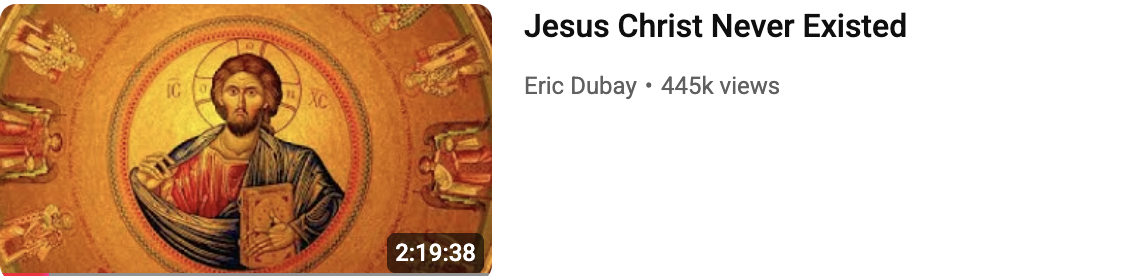
The documentary opens by invoking the principle that "extraordinary claims require extraordinary evidence." It contends that the burden of proof lies not with sceptics to disprove supernatural claims, but with believers to substantiate them. The film draws a parallel with Hercules, noting it does not accept the Greek "son of God" as historical, and its burden of proof should be no greater than that demanded of Christian apologists.
Absence of Contemporary Evidence
The documentary emphasises the complete lack of contemporary historical documentation for Jesus. It lists numerous historians who lived in the Mediterranean during Jesus's supposed lifetime—including Aulus Gellius, Columella, Justus of Tiberias, Livy, Lucanus, Petronius, Phaedrus, Philo Judeus, Pliny the Younger, Plutarch, Seneca, and Tacitus—none of whom mention Jesus, his family, or his followers.
The argument extends to physical evidence: "There are no physical artifacts from the first century. We don't have any autographs or originals of the gospels or the epistles." The canonical Gospels do not appear in the historical record before the end of the second century, and there is no evidence they were written by their attributed authors.
The Forgery of Josephus
The documentary treats the Testimonium Flavianum—the passage in Josephus purporting to confirm Jesus's existence—as a proven forgery. It states it was "forged in the 4th century by a guy named Eusebius," an early church father. The film notes Josephus was not born when Jesus was supposedly crucified, making him incapable of being an eyewitness.
Tacitus and Secondary Sources
The second source typically cited, Tacitus, fares no better in the documentary's analysis. Writing in the second century, Tacitus "was not born when Jesus was alive and could never have laid eyes on him." The film argues Tacitus merely notes the existence of a Christian cult, which proves nothing about the historicity of their figurehead: "Just because there are cults in the day, doesn't mean the figures the cults were worshipping were actually real."
Pre-Christian Parallels and Solar Mythology
The documentary presents extensive comparative mythology, arguing Jesus's story replicates earlier divine figures:
Horus (Egypt, c. 3000 BC): Born of a virgin (Isis), miracle conception announced by Thoth, baptism, ministry, crucifixion, and resurrection
Mithra (Persia, c. 1200 BC): Born of a virgin on 25 December, twelve disciples, died for three days and resurrected, called "the Truth, the Light," worshipped on Sunday
Attis (Phrygia, c. 900 BC): Born of a virgin on 25 December, martyred on a cross, died for three days, resurrected
Krishna (India, c. 900 BC): Virgin birth heralded by a star, tyrant slaughtered infants to kill him, performed miracles, crucified between two thieves, resurrected
The documentary lists fifteen pre-Christian deities sharing virgin birth, crucifixion, and resurrection motifs, including: Buddha, Dionysus, Osiris, Zoroaster, Odin, Baal, Adonis, Prometheus, and Quetzalcoatl.
Astrological Allegory
The film argues the Gospels encode solar and zodiacal symbolism:
- The twelve disciples represent the twelve constellations
- The cross derives from the "cross of the zodiac," the sun's path through the year
- December 25th marks the sun's resurrection after the winter solstice; the sun "dies" for three days at the solstice (the "crucifixion"), hung in the vicinity of the Southern Cross constellation
- The three wise men are the three stars of Orion's Belt, which align with Sirius (the brightest star) to point to the sunrise on 25 December
- Virgo the Virgin ("Bethlehem" literally means "house of bread," matching Virgo's wheat sheaf symbol) "gives birth" to the sun
The ages of Jesus—12 and 30—correspond to the sun's position at noon and its entry into constellations at 30-degree intervals. The fish symbolism throughout the New Testament marks the Age of Pisces, which Jesus was said to usher in.
Gnosticism versus Literalism
The documentary presents Gnosticism as the authentic spiritual tradition, suppressed by the Roman Church. Gnostics understood Jesus as a metaphor for divine knowledge (gnosis) and "Christ consciousness," not a historical man. The literalist church, beginning with Constantine's Council of Nicaea (325 AD), transformed this mystical tradition into a tool for political control.
The film cites Saint Athanasius: "Should we understand sacred writ according to the letter, we should fall into the most enormous blasphemies." The Gnostic Nag Hammadi texts (discovered 1945) revealed this suppressed tradition.
Historical Inaccuracies in the Bible
The documentary catalogues internal contradictions:
- Jesus's birth date: Matthew places it before 4 BC (Herod's death); Luke places it at 6 AD (the census)—a ten-year discrepancy
- Birthplace: Matthew and Luke say Bethlehem; John says Galilee
- The Slaughter of the Innocents: Recorded only in Matthew; absent from Josephus's detailed catalogue of Herod's crimes
- Passover prisoner release: No such practice existed historically
- Caiaphas and Annas: Never served jointly as high priests
The Political Construction of Christianity
The film argues Christianity was manufactured at the Council of Nicaea by merging competing cults under Constantine's authority. The phrase "Jesus Christ" allegedly did not exist before this council. Pagan temples became churches; pagan holidays (solstice, equinox) became Christian holy days. The Vatican itself was originally a Mithraic temple until seized in 376 AD.
The Great Library at Alexandria was destroyed in 391 AD to erase these origins. For over a millennium, average Christians were forbidden to read the Bible—only priests could interpret the Latin text.
Conclusion: Myth as Living Wisdom
Despite rejecting historicity, the documentary affirms the symbolic power of the Jesus myth. The crucifixion scene retains existential weight as "the tragedy of a great man being hung between two thieves"—an allegory for authentic human suffering and moral courage. The sun, not a man, is "the Christ"—the light that sustains life. The documentary concludes that recognising the mythological nature of Jesus liberates the tradition from authoritarian control, restoring its Gnostic function as a path to direct spiritual experience.