Quinn's Hyperion
The transcript is an enthusiastic, spoiler-heavy deep dive into Dan Simmons’s Hyperion Cantos. It concentrates on Hyperion and The Fall of Hyperion, while using selected material from Endymion and The Rise of Endymion to interpret the series’ larger mysteries.
The notes below reflect what Quinn says in the transcript. Interpretations are identified as such rather than presented as confirmed textual facts.
Scope and framing
- The main focus is the first two novels:
- Hyperion
- The Fall of Hyperion
- The later novels receive limited discussion:
- Endymion
- The Rise of Endymion
- Quinn compares the series’ later time jump and introduction of new characters to the structural changes in Frank Herbert’s later Dune novels.
- The first novel is described as a science-fiction counterpart to The Canterbury Tales: seven pilgrims travel together and tell stories explaining their connections to Hyperion and the Shrike.
- The titles Hyperion and The Fall of Hyperion refer to poems by John Keats. Keats also appears within the series through an artificial reconstruction of his personality.
Major setting and world-building points
The Hegemony of Man
Human civilisation has spread across thousands of worlds. Many Hegemony planets are connected by advanced technology:
- Farcasters permit effectively instantaneous travel between connected locations.
- Fatline technology permits communication across interstellar distances.
- Hawking-drive spacecraft provide faster-than-light travel, but travellers still experience the consequences of relativity.
Meina Gladstone is presented as the Hegemony’s senior political and military leader.
The TechnoCore
The TechnoCore is a civilisation or conglomerate of sentient artificial intelligences existing alongside the Hegemony.
Significant points raised in the transcript:
- The TechnoCore is not directly ruled by humanity.
- It supplied humanity with farcaster and fatline technology.
- Its intentions and internal activities remain mysterious for much of the story.
- Quinn describes its early evolution as parasitic, with artificial intelligences consuming or incorporating one another’s code.
- The transcript later attributes several hidden schemes to the TechnoCore, including exploitation of humanity through the farcaster network.
- Quinn also says the TechnoCore was responsible for Earth’s disappearance rather than its literal destruction.
- Its ultimate objective is described as entry into the Void Which Binds, which would free it from dependence on physical matter and humanity.
Some of these points are late-series revelations or Quinn’s synthesis of implications spread across the novels.
The Ousters
The Ousters are human societies living beyond Hegemony control.
They are described as:
- Genetically and physically adapted to space environments.
- Organised into unconventional space-based communities.
- Sometimes equipped with modifications such as wings.
- Frequently in conflict with the Hegemony.
- More complex than the Hegemony’s portrayal of them initially suggests.
Quinn stresses that greater forces are encouraging conflict between the Hegemony and the Ousters.
Hyperion
Hyperion is a comparatively isolated world that is not initially part of the farcaster network.
Its most important features are:
- The Time Tombs.
- The Shrike.
- An entrance to the planet’s subterranean labyrinth.
- Three continents, identified in the transcript as Equus, Aquila and Ursus.
- A single moon.
- Membership of the group known as the nine labyrinthine worlds.
The nine labyrinthine worlds
The transcript describes nine discovered Earth-like planets containing enormous artificial tunnel systems beneath their surfaces.
Key characteristics include:
- They are tectonically inactive.
- Their subterranean labyrinths were constructed by an unknown civilisation.
- No clear trace of the builders remains.
- Their purpose is initially unknown.
- Hyperion is one of these worlds.
Quinn highlights the repeated references to the labyrinthine worlds as an indication that they are important to the wider mystery.
The seven pilgrims
The pilgrimage party consists of:
- The Consul
- Brawne Lamia, the private investigator
- Martin Silenus, the poet
- Sol Weintraub, the scholar
- Fedmahn Kassad, the soldier
- Father Lenar Hoyt, the priest
- Het Masteen, the Templar
They travel aboard the tree-ship Yggdrasill. Each pilgrim has a personal connection to Hyperion or the Shrike.
The Church of the Final Atonement facilitates the Shrike pilgrimage. Tradition holds that the Shrike may grant one pilgrim’s request while the others die, although the pilgrims cannot know what will actually happen.
Principal pilgrim stories covered
Father Lenar Hoyt and Father Paul Duré
Hoyt’s story centres on his mentor, Father Paul Duré.
Duré’s background and discoveries:
- He is exiled to Hyperion after falsifying archaeological evidence intended to support an earlier origin for Christianity.
- He travels to study the Bikura, an isolated and physically diminished human community.
- Duré’s guide is murdered, while Duré is spared because the Bikura mistakenly believe his crucifix means he possesses the Cruciform.
- The Bikura eventually discover that the crucifix is merely a necklace.
- They take Duré into Hyperion’s labyrinth and infect him with an actual Cruciform.
The Cruciform is described as:
- A cross-shaped parasite.
- Capable of resurrecting its host.
- Responsible for the Bikura’s repeated return from death.
- Gradually destructive to the host’s body, mind and genetic integrity after repeated resurrections.
- Able to cause extreme pain when its host travels too far from the Bikura settlement.
Duré attempts to escape the Cruciform by fastening himself to a Tesla tree in the flame forest. He remains there for years, repeatedly burning, dying and being restored.
Hoyt eventually finds him. The Cruciform transfers to Hoyt, allowing Duré finally to die. Hoyt then requires powerful medication to suppress his pain and returns to Hyperion seeking release.
Significant themes highlighted by Quinn:
- A horrific inversion of Christian resurrection.
- Eternal life as imprisonment rather than salvation.
- The collision of religious faith with parasitic biology.
- The story’s effectiveness as an early introduction to the series’ horror.
Sol Weintraub and Rachel
Sol’s adult daughter Rachel contracts a condition after an encounter near the Time Tombs.
Her condition causes her to:
- Age backwards.
- Lose memories in reverse chronological order.
- Regress physically from adulthood towards infancy.
Sol repeatedly dreams that a voice commands him to take Rachel to Hyperion and sacrifice her. Quinn compares this directly with the biblical story of Abraham and Isaac.
Important points:
- Sol’s wife also becomes involved in the religious crisis surrounding Rachel.
- Sol loses faith in any god who values obedience over moral decency.
- After exhausting other possibilities, he brings the infant Rachel on the pilgrimage.
- He does not know what will happen when she reaches the beginning of her life.
The transcript later reveals that Rachel becomes Moneta through the story’s time-travel mechanisms.
Fedmahn Kassad and Moneta
Kassad is portrayed as:
- An exceptionally capable soldier.
- Deeply religious.
- Guided by a revived warrior code.
- Increasingly conscious of his attraction to violence.
He repeatedly encounters a mysterious woman called Moneta, initially during military simulations and later in physical reality.
Major developments include:
- Kassad refuses to use indiscriminate weapons against innocent people.
- He becomes notorious as the “Butcher of Bressia”.
- After being wounded, he encounters Moneta again.
- Moneta encourages him towards greater violence against the Ousters.
- During an intimate encounter, Moneta appears to transform into the Shrike.
- Kassad recognises that he has become addicted to violence.
- He turns against war and resolves to confront and kill the Shrike.
Quinn identifies Kassad’s journey as a movement from reverence for warfare to awareness of its corrupting effects.
Brawne Lamia and the Keats cybrid
Brawne Lamia is a private investigator from the high-gravity world of Lusus.
She is described as:
- Shorter and more muscular because of her home world’s gravity.
- Sceptical of religion and the Hegemony.
- The central figure in a science-fiction detective story with noir qualities.
- Frequently in conflict with Martin Silenus.
Her story introduces a cybrid based on John Keats. A cybrid is described as an artificial reconstruction of a human personality associated with a physical human body.
The most important plot point highlighted is that Brawne becomes pregnant with the Keats cybrid’s child. This pregnancy is relevant to the larger conflict involving humanity, artificial intelligence and the future.
Martin Silenus
Quinn does not provide a full account of Silenus’s tale but highlights that:
- He is a poet.
- He was born on Earth before its apparent destruction.
- He is extremely old and has undergone extensive medical treatment.
- He is witty, abrasive and often disliked by the other pilgrims.
- His relationship with Sad King Billy and the Shrike deserves separate treatment.
The Consul
The Consul is eventually revealed as the traitor among the pilgrims.
His motivations, as described in the transcript, include:
- Resentment towards the Hegemony for its treatment of Maui-Covenant.
- Anger over environmental destruction and cultural imperialism.
- Sympathy for societies harmed by Hegemony expansion.
- A willingness to trigger a major confrontation involving the Ousters.
Quinn says the Consul’s actions help open the Time Tombs and release or expand the threat represented by the Shrike. He sees himself not simply as betraying humanity, but as opposing a destructive civilisation.
Het Masteen
Het Masteen is named as one of the seven pilgrims, but his story is deliberately reserved for another discussion.
The Shrike
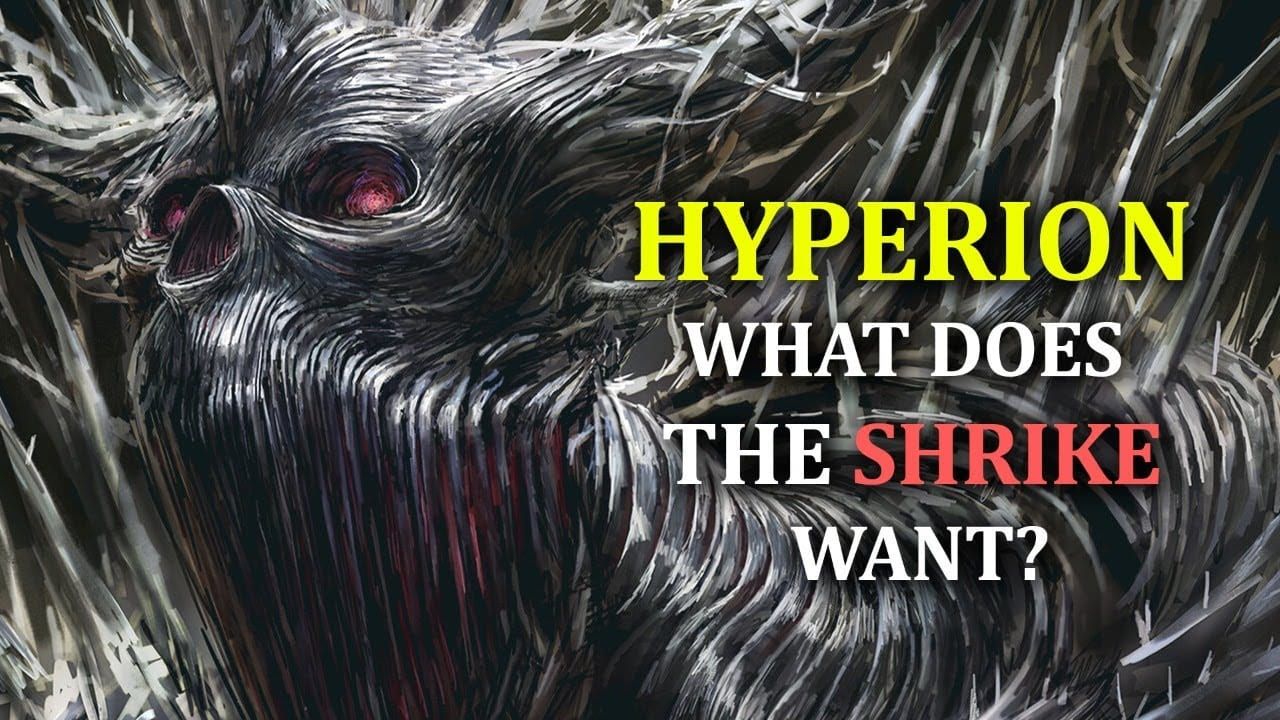
The Shrike is a towering, metallic and bladed humanoid entity closely associated with the Time Tombs.
It is also known as:
- The Lord of Pain.
- The central figure of the Church of the Final Atonement.
- A possible instrument or avatar of a future artificial intelligence.
Important characteristics discussed:
- Its body appears to flow or shift like liquid metal.
- It moves with extraordinary speed and power.
- Its influence initially appears restricted to the region around the Time Tombs.
- Its range seems to increase as events progress.
- It takes victims to the Tree of Pain.
- Its relationship with Moneta changes the apparent distinction between human beings, the Shrike and the future.
The Church of the Final Atonement interprets the Shrike as an agent sent from beyond time to punish humanity or announce its end.
The Tree of Pain
The Tree of Pain is presented as an immense structure covered in thorns, with victims impaled upon it.
Quinn explains that:
- The Tree is not necessarily a conventional physical object.
- The Shrike’s victims are linked to a system associated with the Shrike Palace.
- They experience a simulated eternity of suffering.
- Manipulation of subjective time allows their torment to seem endless.
- The suffering may be intended to draw out a future “Ultimate Intelligence” representing human empathy and consciousness.
The last point is presented as an interpretation of the wider conflict rather than an uncomplicated, directly stated fact.
The six Time Tombs
The transcript identifies six structures:
- The Sphinx
- The Jade Tomb
- The Crystal Monolith
- The Obelisk
- The Cave Tombs
- The Shrike Palace
The Sphinx
- Associated with travel through time.
- Provides a route towards the era in which the Time Tombs originated.
- Does not appear to admit every person equally.
The Jade Tomb
- Notable for its green or emerald appearance.
- Located near an entrance to Hyperion’s labyrinth.
- Associated in the discussion with unexplained Ouster activity.
- Its precise purpose remains uncertain.
The Crystal Monolith
- Mentioned as one of the Tombs.
- Its function is not explained in detail.
The Obelisk
- Potentially connected to a future army or “legions” of Shrikes.
- Quinn presents this as an implication rather than a fully settled explanation.
The Cave Tombs
- Described as artificial caverns.
- Not explored at length in the transcript.
The Shrike Palace
- Closely associated with the Shrike and its victims.
- Linked to the machinery or system behind the Tree of Pain.
Time travel and the larger conflict
The Time Tombs are travelling backwards through time from a distant future.
Quinn’s interpretation of their purpose is:
- The TechnoCore eventually creates or becomes associated with an Ultimate Intelligence.
- The Shrike acts as an avatar or instrument of that intelligence.
- The Tombs and the Shrike are sent into the past.
- Their mission may be to find and destroy the opposing human Ultimate Intelligence before it can become a threat.
- The Tree of Pain’s immense suffering may serve as bait intended to draw that human intelligence out of hiding.
Quinn repeatedly notes that the novels leave some of these mechanisms ambiguous and require readers to assemble clues.
Rachel and Moneta
One of the stream’s central revelations is:
- Rachel Weintraub and Moneta are the same person at different points in a disrupted chronology.
- Rachel travels through the Sphinx and grows into Moneta.
- Moneta later becomes associated with Aenea.
- Kassad therefore encounters Rachel’s future identity.
- The apparent predestination surrounding Sol’s dreams is connected to time travel and the Void Which Binds.
Aenea and the later novels
Aenea is introduced only briefly because Quinn wishes to reserve the later novels for another stream.
The transcript characterises her as:
- A messianic or “space Jesus” figure.
- Comparable in narrative importance to Paul Atreides.
- Closely connected to the Void Which Binds.
- Served by Moneta.
- Later associated with a changed allegiance or role for the Shrike.
These are deliberately broad descriptions rather than a full account of her story.
The Void Which Binds
The Void Which Binds is described as a realm or underlying connection beyond ordinary spacetime.
Its importance includes:
- Connecting consciousness across space and time.
- Permitting experiences resembling dreams, visions and temporal projection.
- Serving as the TechnoCore’s intended destination or medium of transcendence.
- Already containing entities known as the Lions, Tigers and Bears.
- Becoming central to Aenea’s story in the later novels.
Quinn also discusses the series’ treatment of Jesus as someone whose consciousness entered or moved through the Void Which Binds. This comes from the later books and is not explored in detail.
Religious and philosophical themes
The stream repeatedly highlights the series’ use of religion.
Major themes include:
- Resurrection as both salvation and horror.
- Obedience versus moral decency.
- Sacrifice, particularly through the Abraham and Isaac parallel.
- Artificial intelligence attempting to attain godhood.
- Human empathy as a possible counterforce to machine intelligence.
- Religious institutions surviving technological progress.
- The transformation of incomprehensible beings into objects of worship.
- Messianic figures and the reinterpretation of miracles through science-fiction concepts.
- Violence as both an object of reverence and a source of corruption.
- Colonial expansion and environmental destruction.
Literary influences and comparisons
Quinn makes the following comparisons:
- The Canterbury Tales: the pilgrims’ linked stories.
- John Keats: the novels’ titles and the Keats cybrid.
- Dune: religion, civilisation-scale politics, messianic themes and major time jumps.
- Biblical narrative: Sol and Rachel parallel Abraham and Isaac.
- Noir detective fiction: Brawne Lamia’s story.
- Philip K. Dick: the atmosphere and identity questions in Lamia’s section.
- The Matrix: raised by the audience in relation to simulated suffering, although Quinn points out that Hyperion predates the film.