Regime Change
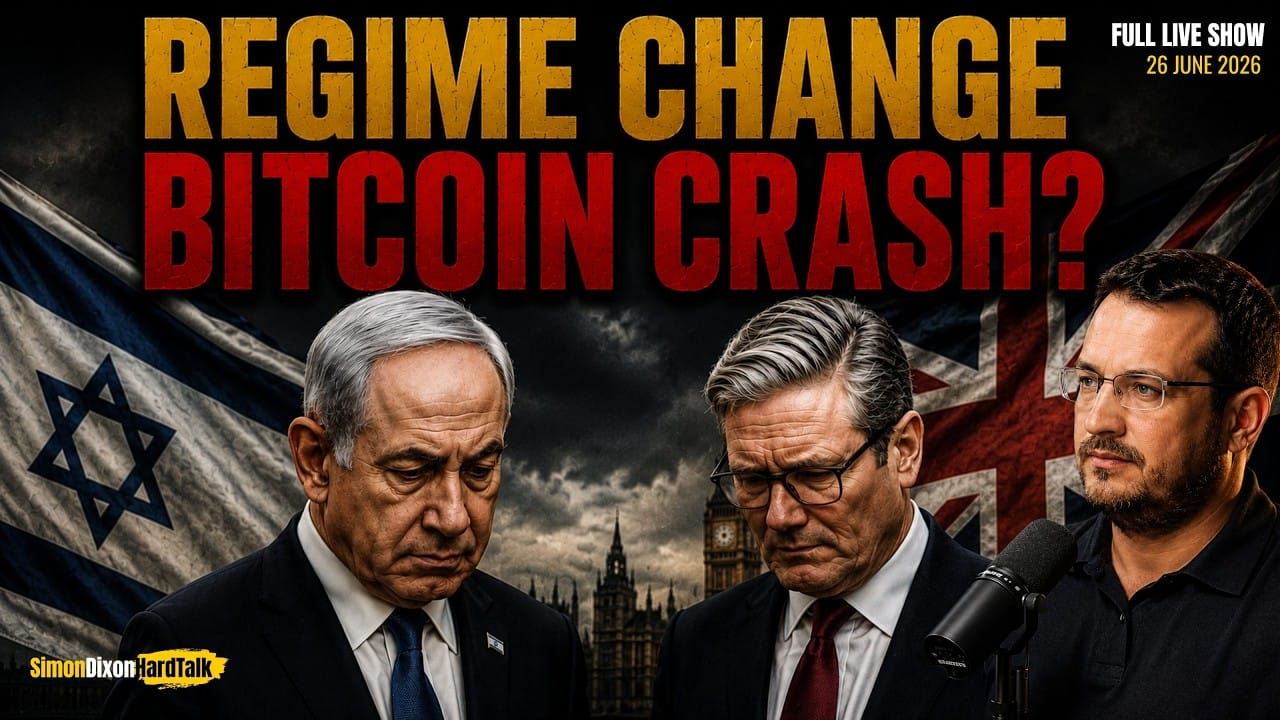
Episode title: "The UK & Israel Just Got Regime Changed for the AI Era… While Bitcoin Crashes"
The monologue is structured in two parts: (1) a live geopolitical/macroeconomic analysis, and (2) a premiered interview with Archie from Bitcoin Archives on "the battle for Bitcoin sovereignty." Below are the significant points and lists, paraphrased and organised thematically.
1. Core Thesis — The MIC → TIC Transition
Simon's central framework is that global power rotates between three "complexes" underneath the Financial Industrial Complex (FIC):
| Abbreviation | Full term | Role |
|---|---|---|
| MIC | Military-Industrial Complex | Forever wars, weapons contracts |
| TIC | Technical-Industrial Complex | AI, surveillance, digital identity |
| FIC | Financial-Industrial Complex | Top-level power that rotates between MIC and TIC |
The argument: the UK and Israel are being "regime changed" from a MIC-led order to a TIC-led order, while Bitcoin's price weakness is a co-ordinated liquidity drain tied to this transition.
2. UK Regime Change Analysis
Significant claims:
- The UK has had its seventh regime change in 10 years; each prime minister serves a specific agenda then is replaced.
- Each PM's assigned role (as Simon characterises them):
- Boris Johnson — enforce lockdowns.
- Rishi Sunak — profit from vaccine rollout (described as ex-Goldman Sachs with family vaccine investments).
- Liz Truss — regime-changed by the Bank of England via the gilt market crash when she "tried to do something."
- Keir Starmer — the "MIC node"; his background as DPP prosecuting Julian Assange is cited as his proof of utility to military intelligence. His role: justify Ukraine funding while pretending to "defend democracy."
- The next phase belongs to the TIC: AI surveillance, digital identity, predictive policing — "beta tested in Gaza" now spreading across Europe and the UK.
- Tommy Robinson is described as "paid by Israel" and partnered with Elon Musk (a "TIC node") to manufacture civil unrest that justifies the surveillance rollout.
- Far-right alternatives (Nigel Farage, Reform, Rupert Lowe, Andrew Tate/"Brav Party") are framed as "different flavours of the same thing" — all ultimately serving FIC.
UK fiscal/monetary structure:
- Britain is not financially sovereign — ~100% debt-to-GDP, stagflationary, slowing growth.
- The City of London is a separate jurisdiction from the UK, independent of the rest of the country.
- UK gilts are bought primarily by leveraged US capital (institutions borrowing dollars, sometimes via the Japan carry trade) — making Britain subordinate to US bondholders.
- The UK operates as a "collateralised debt obligation" where losses are socialised and gains privatised.
- Liz Truss's removal demonstrated "how quickly markets can remove a government."
UK policy changes flagged:
- ISA changes: taxation of interest earned on cash within Stocks & Shares ISAs increasing from April 2027; cash ISA allowance being reduced.
- Windfall taxes on energy.
- Real estate changes encouraging institutional ownership, discouraging individual buy-to-let — framed as "you will own nothing and be happy."
- Stablecoin policy reversal: UK simultaneously relaxed stablecoin rules while the Bank of England works on CBDC policy — described as building "privatised programmable money."
- Stablecoins are backed by government debt (gilts for pound stablecoins, Treasuries for USD stablecoins), creating demand for sovereign debt.
3. US Legislative & Market Developments
- US House act delaying a Federal Reserve CBDC until 2030 — giving stablecoins a "head start." Simon notes the Fed already has a wholesale CBDC (FedNow) for interbank clearing.
- GENIUS Act and likely CLARITY Act — stablecoin/tokenised treasury regulatory framework.
- Trump's quantum computing acceleration — billions flowing into quantum infrastructure (a "stimulus cheque for TIC").
- Intel investment — domesticating semiconductor chip manufacturing.
4. Market Check-in (figures as stated by Simon)
| Asset / Metric | Figure cited |
|---|---|
| Bitcoin | Traded below $60,000 (first time since 2021) |
| Gold | Below $4,000, at ~$3,960 |
| STRC (Strategy structured product) | Sold as $100 principal + dividend; dropped below $73, ~$75 at time of recording; pays ~11.5% dividend |
| WTI oil | Below $70 |
| Brent crude | ~$75 |
| Japan oil cost | ~$170 (via Strait of Hormuz) |
| US 30-year yield | ~4.86% (came back below 5%) |
| US 10-year yield | 4.37% |
| US national debt | ~$40 trillion, paying average 3.3% |
| CPI | 4.2% |
| PCE | ~4.1% |
| Bitcoin ETF outflows | Record ~$6.4 billion 30-day outflow; $233 million in a single week |
| SpaceX IPO | ~$2 trillion valuation; reportedly seeking additional $20 billion in debt (5x oversubscribed) |
| SK Hynix IPO | ~$29 billion (described as fifth-largest IPO) |
| OpenAI IPO | Delayed to 2027 |
5. Middle East — The "5D Chess" Framework
This is Simon's longest-running analytical framework, which he claims is now being vindicated.
Core thesis:
- Iran, China, BRICS and the GCC have been on the same side to expel the US from the region.
- FIC partners with them to regime-change from MIC (forever war) to TIC (regional stability + reconstruction contracts).
- The endgame is not who won the war but who reshapes peace.
Key elements of the Memorandum of Understanding (MOU) / Islamabad Accord:
- Immediate and permanent termination of military operations across all fronts including Lebanon.
- Mutual respect for sovereignty; non-interference clause — US commits not to interfere in Iranian politics; Iran guarantees commercial passage through the Strait of Hormuz.
- 60-day fee-free passage through Hormuz (previously fees charged in Bitcoin or Chinese yuan; stablecoin fees frozen by Scott Bessent under "Operation Economic Fury" / "Operation Epic Fury").
- Ongoing dispute: Rubio says no fee; Iran says "service charge" (distinct from a toll). Simon predicts some fee will eventually be charged.
- Iran nuclear programme: status quo, to be defined in final negotiations.
- Iranian oil exports continue via US waivers; frozen investment assets due for release; sanctions on petrochemicals removed.
- Reconstruction contract worth hundreds of billions — "whoever pays for it sets the world order." Simon predicts predominantly GCC.
- Future reductions in US military presence near Iran — strategic retreat.
Iranian leadership changes (officials "no longer with us"):
- Commander-in-chief of the IRGC
- Chief of staff of the Iranian armed forces
- Intelligence minister
- Senior IRGC intelligence leadership
- Head of the military office of the Supreme Leader
- Secretary of the Supreme National Security Council
Current pragmatic leadership identified:
- Masoud Pezeshkian — political arm
- Abbas Araghchi — diplomatic negotiations
- Mohammad Javad Zarif — intellectual architecture of the region
- Mojtaba Khamenei — continuity between the previous and current ayatollah; religious establishment
Polling cited (Simon notes polls can be manipulated):
- ~85% of Americans believe the US won the war; ~10–15% believe Iran won.
- ~90% of Israelis believe Iran won; ~10% believe Israel won.
- Framed as media setup for Israeli regime change.
New Muslim-nation alliance forming:
- Turkey (MIC manufacturing base), Pakistan (nuclear might), Saudi (capital), UAE (purchasing Israeli assets), Yemen/Houthis (strategic ports — signed agreement with Saudi), Iran and Oman (strategic ports), Egypt (military might; rejected IMF bribes, took Gulf/China BRI money instead).
Maritime choke points flagged for multipolar negotiation:
| Choke point | Controller(s) |
|---|---|
| Strait of Hormuz | Iran / Oman |
| Bab-el-Mandeb | Yemen / Houthis |
| Strait of Malacca | Singapore, Indonesia, Malaysia |
| Sunda Strait | Indonesia |
| Lombok Strait | Indonesia |
| Suez Canal | Egypt |
| Panama Canal | Geopolitical tension US–China |
Simon argues Iran's model at Hormuz will set the precedent for all these choke points, ending the post-WWII "freedom of navigation" order.
6. Oil Market Analysis
- Oil continued to fall despite geopolitical tensions — market signals the deal will hold.
- China reduced imports significantly; US drained strategic petroleum reserves; Japan consumed energy while managing a currency crisis.
- Net losers: India and Japan.
- India pushed further into China/BRICS; record oil imports from Russia.
- Japan: yen weakening toward lowest levels since mid-1980s; spent ~$73 billion intervening in currency; risk of selling US Treasuries (Japan is second-largest holder).
- Saudi expanded storage capacity; alternative pipelines from UAE and Saudi.
- LNG (not oil) is the real story — determines AI energy inputs and nuclear reconstruction; Iran has second-largest LNG reserves.
7. Other Regime Change Operations
Venezuela:
- Maduro operation may prepare one of the largest sovereign debt restructurings in history — ~$250 billion.
- Oil production central; hard/clunky oil that Saudi Aramco infrastructure might benefit from.
- Earthquakes and natural disasters this week create more subordination/reconstruction contracts.
- Will determine level of civil unrest in Central/South America and FIC's control of the global south.
8. Bitcoin Treasury Company Meltdown
Key points:
- Market is repricing Bitcoin treasury companies in every way.
- Capital becoming more expensive; equity trading at discount to NAV (mNAV negative) means they can't sell equity without diluting Bitcoin per share.
- Only option: hold Bitcoin as collateral to borrow against — risks margin calls and Chapter 11.
- Nakamoto (a treasury company): 85% collateral in Kraken for distressed loans.
- Adam Back's BSTR: expected to debut with ~30,021 Bitcoin; merger vote pending; Cantor Fitzgerald strategy (SPAC → public offering → FIC subordination); merging Blockstream into structure.
- Strategy (MSTR): Simon believes this one survives — it has dollar reserves to see through the cycle. STRC at ~$75 (25% discount to $100 par), paying 11.5% dividend, ~1 year runway.
- Simon's recommendation for Strategy: use dollar reserves to buy back STRC at $75 to get it back to $100 par — eliminates yield obligation, 25% upside, without buying more Bitcoin.
- Wall Street is in accumulation phase; wants retail "levered up on the wrong side of trades."
Simon's core distinction:
"Owning Bitcoin is not the same as owning a Bitcoin treasury company."
9. Bitcoin Fundamentals & Strategy
- ~20 million Bitcoin mined; ~1 million left to be mined over next ~120 years.
- ~11 million Bitcoin at unrealised loss (per Glassnode) — ~75% of circulating supply held by long-term holders; roughly one-third of long-term holders underwater.
- Four-year cycle "less relevant" given scarcity remaining.
- Bitcoin "not collapsing in any way" — self-custody, peer-to-peer, fixed monetary policy, difficulty adjustment, decentralised mining in a multipolar world.
- Upcoming Bitcoin war (August) — miners signal before code reverts; knots vs. core debate.
- Strategy: dollar-cost average — own more Bitcoin this month/week/day than the previous. Value wealth in Bitcoin, not fiat.
All asset classes competing for the same liquidity:
- ETF outflows (institutions selling)
- Treasury companies at peak
- Treasury reorganisations (more FIC control)
- AI fundraising (capital rotation)
- Sovereign bond yield issues (eurodollar, petrodollar, Japan carry trade)
- Government debt rollover issuance while central banks shift to gold
- AI stock market bubble
- Derivatives/paper contracts in commodity markets
- Potential higher interest rates post-Fed regime change
- QE requiring a correction to "socialise losses and privatise gains"
10. Part Two — Interview with Archie (Bitcoin Archives)
Iran as the real Bitcoin adoption story:
- Iran is likely the largest sovereign Bitcoin miner; Russia second; UAE third.
- During the "12-day war" / "Operation Midnight Hammer" (B2 bombing), a massive Bitcoin hash rate drop coincided with movement of highly enriched uranium — speculation that nuclear power plants mine Bitcoin.
- Iran accepting Bitcoin for Strait of Hormuz passage — bespoke insurance service, cryptographic proof on-chain, multi-signature wallet, circumventing SWIFT and Lloyd's of London.
- Nothing in crypto helped Iran stay sovereign — only Bitcoin did (stablecoins/tether on Tron have freeze functions; Bitcoin does not).
- Speculation: Iran could build an open-source Bitcoin mixer that the US cannot attack — the first "sovereign crypto developer."
Samurai Wallet case:
- Developer prosecuted not for the coin-join code but for comments on X about facilitating money laundering.
- Settled (funds confiscated, couldn't afford defence); sentenced to five years.
- Friction point is privacy, not self-custody — "they're okay with Strategy, BlackRock, Coinbase... the friction point is the privacy side."
Strategy/MSTR debate:
- Archie sees Strategy as an "attack vector on Wall Street" sucking capital into Bitcoin.
- Simon sees it as FIC's tool — a "foundational node in their derivative complex" giving Wall Street instruments to manipulate short-term price. "Why would they want to kill Strategy? Strategy is their strategy."
- Both agree there is "no second best" Bitcoin for financial sovereignty.
AI vs. Bitcoin mining:
- Public miners pivoting to AI data centres (fiduciary duty to maximise returns) — e.g., TeraWolf rebranded as "energy infrastructure company."
- Result: difficulty adjustment → more decentralised hash rate → "cleansing force."
Price outlook:
- Simon expects weakness "for the rest of the year" and "an opportunity to buy cheaper Bitcoin."
- Tailwind from Iran war resolution + AI IPOs.
- Does not believe fiat will disappear — "so long as we have functioning states, we will have functioning fiat currencies."
- Disagrees with Jeff Booth's view that Bitcoin kills fiat and ends in utopia.
Market cap context:
- Nvidia ~$5 trillion (peaked ~$6 trillion); Bitcoin ~$1.5 trillion.
- Bitcoin is a top 30 global asset by market cap.
- Milestone: Bitcoin reaching one-third of gold's market cap would be "hugely significant."