Sci-Fi - what to read?
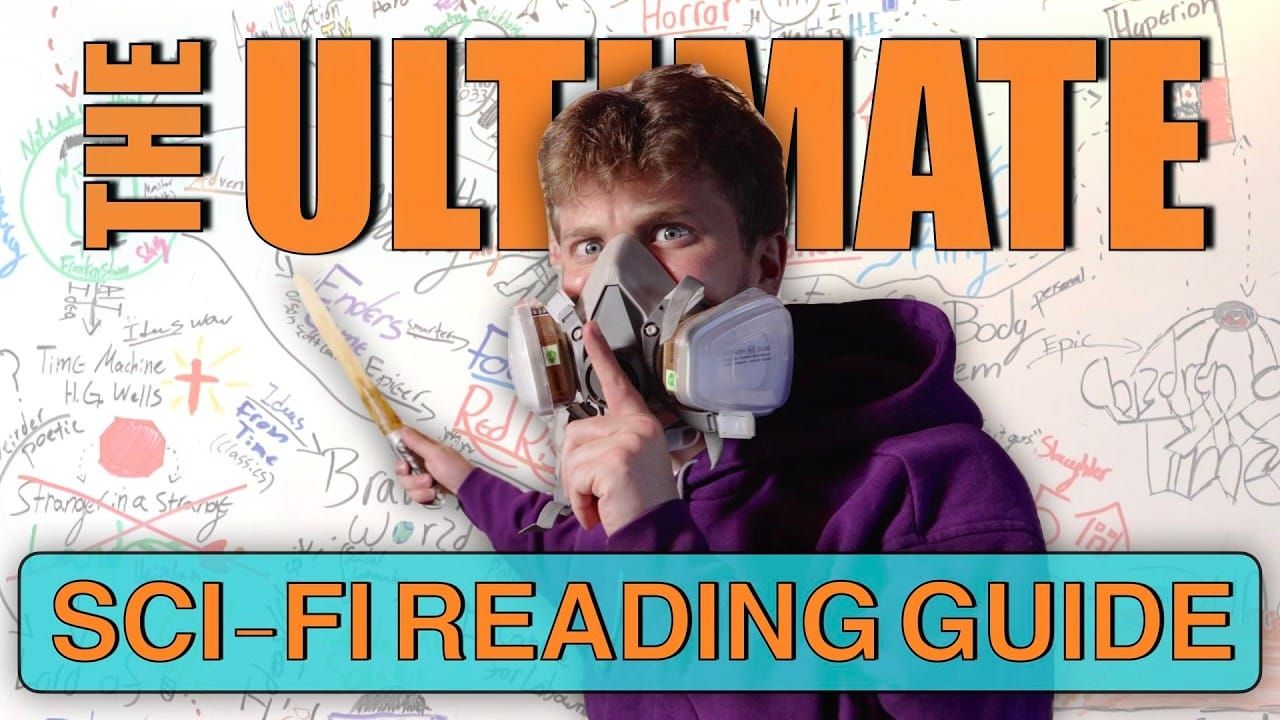
The transcript presents science fiction as a broad web of overlapping tastes rather than a single genre. Its central device is a branching reading guide: begin with Frankenstein, identify what appealed to you, and follow recommendations towards horror, adventure, hard science fiction, satire, social commentary, dystopia, space opera or science fantasy.
The guide is energetic and wide-ranging, but the raw transcript contains numerous transcription errors, several factual slips and many subjective claims stated as facts. The review below preserves the speaker’s intended recommendations while correcting names and clearly distinguishing opinion from verifiable information.

Central points
- Science fiction is exceptionally broad. The speaker argues that it may be harder to navigate than fantasy because it encompasses horror, adventure, philosophy, politics, satire, dystopia, technology and speculative social commentary.
- The guide is designed for multiple levels of reader.
- New readers looking for accessible entry points.
- Established readers seeking classics or overlooked works.
- Experienced readers interested in less frequently discussed books.
- Taste matters more than canonical status. Each recommendation is based on what a reader enjoyed in the previous book.
- Science fiction frequently examines the present through the future. The speaker repeatedly emphasises that futuristic societies often function as commentary on current political and social conditions.
- Strong concepts do not always come with strong prose. Several classic science-fiction writers are praised primarily for their ideas, while writers such as Mary Shelley, Ray Bradbury, Octavia E. Butler, Ursula K. Le Guin and Roger Zelazny are singled out for their prose.
- Older works require context. The transcript acknowledges that some classics contain dated or objectionable attitudes. Individual readers will have different levels of tolerance for this.
- Science fantasy deserves separate consideration. Dune, The Book of the New Sun and The Fifth Season are presented as examples of works that blur the boundary between science fiction and fantasy.
- “All roads lead to Dune” is a recurring joke and organising idea. Dune is treated as a major destination for readers interested in epic scale, religion, politics, environmental crisis or messianic figures.
Entry point: Frankenstein
Mary Shelley’s Frankenstein is selected as the guide’s starting point because it combines:
- Gothic horror.
- Scientific speculation.
- Philosophical questions.
- The consequences of creation.
- Human pride and responsibility.
- The apparent conflict between humanity and monstrosity.
The speaker also praises Shelley’s prose and argues that adaptations frequently change important themes. That assessment is subjective, although the novel’s importance to the development of modern science fiction is widely recognised.
The recommendation to seek an “uncensored” version needs clarification. Readers normally choose between:
- The original 1818 edition.
- Mary Shelley’s substantially revised 1831 edition.
Neither is conventionally described as the definitive “uncensored” edition.
Horror pathway
From Annihilation
Jeff VanderMeer’s Annihilation is used to distinguish between several kinds of science-fiction horror:
- Environmental horror.
- Existential horror.
- Monster horror.
- Fear generated by alien or incomprehensible forces.
The speaker characterises it as unsettling rather than simply frightening and contrasts its subtle written horror with the film’s more visual approach.
Environmental horror
Recommended route:
- Annihilation by Jeff VanderMeer.
- Metro 2033 by Dmitry Glukhovsky.
- The Road by Cormac McCarthy.
- The Mist by Stephen King.
- I Have No Mouth, and I Must Scream by Harlan Ellison, where environmental and existential horror overlap.
Significant appeals include:
- Hostile or transformed environments.
- Post-apocalyptic survival.
- Radioactive or unnatural creatures.
- Humanity becoming the true source of horror.
- Lovecraftian or incomprehensible threats.
Existential horror
Recommended route:
- Annihilation.
- Blindsight by Peter Watts.
- I Have No Mouth, and I Must Scream.
Blindsight is strongly recommended for its ideas about consciousness, intelligence and alien life. The description includes major elements such as the unusual crew and the presence of a scientifically explained vampire.
The L. Ron Hubbard section is explicitly a joke. The speaker says not to read Hubbard’s work and does not treat it as a genuine recommendation.
Monster horror
Recommended route:
- Annihilation or Blindsight.
- Jurassic Park by Michael Crichton.
The appeal here is straightforward:
- Memorable creatures.
- Pursuit and survival.
- Scientific experimentation going wrong.
- Physical danger rather than primarily philosophical dread.
Horror convergence
Hyperion by Dan Simmons is presented as combining:
- Environmental horror.
- Existential horror.
- Monster horror.
- Pilgrimage and mystery.
- A structure influenced by The Canterbury Tales.
Adventure and first-contact pathway
Project Hail Mary
Andy Weir’s Project Hail Mary is selected as an accessible science-fiction adventure combining:
- Hard-science elements.
- Space travel and technology.
- Humour.
- A situational rather than villain-driven conflict.
- First contact.
Readers who wish to avoid spoilers should not read detailed descriptions of this branch before beginning the novel.
Alien contact and conflict
Recommended route:
- Project Hail Mary.
- Contact by Carl Sagan.
- The Three-Body Problem by Cixin Liu.
- Then either:
- Blindsight for a more intimate and frightening encounter.
- Children of Time by Adrian Tchaikovsky for a larger-scale story.
The transcript’s names “Carl Sean”, “Susan Lou” and “Adrien Jaikovski” are transcription errors.
Contact is praised for its scientific curiosity and handling of faith, evidence and sexism, but criticised for characterisation and prose. These are the speaker’s assessments rather than objective facts.
Children of Time is one of the speaker’s strongest recommendations. Its attractions include:
- The remnants of humanity travelling through space.
- A generation ship.
- An uplifted spider civilisation.
- Communication between radically different forms of intelligence.
- Social, evolutionary and existential ideas.
Alien societies and humour
Recommended route:
- Project Hail Mary.
- The Hitchhiker’s Guide to the Galaxy by Douglas Adams.
- Slaughterhouse-Five by Kurt Vonnegut.
The speaker praises Adams for:
- Satire.
- Absurdity.
- Bureaucratic humour.
- Using alien societies to reflect human behaviour.
Slaughterhouse-Five is presented as both science fiction and an exploration of Vonnegut’s wartime experiences, particularly the bombing of Dresden. The speaker regards it as essential regardless of the reader’s preferred pathway.
Alien societies with less emphasis on comedy
Recommended works:
- The Gods Themselves by Isaac Asimov.
- This Is How You Lose the Time War by Amal El-Mohtar and Max Gladstone.
- The Left Hand of Darkness by Ursula K. Le Guin.
The transcript correctly identifies The Gods Themselves as a work Asimov reportedly regarded particularly highly. Its prose and alien society are praised more strongly than Asimov’s usual characterisation.
This Is How You Lose the Time War was published under both authors’ names, not a shared pseudonym.
Space, technology and epic conflict
Ender’s Game
Ender’s Game by Orson Scott Card is included because of its influence and its focus on:
- Child soldiers.
- Military institutions.
- Strategy.
- Space warfare.
- Technology and manipulation.
The speaker personally considers it overrated but accepts its importance.
More conceptual: Foundation
Isaac Asimov’s Foundation is recommended for readers interested in:
- Civilisational collapse.
- Predictive social science.
- The preservation of knowledge.
- Large historical timescales.
- The attempt to reduce a coming dark age.
The television adaptation is described as substantially different from the books. Its quality and fidelity ratings are the speaker’s opinions.
Larger-scale epics
Recommended works:
- The Three-Body Problem by Cixin Liu.
- A Fire Upon the Deep by Vernor Vinge.
- Red Rising by Pierce Brown.
A Fire Upon the Deep is placed on the speaker’s to-be-read list rather than reviewed from direct reading. Any recommendation here is therefore based on research rather than first-hand assessment.
Red Rising and the messianic path
Red Rising is presented as featuring:
- Darrow of Lykos.
- A rigid colour-based social hierarchy.
- Revolution and manufactured heroism.
- A hero’s journey.
- Social commentary.
- A progression from a competition narrative into space opera.
Readers drawn to the messianic element are directed towards Dune.
Dune and science fantasy
Frank Herbert’s Dune is described as an examination of:
- Religion.
- Political power.
- Aristocracy.
- Colonialism and control.
- Environmental conditions.
- Manufactured prophecy.
- The danger of heroic or messianic figures.
Readers wanting more science fantasy are directed to The Book of the New Sun by Gene Wolfe. The speaker interprets it through the idea of a messianic or second-coming narrative centred on a torturer in the distant future. This is an interpretive description, not a neutral plot summary.
Political space opera and character-focused science fiction
The Expanse
The Expanse by James S. A. Corey is recommended for:
- Solar-system politics.
- Tension between Earth, Mars and the Belt.
- Class conflict.
- Physically and culturally distinct human populations.
- Industrial, lived-in technology.
- Strong character work.
James S. A. Corey is the shared pen name of Daniel Abraham and Ty Franck.
The first novel is Leviathan Wakes. Readers are not required to complete the entire series before following the next branch.
Smaller and more intimate: The Murderbot Diaries
Martha Wells’s Murderbot Diaries are recommended for:
- A security construct that has overridden its control module.
- Dry humour.
- Questions of autonomy and personhood.
- Social discomfort and alienation.
- Neurodivergent resonance.
- Mostly novella-length instalments.
Larger shared universes
For readers wanting an extensive fictional setting, the guide suggests:
- Warhammer 40,000 novels.
- Star Wars novels.
The speaker does not provide a specific Warhammer 40,000 starting title, instead advising readers to consult its fan communities. This recommendation is based on scale and potential for immersion rather than a particular book’s quality.
The Star Wars novels are treated as lighter science fantasy with strong aesthetic appeal. Readers wanting heavier political and religious themes are redirected to Dune.
Concept-driven classics
The Time Machine
H. G. Wells’s The Time Machine is recommended for readers interested in:
- Early treatments of time travel.
- Class division.
- Humanity diverging into different species.
- Social commentary from a nineteenth-century perspective.
It should not be called definitively the first time-travel story. It was, however, highly influential in popularising mechanical time travel.
The transcript’s discussion of “crab superiority” refers loosely to carcinisation, the repeated evolution of crab-like body forms. Calling crabs evolutionarily “superior” is not scientifically accurate, and Wells’s distant-future crabs are not evidence that the novel anticipated the modern concept.
More ambitious prose and mythology
Recommended route:
- The Time Machine.
- Lord of Light by Roger Zelazny.
- Then either:
- Childhood’s End by Arthur C. Clarke.
- Children of Time for a larger story with sequels.
Lord of Light is praised for:
- Elevated prose.
- Technology that allows humans to assume godlike roles.
- A society shaped around Hindu deities.
- Action, humour and philosophical ideas.
- A self-contained narrative.
Dystopia and social commentary
Brave New World
Aldous Huxley’s Brave New World is used as the main branching point for political and social science fiction. It explores:
- Manufactured pleasure.
- Social conditioning.
- Reproductive control.
- Authoritarian stability.
- The loss of individuality and freedom.
The speaker admires its continuing relevance but is less impressed by its prose and characterisation.
Political dystopia
Recommended works:
- Fahrenheit 451 by Ray Bradbury.
- Nineteen Eighty-Four by George Orwell.
- Artificial Wisdom by Thomas R. Weaver.
Bradbury is especially praised for the quality of his prose.
Artificial Wisdom is described as involving artificial intelligence, political leadership and climate crisis. The comparisons to other works are the speaker’s personal critical shorthand.
Social and climate commentary
Recommended route:
- Brave New World.
- Parable of the Sower by Octavia E. Butler.
- Then either:
- A Canticle for Leibowitz by Walter M. Miller Jr.
- Neuromancer by William Gibson.
- The Handmaid’s Tale by Margaret Atwood.
Religion and cyclical collapse
A Canticle for Leibowitz examines:
- A post-apocalyptic world.
- Monastic preservation of knowledge.
- Tension between religion and science.
- Civilisation’s repeated cycles of destruction.
Readers interested in religion, power and civilisational cycles are again directed towards Dune.
Cyberpunk
Recommended route:
- Neuromancer by William Gibson.
- Snow Crash by Neal Stephenson.
- The Hitchhiker’s Guide to the Galaxy if the humour becomes the main attraction.
Neuromancer is recognised as foundational cyberpunk, featuring:
- Corporate power.
- Cyberspace.
- Artificial intelligence.
- Criminal and technological underworlds.
- An individual facing apparently overwhelming systems.
Gibson coined “cyberspace” in his earlier story Burning Chrome, not in Neuromancer itself, although Neuromancer popularised the term.
Snow Crash is presented as a more absurd and comic treatment of cyberpunk conventions. Its protagonist is deliberately named Hiro Protagonist.
Grounded social dystopia
Recommended route:
- The Handmaid’s Tale by Margaret Atwood.
- The Dispossessed by Ursula K. Le Guin.
- Lilith’s Brood by Octavia E. Butler.
The Handmaid’s Tale is described as depicting a theocratic state imposing reproductive control and extreme patriarchal rule.
The Dispossessed is praised for:
- Cross-cultural exchange.
- Contrasting political systems.
- Nuanced social examination.
- An absence of simplistic ideological conversion.
- Hope in individual and collective possibility.
Large-scale social science fantasy
N. K. Jemisin’s The Fifth Season is recommended for readers wanting:
- Environmental catastrophe.
- Oppression and social hierarchy.
- Religion and institutional power.
- A mother searching for her daughter.
- A structurally challenging narrative.
- Science-fiction and fantasy elements working together.
The speaker sees strong affinities between The Fifth Season and Gene Wolfe’s The Book of the New Sun, particularly in the demand both place on readers to interpret incomplete or difficult information. The transcript explicitly says this is a personal comparison and does not claim that Jemisin was directly influenced by Wolfe.
Strongest endorsements
The books receiving the most enthusiastic praise are:
- Frankenstein by Mary Shelley.
- Blindsight by Peter Watts.
- Hyperion by Dan Simmons.
- Project Hail Mary by Andy Weir.
- Children of Time by Adrian Tchaikovsky.
- The Hitchhiker’s Guide to the Galaxy by Douglas Adams.
- Slaughterhouse-Five by Kurt Vonnegut.
- The Gods Themselves by Isaac Asimov.
- Dune by Frank Herbert.
- The Murderbot Diaries by Martha Wells.
- Lord of Light by Roger Zelazny.
- Parable of the Sower by Octavia E. Butler.
- The Dispossessed by Ursula K. Le Guin.
- The Fifth Season by N. K. Jemisin.
- The Book of the New Sun by Gene Wolfe.