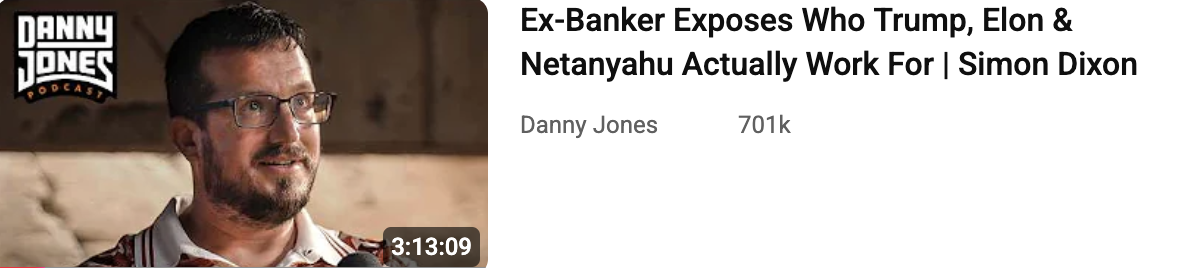
Simon and Danny

Core thesis: the visible "World War III" narrative is largely a surface phenomenon; underneath it, the United States, the Gulf states and China are converging into a multipolar order, and Israel is a node inside a financial structure rather than the structure's owner.
1. The method: forensic finance
Dixon's stated framework is deliberately amoral — he separates what he wants to happen from what he thinks is happening ("almost all the time what I want to happen is not what is happening"):
- Ignore what politicians say. Look instead at who funds them and what they financially gain.
- Treat every media outlet as pushing someone's agenda. Ask what its business model, sponsorship and capital structure are — "why do they want me to believe that?" — rather than "are they telling the truth?"
- Triangulate: when the capital flows, the ownership and the messaging align, treat the claim as real.
- Treat countries as capital structures, not nations. The question becomes: who is the government subordinate to?
- Bank records beat testimony. On Epstein: "until we get the bank records, everything is not going to tell us the full truth" — and the banks holding them (JPMorgan, Deutsche Bank) settled years before the recent file releases.
2. Three industrial complexes (his central model)
| Complex | Composition | What it controls |
|---|---|---|
| MIC — military-industrial | Lockheed Martin, General Dynamics, Raytheon, Boeing, Palantir, plus intelligence networks | War, reconstruction contracts, "forever war" revenue |
| FIC — financial-industrial | Commercial banks, asset managers (BlackRock, State Street, Vanguard, Fidelity), investment banks, bondholders, central banks | Money creation, pensions, board seats, government debt |
| TIC — technical-industrial | AI, data hosting, algorithms, social platforms | Behavioural manipulation, surveillance, programmable money |
His reading of recent US presidents: Biden as a neocon/MIC figure; Trump as transactional, aligned with FIC and TIC. He is explicit that the framework is a simplification and that the three complexes have distinct "superpowers" that keep each other in check — banks create money, asset managers aggregate voting rights, investment banks securitise companies.
3. How money is created — and why he calls it a Ponzi scheme
The explainer runs goldsmith receipts → fractional reserve lending ("they're committing fraud") → government guarantee and legalisation → money as debt:
- About 97% of every dollar in existence is somebody else's debt; only ~3% is state-issued cash.
- Interest is never created alongside principal, so repayment requires new borrowing: "by definition a Ponzi scheme."
- Governments are funded by debt, not taxes; taxes function to control prices and enforce demand for the currency.
- The central bank socialises losses (onto government debt and the population via inflation) and privatises gains (into the stock market).
- Result: the K-shaped economy — asset owners compound upwards, wage earners and debtors slide.
- "It's not capitalism. Capitalism requires a monetary system that works."
He cites the US at ~$40 trillion of debt with ~$1.2 trillion of annual interest, and 90% of US stock market wealth held by 10% of households.
4. The empire template: Dutch → British → American
Dixon dates the model to roughly 1600 and the Dutch invention of the central bank + stock market + bond market triad, with the Dutch East India Company as a private vehicle for privatising colonial and wartime profit. Britain copied it; America inherited it. The mechanism of handover:
- Crises are the transfer mechanism — 2008, COVID, war — pricing people out of assets that capital then buys cheaply.
- 1913: Federal Reserve created (third attempt at a US central bank), immediately followed by war.
- 1917: Balfour Declaration; Bolshevik Revolution ("communism is a Western ideology" — Marx trained in British universities); the same financiers funding both sides of European wars.
- 1933: FDR bans private gold ownership; Americans surrender gold for $20 notes, leaving the US with roughly 8,000 tonnes — he says ~75% of world gold outside private banking hands.
- 1919/1930s: Treaty of Versailles debt dumped on Germany; the Bank for International Settlements manages reparations via the Bank of England, the Fed and the Swiss National Bank. His claim: as Hitler annexed countries, the BIS simply relabelled gold ownership, so the financial system kept backing Nazi currency while Britain and America were nominally at war.
- Weimar → Hitler: Treasury-issued (non-debt) currency, full employment, then invasion to acquire gold backing, then conversion of civilian industry to armaments.
- 1944 Bretton Woods: Keynes's proposed global currency Bancor rejected; World Bank and IMF created; everyone else pegged to a dollar convertible into gold.
- 1954 (as stated) Suez: Nasser's nationalisation as the final unmasking of British naval power — the template he maps onto the Strait of Hormuz today.
- 1971: Nixon closes the gold window — the first purely fiat, debt-based global monetary system.
On the Rothschilds he is notably careful: they were merchant/investment bankers with shareholdings and government debt, "but they didn't own the Bank of England" and the Fed is owned by its member banks.
5. Israel: an asset, not the architect
His most contentious move is to decentre Israel while refusing to excuse it: "I don't want to excuse Israel for their crimes… [but] separate the crimes against humanity from the practical business model of what Israel is."
- Israel was created during the British-to-American imperial handover (1917 declaration, 1948 statehood, 1967 borders, incremental dispossession).
- Its growth model mirrors US settler colonialism: import population, radicalise it, build the IDF, destabilise the region, negotiate over others' resources.
- It is not resource-sovereign: a sovereign wealth fund of only ~$2 billion, with the value held privately in stocks. "The Israeli stock market can do very well while the economy gets absolutely crucified."
- Netanyahu is not the boss. The question nobody asks: who lobbies Israel? He points to Israeli defence firms (Elbit Systems, IAI) being part-privatised via IPOs, with shareholders including Israeli pension funds and BlackRock-managed ETFs.
- Aid is circular: Congress appropriates, cash goes to Israel, Israel must spend it back on US weapons — "it's a stock market stimulus" (~$3 billion in the cited case; ~$352 billion since 1951, per the clip played).
6. The petrodollar and the Gulf pivot
- OPEC formed as a counter-cartel of oil-producing states that retained national ownership (Aramco wholly state-owned); the 1973 embargo followed Israel's war, with King Faisal assassinated in 1974.
- The petrodollar bargain: price oil in dollars, settle in dollars, hold surpluses in US Treasuries, spend on US weapons, host US bases — "a protection racket… we won't regime change you."
- The break: Trump-era fracking made the US an energy exporter, so the Gulf's customer became China. Settlement diversified (~30% petroyuan in his estimate), bond purchases became equity purchases — Gulf sovereign wealth funds are now co-owners of the MIC/FIC/TIC.
- Aramco's partial listing put its CEO on BlackRock's board — his illustration of transnational capital, not national capital.
- Iran is the counter-example: BP retained most oil revenue until Mossad/CIA restored the Shah in 1953; the 1979 revolution's nationalisation is why Iran remains "enemy number one to big oil."
7. Trump as middleman
Dixon's donor map for Trump's second term: Elon Musk (TIC node), the Mellon banking family / BNY (FIC node, second largest), Miriam Adelson (MIC node) — plus Jared Kushner's Affinity Partners (~$5 billion, Gulf sovereign capital, exposure to Israeli pensions and West Bank settlements, positioned for reconstruction deals).
Policy read-through:
- DOGE — cannot pay down debt (the dollar is debt), so the real function was data consolidation into Palantir-type systems.
- Stargate — half a trillion for data centres, seeding the AI bubble; government borrowing now competes with AI corporate issuance, pushing yields to ~5.3%.
- Tariffs — a tax on importing small businesses, offsettable by multinationals; net effect is to push the world into Chinese/BRICS orbits ("the most radical shift since COVID").
- GENIUS Act / stablecoins — issuers must become banks, hold reserves at the Fed and buy Treasuries; World Liberty Financial (Trump, Witkoff families), a $2 billion UAE investment into Binance, a licence, a presidential pardon for CZ, and Nvidia chip approvals for UAE-linked entities.
- He plays a Marco Rubio exchange alleging 3,700 presidential stock trades in three months, Palantir and Nvidia purchases timed to announcements, and a UAE crypto deal — then disagrees with the framing: "They've all been doing this. Trump's just showing what everyone has always been doing."
8. China as the sovereign exception
China is "the most sovereign government in the world": cutthroat capitalism at the bottom, state supremacy at the top — no company may outgrow the party (Alibaba, Huawei lesson). Capital controls (he cites a $50,000/year overseas investment cap), a nationalised central bank (PBOC), and open-source AI strategy. Crucially: MIC/FIC/TIC cannot function without Chinese supply chains — "there's not an American weapon that can be produced without China." Beijing is not trying to kill the dollar; it wants a strong dollar and a weak yuan to maximise exports.
9. 9/11, black budgets and Epstein
- Intelligence funding has three legs: Pentagon budgets, private contracting, and off-balance-sheet black ops (trafficking, cartel partnerships).
- On 9/11 he alleges "factions" of Mossad, CIA elements linked to the Bush Safari Club network, and Saudi/UAE laundering — not a single actor. He notes the Patriot Act, Bank Secrecy Act and war plans were pre-written, and the options-trading broker was never disclosed.
- Epstein files as "a peek behind the veil": exposing them, he argues, drains the dollar's backing (trafficking networks), not the swamp.
10. Forecast and prescription
Macro forecast: not a dollar collapse but slow erosion; fiscal dominance (spend, roll over, inflate); the Ponzi persists while GDP growth exceeds the ~3.3% average cost of debt. Watch three unwind points — the Strait of Hormuz (petrodollar), the yen carry trade (Bank of Japan raising rates), and eurodollar contraction. The Middle East "becomes West Asia again"; US bases leave; Israel is privatised; war capacity relocates to Europe and Latin America. Endgame: surveillance grid, programmable money/CBDCs, universal basic income as the control mechanism, and "freedom of speech but not freedom of reach."
Micro prescription: the real conflict is centralisation versus decentralisation. Own productive assets every month (spend less than you earn, invest the difference — he bought Bitcoin at ~$3 in 2011), self-custody, run your own models and data, reject left/right framing. "You vote with your money… you control yourself, your mind, your health, your relationships, your home, your community." He ends deliberately against doomerism: the world on your phone is scarier than the world outside it.
References
- BlackRock Reports Third Quarter 2026 Diluted EPS (16%) ↩︎
- National Debt Reaches $40.55 Trillion, Increased $2.46 Trillion Year ... (12%) ↩︎
- U.S. debt interest payments hit $3 billion a day and jumped 8% in fiscal 2026 — faster than total federal spending, revenue and GDP growth | Fortune (9%) ↩︎
- CBO: National debt interest payments will total $20 trillion between 2026, 2036 | Fortune (8%) ↩︎
- How Much Gold Is in Fort Knox? The 2026 Treasury Numbers (16%) ↩︎
- U.S. Household Stock Ownership Hits Record 33% of Total Wealth | Gate News (17%) ↩︎
- Understanding Deposit Insurance | FDIC.gov (23%) ↩︎