Simon on Week 2
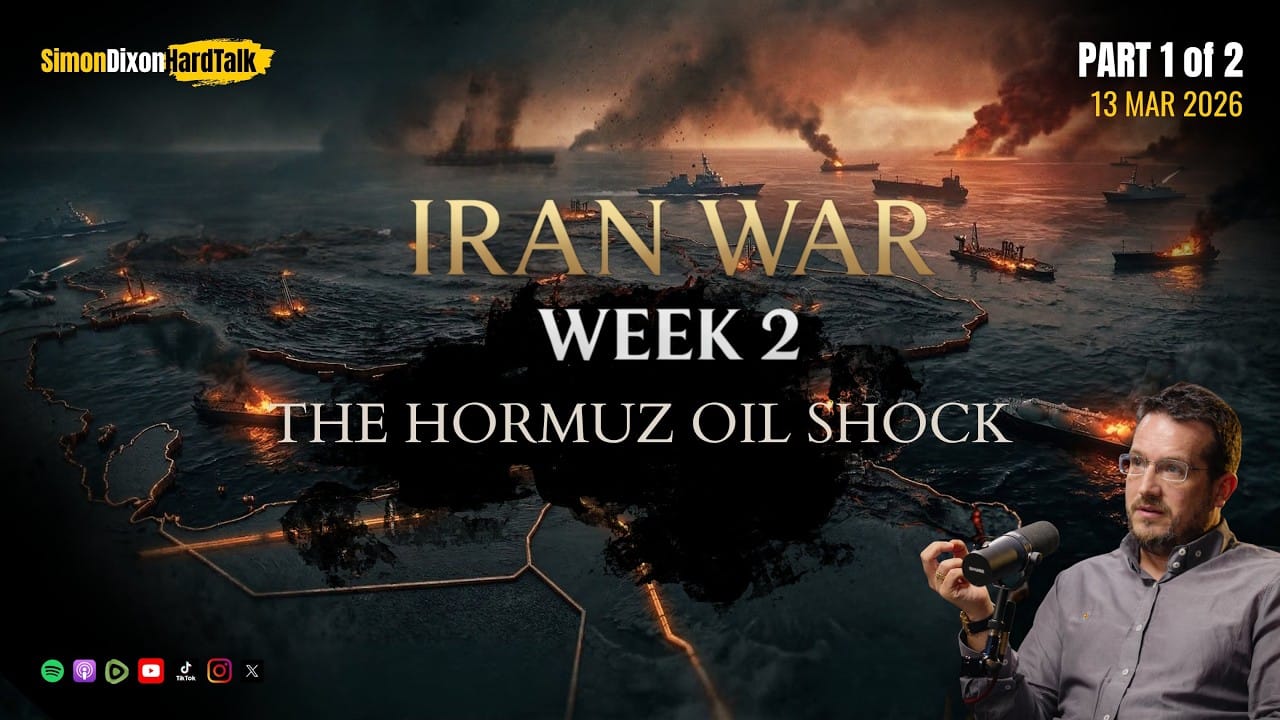
The Hormuz Oil Shock
Simon Dixon's analysis of the second week of the Iran war focuses on market reactions, the closure of the Strait of Hormuz, and what he interprets as a "managed transition" to a multi-polar world order. The transcript reveals his theory that the conflict is theatrical rather than existential, orchestrated by competing factions within global power structures.
Key Arguments and Framework
Dixon operates from a core thesis: two factions of power are managing this conflict:
- The Financial Industrial Complex (FIC): Aligned with Gulf sovereign wealth funds, China, reformist elements of Iran's government, and pragmatic IRGC factions
- The Military-Industrial Complex (MIC): Aligned with American neocons, hardline IRGC elements, and radical Zionist factions in Israel
He believes the FIC will ultimately prevail because it controls capital flows and has negotiated a "theatrical war" that meets strategic goals while allowing profiteering from reconstruction.
The Hormuz Shock: What Actually Happened
The Strait of Hormuz — through which approximately 20% of global oil normally flows — was effectively closed in week two. However, Dixon emphasizes this closure was achieved through financial mechanisms rather than physical destruction:
- Iran passed parliamentary acts and the IRGC announced enforcement
- War risk insurers withdrew coverage, making passage commercially impossible (premiums hit 75% of cargo value)
- No confirmed direct tanker strikes occurred; debris from intercepted missiles caused minor damage
- The closure was "financially engineered" — Dixon questions why insurers stopped covering ships but continued covering 20,000 cancelled flights despite similar risks
Oil price volatility was unprecedented:
- Pre-war: ~$50-60/barrel
- War onset: climbed to $70s
- Post-Hormuz closure peak: $115 (futures market)
- Collapsed to ~$89 within days — a $26 swing, the largest price increase-decrease in oil market history
This price ceiling (~$110-$120) represents, in Dixon's view, the intervention threshold where extreme measures are deployed to prevent economic contagion.
Tools Used to Suppress Oil Prices
Dixon identifies several mechanisms deployed when oil breached $110:
| Tool | Application |
|---|---|
| Trump's "Taco Trade" announcements | Social media posts claiming war's imminent end; diminishing effectiveness due to "boy who cried wolf" effect |
| G7 strategic petroleum reserves | 400 million barrels announced (41% of US reserves); ~2.7 days of global demand |
| Futures market intervention | Treasury/covert operations shorting oil futures; creates structural short positions requiring price suppression before expiry |
| Russian sanctions relief | Most effective tool — Russian oil shipments resumed, stabilizing supply |
He notes these tools are depleting and time-limited.
Alternative Routes and Their Significance
The market's relative stability stems from bypass infrastructure that shifted approximately 5-7 million of the 20 million barrels/day normally transiting Hormuz:
- Saudi East-West Pipeline: 7 million barrels/day at maximum capacity (first time at full utilization)
- UAE ADNOC pipeline: Additional capacity via UAE
- Iran's Goreh-Jask pipeline: Domestic bypass
- Iraq-Turkey pipeline: Mediterranean export route
Dixon calculates theoretical alternative capacity at ~10 million barrels/day, though real operational capacity is lower due to infrastructure limitations.
Russia: The Quiet Victor
Russia emerges as the primary beneficiary of week two:
- Shifted from selling oil at ~$35-40 discount (under sanctions) to ~$100/barrel
- Massive revenue boost to strategic reserves, de-dollarized economy
- Strengthened BRICS corridor positioning
- Gained leverage over GCC countries seeking to renegotiate US security agreements
Dixon emphasizes: "This is pure win for Russia" with no negative knock-on effects [1:10].
Financial Market Stress Signals
Week two revealed structural vulnerabilities:
- Private credit markets: Major institutions (BlackRock, JPMorgan, Deutsche Bank) restricted withdrawals; "force majeure" invoked due to war outbreak
- Distress selling: Some private credit products trading at 14 cents on the dollar
- AI/data center exposure: Gulf sovereign wealth funds using leverage to renegotiate AI infrastructure investments that underpin US growth
- Treasury yield pressure: 10/20/30-year yields rising despite dollar strengthening — signals bondholder demands for higher returns to finance US debt
- Gold behavior: Remained flat (~$3,000) rather than spiking to $6,000-$10,000 as would occur in genuine WWIII scenario
Dixon's Predictions and Timeline
Critical prediction: Ceasefire in March 2026, culminating in a Trump-Xi summit where the "managed transition" concludes.
Expected final act: US strike on Iranian nuclear facilities styled after "Operation Midnight Hammer" — theatrical, Hollywood-style victory allowing Trump to declare success while China secures regional stability behind the scenes [1:13].
What each faction gains in his scenario:
| Actor | Perceived Victory | Real Outcome |
|---|---|---|
| US/Trump | "Destroyed nuclear program," strong leadership narrative | Weaker regional position, renegotiated base agreements |
| Israel | "Secure borders," proxy networks decapitated | Regime change to leftist/GCC-Turkey puppet government, Netanyahu exit |
| Iran | Prevented regime change, expelled US bases | Political shift under reformist/IRGC cooperation, economic opening via China plan |
| GCC | Leverage for infrastructure contracts | Reduced US military footprint, "West Asia" reorientation |
| China/Russia | Regional stability, BRICS corridor | Dominant influence over energy flows, multipolar institutional framework |
Significant and Surprising Points
Most significant revelations:
- The "theatrical war" thesis — Dixon explicitly states this is not a real war in the WWII sense but a negotiated transition with agreed outcomes, despite real bombs and casualties
- Insurance markets as primary closure mechanism — The Strait was closed by financial actors, not military destruction; Dixon finds it suspicious that aviation insurance continued while maritime insurance withdrew
- Russian sanctions relief as price suppression tool — The US effectively abandoned its Ukraine-war sanctions posture to stabilize oil markets, revealing the hierarchy of priorities
- Private credit market fragility — The "retailisation" of private credit and subsequent force majeure withdrawals expose a $trillion+ shadow banking system vulnerable to geopolitical shocks
- GCC leverage over US AI infrastructure — Gulf sovereign wealth funds are explicitly using the crisis to renegotiate data center investments that prop up American growth metrics
- The "taco trade" concept — Trump's repeated premature victory declarations creating a predictable market pattern that degrades his credibility as a stabilizing voice
Most surprising elements:
- The son of Khamenei was installed as Supreme Leader on March 8, 2026 — Dixon suggests this signals IRGC cooperation with the reformist/financial faction plan
- Pescian's March 7 speech implying civilian government control over military assets — interpreted as signaling to financial powers that negotiated outcomes are achievable
- Europe's extreme vulnerability — Cut off from Qatari LNG, dependent on US/Russian supplies, facing "vassal pressure" from both energy and bond markets simultaneously
- China's chokehold on US military production — Dixon notes the US cannot manufacture drones, missiles, or F-35s without Chinese components; "if China stopped exports tomorrow, the US military-industrial complex can't replenish"
Market Interpretation
Dixon reads current market behavior as validation of his managed transition thesis [1:16]:
- Oil up + gold flat + Bitcoin up = energy shock priced in, systemic collapse rejected, AI trade continuing
- S&P at ~6,700 (down from 7,000+) = correction, not crash
- Asian markets hit harder = supply chain vulnerability acknowledgment
- Dollar strengthening = temporary flight to safety, reversing pre-war weakening trend
He concludes: "The market is pricing just for an energy shock but not a systemic collapse".
Preserved Lists and Citations
Dixon's escalation ladder:
- Hormuz closure (achieved — $115 ceiling established)
- Red Sea closure via Houthi activation (next potential phase)
- Full closure = oil above $150, requires massive intervention/bailouts
Energy supply chain impacts:
- Oil and LNG (electricity)
- Petrochemicals → pharmaceuticals
- Fertilizers → food security (India specifically)
- Sulfur/sulfuric acid → mining
- Copper/cobalt → semiconductor alternatives to silver
- Jet fuel → aviation/tourism (Dubai, Doha, Abu Dhabi, Saudi affected)
Tools diminishing over time:
- Trump announcements (taco trade degradation)
- Strategic petroleum reserves (depletion risk)
- Futures market intervention (structural short squeeze risk)
Historical parallels cited:
- 1973 Yom Kippur War oil embargo
- Russia-Ukraine conflict (2022)
- Operation Ajax (1953 Iran coup)
- Khamenei ending Iran-Iraq War (1988)
Dixon maintains his core prediction despite accelerated timelines: multi-polar world order, US exit from Middle East, Iran-GCC normalization, Palestinian resolution, and BRICS corridor institutionalization.