Six exploits
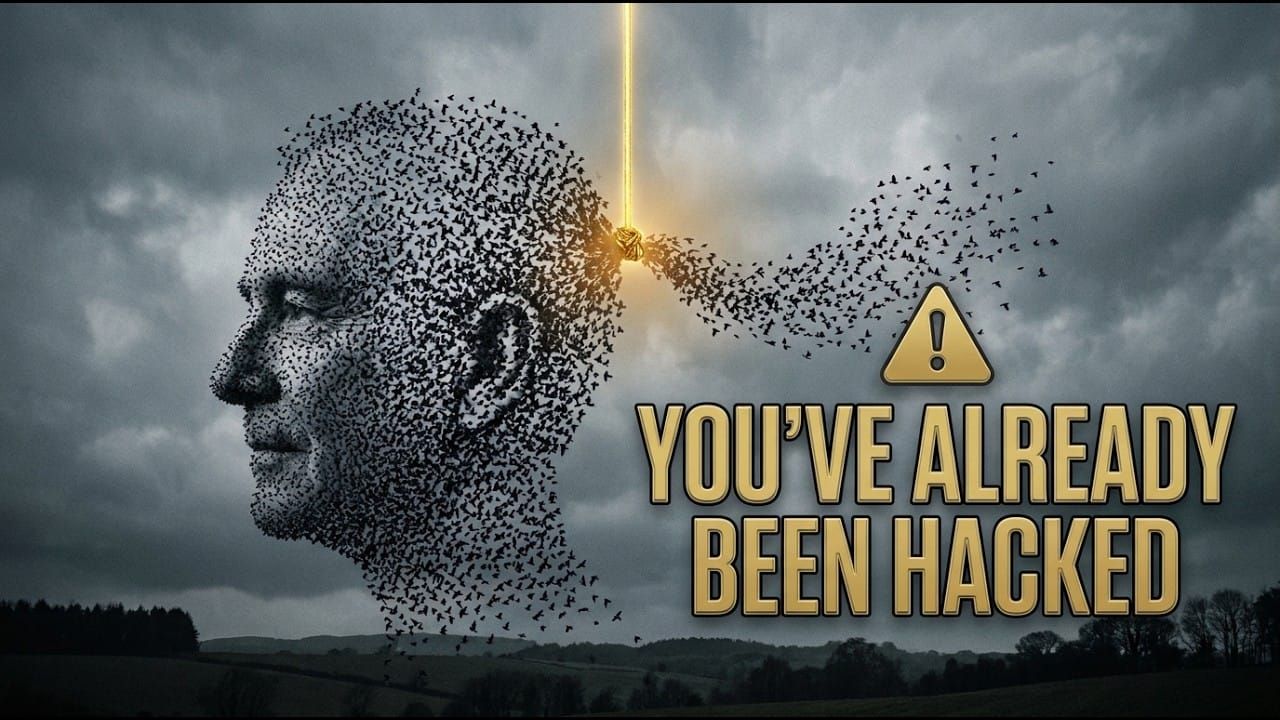
The video is framed as a "manual" of six psychological exploits, each demonstrated live on the viewer rather than merely described. The through-line: you don't receive the world, you predict it — and anything that can predict you can steer you. Each exploit ends with a practical "patch".
The six exploits
| # | Exploit | How it's demonstrated | Evidence cited | Real-world parallel | Patch |
|---|---|---|---|---|---|
| 1 | Expectation shapes perception | A distorted audio clip is unreadable until words are shown on screen; the same clip then becomes intelligible. A repeated phrase makes the eye skip a duplicated word ("the"). | Loeb/Carnegie-Mellon-style 1974 car-crash experiment: "hit" vs "smashed" shifted speed estimates by ~7 mph; a week later a third of the "smashed" group recalled broken glass that was never there. | Headlines, captions, and whether an event is called a "crash", "collision" or "incident" | Cover the caption: watch first, read second; ask who wrote the words and what they needed you to see |
| 2 | Reflex before reflection | A Stroop test (name the ink colour, not the word) produces a stumble — reading happens even when you decide not to read. | Slot machines return ~40 cents per dollar yet still play the winning song; physiological arousal to a loss mirrors a win. Apps reportedly run 10,000+ experiments a year on what makes you act before you think. | Pull-to-refresh, autoplay, red badges, one-click buy, sale countdown timers | You can't stop the reflex, but you can feel it: phone face down, count to 10 |
| 3 | Anchoring and defaults | Asked whether the tallest tree is taller or shorter than 1,200 ft, viewers guess around 844 ft; a 180 ft anchor yields ~282 ft. The true height is about 380 ft. | Organ donation: Germany (opt-in) ~12% vs Austria (opt-out) 99.98% — same kind of people, one ticked box. | Pre-ticked boxes, auto-renewing subscriptions, recommended plans, autoplay on by default, big green "Accept all" vs small grey "Manage settings" | Before clicking, find the choice already made for you and ask who made it; decide as if the box were empty |
| 4 | Confabulation (the "press secretary") | Asked why you clicked the video, an answer arrives instantly — but it is a press release, not a reason. | Classic stocking study: shoppers chose the right-hand pair 4:1 and praised its softness and weave, though all four pairs were identical; told the truth, they denied it. | Repeated opinions in a feed; ads that plant a product, after which you supply the justification | Distrust instant reasons; ask what reached you before you were conscious of choosing (what was on the right, what kept recurring in your feed) |
| 5 | Change blindness | A "green dot" appears to orbit — there are no green pixels; lilac dots vanish while the eyes hold a fixation point. Then a kitchen scene where the wall shifts from pale to dark, imperceptibly, mid-sentence. | A social network with a billion users altered what 689,000 people saw for one week; their own posts shifted to match the mood shown, and nobody noticed. | Camera framing and omission; prices rising monthly, shrinking packets, terms changed on page nine | Periodically look at "the wall": re-check the bill, the price, the setting you switched on once and forgot |
| 6 | Perceived authority | After-images: staring at a fixation dot makes a black-and-white scene appear coloured — the brain paints it in. Reveal: the presenter, the rooms and the voice are AI-generated predictions. | 1961 obedience experiment: a man in a grey coat with a clipboard got 65% of ordinary people to continue pressing a button they believed was harming a stranger — no rank, no power to punish. | Uniforms, titles, verification ticks, the expert in the advert, a confident voice explaining things to you (including this one) | Authority is a costume: ask what a voice was built to predict, and who paid for the prediction |
Significant points
- Perception is inference. The opening audio demonstration is the thesis in miniature: the sound never changed; only your expectation did.
- Prediction is the vulnerability. The closing argument: "If your own brain mostly runs on predictions, then whoever predicts you best is closer to the controls than you are." Recommendation engines, feeds and generative models exploit this without needing to understand you — "it only has to steer you."
- The one thing the manual can't reach. Something in you observed every exploit as it ran — heard the guess, felt the stumble, hunted for the change. The video poses this as an open question: was the watcher the machine, or you?
- The hopeful ending. Because the brain finds what it expects, expectation is a lever you can hold: "Look for outrage, and you'll find outrage. Change what you're looking for, and you change what you find." Practical habit: when a thought arrives fully formed — a want, an outrage, a certainty — pause and ask who put it there, "including me".
- Teaser. An upcoming installment covers AI that is learning to predict you.
Citations and references
The transcript describes these studies without naming researchers, journals or dates beyond those given. The identifications below are my matching of the descriptions to the published literature — treat them as context, not as claims made in the video.
| Video's description | Likely source | Note |
|---|---|---|
| 1974 car-crash film, "hit" vs "smashed", broken glass that wasn't there | Loftus & Palmer, Reconstruction of automobile destruction (1974) | Video's "7 mph" and "a third" match the published figures |
| Germany ~12% vs Austria 99.98% organ donation | Johnson & Goldstein, Do defaults save lives? (Science, 2003) | Rates are from that paper's period, not necessarily current |
| Identical stockings, right-hand pair chosen 4:1 | Nisbett & Wilson, Telling more than we can know (1977) | |
| 689,000 users, one week, mood manipulation | Facebook emotional-contagion experiment (published 2014; data collected 2012) | The video says "in 2012", which matches data collection, not publication |
| 1961 obedience, 65% went to the maximum | Milgram, Yale obedience studies (1961–63) | |
| Tallest tree "about 380 ft" | Coast redwood Hyperion, measured at roughly 380 ft |