Sixteen Cruficied Saviours
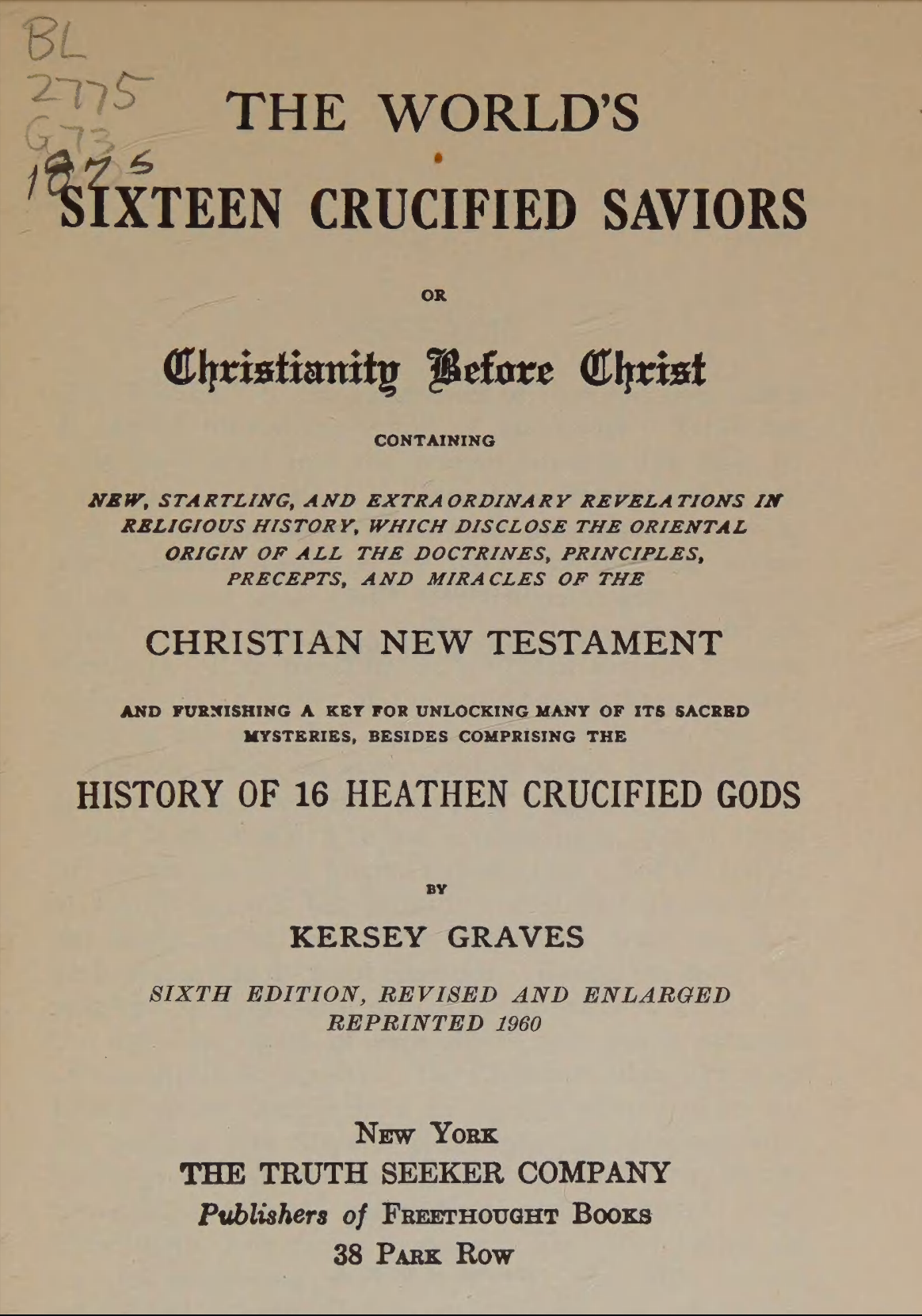
The World's Sixteen Crucified Saviours; or, Christianity Before Christ (1875) is a controversial work by American freethinker Kersey Graves (1813–1883) that became one of the most influential texts in the Christ myth theory tradition.
Core Thesis
Graves argues that Jesus was not a historical person but rather a composite figure created from pre-existing myths of crucified divine saviours found across numerous ancient cultures. The book asserts that Christianity borrowed heavily from earlier pagan religions, challenging claims of the faith's uniqueness.
The Sixteen Saviours
Graves identifies sixteen ancient deities and god-men from various cultures who allegedly shared striking parallels with Jesus Christ, including:
- Crucifixion or execution on a cross or tree
- Descent into and ascent from the underworld
- Miraculous or virgin births
- Resurrection and ascension to heaven
Additional Parallels Examined
Beyond crucifixion narratives, Graves documents numerous other common motifs across these traditions:
- Immaculate conception and virgin-born gods
- Visitations by magi, shepherds, and angels to infant saviours
- December 25th as the birthday of multiple gods
- Various other miraculous elements
Sources and Legacy
Graves drew heavily from Godfrey Higgins's earlier work Anacalypsis (1833–1836), an extensive comparative study of religious mythology. The book's "flaming argumentation and exhaustive detection of biblical flaws" made it simultaneously inspirational to sceptics and infuriating to Christian apologists.
The full list
Here are the sixteen crucified saviours listed in Kersey Graves' work, arranged chronologically as he presents them, with brief summaries of the claims made about each:
- Thulis of Egypt (1700 BCE) — An Egyptian saviour figure whom Graves claims was crucified and who descended into and ascended from the underworld.
- Bali of Afghanistan — A divine figure from Afghan tradition said to share the crucifixion and resurrection pattern.
- Crite of Chaldea — A Chaldean saviour deity included in Graves' comparative list of crucified god-men.
- Thammuz of Syria — A Syrian deity whom Graves associates with the dying-and-rising god motif and crucifixion narrative.
- Hesus of the Celtic Druids — A Celtic god claimed by Graves to have been crucified, with parallels drawn to the Jesus narrative.
- Attis of Phrygia — A Phrygian god whose death and resurrection cult Graves cites as prefiguring Christian themes, including crucifixion on a tree.
- Mithra of Persia (600 BCE) — According to Graves citing Higgins, Mithra was "slain upon the cross to make atonement for mankind, and to take away the sins of the world," born on 25 December, and crucified on a tree.
- Indra of Tibet — A Tibetan divine figure included among the crucified saviours in Graves' catalogue.
- Alcides of Thebes — A Theban hero or deity whom Graves presents as having undergone crucifixion and resurrection.
- Beddru of Japan — A Japanese figure claimed by Graves to fit the crucified saviour pattern.
- Hesus or Eros of the Druids — Another Celtic/Druidic entry, possibly conflated with or distinct from the earlier Hesus listing in Graves' enumeration.
- Chrishna of India — The Hindu deity Krishna, whom Graves extensively compares to Jesus, claiming 346 striking analogies between them including crucifixion motifs.
- Horus of Egypt — The Egyptian god whose myth Graves presents as containing crucifixion, resurrection, and ascension parallels predating Christianity.
- Baal of Phoenicia — A Phoenician deity included in the list of pre-Christian crucified saviours.
- Tammuz of Syria — A Mesopotamian/Syrian deity whose death and resurrection were celebrated annually, presented by Graves as a crucified saviour figure.
- Jesus Christ — Graves presents Jesus as the final entry in this tradition, arguing he was not a historical person but a composite creation drawing from all these earlier crucified saviour myths.