Slavlander aka Rurik
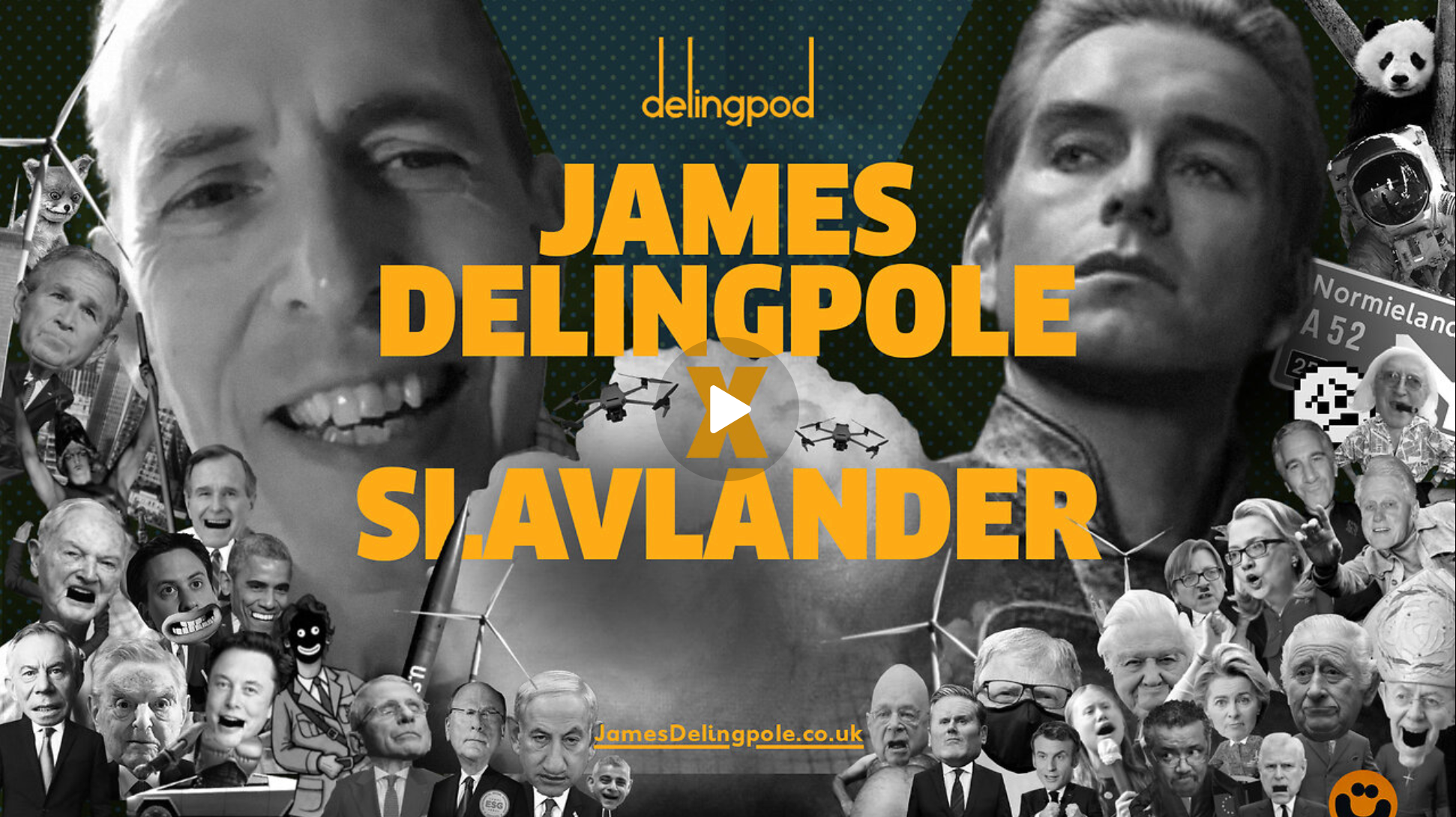
This is a ~1 hour 43 minute interview on James Delingpole's podcast with the guest known as Slavlander (formerly Rurik Skywalker), an anonymous blogger who writes about Russia, geopolitics, and religious history.
Guest Background
- Born in Kyiv, Ukraine, moved to the United States as a child
- Studied in Russia, where he was involved in journalism and engaged with conspiracy theorists across the political spectrum
- Was previously Russian Orthodox before abandoning the faith
- Runs a blog covering Russia, geopolitics (which he describes as "strictly secular"), and a separate section on "apostasy, heresy, and mysticism"
- His pseudonym "Slavlander" is a play on the character Homelander from The Boys (though he hasn't actually watched the show)
Click to listen to the full discussion
Key Topics Discussed
1. The "Convergence" Theory
The founding pillar of Slavlander's blog is the theory that the Soviet elite sought to merge with the Western elite to create a single global elite. He claims to have documentary evidence for this, tracing how the plan played out around the implosion of the USSR and Putin's role in it.
2. Religious Philosophy — Slavlander's Departure from Orthodoxy
This is the central tension of the interview. Delingpole is a devout Christian (Church of England, but sympathetic to Orthodoxy) who believes the God of the Old and New Testaments literally created the world, that the people running the world serve "team Satan," and that anyone denying this is "missing a very important part of the jigsaw puzzle."
Slavlander, by contrast, is now anti-Abrahamic (he explicitly says "anti-Jewish, anti-Islamic and anti-Christian"). His stated preferences:
- He would prefer secularism and a return to 19th/20th-century-style nationalism, with religion kept as a private matter
- He does believe in "God" but not the God of the Old Testament, which he views as a construct
- He does not worship any deity; he believes in "man's inherent worth and our limitless spiritual potential"
3. The Plato Thesis — Christianity as Social Engineering
Slavlander's main critique of Christianity is that it was essentially engineered from Platonism. His argument:
- Plato wrote a blueprint for creating a "new world order" using religion and social engineering
- He references a Russian-American author named Russell Gamerkin who examined similarities between the Septuagint/Pentateuch and Plato's treatises
- He claims that Platonists in Alexandria (~270 BC) wrote the Old Testament, making Christianity essentially a product of that Platonic social engineering project
- He argues Platonism and Christianity are "very closely intermixed, interwoven"
Delingpole is openly skeptical, comparing it to other theories he's heard ("Christianity was invented by the Romans/Jews as a control mechanism") and suggesting he'd research it and "find it was more bollocks."
4. The Journey Out of Orthodoxy — Hesychasm
Slavlander describes in detail how he left Orthodoxy through his interest in Hesychasm (Orthodox monastic meditation):
- He read Father Seraphim Rose (Eugene Rose), whom he later discovered was involved in a teenage boy abuse ring at the Platina monastery (run by Rose's partner Gleb Podmoshchensky), which was a significant blow
- He studied the Philokalia and The Way of a Pilgrim — texts priests told him were "off-limits" to laypeople
- He pursued the Jesus Prayer and heart-focused meditation but couldn't master the breathing technique
- He was told he had fallen into prelest (spiritual delusion/arrogance) for wanting mystical experiences without doing the prescribed rituals
- The breakthrough moment: he realized the meditation techniques (altered states, heart focus, breathing, mantras) "work equally well for any religion" and don't require Christian belief — this was "how the devil got his claws in me"
He describes the Hesychast practice in detail: intense repetition of the Jesus Prayer (thousands of times daily), navel breathing, focusing on the heart, inducing overwhelming emotions/euphoria/tears, sitting in darkness. The second stage (Theoria) is where one supposedly develops supernatural abilities — seeing spirits, halos, even "skywalking" (teleportation), and talking to animals (which he connects to tantric heart-chakra practices).
5. Reinterpreting "Earth Devils" as Native Spirits
A pivotal reframe for Slavlander: the Orthodox concept of aerial toll-house guardians / earth devils (depicted in the Ladder of Divine Ascent and the Agony of Saint Jerome) — he came to see these not as evil demons but as native earth spirits, equivalent to those in Shinto (Pokémon), Miyazaki films, Pocahontas, and other animistic traditions. He argues Christianity simply slapped an "Abrahamic moral tint" on a universal cross-cultural phenomenon.
6. The Orthodox Church and the Russian Revolution
Slavlander presents a revisionist history:
- The February Revolution (Kerensky's provisional government) preceded the October Revolution by months
- The Orthodox Church/Synod was the first faction to openly denounce the Tsar, ceremonially hauling out the Tsar's chair and dumping it on the cobblestones
- They issued a Russia-wide call to prayer supporting Kerensky's revolutionary government
- Their motivation: the Tsar refused to grant them a Patriarchate (the church wanted papal-level authority, free from the Tsar's veto). They got this upgrade after the revolution, which is why Moscow is now "the Patriarchate"
- He accuses the church of involvement in subversive conspiracies including Father Gapon (1905), Rasputin, and others
7. The Nicholas II Bones Conspiracy
Slavlander claims the remains interred in 2011 at the Peter and Paul Fortress in St. Petersburg are not those of Nicholas II — a "PSYOP" by Patriarch Kirill. His evidence: Nicholas II was scarred on the temple by a samurai's katana during a visit to Japan, but the skull examined showed no such scar. He says catacomb/schismatic Orthodox ("True Orthodox") believe the church serves the Antichrist and that Patriarch Kirill is the harbinger of the Antichrist, and they view the fake bones as a cover-up of their failure to properly honor the martyred Tsar.
8. The 1913 Mount Athos Naval Raid
Slavlander describes (and Delingpole looks up) the July 5, 1913 naval raid on Mount Athos, where Russian Marines were sent to suppress a Hesychast/Gnostic-leaning group (associated with "love of Sophia"). The soldiers initially refused orders, so the priests got them drunk, and they butchered monks (~100 killed), shaved the survivors' beards, excommunicated them, and sent them to Siberian exile.
9. The Old Believers
He discusses the Old Believers schism: church reforms by Patriarch Nikon were based on documents that turned out to be medieval forgeries from Venice (not ancient Greek texts). The church hounded out the Old Believers (who were the merchant/middle class) over trivialities like the number of fingers used in the sign of the cross, enslaving and selling them — then brought in Jews to take over their economic roles.
10. Greek Myths vs. Biblical Narratives
Slavlander argues the Greek myths came first and the Biblical stories are inversions:
- Prometheus (who created humanity with Athena, stole fire for us) → became Lucifer in the Bible
- Zeus's flood → became God's flood, but inverted so the flooding god is also the saving god ("it doesn't make sense anymore")
- The Titan/Olympian war → the fallen angels/good angels war
- The Nephilim → Titans
- Humans are the product of Titans/Nephilim, which he says the Jews explicitly acknowledge in Maccabees, Jubilees, and Enoch as the reason for their holy war against Gentiles
11. Jews, Yahweh, and Human Sacrifice
This is where the interview becomes most contentious. Slavlander argues:
- Jews run the world — pointing to top CEOs, globalist organizations, Trump's relationship with Israel/Netanyahu, Ivanka's conversion to the Kushner family
- He rejects the Khazar theory (calls it a 1960s Zionist invention)
- He claims Yahweh is a god of human sacrifice, citing the firstborn sacrifice in Exodus and David sacrificing Saul's grandchildren to end a famine
- He argues Jewish ritual purity laws (circumcision, dietary rules, fabric mixing) are about protection from "spirits of the air / earth devils"
- He claims the Maccabean revolt was explicitly motivated by the belief that Greeks were descendants of the Nephilim and therefore demon-possessed
Delingpole pushes back hard here, arguing Yahweh explicitly condemns child sacrifice and the Isaac story represents an exit from human sacrifice traditions. He says Slavlander is "mingling stuff" and "hasn't a bloody clue."
12. The Church's Protection of Jews
Slavlander argues the Orthodox Church protected Jews rather than opposing them:
- The church condemned peasants who carried out pogroms
- A sermon by the Metropolitan of Kiev (and one from John of Kronstadt) called Slavic peasants "barbarous Gentiles" while calling Jews "the moral nation" and "moral exemplars"
- The church fiercely resisted assimilation/conversion policies because their prophecies require Jews to remain unconverted as witnesses to the return of Christ
- This gave Jews "carte blanche to basically sit there like a terror cell... metastasizing"
13. Ancestralism and the Afterlife
When asked where he goes when he dies, Slavlander describes a belief he calls "ancestralism" (a term he says he just made up):
- Your race and ancestors play a big role in where you go after death
- There are ancestral spirits and a "metaphysical race soul" — what Rupert Sheldrake would call a morphic field
- You "return to the source of your people"
- He wants to understand and reconnect with what his peasant ancestors believed — "stuff that my grandma would have done in the village"
- He explicitly rejects "high paganism" (no Valhalla) and is focused on folk/peasant-level ancestral traditions
He also describes the Orthodox afterlife tradition (mytarstva): the soul floats outside the body for three days, rises, encounters aerial toll-houses guarded by earth demons/archons (requiring correct pass-phrases), and needs the church's prayers to guide it through — which he notes is "remarkably similar to pretty much every single mystical tradition" (esoteric Japanese rites, Chinese practices).
The Dynamic Between Host and Guest
The interview is marked by a genuine intellectual tension. Delingpole is clearly fascinated by Slavlander ("you are a fascinating and persuasive podcast guest") but repeatedly troubled by his positions. He tells Slavlander he's "a bit like a fallen angel... like Lucifer" — too proud, wanting the "good stuff" (mystical experiences) without the humility, fasting, and prescribed rituals. He accuses Slavlander of being "quite slippery" and digressing when asked direct questions, while Slavlander counters that there's "no ism" he can give — his position is an ongoing investigation, not a fixed doctrine.
Delingpole's closing assessment: the audience will split three ways — some cheering Slavlander on, some wondering how Delingpole "put up with this," and a majority finding it interesting with some good points made. He notes Slavlander hasn't shaken his Christian faith "at all" but acknowledges there are areas of agreement (skepticism about the word "Jew," about the Big Bang, about evolution).