Spider's web
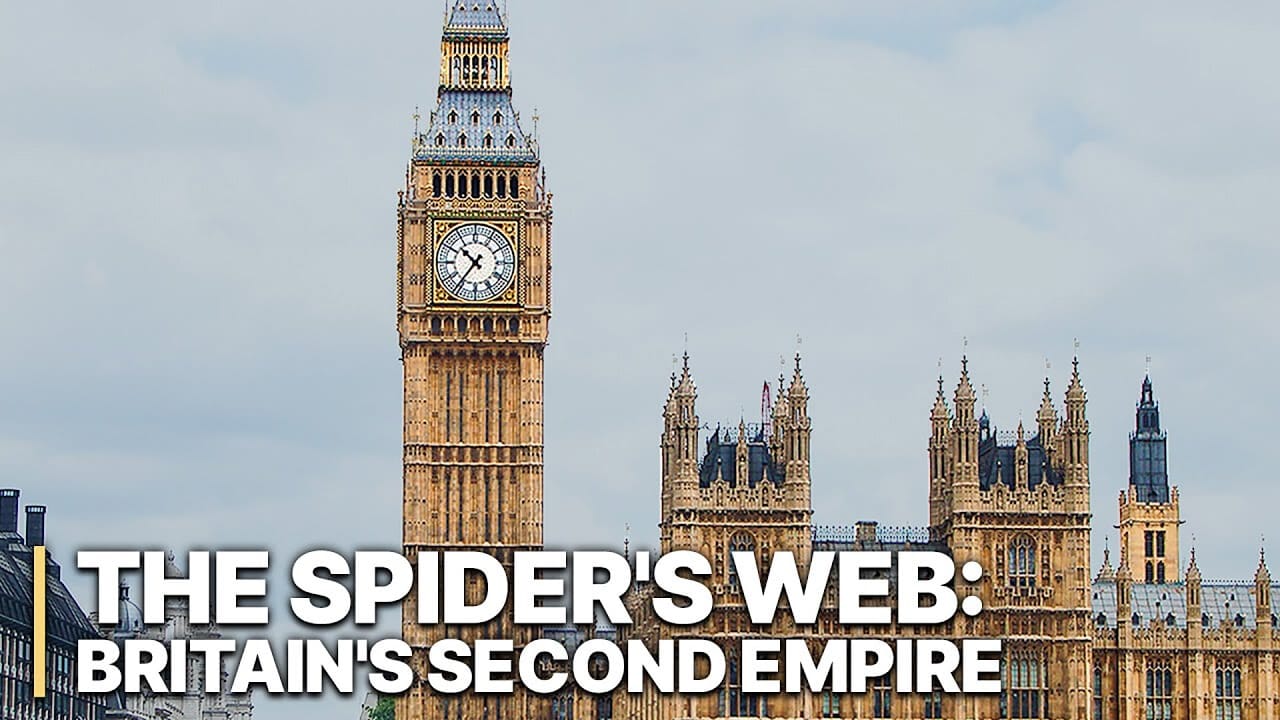
The Transformation from Colonial to Financial Empire
The documentary traces the profound metamorphosis of Great Britain following the collapse of its colonial empire. For over three centuries, Britain projected power through military conquest and trade, governed by the City of London as the financial heart of the Imperial engine. However, the aftermath of World War II and the wave of decolonization signaled the end of this era. The turning point was the 1956 Suez Crisis, a military humiliation that confirmed Britain was no longer a global superpower capable of imposing its will by force. Facing a decline in Sterling and the disintegration of imperial wealth, British elites sought a new role to maintain their privileges and relevance in a changing world. They found this role in finance, effectively replacing a physical empire with a financial one.
The genesis of this transformation occurred in the City of London during the 1950s. To protect the pound, the British government restricted domestic banks from lending overseas. However, the Bank of England—dominated by banking interests—quietly agreed to let banks lend in foreign currencies, specifically US dollars, provided the transactions occurred between non-residents. This decision birthed the "Eurodollar" market. It created a legal fiction: a financial space that was technically "elsewhere," unregulated by British law despite being managed from London. American banks, seeking to escape strict US domestic regulations, flocked to London. This deregulation re-established the City as a global financial hub, operating independently of the British economy’s actual industrial health.
The Spider’s Web: The Offshore Network
While the City of London served as the hub, the "spokes" of this new financial empire were the remnants of Britain's colonial territories—small islands like Jersey, Guernsey, the Isle of Man, the Cayman Islands, Bermuda, and the British Virgin Islands. Once considered backwaters, these territories were transformed by lawyers and accountants from the City into "secrecy jurisdictions."
The documentary identifies these territories as the "Spider’s Web." They offer a unique proposition: the stability and legal framework of British law combined with local autonomy that allows for zero taxation and absolute secrecy. The Bank of England observed this proliferation of "brass plate" banks in the late 1960s and, rather than stopping it, allowed it to flourish, provided it did not destabilize the domestic pound.
The central mechanism of this system is the "trust." rooted in medieval Crusader laws, a trust allows an individual to hand over assets to a trustee (often a lawyer in a tax haven), thereby separating legal ownership from beneficial enjoyment. This arrangement renders the true owner invisible to tax authorities and law enforcement. When combined with shell companies across multiple jurisdictions, trusts create impenetrable layers of secrecy. This system allows trillions of dollars—estimated at up to $50 trillion globally—to sit offshore, legally belonging to "nobody," protecting the wealth of the global elite from taxation and scrutiny.
The City of London Corporation
A crucial element of this system is the unique status of the City of London itself. Distinct from the Greater London metropolis, the "City" (the "Square Mile") is a state within a state, governed by the City of London Corporation. This ancient private entity operates outside many democratic norms that govern the rest of the UK. Its voting system is dominated by businesses rather than residents, and its head, the Lord Mayor, is selected by medieval guilds.
The Corporation exerts immense political influence. It possesses a dedicated lobbyist in the House of Commons known as the "Remembrancer," a non-elected official who sits behind the Speaker’s chair to ensure that no legislation harms the City's financial interests. This entrenched political power ensures that the financial sector remains largely self-regulated, or regulated with a "light touch." This culture of non-interference was starkly illustrated by the collapse of the Bank of Credit and Commerce International (BCCI). Despite knowing about BCCI's involvement in terrorism financing, money laundering, and fraud, the Bank of England failed to intervene for years, prioritizing the protection of the banking sector's reputation over the safety of depositors or the prevention of crime.
The Impact on the Developing World
The narrative argues that this "Second Empire" is as extractive as the first. While the colonial empire looted resources through occupation, the financial empire extracts wealth through capital flight. The documentary highlights the devastating impact on Africa. While Sub-Saharan Africa is often portrayed as a debtor region owing roughly $177 billion (as of 2008), the capital flight from the continent to offshore havens during the same period was estimated at $944 billion.
Consequently, Africa is technically a net creditor to the world, but its wealth is stolen by corrupt elites and corporations, then funneled into the British offshore network. This system facilitates corruption by providing a safe harbor for illicit funds, undermining development, healthcare, and education in the Global South. Western nations block attempts to create a global tax body or transparent registries, as these flows of capital prop up their own currencies and financial markets.
Financialization and Domestic Decay
The documentary also explores how this system has impacted the UK and the US domestically. In the 1960s, the US government, facing a balance of payments deficit due to the Vietnam War, tacitly supported the offshore system (via banks like Chase Manhattan) to prevent dollars from flowing to rival nations like France. They encouraged the Caribbean havens to capture these dollars and recycle them back into the US economy.
Similarly, Britain used the inflow of "hot money" from around the world to artificially prop up the Sterling. However, this reliance on finance has led to the "financialization" of the British economy. Investment flows into speculative markets and real estate rather than manufacturing or industry. The result is a de-industrialized nation where the interests of the City supersede the needs of the wider population. The documentary posits that London has become the money-laundering capital of the world, creating a property bubble and exacerbating inequality.
The Enablers: Professional Services and Political Capture
The infrastructure of this system is maintained by a "pin-stripe army" of accountants, lawyers, and bankers. The "Big Four" accounting firms are singled out for their role in designing tax avoidance schemes and penetrating the state apparatus. The documentary describes a "revolving door" where senior tax officials and politicians move seamlessly between public service and lucrative positions in private firms that profit from the very loopholes they failed to close.
A prime example given is Dave Hartnett, a former head of Her Majesty's Revenue and Customs (HMRC), who pioneered "sweetheart deals" with major corporations like Vodafone and Goldman Sachs, forgiving billions in taxes. He was later knighted and took a position at Deloitte. This capture extends to the government itself, with politicians from all major parties often having personal or financial ties to the offshore world. The documentary suggests that the British establishment protects this system because they are its primary beneficiaries.
The Culture of Silence
Finally, the film examines the mechanisms of suppression used to maintain the status quo. In the small island jurisdictions like Jersey, dissent is ruthlessly punished. The case of Stuart Syvret, a former Health Minister in Jersey, illustrates this. After blowing the whistle on systemic abuse and failures, he was harassed, prosecuted on data protection charges, and imprisoned. The insular nature of these jurisdictions, where the legislature, judiciary, and financial sector are deeply intertwined, makes genuine accountability impossible. The message is clear: those who threaten the reputation or profitability of the finance industry face social ostracism and legal persecution.
Conclusion
"The Spider's Web" concludes that Britain has successfully reinvented its imperialism. The British Empire did not disappear; it merely shifted from visible conquest to invisible finance. Today, the UK and its satellite jurisdictions account for approximately 25% of the global market for international financial services and host nearly half of the world's secrecy jurisdictions.
This system serves the interests of a global elite—criminals, kleptocrats, and corporations—at the expense of ordinary citizens everywhere. It erodes democracy by allowing money to dictate policy, starves developing nations of essential revenue, and transforms Western economies into vehicles for speculation and laundering. The documentary asserts that despite public pronouncements against corruption, the British government actively protects and perpetuates this offshore network, as it is the foundation of Britain's remaining global power.