Surveillance Report
Review of the weekly Techlore Surveillance Report transcript, dated around late June 2026. The episode covers threats to security, privacy, and digital freedom.

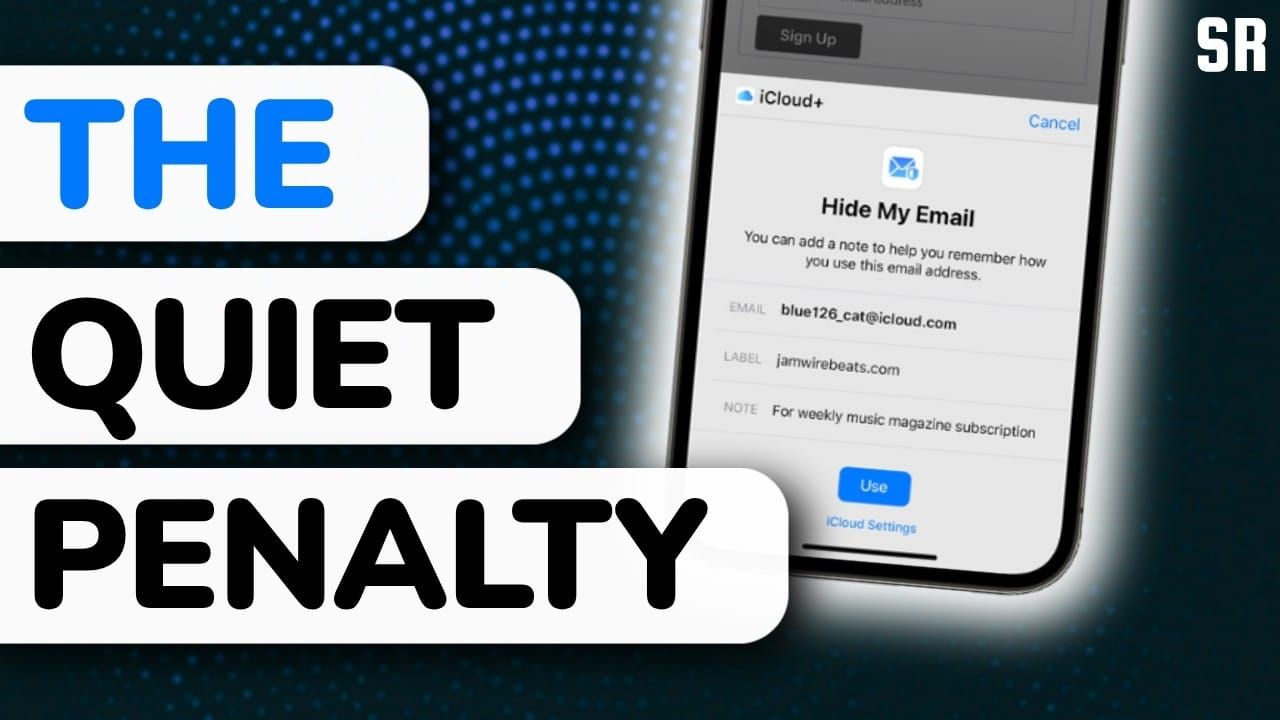
1. Apple — Hide My Email Domain Downgrade
Significant points:
- Apple's Hide My Email feature currently generates alias addresses under the icloud.com domain, forwarding emails to your real Apple account while hiding your actual address from services.
- Apple has notified developers that, in the coming weeks, generated email addresses will move to a new subdomain: private.icloud.com.
- The stated purpose is to make it 'easier for apps and websites to know that an email address is private and block users from signing up'.
- This does not change the underlying privacy or security of the service, but it makes alias addresses easily identifiable and blockable — a known problem for users of privacy tools (e.g., alternative phone number providers like MySudo or Google Voice are frequently rejected by services).
- Henry argues for a right to use any provider — that rejecting non-Gmail/non-iCloud addresses is discriminatory against people who don't use Big Tech providers, tying this to concepts like the DMA and interoperability.
- TechCrunch reported that Apple turned over the real account information of a user who generated an anonymised email address — a reminder that aliasing services are not end-to-end encrypted; you are trusting Apple as the intermediary.
- Workaround: Open-source alternatives (e.g., SimpleLogin, Addy.io) offer multiple domains and support custom domains, which are much harder to block.
Additional Apple story:
- An unpatchable flaw was found in older Apple chips (A12, A13 — released 2018–2019), affecting phones from the iPhone XS/XR up to the iPhone 11. It opens the door for a potential jailbreak (and thus also represents a vulnerability). Henry frames this as a reminder that older devices are reaching end-of-life, and recommends upgrading (second-hand to avoid e-waste).
2. Google — IP Address Tracking & Fingerprinting
Significant points:
- Google is notifying advertisers that it will begin using IP addresses for ad measurement and personalisation across the EEA, the UK, and Switzerland, on or shortly after 3 August 2026.
- The primary concern is fingerprinting.
- In 2019, Chrome engineering director Justin Schuh wrote that 'fingerprinting subverts user choice and is wrong because users cannot clear it the way that they can clear cookies.' Henry reverses this stance: Google dropped its prohibition on fingerprinting for advertisers in December 2024, explaining why Chrome lacks strong fingerprinting resistance and why Google is open to IP-based tracking.
- Henry notes this aligns with Google's core business model (advertising) and expresses disappointment that there appears to be no floor to how far Google will go.
Actionable mitigations mentioned:
- Decline non-essential cookies / engage with consent prompts
- Review ad personalisation settings in your Google account
- Hide your IP address using a VPN or Tor (more advanced)
3. Chrome — Killing Ad Blockers (Manifest V3 & MV2 Removal)
Significant points:
- Manifest V2 (MV2) is the underlying extension technology that has historically powered effective ad blockers. Manifest V3 (MV3) is the newer, more restrictive update that limits what extensions can do.
- Google claims MV3 is for better security and permissions; critics argue the decisions were designed to make ad blocking harder — a conflict of interest given Google's advertising business and ownership of Chrome, YouTube, etc.
- uBlock Origin has had to retire its old extension on Chrome; uBlock Origin Lite is MV3-compatible but 'nowhere near as powerful.'
- Chromium until now retained a flag (
ExtensionManifestV2Disabled) that allowed MV2 extensions to still run. A new Chromium commit removes that flag entirely; a Googler confirmed they intend to let it go. - 9to5Google notes this will impact other Chromium-based browsers like Edge and Opera.
- Brave and Vivaldi have committed to supporting MV2 for as long as they can. Henry speculates on whether they relied on the flag workaround (now being removed) or found a sustainable alternative path. Brave at least builds ad blocking directly into the browser, bypassing the need for an extension.
4. Sponsor Segment — Easy Optouts
- A data removal service Henry personally uses to remove personal information from data brokers and people-search websites.
- $20 per year (not per month).
- Verified by Consumer Reports as tied for the most effective data removal service alongside Optery.
5. Canada — Surveillance Bill (C-22)
Note: Henry refers to the bill as 'BC-22' in the transcript; this appears to be a verbal error for Bill C-22 (the bill is consistently referenced as a Canadian surveillance bill). This is flagged here for accuracy.
Key concerns of the bill:
- Requirements for metadata retention
- Expanded information sharing with foreign governments
- A mechanism to demand companies create backdoors, effectively breaking encryption
Broad opposition from:
- Citizen Lab
- Canadian Civil Liberties Association
- EFF
- Signal
- Big tech companies (Apple, Google)
- VPN providers
Henry stresses that this is a global issue — 'every domino that falls' matters internationally. The bill has not yet passed but is moving forward without serious debate. Canadians are urged to contact their representatives.
6. UK — Social Media Ban for Under-16s
Significant points:
- The UK plans to ban social media for under-16s, inspired by Australia's failed ban — which has been 'catastrophic': children get around it, it hasn't demonstrated effectiveness, and it creates internet gatekeeping while ignoring root issues with exploitative companies.
- A quote from Prime Minister Keir Starmer: 'This is not something I do lightly, and I will not present it as cost-free, as if social media has brought no benefits to young people, because clearly that is wrong. But government is always about choices, and it's clear to me that a total ban is the right choice.'
- Henry strongly disagrees, arguing:
- The right choice is allowing parents to decide whether their children use these platforms.
- People should have the choice to use platforms that don't exploit them.
- The government's framing presents a false dichotomy: either ban platforms + require age verification (a privacy nightmare for children and adults alike), or hold companies accountable and make them safer.
- The real problem is the companies, not children — they should be held liable and forced to create safe environments.
- Comparison: banning children from parks because parks are dangerous, rather than making the parks safer.
- Uses Techlore's own PeerTube server (Techlore.tv) as an example of safe, non-exploitative video sharing — accessible via RSS, no account required, open source, self-hosted, no advertising surveillance economy.
- The implementation would require ID or face scans before accessing social media accounts — which Henry finds deeply concerning.
7. Arch Linux — AUR Malware Attacks
Significant points:
- The AUR (Arch User Repository) is a user-contributed, open repository (like an app store but completely open) where anyone can publish packages.
- On 12 June 2026, what was initially thought to be ~400 compromised packages turned out to be more than 1,500 packages containing malware.
- On 14 June 2026, a second, more obfuscated sophisticated malware attack hit the AUR.
- Henry expresses genuine alarm and argues this highlights the risk of purely community-maintained repositories without a well-resourced gatekeeper.
- F-Droid is cited as a good middle ground — it's on the user's team but also verifies apps (open source, no suspicious domain contacts, flags suspicious behaviour).
- Recommendation: Reconsider relying strictly on community-based sources; obtain software from official developers where possible. Henry applies the same philosophy to Flatpak — he does not consider a Flatpak a trustworthy way to run Signal on desktop Linux because he won't trust a random community maintainer to push updates for Signal.
- Users who may have installed affected packages should consult show notes for remediation steps.
8. Defence Bulletin — Data Breaches
| Entity | Details |
|---|---|
| Texas government | Hackers stole 3 million driver's licences and passports. Texas residents should check if they were affected. |
| LastPass | New breach via a 3CLUE supply chain attack. No vault data compromised, but customer names, phone numbers, email addresses, physical addresses, and support case information were leaked. Concern: downstream phishing and social engineering attacks. LastPass's history is described as 'not the strongest.' |
| iRhythm | Cardiac monitoring service disclosed a data breach. Has analysed 2 billion hours of curated heartbeat data from 12 million patients. |
| Kodak | Confirmed a breach claimed by the ShinyHunters extortion gang. Kodak stated only a limited amount of data was accessed. |
| Madison Square Garden | Covered by 404 Media; appears to be more of a business/internal data breach rather than customer data. Limited impact expected. |
| FIFA World Cup portal | A researcher gained access to everything inside the portal — all streams, analytics, internal workings. Could have started/stopped streams, potentially broadcasting to live television. Documented in a blog post; FIFA fixed it quietly after being contacted. Henry describes this as highly entertaining and shareable. |
9. Defence Bulletin — Threats
| Threat | Details |
|---|---|
| Fortinet 40 sandbox flaw | Now being exploited in attacks. Fortinet users should investigate. |
| WordPress — Gravity SMTP plugin | Flaw addressed in the newest version; users should update. |
| WordPress — Shared Plugin (supply chain attack) | Updating to the newest version also affected other plugins: Product Slider Pro, WooCommerce, Real Testimonials, and Smart Post Show Pro. |
| Microsoft Defender — Rogue Planet zero-day | Patch being worked on (vulnerability disclosed the prior week; fix expected soon). Flagged for friends and family. |
| Secure Boot keys expiry | Deadline was 24 June 2026. Three certificates that cryptographically verify firmware/software during boot expired. Machines that don't update will still function but lose protection against new threats. Windows: check via Windows Security > Device Security > Secure Boot (green checkmark = updated). Most Windows machines auto-update via monthly patches; older machines may need manual attention. Linux users should watch for new shims. |
| Microsoft Copilot critical vulnerability | Allowed hackers to steal 2FA codes from users. Described as one of countless Copilot issues. Must-read for Copilot users. |
| Apple Beats Studio Buds flaw | Let hackers spy on conversations. Already patched; fix automatically delivered when headphones are paired and within Bluetooth range of an iPhone, iPad, or Mac. |
| AMD TSME reversal | AMD was going to strip TSME (memory encryption against physical attacks) from consumer CPUs. After backlash, reinstated memory encryption. Henry notes it's handled but 'weird that it had to get that far.' |
10. Defence Bulletin — FOSS / Open Source Updates
| Project | Version / Update |
|---|---|
| Tor Browser | 15.0.16 — security updates. |
| Mozilla Firefox | 152 — revamped settings, JPEG XL support, easier tab muting. UI overhaul looks good. Also launched a Firefox Roadmap detailing future work: tab groups on mobile, PDF editor improvements, VPN on mobile, private window update, containers, ad blocking, 'AI done differently.' Praised for transparency. |
| Tails | 7.9 — includes the Tor Browser update; all Tails users should update. |
| GrapheneOS | Fully ported to Android 17; available soon. Supported devices: Pixel 6a, 7, 7a(?), 8, 8a(?), 10a, and 10 Pro Fold. (Note: transcript lists '7, 7, 8, 8, 10a' which likely contains transcription errors for device model names.) |
| postmarketOS | 26.06 — GNOME 50, KDE Plasma 6.6, Phosh 55, improved booting. |
| KDE Plasma | 6.7 — per-screen virtual desktops, unified theming system, Wayland updates. |
| AltStore PAL | Now available in Brazil as Apple enables alternative app marketplaces there (matching what Europeans have had). |
| Proton | Released Easy Switch for Business to help companies migrate away from Google. A similar tool for individuals was previously released. |
11. Closing Notes
- Supporters can become a 'Techlorian' via the link in show notes — gaining access to an exclusive Signal community, Henry's private RSS feed (updated throughout the week, including while travelling), and other perks.
- Alternatively, listeners can help by leaving a rating, sharing the episode, or leaving a comment on Spotify, YouTube, etc.