The Christ Conspiracy
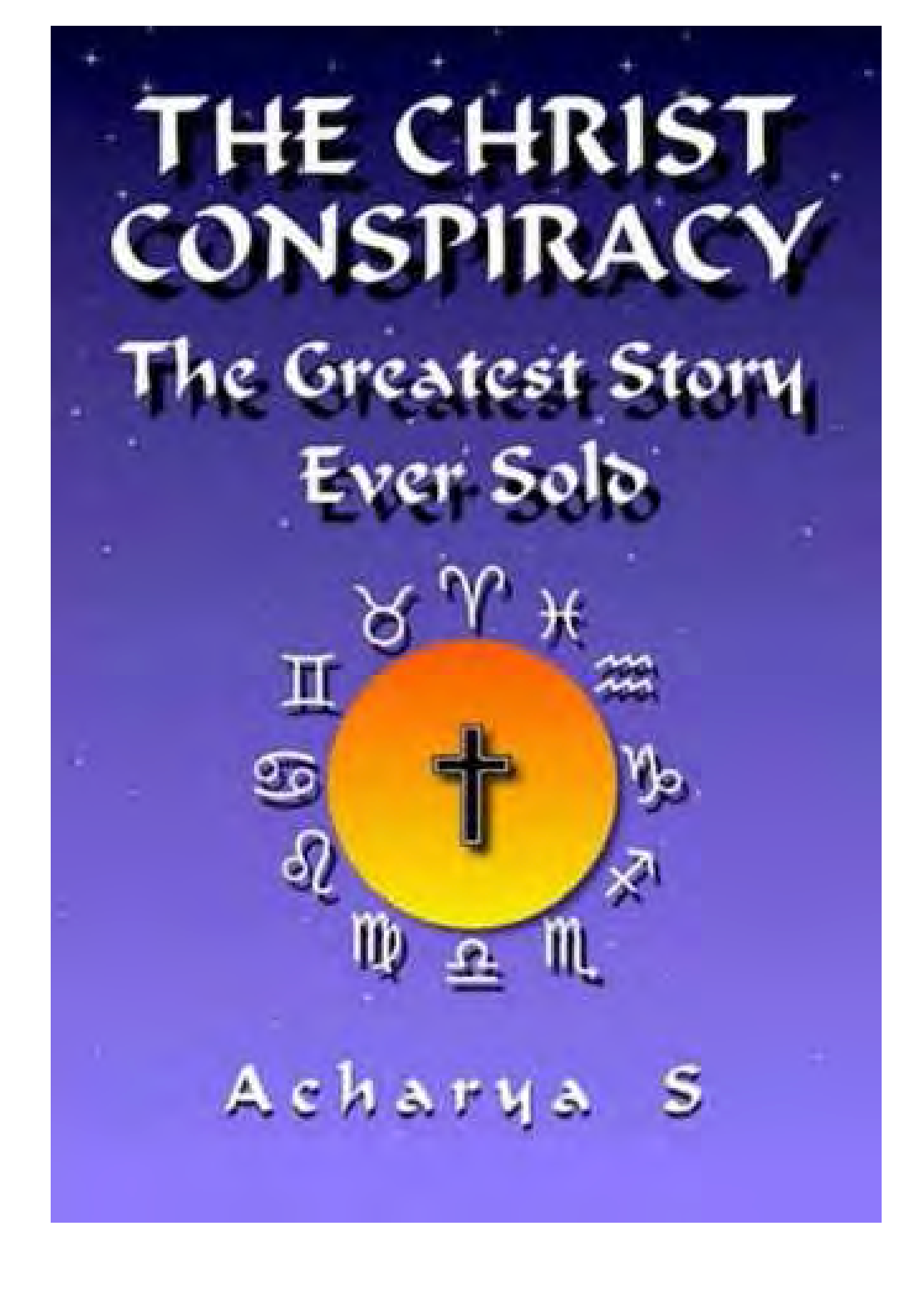
"The Christ Conspiracy: The Greatest Story Ever Sold" is a controversial 1999 book by Dorothy Milne Murdock, who wrote under the pen name Acharya S (also known as D.M. Murdock). She was an American writer who studied Classics and Greek Civilization at Franklin & Marshall College.
Central Thesis
The book argues that Christianity and Jesus Christ were deliberately fabricated by members of various secret societies, mystery schools, and religions. According to Murdock, this "multinational cabal" sought to unify the Roman Empire under one state religion by drawing upon pre-existing myths and rituals from numerous cultures, then reworking them over centuries into the biblical narrative familiar today.
Key Arguments
Murdock's work marshals evidence that:
- The Jesus story incorporates elements from myths and rituals that existed long before the Christian era
- Early Christian history is largely myth rather than historical fact
- The church suppressed the originally intended understanding of these materials
Here's a comparison of "The Christ Conspiracy" by Acharya S (D.M. Murdock) and "Caesar's Messiah" by Joseph Atwill:
Similarities
Shared Core Thesis
- Both books argue that Jesus of Nazareth was not a historical figure but rather a deliberate invention
- Both propose conspiracy theories involving powerful groups manufacturing Christianity for social control
- Both reject mainstream biblical scholarship and historical Jesus research
- Both are widely rejected by academic scholars and biblical historians
Methodological Parallels
- Both authors rely on identifying parallels between Christian texts and other sources (myths, histories) as "proof" of fabrication
- Both claim to have discovered hidden patterns unknown to centuries of scholars
Key Differences
| Aspect | The Christ Conspiracy (1999) | Caesar's Messiah (2005) |
|---|---|---|
| Alleged Conspirators | Various secret societies, mystery schools, and religions across multiple cultures over centuries 1 | Specifically the Flavian family of Roman emperors (Vespasian, Titus, Domitian) and their associates, including Flavius Josephus, Berenice, and Tiberius Julius Alexander 12 |
| Primary Sources | Draws from mythological parallels across Egyptian, Greek, Hindu, Buddhist, and other traditions 1 | Focuses on parallels between the Gospels and Josephus' Jewish War, claiming the New Testament was designed as a satire of Titus Flavius' military campaign 13 |
| Motive | To unify the Roman Empire under one state religion 1 | To pacify Jewish rebellion by promoting a "suffering messiah" rather than a conquering one, making Jews more submissive to Roman rule 26 |
| Literary Approach | Claims the Gospels rework pre-existing myths and rituals into a new narrative 1 | Claims the Gospels were designed as a two-level text: surface-level religious story and hidden satirical commentary on Roman military campaigns 3 |
| Author Background | Classics and Greek Civilization education; independent researcher 3 | Studied at Jesuit-run St. Mary's Military Academy in Japan; background in computer science 5 |
| Scope | Broader: addresses Christianity as a whole and its mythological roots | Narrower: focuses heavily on Matthew's Gospel and Flavian-era Roman politics 4 |
Summary
While both books argue Jesus was invented, Acharya S sees Christianity as an ecumenical mythological synthesis developed organically over centuries, whereas Atwill posits a specific political operation by identifiable Roman elites around 70 CE with a precise literary technique (the "satirical" two-level reading). Atwill's theory is more narrowly targeted in its culprits and timeframe; Acharya S's is more diffuse in its conspirators but broader in its comparative mythology.
Here is a chapter-by-chapter summary
Preface
Murdock establishes her purpose: to demonstrate that Christianity was deliberately fabricated from pre-existing myths, rituals, and secret traditions. She positions her work as an exposé of the "greatest story ever sold"—one that has dominated Western civilization for nearly two millennia.
1. Introduction
Murdock introduces the central thesis that Jesus Christ never existed as a historical person. She argues that the Christian narrative was constructed by various groups over centuries, drawing from a vast reservoir of older religious and mythological traditions. The chapter sets the stage for a systematic deconstruction of Christian origins.
2. The Quest for Jesus Christ
This chapter surveys historical Jesus research and finds it wanting. Murdock argues that despite centuries of scholarly effort, no credible historical evidence for Jesus exists. She critiques the methods of biblical scholars and suggests that the search for a historical Jesus is fundamentally flawed because the figure was always mythological.
3. The Holy Forgery Mill
Murdock examines textual forgery in early Christianity. She documents how early Christian writers and scribes allegedly fabricated documents, interpolated texts, and engaged in pious fraud to create an appearance of historical legitimacy for Jesus and the early church.
4. Biblical Sources
An analysis of the Bible as a historical document. Murdock argues that the canonical texts are not reliable historical records but rather compiled from earlier sources, edited over centuries, and filled with contradictions and anachronisms that undermine claims of historicity.
5. Non-Biblical Sources
Murdock addresses extra-biblical references to Jesus (Josephus, Tacitus, Pliny, etc.). She contends these are either forgeries, interpolations, or references to Christians rather than to a historical Jesus. These sources, she argues, do not constitute independent verification.
6. Further Evidence of a Fraud
Additional arguments against the historicity of Jesus are presented, including internal inconsistencies in the Gospel narratives, conflicting genealogies, and the lack of contemporary Roman records documenting Jesus' extraordinary activities.
7. Physical Evidence
Murdock examines archaeological and material evidence, or the lack thereof. She argues that there is no physical evidence supporting the Gospel accounts—no artifacts from Jesus' life, no inscriptions, and no archaeological confirmation of key biblical events.
8. The Myth of Hebrew Monotheism
This chapter challenges the idea that ancient Hebrews were strict monotheists. Murdock presents evidence of polytheistic elements in early Israelite religion, suggesting that the development of Hebrew monotheism was gradual and that Yahweh was originally one god among many in a pantheon.
9. The Characters
Murdock argues that biblical figures are mythological or composite characters rather than historical individuals. This chapter discusses how figures like Jesus, Moses, and Abraham may be amalgamations of various gods, heroes, and legendary figures from surrounding cultures.
10. Astrology and the Bible
An introduction to astrological symbolism in biblical texts. Murdock demonstrates that many biblical narratives and imagery have astrological correlates, suggesting that ancient peoples encoded astronomical knowledge into their religious stories.
11. The Son of God is the Sun of God
This chapter argues that "Son of God" is a corruption of "Sun of God". Murdock traces solar mythology across cultures, showing how attributes of sun gods (birth at winter solstice, twelve helpers/zodiac signs, death and resurrection) were transferred to Jesus. Horus, Mithras, Apollo, and other solar deities are discussed as precedents.
12. The Disciples are the Signs of the Zodiac
Murdock proposes that the twelve disciples represent the twelve signs of the zodiac. She examines how the number twelve recurs in religious symbolism and argues this reflects an astrological framework underlying the Gospel narrative rather than historical reporting.
13. The Gospel Story
A comprehensive analysis of the Gospel narrative as myth. Murdock breaks down the life of Jesus—virgin birth, ministry, crucifixion, resurrection—and demonstrates parallels with myths from Egypt, Greece, Mesopotamia, and other cultures. She argues these parallels are too extensive to be coincidental.
14. Other Elements and Symbols of the Christian Myth
This chapter explores additional Christian symbols and their pre-Christian origins: the cross, the fish, the lamb, the dove, and other iconography. Murdock traces these to pagan antecedents and argues they were appropriated and Christianized.
15. The Patriarchs and Saints are the Gods of Other Cultures
Murdock extends her comparative analysis to Old Testament figures and Christian saints, arguing they are repackaged versions of earlier deities. She examines how cultures transformed gods into "patriarchs" or "saints" as religious systems evolved.
16. Etymology Tells the Story
This chapter uses word origins and linguistic analysis to uncover hidden connections. Murdock argues that names and terms in the Bible encode older religious concepts, and that etymology reveals the true mythological nature of biblical figures.
17. The Meaning of Revelation
An interpretation of the Book of Revelation as astrological and mythological allegory rather than prophecy. Murdock decodes its imagery as references to precession of the equinoxes, celestial events, and ancient astrotheology.
18. The Bible, Sex and Drugs
Murdock examines entheogen use and sexual symbolism in ancient religions and their presence in biblical texts. She suggests that mystical experiences induced by psychoactive substances and sacred sexuality were part of earlier traditions later suppressed by orthodox Christianity.
19. Essenes, Zealots and Zadokites
This chapter discusses Jewish sects contemporary with the supposed time of Jesus. Murdock examines how these groups may have influenced or been co-opted into the emerging Christian narrative, and how their actual histories were obscured.
20. Alexandria: Crucible of Christianity
Murdock identifies Alexandria, Egypt as the primary birthplace of Christianity. She argues that this cosmopolitan center—with its famous library, mix of cultures, and synthesis of Greek, Egyptian, and Jewish thought—provided the intellectual environment where Christianity was forged from existing myths and philosophies.
21. Enter Rome
The chapter traces how Roman political power adopted and shaped Christianity. Murdock discusses the role of Roman emperors and the empire's need for a unifying state religion, suggesting Christianity was promoted and modified to serve imperial purposes.
22. The Making of a Myth
A synthesis of how various elements coalesced into orthodox Christianity. Murdock describes the editorial process—councils, canon formation, and theological disputes—that transformed diverse traditions into a standardized religion with a supposedly historical founder.
23. Out of Egypt or India?
Murdock explores alternative origins for Christian teachings, examining Egyptian and Indian (Hindu/Buddhist) influences. She considers whether Jesus was originally a mythical figure imported or adapted from these older civilizations.
24. Evidence of an Ancient Global Civilization
This chapter proposes that similar myths worldwide reflect not independent development but evidence of an ancient global civilization or shared knowledge system. Murdock uses this to explain cross-cultural religious parallels.
25. Conclusion
Murdock summarizes her argument: Christianity is a fabricated religion built from pre-existing materials by various groups for social and political control. She calls for a re-examination of Western religious history and liberation from what she portrays as a long-standing deception.