The Hobbit
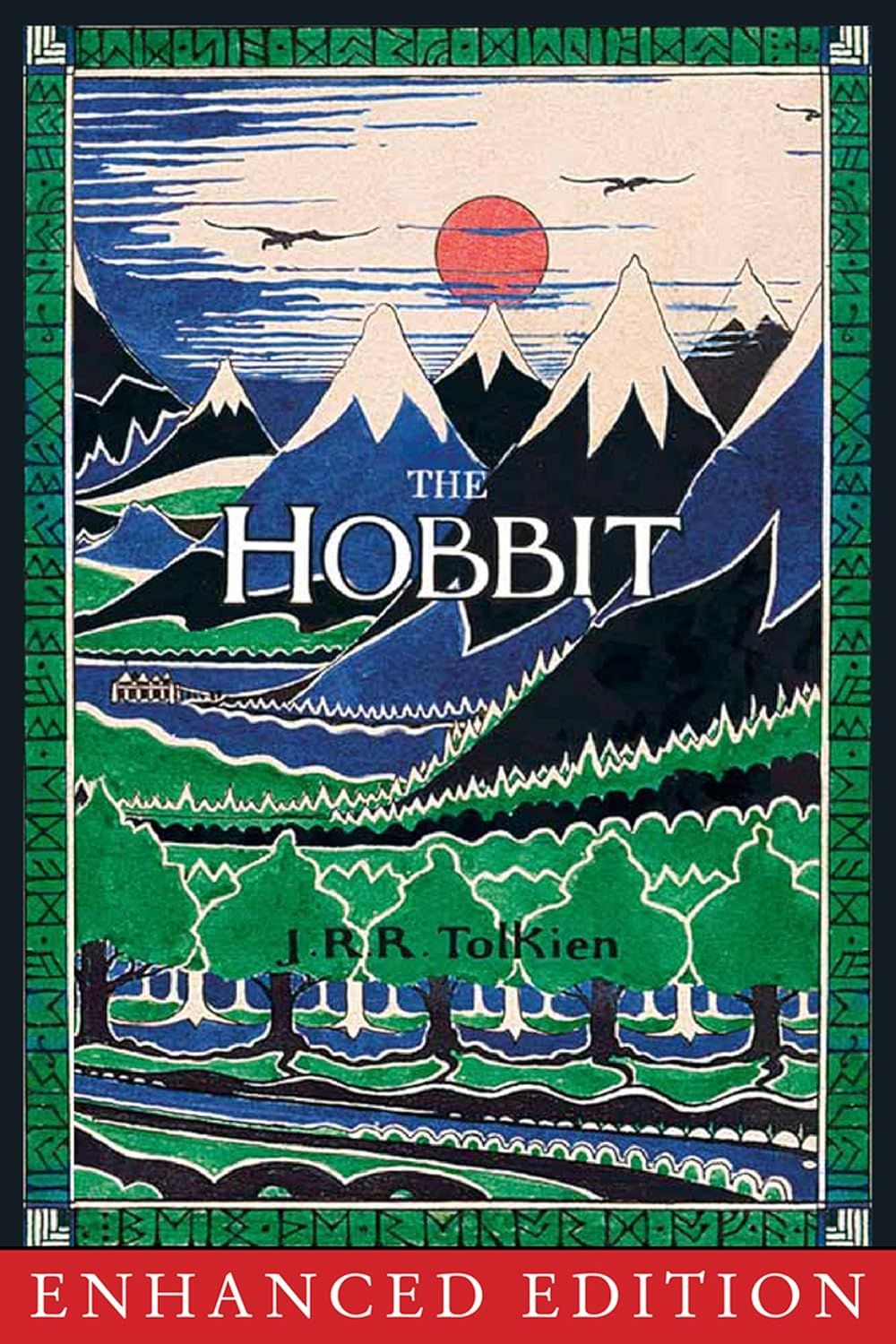
The Hobbit, or There and Back Again is a children's high-fantasy novel by the English author J.R.R. Tolkien, first published on 21 September 1937 to wide critical acclaim. It was nominated for the Carnegie Medal and won a prize from the New York Herald Tribune for best juvenile fiction. Critics at the time likened it to Alice's Adventures in Wonderland. It is recognized as a classic in children's literature and is one of the best-selling books of all time, with over 100 million copies sold — and it has never been out of print [1][2].
The book introduced Tolkien's richly imagined world of Middle-earth in its Third Age and served as a prologue to The Lord of the Rings [2:1].
Origins & Writing
The story originated from bedtime stories Tolkien told his children and was formally composed between 1926 and 1930 [3]. The manuscript was eventually read by a former student who recommended it to the publisher George Allen & Unwin. The firm's chairman, Stanley Unwin, gave the manuscript to his 10-year-old son Rayner to review — Rayner's positive report ("a good book and should appeal to all children between the ages of 5 and 9") helped convince the publisher to accept it [1:1].
The book combines elements of ancient Anglo-Saxon and Scandinavian epics with the familiar setting of rural England [2:2]. Tolkien took the names of Gandalf and 12 of the 13 dwarves (excluding Balin) from the Old Norse poem Völuspá [4].
The Plot
The Unexpected Party
The wizard Gandalf tricks the home-loving hobbit Bilbo Baggins into hosting a party for Thorin Oakenshield and his band of twelve dwarves. They go over their plans to reclaim their ancient home, the Lonely Mountain (Erebor), and its vast treasure from the dragon Smaug. Gandalf unveils Thror's map showing a secret door into the Mountain and proposes that a dumbfounded Bilbo should serve as the expedition's "burglar." The dwarves ridicule the idea, but Bilbo, indignant, sets off with them [1:2].
Over the Misty Mountains
The group travels into the wild. Gandalf saves the company from trolls and leads them to Rivendell, where Elrond reveals more secrets from the map. When they attempt to cross the Misty Mountains, they are caught by goblins and driven deep underground. Gandalf kills the goblin king and rescues them, but Bilbo gets separated in the goblin tunnels.
Lost in the dark, Bilbo stumbles across a mysterious ring and then encounters Gollum, who engages him in a riddle-game. If Bilbo wins, Gollum will show him the way out; if he fails, his life is forfeit. With the help of the ring — which confers invisibility when worn — Bilbo escapes and rejoins the dwarves, greatly improving his reputation with them. The goblins and Wargs give chase, but the company are saved by eagles and rest in the house of the skin-changer Beorn [1:3][5].
Through Mirkwood
The company enters the dark forest of Mirkwood without Gandalf, who has other responsibilities. In Mirkwood, Bilbo comes into his own: he saves the dwarves from giant spiders and then from the dungeons of the Wood-elves (the Elvenking's halls). Nearing the Lonely Mountain, the travellers are welcomed by the human inhabitants of Lake-town (Esgaroth), who hope the dwarves will fulfil prophecies of Smaug's demise [1:4].
Smaug the Dragon
The expedition reaches the mountain and finds the secret door. The dwarves send a reluctant Bilbo inside to scout the dragon's lair. He steals a great cup and, while conversing with Smaug, spots a gap in the ancient dragon's armour. The enraged dragon, deducing that Lake-town has aided the intruders, flies off to destroy the town. A thrush overhears Bilbo's report of Smaug's vulnerability and tells a Lake-town resident named Bard. Smaug wreaks havoc on the town until Bard shoots an arrow into the chink in Smaug's armour, killing the dragon [1:5].
The Battle of Five Armies
When the dwarves take possession of the mountain, Bilbo finds the Arkenstone — the most-treasured heirloom of Thorin's family — and secretly pockets it. The Wood-elves and Lake-men request compensation for Lake-town's destruction and settlement of old claims on the treasure. When Thorin refuses, they besiege the mountain. Thorin sends for his kinfolk in the Iron Hills, and his cousin Dáin Ironfoot marches with an army of dwarf warriors.
Bilbo slips out and gives the Arkenstone to the besiegers, hoping to head off a war. When they offer the jewel to Thorin in exchange for treasure, Bilbo reveals how they obtained it. Thorin, furious at what he sees as betrayal, banishes Bilbo. Battle seems inevitable — but Gandalf reappears to warn all of an approaching army of goblins and Wargs. The dwarves, men, and elves band together, and only with the timely arrival of the eagles and Beorn (fighting in his bear form, who kills the goblin general) do they win the climactic Battle of Five Armies. Thorin is fatally wounded and reconciles with Bilbo before he dies [1:6].
Home Again
Bilbo returns home about a year and a month after he first left, now a wealthy hobbit (with his share of the treasure), and years later writes the story of his adventures [1:7].
Key Characters
| Character | Race / Role | Description |
|---|---|---|
| Bilbo Baggins | Hobbit | The protagonist; a home-loving, unadventurous hobbit who transforms into a courageous, resourceful hero over the course of his journey [6]. |
| Gandalf the Grey | Wizard | Enlists Bilbo as the expedition's "burglar"; guides and rescues the company through the early and late stages of the journey [6:1]. |
| Thorin Oakenshield | Dwarf | The proud, stubborn leader of the Company of Dwarves; heir to the throne of the Lonely Mountain. His greed for the Arkenstone nearly leads to tragedy, but he reconciles with Bilbo before dying [7][8]. |
| Smaug | Dragon | The great dragon who seized the Lonely Mountain and its treasure long ago; cunning, vain, and deadly. Killed by Bard's arrow [7:1]. |
| Gollum | Hobbit (corrupted) | A wretched, ring-obsessed creature living alone under the Misty Mountains; engages Bilbo in the famous riddle-game. His origins remain mysterious in The Hobbit, but he sets the stage for The Lord of the Rings [9]. |
| Bard | Man (Lake-town) | A bowman of Lake-town, descendant of the rulers of Dale; slays Smaug with a single black arrow [7:2]. |
| Elrond | Half-elven | Lord of Rivendell; deciphers the moon-letters on Thror's map [7:3]. |
| The Elvenking (Thranduil) | Elf | King of the Wood-elves of Mirkwood; imprisons the dwarves, later fights alongside them at the Battle of Five Armies [7:4]. |
| Beorn | Skin-changer | A fierce man who can take the form of a great bear; shelters the company and turns the tide of the Battle of Five Armies [1:8]. |
| Thorin's Company | Dwarves | The twelve other dwarves: Dwalin, Balin, Kíli, Fíli, Dori, Nori, Ori, Óin, Glóin, Bifur, Bofur, and Bombur [4:1]. |
References
- The Hobbit - Wikipedia (57%) ↩︎ ↩︎ ↩︎ ↩︎ ↩︎ ↩︎ ↩︎ ↩︎ ↩︎ ↩︎ ↩︎ ↩︎ ↩︎ ↩︎ ↩︎ ↩︎ ↩︎
- The Hobbit (novel by J.R.R. Tolkien) | Summary & Analysis | Britannica (9%) ↩︎ ↩︎ ↩︎
- Bilbo Baggins | Hobbit, Middle-earth, Adventure | Britannica (3%) ↩︎ ↩︎
- List of The Hobbit characters - Wikipedia (3%) ↩︎ ↩︎
- The Hobbit: Full Book Summary | SparkNotes (5%) ↩︎
- The Hobbit Characters - eNotes.com (4%) ↩︎ ↩︎
- The Hobbit: Character List | SparkNotes (7%) ↩︎ ↩︎ ↩︎ ↩︎ ↩︎
- Thorin Oakenshield - Wikipedia (2%) ↩︎
- Gollum Character Analysis in The Hobbit | SparkNotes (3%) ↩︎
- Dive deep into J. R. R. Tolkien's The Hobbit with extended analysis... (5%) ↩︎ ↩︎
- The History of The Hobbit - Wikipedia (1%) ↩︎
Here are detailed chapter-by-chapter summary of The Hobbit:
Chapter 1: An Unexpected Party
Bilbo Baggins is a hobbit who lives comfortably in his underground home, Bag End, in the Shire village of Hobbiton. He has no interest in adventures — respectable hobbits don't go on them. One morning, the old wizard Gandalf appears at his door, looking for someone to join an adventure. Bilbo panics, wishes him good day, and ducks back inside — but not before impulsively inviting Gandalf to tea the next day 2.
The next afternoon, Gandalf arrives — and so, in rapid succession, do thirteen dwarves, led by Thorin Oakenshield(the others: Dwalin, Balin, Kíli, Fíli, Dori, Nori, Ori, Óin, Glóin, Bifur, Bofur, and Bombur). They take over Bilbo's home, devour his larder, and then get down to business. Thorin explains their quest: long ago, the dwarves of his royal line lived prosperous in the Lonely Mountain (Erebor) until the great dragon Smaug attacked, drove them out, and claimed their vast hoard of gold. The company plans to reclaim the Mountain and its treasure from Smaug 1.
Gandalf unveils Thror's map, showing a secret door into the Mountain, and reveals a key to go with it. The dwarves propose that a dumbfounded Bilbo should serve as the expedition's "burglar." They offer him one-fourteenth of the treasure in return. The dwarves ridicule the idea that this soft hobbit could be useful, but Bilbo, stung by their mockery, is roused by a hidden adventurous streak (the "Tookish" side of his nature) and, after a night of strange dreams, sets off with them the next morning 1.
Key details: Bilbo's quiet life is turned upside-down; the contrast between his cozy English-style existence and the mythological quest ahead is established. Bilbo doesn't explicitly consent but is swept along by Gandalf's manipulation and his own buried longing for adventure.
Chapter 2: Roast Mutton
Bilbo rushes to the local tavern (the Green Dragon Inn) to meet the company, and they set off into the wild. Shortly after, Gandalf mysteriously disappears. It rains. In the distance, the dwarves spot a light, and Bilbo is sent to investigate — his first real test as "burglar" 3.
Bilbo finds three trolls — Tom, Bert, and William — roasting mutton around a fire. He tries to pick a pocket but is caught. The trolls then capture all the dwarves one by one as they come looking for Bilbo. The trolls argue about how to cook their captives. Gandalf returns and secretly mimics the trolls' voices, keeping them bickering until dawn breaks— and sunlight turns the trolls to stone (trolls cannot survive daylight) 1.
The company frees itself and discovers the trolls' hoard in a cave — gold and two ancient, beautiful Elvish swords: Gandalf takes Glamdring ("Foe-hammer") and Thorin takes Orcrist ("Goblin-cleaver"). Bilbo finds a small Elvish knife that serves him as a sword (later named Sting) 1.
Key details: This is Bilbo's first real encounter with danger; he proves out of his depth but Gandalf saves the day. The magic swords will recur throughout the story.
Chapter 3: A Short Rest
The company travels on to Rivendell, the Last Homely House east of the Sea, home of the elf-lord Elrond Half-elven. They rest there and are treated with Elvish hospitality. Gandalf and Elrond examine Thror's map more closely 1.
Elrond discovers "moon-letters" on the map — secret runes that can only be read when the moon shines behind them at the right time. They read: "Stand by the grey stone when the thrush knocks and the setting sun with the last light of Durin's Day will shine upon the key-hole." Durin's Day is the dwarves' New Year, the day of the last moon of autumn. This reveals the secret of how to find and open the secret door into the Lonely Mountain 1.
Key details: A quieter, more contemplative chapter. Rivendell is a place of safety and wisdom. Elrond's decoding of the map gives the quest a crucial piece of the puzzle — they now know when the secret door will open.
Chapter 4: Over Hill and Under Hill
Gandalf leaves the company again as they attempt to cross the Misty Mountains. A terrible storm strikes; they see stone giants hurling rocks in the high passes and are forced to take shelter in a cave. Fili and Kili, the youngest dwarves, find what they think is a safe dry cavern 1.
In the night, goblins emerge from a crack in the cave wall and capture Bilbo and all the dwarves (Gandalf escapes). They are dragged down into Goblin-town and brought before the Great Goblin, who is enraged to see Thorin carrying Orcrist, a famous goblin-cleaving sword. Just as the goblins are about to attack, Gandalf reappears, extinguishes the lights with a magical flash, and kills the Great Goblin. He leads the company in a desperate escape through the tunnels 1.
In the chaos of the flight, a goblin seizes Dori, who is carrying Bilbo on his back. Bilbo falls from Dori's shoulders, bumps his head on the hard rock, and loses consciousness — becoming separated from the entire group 1.
Key details: The goblin swords Glamdring and Orcrist are revealed to have special anti-goblin properties. This chapter marks Bilbo's separation from the group, setting up the pivotal encounter in Chapter 5. Gandalf's repeated departures and returns become a recurring pattern.
Chapter 5: Riddles in the Dark
Bilbo wakes up alone in total darkness, deep in the goblin tunnels. Feeling around, he finds a small metal ring on the ground and pockets it without thinking 1.
Wandering by an underground lake, he encounters Gollum — a small, slimy, pitiable yet dangerous creature who lives alone on an island in the dark, eating fish and stray goblins. Gollum proposes a riddle-game: if Bilbo wins, Gollum will show him the way out; if Bilbo loses, Gollum will eat him. They trade a series of classic riddles (the wind, teeth, time, dark, fish, eggs, etc.) until Bilbo, unable to think of a riddle, blurts out "What have I got in my pocket?" — technically not a riddle. Gollum guesses three times and fails. Bilbo wins 1.
But Gollum, having lost, says he must first go back to his island to fetch something — a magic ring of invisibility — which he intends to use to kill Bilbo anyway. When Gollum discovers the ring is missing, he realizes Bilbo has it and flies into a rage. Bilbo, fleeing, slips the ring on his finger and discovers by accident that it makes him invisible. Gollum rushes past him, thinking Bilbo is heading for the exit. Bilbo follows Gollum to the goblin-guarded gate, then leaps over Gollum (in one version) and squeezes past the goblin guards using the ring's invisibility, escaping to the eastern slopes of the Misty Mountains where he reunites with Gandalf and the dwarves, who are now impressed by his resourcefulness 1.
Key details: This is one of the most famous and important chapters in all of fantasy literature. It introduces the One Ring(its full significance only revealed in The Lord of the Rings) and Gollum, who becomes a central figure in the sequel. In the original 1937 edition, Gollum willingly bet his ring and showed Bilbo the way out; Tolkien rewrote this chapter in 1951 to align with the Ring's sinister importance in The Lord of the Rings.
Chapter 6: Out of the Frying-Pan into the Fire
Bilbo emerges from the goblin tunnels into the open air on the east side of the Misty Mountains. He has somehow found his way back to the other side of the goblins' front gate. After some searching, he follows the sound of dwarvish conversation and finds Gandalf and the company. Bilbo keeps the Ring secret — he tells them he simply "slipped past" the goblin guards, which only deepens their newfound respect for him. He privately begins to worry about how to use the Ring — it seems to help, but he doesn't fully understand it .
The company is still not safe. Wargs — large, evil wolves — gather in the clearing for a meeting with goblins. Bilbo and the dwarves climb trees to escape, but the Wargs set fires at the bases of the trees, threatening to burn them out or smoke them to death. The Lord of the Eagles of the Misty Mountains sees the commotion and, curious (and no friend of goblins or Wargs), leads a flock of giant eagles to rescue them. The eagles carry the entire company to their eyrie atop a high peak. There the company rests, and the eagles agree to carry them further the next morning .
Key details: Bilbo's star continues to rise; he is now thought of as genuinely useful. The title's idiom ("out of the frying-pan into the fire") captures the serial-escape structure. The eagles will return as crucial allies in the Battle of Five Armies.
Chapter 7: Queer Lodgings
The eagles deposit the company on the Great Rock (the Carrock), a flat-topped stone in the middle of the River Anduin, the home territory of the skin-changer Beorn — a huge, fierce man who can take the form of a great black bear. Gandalf takes Bilbo with him to Beorn's hall, leaving the dwarves hidden, and introduces the group to Beorn in stages: he tells Beorn the story of their adventures so far (goblins, Wargs, eagles) and has a few dwarves arrive at intervals, each group "interrupting" the story, so Beorn becomes curious and amused rather than hostile. The trick works, and Beorn — who hates goblins — welcomes the whole company .
Beorn feeds and shelters them, and tells them of the perils ahead: the dark forest of Mirkwood is infested with goblins, Wargs, and monstrous creatures, and its once-great Elven-road is now dangerous and overgrown. He warns them not to stray from the forest path, not to drink from the enchanted stream, and to be on their guard against the Wood-elves, whose king is suspicious of strangers. Beorn provides the company with ponies, food, and water-skins, and lends them boats to cross the river. He also gives them cryptic advice about provisions and time .
Gandalf announces that he will leave the company at the edge of Mirkwood — he has other pressing business to attend to. The dwarves are dismayed; Bilbo is especially uneasy at the prospect of the forest without the wizard's protection. They reach the Old Forest Road gate and enter Mirkwood .
Key details: Beorn is a key figure whose power (as a bear) will be decisive later. The warnings about Mirkwood (stay on the path, don't drink the stream, beware the Wood-elves) function as classic taboo instructions that the company will proceed to violate one by one. Gandalf's departure forces Bilbo into a leadership role.
Chapter 8: Flies and Spiders
The company enters Mirkwood and the path quickly becomes dark, oppressive, and disorienting. The air is thick with unpleasant darkness — the forest is gloomy, silent, and ancient. After days of marching, they come to the Black Stream(the Enchanted River), dark and forbidding, and Beorn's warning echoes: do not drink from it or fall in. Bombur, the fattest dwarf, slips and falls in. They pull him out with a boat and rope, but Bombur has been enchanted: he falls into a deep, dream-filled sleep and cannot be roused for days, forcing the others to carry his dead weight.
The company struggles on, their food running low, carrying the sleeping Bombur. Eventually, to their great relief, Bombur wakes up — but he has had vivid, beautiful dreams of feasting in the Elvenking's halls and has forgotten much of their journey. He refuses to believe the harsh reality.
Soon after, the company sees lights off the path through the trees — they think they are Elven feasts. Despite Gandalf's and Beorn's warnings, Balin and then others leave the path to investigate. Each time they approach, the lights vanish, and the company gets lost. After repeated tries, they lose the path entirely and become separated.
Giant spiders attack. Bilbo, dozing separately, wakes to find himself bound in spider-web. He frees himself with his sword (which he now names Sting), kills a spider, and then — using the Ring to become invisible — taunts and confuses the spiders, throwing stones to draw them away from the dwarves, who are cocooned in the trees. He eventually leads the spiders off and frees the dwarves. They fight a desperate battle against the swarm of spiders; at one point Bilbo risks his life to distract them so the dwarves can escape. The company drives the spiders off with stones and their Elvish swords .
Bilbo reveals to the dwarves the existence of the Ring — though he keeps the full truth of how he got it to himself. The dwarves are now thoroughly impressed with him: his courage and cleverness have saved them all. But during the chaos they discover that Thorin is missing .
Key details: This is the chapter where Bilbo truly comes into his own as a hero. He names his sword (a ritual of growth), uses the Ring strategically, and risks his life for the dwarves — all without Gandalf. The repeated violation of the "stay on the path" taboo leads to disaster, as Beorn warned. The naming of Sting echoes the naming of ancient heroes' swords in Norse saga.
Chapter 9: Barrels Out of Bond
The dwarves realize Thorin is missing. Unknown to them, Thorin was taken by the Wood-elves (Silvan Elves of Mirkwood, whose king is Thranduil, called simply "the Elvenking"). The Wood-elves are suspicious of dwarves — the old enmity between the two races is mentioned — and Thorin, proud and guarded, refuses to explain his quest, so the Elvenking imprisons him in his underground halls.
The lost dwarves, still trying to find the path, are also captured by the Wood-elves (spotted by the Elvenking's hunters). Like Thorin, they refuse to explain their business, so they too are locked up — each in a separate cell. Bilbo, however, is not captured because he wears the Ring and stays invisible. He follows the elves back to their halls, and now must figure out how to rescue the entire company.
Bilbo spends weeks lurking invisibly in the Elvenking's halls, learning its layout, eavesdropping, and growing increasingly miserable — his situation is desperate. He eventually finds Thorin and the other dwarves in their cells and uses his invisibility to communicate with them, bringing them messages and keeping up their spirits.
He discovers that the Elvenking's halls have a river-gate: a trapdoor opening onto the Forest River, which flows under the caves and out to Lake-town (Esgaroth) on the Long Lake. The elves use this route to send empty barrels of wine and other goods downstream to their trading partners in Lake-town. Bilbo hatches a plan: he will smuggle the dwarves inside empty barrels, which the elves will float down the river to Lake-town.
Bilbo steals the keys from the Elvenking's butler (who has fallen into a drunken sleep — Bilbo also takes the opportunity to sample the elves' excellent wine). He frees the dwarves and helps them climb inside empty barrels. When the elves roll the barrels to the trapdoor and push them into the river, Bilbo clings to the outside of the last barrel (he doesn't fit inside) and rides the current. The cold, wet, uncomfortable journey carries them down the Forest River, through a series of rapids and past an elf-guard station, out onto the Long Lake. There they are found by men from Lake-town and pulled ashore .
Key details: This chapter mirrors the first chapter's title ("An Unexpected Party") — it is Bilbo's second unexpected "party", but now he's the orchestrator. Bilbo does the entire rescue alone, using only the Ring and his own wits — no Gandalf at all. His heroism is now beyond doubt. The dwarves are bruised, battered, and half-drowned but free. The long, patient lurking in the Elvenking's halls echoes the patience of classic fairy-tale heroes.
Chapter 10: A Warm Welcome
The barrels are pulled ashore at Lake-town (Esgaroth), a settlement built entirely on pilings over the Long Lake — a town of wooden platforms and bridges, reachable only by boat or the great wooden bridge to the shore. The town is governed by a Master and its people are descendants of the men who once lived in Dale, the town near the Lonely Mountain that Smaug destroyed. They have long lived in the shadow of the dragon and their prosperity has faded, but old prophecies of the dwarves' return and Smaug's fall are still remembered among them.
Bilbo frees the half-drowned dwarves from the barrels (Thorin is with the others now, having been released from his cell earlier as part of the escape). The company is taken to the Master of Lake-town. At first the townspeople don't quite believe this ragged, wet group could be the fulfillment of prophecy. But Thorin announces himself — "I am Thorin son of Thrain son of Thror, King under the Mountain!" — and speaks of the return of the King under the Mountain and the recovery of the dwarves' gold and the fall of Smaug. The people are overjoyed: songs and prophecies of the King's return and the dragon's death have been handed down for generations. The Master, a canny politician, sees which way the wind is blowing and welcomes the company with feasting and lodging.
The company spends about a fortnight in Lake-town, recovering and resupplying. They are treated as heroes and the town buzzes with excitement. But as the time to depart draws near, the mood shifts: the mountain looms closer, and the dragonwith it. The townspeople fall silent and somber; some even question whether the dwarves can really do what they claim. The Master provides the company with horses, ponies, boats, and provisions for the final leg of the journey to the Lonely Mountain. They travel by boat up the River Running and then overland to the foot of the Mountain.
Key details: Lake-town is a fully realized secondary-world settlement with its own politics (the Master is self-serving, the people are hopeful but superstitious). The chapter's title — "A Warm Welcome" — is gently ironic: the welcome is warm at first, but as the dragon looms, the mood cools. The people of Lake-town will be central to the story's climax (it is Bardof Lake-town who will slay Smaug).
Chapter 11: On the Doorstep
The company leaves Lake-town and travels to the Lonely Mountain (Erebor). They reach the ruins of Dale, the old town of Men at the mountain's foot, destroyed by Smaug long ago. The desolation around the mountain — the scorched, barren land — deeply affects them, and the dwarves' spirits sink .
They search the mountainside for the secret door shown on Thror's map. After much effort, they find a flat, smooth patch of rock high on the western slopes that could be the door, but there is no keyhole and no way to open it. They also discover the old main gate — the great entrance the dwarves once used — but it is open and dark, and a dreadful smell of dragon drifts out. None dare enter that way .
The company camps on the "doorstep" (the ledge before the secret door) and waits. They try various ways to open the door — pushing, picking at the rock, using tools — but nothing works. They realize they must wait for Durin's Day, as the moon-letters said, when the last light of the setting sun on that specific day will reveal the keyhole. They wait anxiously, watching the sky and calendar, running out of patience .
Key details: The barren "Desolation of Smaug" powerfully evokes the dragon's destructive reach. The chapter builds tension around the puzzle of the door — a mythic "locked gate" problem that cannot be solved by force, only by patience and the right moment.
Chapter 12: Inside Information
The dwarves wait on the doorstep. One evening, a thrush (a bird) lands on the grey stone by the door and begins tapping at it with a snail. Bilbo, remembering the moon-letters ("when the thrush knocks"), is struck by the coincidence. As the sun sets on Durin's Day, a single shaft of last light strikes the flat rock — and a keyhole appears. Thorin quickly inserts the key, turns it, and the secret door opens .
The door opens, but the mountain passage beyond is dark and terrifying. The dwarves send Bilbo inside alone — he is the burglar, after all. Bilbo descends the tunnel toward the great hall at the mountain's heart. He enters the enormous Hall of Thrór and finds Smaug — a vast red-gold dragon, lying on a colossal heap of gold, jewels, and armor, asleep. Overcoming his terror, Bilbo creeps forward and snatches a large two-handled gold cup from the hoard, then escapes back up the tunnel unnoticed .
The dwarves are thrilled at this proof of Bilbo's burglary. But when Smaug awakens and discovers the cup missing, he is enraged. He surmises that Men from Lake-town have aided the thief, and that night he attacks the mountain's outer slopes in a fury, catching the company by surprise. The dwarves and Bilbo barely manage to shelter in the secret tunnel; Smaug smashes the mountainside but cannot reach them .
Bilbo descends again for a second look. This time Smaug is awake, and Bilbo — wearing the Ring — has a remarkable conversation with the dragon. Smaug smells him but cannot see him. Bilbo engages in clever wordplay, flattery, and riddle-talk, introducing himself with grandiose titles ("Barrel-rider," "Lucky number," "He that walks unseen"). Smaug is amused and vain, and Bilbo learns key information:
- Smaug knows the dwarves' quest and mocks their chances, pointing out that the dwarves (apart from Bilbo's "burglary") have accomplished nothing on their own .
- Smaug reveals that the mountain's undergate (a lower entrance) is sealed and that the only way in or out is the main gate (which Smaug guards) and the secret door .
- Most importantly, Bilbo, observing Smaug as the dragon turns, spots a bare patch on the dragon's left breast — a single place where a scale is missing, leaving Smaug's underbelly exposed at that spot .
Bilbo returns up the tunnel and tells the dwarves what he has seen. At Balin's urging, he also tells them of Smaug's taunts about the dwarves' uselessness. Thorin is stung by the dragon's mockery and defends his father's and grandfather's honor. The old thrush is sitting nearby and appears to be listening. Smaug, meanwhile, deduces that Lake-town has helped the intruders (from Bilbo's Barrel-rider remark) and flies off in a rage to attack and destroy Lake-town .
Key details: The conversation with Smaug is one of the book's most celebrated scenes — a duel of wits. Bilbo's discovery of the dragon's weak spot is the Chekhov's gun that will bring about Smaug's death. The thrush, established in the moon-letters, reappears as a plot-critical listener. This chapter gives "inside information" in both senses — information gained inside the mountain, and the vulnerability in Smaug's armor.
Chapter 13: Not at Home
With Smaug gone (having flown to attack Lake-town), the Hall of Thrór is unguarded. Bilbo and the dwarves debate what to do; eventually Bilbo descends again, with Balin following partway. The great hall is dim, lit only by a faint glow from the hoard. Smaug is not at home.
Bilbo makes his way to the heart of the treasure and finds the Arkenstone — the Heart of the Mountain, a great jewel that was the most prized heirloom of Thorin's royal line. He pockets it, without telling the others, rationalizing that as the burglar he may choose his own share. (He also claims to have it as "his share," intending perhaps to use it later to bargain for peace .)
The dwarves venture down into the hall, marveling at the vast treasure — armor, weapons, gems, gold. Thorin gives Bilbo a coat of mithril mail — a Dwarf-made shirt of a wondrous silver-steel, extraordinarily light and strong. (This mithril coat will later save Frodo's life in The Lord of the Rings.) Each dwarf arms himself with fine weapons and mail from the hoard .
They hear rumblings — the mountain itself seems restless — and decide they should leave the underground hall. They arm themselves, then exit by the main gate, stepping out into the daylight for the first time in days. They are free of the mountain, but they are also exposed on the mountainside with no idea where Smaug has gone or when he will return. They move camp to a safer hollow and debate their next move, unaware of the drama unfolding at Lake-town .
Key details: Bilbo's secret taking of the Arkenstone is a pivotal moral moment — he begins to act on his own judgment, setting the stage for his later peace-making attempt. The mithril coat is a famous piece of Tolkien lore. The chapter's title — "Not at Home" — is dryly ironic: the dragon's absence is the dwarves' opportunity, but also the prelude to the crisis at Lake-town.
Chapter 14: Fire and Water
The narrative shifts to Lake-town (Esgaroth). Smaug arrives in the night, blazing with fury, and attacks the town. He descends upon the wooden city, setting it ablaze with dragon-fire. The townspeople flee in terror; the Master of Lake-town panics and tries to save himself. The town's bridges are burned, the people trapped on the burning platforms, and chaos reigns .
In the midst of the destruction, Bard — a grim-voiced Man of Lake-town, descended from Girion, the last Lord of Dale — takes command of the defense. Bard is a skilled bowman. A thrush lands on his shoulder and speaks to him (Bard can understand the language of birds, being of the line of Dale). The thrush tells him that it overheard Bilbo's report of the bare patch on Smaug's breast — the one place where a scale is missing .
Bard waits for his moment. As Smaug swoops down, his underbelly exposed, Bard draws his great black arrow — the last one he has, an heirloom passed down from his father's line. He aims for the bare patch on Smaug's left breast and shoots. The arrow strikes true, burying itself in the dragon's heart. Smaug screams, crashes down upon the burning town, and dies. His fall destroys what remains of Lake-town, and his body sinks beneath the waters of the Long Lake .
Bard survives and is hailed as a hero. The survivors of Lake-town gather on the western shore, cold and homeless. The Master tries to shift blame to the dwarves ("It was those dwarves who woke the dragon!"), and many people, in their grief and anger, are inclined to agree. Bard, however, speaks for justice: the dwarves did not wake the dragon out of mere greed — Smaug was an ancient evil — and the Lake-men's own hopes and prophecies had invited the quest. Bard proposes that they march to the Mountain to claim part of the treasure, both as rightful share (Smaug had stolen from Dale and Lake-town's ancestors too) and to rebuild their town. He also sends messengers to the Elvenking (Thranduil) of Mirkwood, asking for aid .
Meanwhile, the Elvenking, who had learned of the dwarves' journey and the dragon's death, sets out toward the Mountain with an army of Wood-elves — partly to claim treasure, partly out of longstanding interest in the mountain's hoard, and partly (as he frames it) to see if the dwarves have survived. The Lake-men and the Wood-elves join forces and march together toward the Lonely Mountain, expecting to find the dwarves dead and the treasure unguarded .
Key details: This chapter breaks from Bilbo's point of view entirely — it is told from the perspective of the Lake-town people, making it one of the book's most cinematic chapters. Bard's black arrow and the thrush's message pay off the setup from Chapter 12. Smaug's death — the climax the quest has been building toward — happens off-stage from Bilbo's perspective, emphasizing the larger world beyond the hero's own story. The seeds of the conflict over the treasure (Men + Elves vs. Dwarves) are sown here, driving the final chapters.
Chapter 16: A Thief in the Night
The siege drags on. Thorin continues to refuse negotiation, and Bilbo grows increasingly miserable and troubled by the looming prospect of battle — especially since Dáin Ironfoot's dwarf army is only a day or two away, which would likely trigger a bloody three-way conflict .
Bilbo decides to take matters into his own hands. He waits for nightfall, puts on the Ring, and slips out of the mountain through the secret door. He goes to the camp of the Elvenking and Bard, where he is received with surprise and courtesy. He asks to speak with Bard and the Elvenking (Thranduil) privately.
Bilbo produces the Arkenstone — the Heart of the Mountain, which he had secretly pocketed in Chapter 13 — and hands it over to Bard and the Elvenking. He explains that the Arkenstone is the most treasured jewel in the hoard and that Thorin values it above a river of gold. By giving it to Bard, Bilbo is arming the Men and Elves with a powerful bargaining chip: they can offer to trade the Arkenstone back to Thorin in exchange for a fair share of the treasure. Bilbo explicitly says he is giving them this leverage to help secure peace .
Bilbo also reveals that the Arkenstone was technically his to give — under the terms of the contract, he was promised a fourteenth share of the treasure, and he reasons that the Arkenstone could count as his share. (This is a moral stretch, but Bilbo accepts the risk.) Bard and the Elvenking are impressed by Bilbo's courage and integrity. The old thrush, which has been present, flies off — Bilbo asks it to tell Dáin what has happened, hoping to give the approaching dwarves context .
As Bilbo prepares to return, Gandalf unexpectedly appears in the camp — he has returned at last. Gandalf praises Bilbo's action (though he hints that things may yet turn out differently than Bilbo expects). Bilbo, greatly heartened by Gandalf's presence, returns to the mountain under cover of invisibility and creeps back inside without the dwarves knowing he was gone .
Key details: This is the moral climax of Bilbo's personal arc. He risks Thorin's wrath and his own share of the treasure to prevent a war — a striking act of moral courage that contrasts with Thorin's growing dragon-sickness. The Arkenstone, which Bilbo took secretly, is now used selflessly. Gandalf's reappearance signals that larger forces are at work.
Chapter 17: The Clouds Burst
At dawn, Bard approaches the gate of the mountain with the Arkenstone and displays it, asking Thorin to parley. Thorin is stunned and furious to see his family's greatest heirloom in the hands of his enemies. He demands to know how they got it. Bard (at Bilbo's prior request) does not reveal Bilbo's role directly, but Bilbo steps forward and admits that he gave them the stone — that it was his to give as his share .
Thorin is enraged. He calls Bilbo a traitor and a thief, curses him, and — in his fury — casts Bilbo out of the company, telling him to go and never return. He offers to pay Bard and the Elvenking a price for the Arkenstone in gold (effectively buying it back), but only if they then leave. Bard and Thranduil agree to wait while the payment is gathered .
Just as a tense, fragile arrangement seems to be forming, a messenger arrives with urgent news: Dáin Ironfoot's armyhas reached the valley of Dale and is approaching the mountain. The Men and Elves must either stand and fight or abandon their claim. Bard and the Elvenking send an envoy to Dáin, asking him to halt and parley, offering to let him pass to the gate if he will first trade fairly for the Arkenstone. Dáin refuses — he will not bargain with armed Men and Elves blocking his way .
Dáin's dwarves charge. The Men and Elves prepare to meet them. The two sides are on the brink of a devastating battle when, suddenly, Gandalf appears between the armies, standing on a high rock, and calls for a halt. He announces that a new and greater danger has arrived: the goblins and Wargs of the Misty Mountains, enraged by the death of the Great Goblin (killed in Chapter 4) and learning of Smaug's fall, have gathered in vast numbers under a new leader, Bolg, son of Azog. They are marching on the mountain to seize the treasure for themselves .
The Battle of Five Armies begins. The dwarves, Men, and Elves join together against the common foe. The first day goes badly for the allies: they are pushed back into the valley of Dale, and though they fight valiantly, the goblins and Wargs are overwhelming in number. Night falls, and the allies retire to the slopes of the mountain, battered and anxious. Bilbo, wearing the Ring, stays near Gandalf and the Elvenking, watching the carnage in horror from a distance .
Key details: The title — "The Clouds Burst" — marks the eruption of the conflict that has been building since Chapter 15. Thorin's fury at Bilbo is the emotional nadir of their relationship, and Bilbo's banishment is the price of his conscience. Gandalf's timely intervention transforms a senseless war over gold into a unified defense against evil — a moral reframing of the entire conflict. The goblins' motivation ties back to Chapter 4, giving the story a satisfying causal loop.
Chapter 18: The Return Journey
At dawn, Bilbo is on the slopes of the mountain with the Elvenking's forces when he sees a great host of eaglesapproaching. He cries out — "The Eagles! The Eagles are coming!" — but is struck by a stone (or, in some readings, by a falling rock) and loses consciousness before the battle's end .
When Bilbo wakes, he is carried off the field. The Battle of Five Armies is over: the goblins and Wargs have been defeated. The eagles and Beorn (in bear form) arrived in time to turn the tide — Beorn himself killed Bolg, the goblin leader, breaking the enemy host .
Bilbo is brought to a tent where Thorin Oakenshield lies dying. Thorin has been mortally wounded in the battle. In a deeply moving scene, Thorin reconciles with Bilbo: he apologizes for his anger and his greed, acknowledges that Bilbo was right to seek peace, and says: "If more of us valued food and cheer and song above hoarded gold, it would be a merrier world." Bilbo weeps. They part as friends, and Thorin dies .
Bilbo learns the other casualties: Fíli and Kíli, Thorin's young nephews, died defending him. The other dwarves survived. Dáin Ironfoot becomes the new King under the Mountain, and the treasure is divided fairly — Dáin gives a generous share to Bard (for the rebuilding of Lake-town and Dale) and to the Elvenking, and he gives Bilbo's two small chests of gold and silver to Bilbo as his share (Bilbo refuses more) .
The Elvenking hosts a farewell feast and gives Bilbo the title "Elf-friend." Beorn also comes, and Bilbo stays a while at Beorn's house on the return journey. Gandalf accompanies Bilbo and the surviving dwarves on the long road westward. They pass through Mirkwood (now somewhat safer after the goblins' defeat) and reach Beorn's house, where they rest. Then they travel on, back over the Misty Mountains, and eventually arrive at the trolls' cave (from Chapter 2) where they had turned the trolls to stone — a moment of quiet circularity .
Key details: Thorin's deathbed reconciliation is one of the most emotionally powerful moments in the book, and his famous line about valuing "food and cheer and song above hoarded gold" is often cited as the moral heart of The Hobbit. The deaths of Fíli and Kíli (the youngest, most likable dwarves) give the victory a bittersweet cost. Bilbo takes only a modest share — further proof that he has grown beyond greed. The return journey mirrors the outward one, but everything is changed.
Chapter 19: The Last Stage
Bilbo and Gandalf travel westward together, eventually reaching Rivendell again, where they rest with Elrond for a time (a "short rest," mirroring Chapter 3). Elrond examines the map and the swords once more and tells Bilbo that the goblins of the Misty Mountains have been greatly reduced in power — a lasting good to come of the quest .
Bilbo and Gandalf then continue westward toward the Shire. As they approach Hobbiton, Bilbo sees smoke rising from his chimney — someone is in his home. He arrives at Bag End to discover that he has been presumed dead and that his relatives, the Sackville-Bagginses, are auctioning off his possessions. (Bilbo had been gone for over a year.) There is great commotion: Bilbo's sudden reappearance causes an uproar. He manages to halt the auction and recover most of his belongings, though some have already been sold, and the Sackville-Bagginses are resentful .
More importantly, Bilbo finds that his reputation in the Shire is permanently altered. Once a respectable, predictable hobbit, he is now regarded as "queer" — an eccentric who goes on adventures, has strange friends (wizards, dwarves, elves), writes poetry, and receives odd visitors. The respectable hobbits shake their heads, but Bilbo does not mind. He has his own pursuits: he writes his memoirs (the book that becomes The Hobbit, or "There and Back Again: A Hobbit's Holiday"), reads, writes, entertains occasional visitors, and lives a richer, if less conventionally respectable, life .
In the book's famous closing scene, Bilbo is at home one evening, smoking his pipe by the fire, when there is a knock at the door. It is Gandalf and Balín, who have come to visit. Balín tells Bilbo that Dale has been rebuilt under Bard's rule, that the area around the Mountain is flourishing again, and that the old prosperity has returned to the region. Bilbo says he is content. Gandalf looks at him and says, "My dear Bilbo! Something is the matter with you! You are not the same Hobbit that you were." Bilbo smiles, and the book ends on this quiet note of transformation .
Key details: The auction scene is a comic deflation of the epic — Bilbo's grand quest ends with a petty property dispute, underscoring the comic contrast between the epic world and the Shire. Bilbo's "queerness" in the Shire is the lasting mark of his adventure: he can never fully return to the old life, but he has gained something richer. Gandalf's final line names the theme of the entire book: Bilbo has changed — he has grown, matured, and become wiser and braver, even if the Shire cannot see it. The visit from Balín (who, notably, will later lead a doomed expedition to Moria in The Lord of the Rings) ties the ending to the wider legendarium. The book's last line, with Bilbo puffing contentedly on his pipe, is one of the most quietly satisfying endings in fantasy.
The End
And that completes the full chapter-by-chapter journey of The Hobbit — from an unexpected party in a comfortable hobbit-hole, through goblin tunnels and spider-infested forests, to a dragon's lair, a great battle, and finally back home again, where Bilbo discovers that the greatest treasure he has brought back is himself, transformed.