Time is not what you think
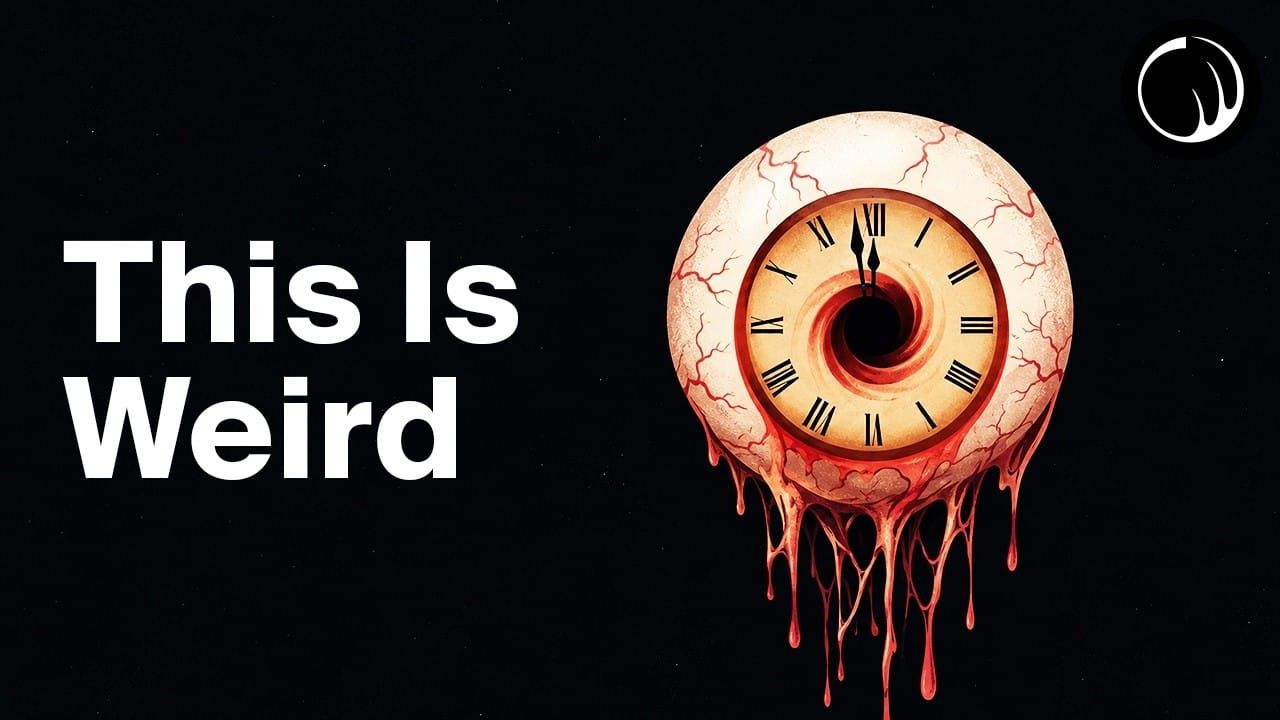
The video argues that time, as we experience and measure it, may not be a fundamental feature of reality. Its central question, posed repeatedly, is whether time was discovered or invented — and it suggests the answer may be invented (or at least constructed by consciousness), pointing to three converging lines of evidence: young children, early human cultures, and modern physics.
1. Children exist "outside" time
- Before roughly age 5–7, children have no real grasp of time: past and future, hours and months, clocks and deadlines are merely sounds, words or objects they don't yet comprehend.
- All they fully know is the present — a state the video calls existing "outside of time".
- Crucially, the video claims children may have a better sense of time's true nature than adults do.
The supporting study: Katharine A. Tillman and David Barner, Learning the Language of Time: Children's Acquisition of Duration Words (2015, Cognitive Psychology, 78, 57–77) [1] [2].
| Finding | Detail |
|---|---|
| What was tested | How children of different ages assign meaning to duration words (second, minute, hour, day, week, month, year) |
| Preschoolers | Can infer the ordering of time words, but have little to no knowledge of the absolute durations they encode |
| Key conclusion | "Associating words with the perception of duration does not come naturally to children" |
| How understanding emerges | Slowly, and only as children learn the formal definitions of the words |
| Implication | We are not born with an innate understanding of time; during our first 5–7 years, time is taught to us |
2. What is time, exactly?
The video notes that time cannot be seen, touched, tasted, smelled, grabbed, or steered; you can't turn directions in it, stop it, or control it. It quotes St. Augustine:
"For what is time? Who can readily and briefly explain this? Who can even in thought comprehend it so as to utter a word about it? What then is time? If no one asks me, I know. If I wish to explain it to one that asketh, I know not."
We observe nature unfolding in apparently one direction and call it time — but the video asks whether that is what time actually is.
3. "A time before time": task orientation vs time orientation
- The video posits that for hundreds of thousands of years, early humans lived without time as we understand it — not because they were cognitively inferior, and not because of superstition, but because there was no need for it.
- Anthropologists note that up to the industrial era, human schedules were shaped by natural necessity: hunting, gathering, harvesting, milking cows.
- Historians call this task orientation, as opposed to our time orientation.
Field research on Indigenous Amazonian cultures — a study of three cultures and languages of Brazil: Huni Kuĩ (Pano, north-west Amazonia), Awetý and Kamaiurá (Tupi-Guaraní, Xingu National Park) [3] [4]:
- Event-based systems of time reckoning
- No abstract words equivalent to "past" and "future"
- No conceptual timeline; life and activities organised around naturally unfolding events
- In Huni Kuĩ, past events are located in the heart, while future events and plans are located in the head/mind [5]
4. What modern physics says
Relativity (Einstein, early 20th century)
- Space and time are linked in a fabric-like structure, spacetime; mass and energy bend it, affecting the rate at which time passes.
- Time is relative to position and speed: it runs slower near massive objects and slower at higher speeds.
- Therefore everyone's clock ticks at a slightly different rate — driving, flying, running, walking, or even sitting still all shift it (by nanoseconds or fractions of nanoseconds, but the video insists that if time is real, nanoseconds are too).
- Consequence: there can be no single shared universal "now". We each inhabit our own slightly different vehicle of now.
The Andromeda paradox (Roger Penrose, 1989)
A thought experiment: you walk past a man standing still, and both of you look up at the Andromeda galaxy (about 2.5 million light-years away). Because of the relativity of simultaneity, the infinitesimal difference in your relative motion is magnified over that distance into days or even weeks. Assuming you walk towards Andromeda, the present moment in that galaxy in your frame is days later than in his.
- Terrifying implication: an alien decision or cosmic event in Andromeda could have already happened for you while still lying days in the future for him.
- Therefore past, present and future cannot be both relative and linearly, universally real.
"The distinction between past, present, and future is only a stubbornly persistent illusion." — Albert Einstein
The block universe theory
- The entire universe is one single geometric block; space, time and everything are contained in a fixed structure.
- Analogy: all pages of a book, or all frames of a film reel, exist simultaneously from start to finish.
- Moments are like coordinates; beings occupy different words on different pages. There is no special universal present moment.
The problem of time
- The Wheeler–DeWitt equation (John Wheeler and Bryce DeWitt), which attempts to unify quantum mechanics and general relativity, results in time disappearing from the equations.
- At the most fundamental level, time appears potentially not to exist, or at least not to be necessary.
- Physics retains time as a means of ordering and measuring causal structures, but discards it as the linear, consistent psychological passage we feel.
5. Why do we experience time at all?
- Change, motion and decay are not time. Memory and anticipation are not time either. None of these require time itself to be real.
- If our ancestors experienced change without time and physics can describe reality without time, then our modern experience of time may be a construction — an intermediate layer of perception overlaid by consciousness onto an increasingly complex world.
- As we built up tools, language, concepts, civilisation and technology, our mental models grew more complex. Time may be merely one such model.
- If so, ancient humans and modern children may be experiencing something more real — with fewer layers of perceptual distortion.
The Fall
- The oldest story in Western culture: humanity fell from blissful innocence into knowledge and conceptual awareness (Genesis — Adam, Eve and the Garden of Eden). Similar themes appear in Greek mythology, Hindu cosmological tradition and the Epic of Gilgamesh.
- The premise: humans once lived without awareness of themselves as separate from everything else. Through knowledge and/or the augmentation of consciousness, we became separate individuals with partitioned realities — and the world became a plurality of objects and phenomena in space and time.
- Modern philosophy echoes this, framing consciousness as a burden, mistake or overgrowth. Named: Arthur Schopenhauer, Søren Kierkegaard, Blaise Pascal, Emil Cioran, Peter Wessel Zapffe and Ernest Becker.
- Peter Wessel Zapffe's famous analogy: human consciousness is like the overgrown antlers of the Irish elk — evolution pushed the trait so far that the elk became weighed down and less agile, eventually contributing to extinction.
- Conclusion: we have fallen, and are perhaps still mid-fall; we cannot go back — not into childhood, not into history, not into ignorance.
6. Closing argument: stop fighting time
- Because of modern culture, technology and civilisation, we experience time much as we see physical space: as something real, fundamental and outside us, with which we have a relationship.
- The video critiques the dominant mentality: time as something to master, maximise, a resource — "time is the currency of life", "time is the most valuable commodity", "make the most of your time".
- If time is not even real in the way we experience it, what are we trying to maximise? Have we confused psychological prosperity with time maximisation?
- Suggested reframe: see time as a psychological function — real enough in important ways, but elusive in equal measure. It need not always be something to use, improve, maximise or beat.
- In moments of ceasing that struggle, we may recall a glimpse of "that bliss of childhood, of archaic human experience, of everything and nothing".
Citations and references mentioned in the video
| Reference | Detail as given in the video |
|---|---|
| Tillman, K. A., & Barner, D. (2015) | Learning the Language of Time: Children's Acquisition of Duration Words — verified as Cognitive Psychology, 78, 57–77 [1:1] |
| St. Augustine | Quotation on the nature of time ("If no one asks me, I know…") |
| Albert Einstein | Quotation on past, present and future as a "stubbornly persistent illusion" |
| Roger Penrose (1989) | The Andromeda paradox |
| John Wheeler & Bryce DeWitt | The Wheeler–DeWitt equation and the "problem of time" |
| Peter Wessel Zapffe | The Irish elk analogy for overgrown human consciousness |
| Other philosophers named | Schopenhauer, Kierkegaard, Pascal, Cioran, Becker |
| Amazonian field research | Huni Kuĩ, Awetý and Kamaiurá event-based time systems [3:1] |
| Religious/mythic sources | Genesis (Adam, Eve, Eden), Greek mythology, Hindu cosmology, Epic of Gilgamesh |
Key takeaways
- Time is not innate knowledge — it is taught to us between roughly ages 5 and 7.
- There may have been a "time before time": early humans organised life by tasks and events, not by clocks or calendars.
- Relativity removes the universal "now" — each of us has our own present moment.
- The Andromeda paradox and the block universe suggest the past, present and future all coexist.
- The Wheeler–DeWitt equation suggests time may vanish at the most fundamental level.
- Our experience of time may be a constructed mental model, layered over reality by consciousness.
- If so, the modern compulsion to "maximise" time may be misplaced.
Notes on the summary: sponsor content has been omitted. Transcript typos and mis-transcribed names have been corrected (e.g. "nancounds" → nanoseconds, "infantessimal" → infinitesimal, "Bla1 Pascal" → Blaise Pascal, "Saurin Kirkagard" → Søren Kierkegaard, "Emil Chiron" → Emil Cioran, "Peter Vessel Zapva/Zappa" → Peter Wessel Zapffe, "Bryce Dit" → Bryce DeWitt, "Katherine A. Tilman" → Katharine A. Tillman, "Hunikuan and Kamura" → Huni Kuĩ and Kamaiurá). No claims have been added beyond those in the transcript, except where the two cited studies were independently verified.
References
- Learning the language of time: Children’s acquisition of duration words (27%) ↩︎ ↩︎
- Learning the language of time: Children's acquisition ... (22%) ↩︎
- Event-Based Time in Three Indigenous Amazonian and ... (27%) ↩︎ ↩︎
- Event-based time in three indigenous Amazonian and Xinguan cultures and ... (16%) ↩︎
- Indexicalization and lexicalization of event-based time ... (9%) ↩︎