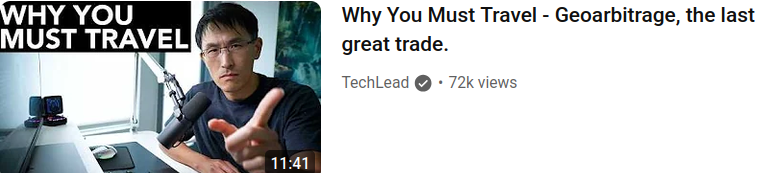
The video argues that geoarbitrage — choosing where you live to reduce spending rather than increase earnings — is one of the last great trades available to ordinary people. The central claim is that this is not about how you make money but how you spend money: if you can live somewhere that costs half as much, you have effectively doubled your earnings.
Click for one of Techlead's more thoughtful videos
Significant Points
1. Geoarbitrage Is a Spending Trade, Not an Earning One
The arbitrage is about how you spend money, not how you make it.
If you can spend half of what you normally would in another country, you have "essentially doubled your earnings."
He calls it "arguably a greater arbitrage than any stock trade or crypto trade you may make."
2. America Was Built on Geography, Not Just Innovation
He challenges the Silicon Valley narrative of "genius founders, garages, universities, disruption," calling it "mostly marketing."
The real secret: access to the cheapest skilled labour on the planet — engineers from India and China imported at low cost, trained at enormous expense by their home countries, who wrote code "for a fraction of what the output was worth in dollars."
"The valley didn't out-think the world. It out-arbitraged it."
Immigrants ran the same trade in reverse: a salary that looked merely good in San Jose looked like "a king's ransom" when sent back home.
Europe runs "the identical play with less branding" — importing labour from poorer countries to harvest crops and staff nursing homes.
"Every rich economy on earth is addicted to this same drug: cheap labour from somewhere the currency is cheaper."
3. Running Geoarbitrage in Reverse (West to East)
For hundreds of years, geoarbitrage went in one direction: talent flowed into America and Europe chasing strong currency and big paychecks.
Now he argues it can cut both ways — spending money in weaker-currency countries rather than earning it in strong-currency ones.
4. Japan as the Prime Example
The yen is near its weakest against the dollar in 40 years.
The Bank of Japan has burned through over $70 billion trying to prop up the yen, and it has "barely moved the needle" for anyone holding dollars.
"Japan just went on the deepest discount of our lifetimes."
Japan used to be considered expensive; today "it's the new Southeast Asia."
5. Critique of American Physical and Social Infrastructure
"The richest country in the world cannot seem to build a single high-speed rail line."
In most advanced places, people are on trains that "arrive to the second," reading books, while Americans sit in traffic "congratulating ourselves that we have autopilot."
America "bet its soul on software" and got good at apps and in-game micro-transactions, but manufacturing economies in Asia "spent those 30 years building the physical world."
6. Health and Food Critique
"We don't even win on lifespan anymore."
Americans are dying of diabetes and cancer at rates that "would embarrass a developing country."
He criticises American food culture: mass-produced GMO chickens, enriched flour "stripped of all nutrients and then repacked with vitamins," described as "a byproduct of a corporate machine."
"There's no place more tasteless and starved of culture than Silicon Valley."
7. Community and "High-Trust Societies"
He contrasts the US with "high-trust societies" where a lost wallet would be returned with all the money still in it.
In the US, "I'm not sure we have so much of a community as much of a special economic zone."
"Our primary form of community is Facebook, a surveillance product wearing the mask of human connection."
Cultural critique: "endless partisan warfare, scandal after scandal… A country that's forgotten what's even for."
"America is magnificent for generating wealth, but tragically terrible at generating belonging."
8. The American Dream as Isolation
He defines the American version of success as escaping from other people: gated estates, tall hedges, yachts, and for the truly rich, "an underground bunker stocked and armed."
"That is the American dream in its full glory. Not a community, but a fortress of one."
In contrast, people in actual homelands "want to belong" — Asian mega-cities alive at midnight, European old towns where "life spills into shared spaces."
9. Layoffs and the Tech Industry (2026)
In 2026, layoffs have accelerated.
Microsoft and Meta cut around 16,000 jobs on the same day, both citing AI.
Oracle laid off 21,000.
Over 100,000 tech workers gone in months.
These same companies are pouring over $700 billion into AI infrastructure, "firing the humans and buying the GPUs with the savings."
He questions corporate social responsibility: when a society allows a company to operate within it, it can ask that company "to treat its society well."
10. Silicon Valley Campuses as "Walled Gardens"
Tech campuses are described as "gleaming, manicured, free cafeterias, climbing walls, and a barista who knows your order" — but "the public cannot enter."
They have "contributed nothing to building the local infrastructure."
Those outside the campuses are "like migrants in their own cities"; those inside "are not friends, they're just co-workers," and "their belonging is conditional on having a badge that still scans."
11. How to Actually Run the Trade
By blood/ancestry: A huge number of countries grant residency by ancestry — if your grandparents came from somewhere, that may work.
Visas: Work visas, entrepreneur and business manager visas, digital nomad visas, golden visas (if you have the capital).
12. Caveats — No Free Lunch
"There's no free lunch ever."
Other nations have different tax codes. Example: Japan has one of the highest inheritance taxes on Earth — up to 55%.
"Make sure you do read the fine print."
13. Fairness to America
He acknowledges America's strengths: "big money, bigger guns, enough nukes to end any argument permanently," and (satirically) "world-class high fructose corn syrup" and "thousand-calorie blueberry muffins from Costco."
"But there's one thing that it will never compete on no matter how rich it gets: community."
"An economic zone is not a culture and no amount of GDP will turn it into one."
14. His Personal Practice
He tries not to spend money in the US because "nothing is affordable anymore."
He reduces all spending to a minimum in the US and reserves his spending for when he is abroad, where he gets "discount on everything for way higher quality."
"The only time I truly feel alive is actually when I'm out abroad."
He calls the US "a grind… a salt mine," referencing the term "the salt mines" for Silicon Valley — "that's where people go to grind and some people never make it out."
Key Lists from the Transcript
Visa/Residency Pathways Mentioned
Pathway
Notes
Residency by ancestry (blood)
"A huge number of countries grant residency by ancestry"
Work visas
Listed as an option
Entrepreneur / business manager visas
Listed as an option
Digital nomad visas
Listed as an option
Golden visas
"If you've got the capital"
Layoff Figures Cited (2026)
Company
Jobs Cut
Reason Cited
Microsoft
~Part of 16,000 (shared figure with Meta)
AI
Meta
~Part of 16,000 (shared figure with Meta)
AI
Oracle
21,000
—
Total tech workers
Over 100,000 in months
—
Key Financial Figures Cited
Figure
Context
$70 billion+
Bank of Japan spent trying to prop up the yen
$700 billion+
US tech companies pouring into AI infrastructure
55%
Japan's top inheritance tax rate
~50% discount
Suggested cost-of-living discount available abroad
Overall Assessment
The video is a persuasive essay rather than a financial guide. Its main argument — that spending power can be dramatically increased by relocating to weaker-currency countries — is economically sound in principle. The supporting critique of American infrastructure, food quality, healthcare, community fragmentation, and tech-industry labour practices is editorial commentary delivered with rhetorical flourish and satire. The practical advice section (visas, ancestry, tax caveats) is brief and high-level, serving more as a starting point than a detailed action plan. The speaker's personal stance is clear: he minimises spending in the US and reserves it for abroad, describing the US as "a salt mine" and feeling "truly alive" only when overseas.